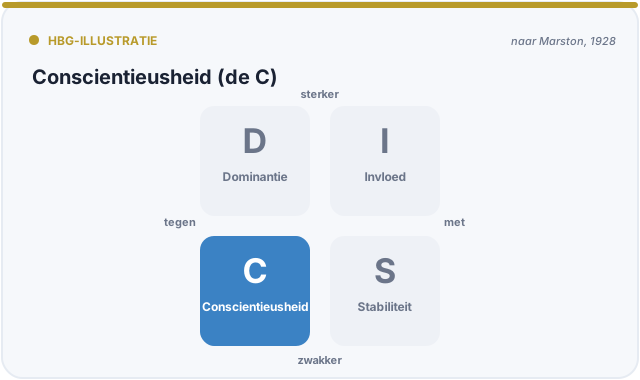
Dit is de oorspronkelijke Engelse tekst zoals Marston die in 1928 schreef, inclusief de originele paginanummers. Onze Nederlandse hertaling hierboven volgt deze tekst getrouw. Zo is elke passage terug te leiden naar de bron.
THE forces of nature comply with one another under appropriate conditions, just as they dominate each other, as we have already noted, under other circumstances. A river may be turned from one channel into another by a wall of rock which chances to crop out across its former course. The stream does not continue to attack an opponent stronger than itself, but complies with such an antagonist by letting the opponent have its own way, and by turning its own energies in another direction. If the path which a stream or other natural force will dominate is determined by the inferior strength of the materials dominated, so in the same way is the course which a river will not follow determined by the superiority of strength possessed by an opposed barrier.
It is certainly a part of the fundamental essence of any physical force that it must go on dominating whatever opponent proves weaker than itself. But it is also just as essential a part of the innate nature of the same physical force to comply with any opponent which proves stronger than itself. If
pagina 233
unable to dominate any of the forces surrounding it, a physical force must cease to act upon them. In so far as it may continue to exert pressure upon the stronger opponents which hem it in, the force has not yet been completely dominated by those opponents. Complete compliance can always be imposed upon any physical force by a sufficiently strong physical opponent, although the opponent may have to exert its power upon the compliant reagent in such a way as to compel the reagent to change its physical form, (from solid to liquid, or from liquid to gas). But, according to the fundamental law of conservation of energy no physical force can be destroyed. It can only (i) dominate, or (2) comply. If it continues to act in its existing form, it may comply with a hundred stronger opposing forces, but it must also find at least one weaker opponent to dominate. If any physical force
I 4 2 EMOTIONS OF NORMAL PEOPLE
is compelled to ultimate compliance, it must change its form in such a way that its new physical expression can find weaker antagonists to dominate.
For example, a river dammed up, as in the instance analysed at the beginning of the last chapter, may be completely dominated by the opposing dam so far as the free flowing of the stream goes. That is, one type of activity or expression of the river is completely dominated by a dam so strong and so high that the river cannot pass it. If, then, the soil of the river bank at one end of the dam proves sufficiently soft to be dominated by the river, the stream may
pagina 234
simultaneously comply with the unpassable dam and also dominate its weaker opponent, the river bank. But if such outlet cannot be made around or under the dam then the river still continues to exert increased pressure against the barrier. In this particular, the dam cannot dominate or over-power the river, and the river, therefore, is not compelled to comply with an opponent which is weaker than itselt in this particular.
The sun, however, constitutes another type of opponent which is stronger than the river in the matter of reducing its pressure. The action of the sun's rays upon the water is able to compel the water to change its form of physical expression altogether, from a fluid to a gas. The water thus vapourized no longer exerts pressure against the dam. Plants and other vegetable growths upon the bank of the dammecf-up river also are able to dominate the water by compelling it to change its form chemically, and to enter into organic molecular structure of a new type, composing the cells of the various plant organisms. The fish and amphibia which make their home in the darnmed-up river also possess sufficient dominance over the river to compel a chemical metamorphosis even more radical, by absorbing the river water into the chemical structures of their own body cells. All types of inanimate physical forces must behave in the same way according to the fundamental reaction principle of compliance, whenever they are confronted by antagonistic forces more powerful than themselves.
' If the physical forces faced by an opponent of superior strength comply with that opponent by decreasing the force of their opposition to the stronger antagonist, what is the measure of this decrease which the compliant reagent must undergo ? In the case where the river, dominated by its
pagina 235
opposing dam, was able to find its way around or under the dam, the volume of water which thus escaped evidently would represent the difference between the former total overflow of the river and the value of the opposed holding power of the obstacle to the river's progress. In the same way, the amount of water vaporized under action of the sun's rays represents a total volume of loss to the water pressure power of the dammed up stream equal to the difference between the initial volume of water and the strength of the antagonistic sun's rays acting upon it. The total volume of loss to the river of its molecular chemical structure H 2 O, as a result of the superior chemical forces exerted by plants and animals upon it, must approximately equal the difference between the initial quantity of H 3 O molecules present in the dammed-up river and the antagonistic forces exerted by plants and animals with which it was necessary for the water of the river to comply.
A rule may be formulated from these examples as follows : A physical force decreases Us power in making a compliance reaction by an amount approximately equal to the difference between its own initial strength and the force of its superior opponent.
Compliance Response in Human and Animal Behaviour
Compliance response is to be found in the behaviour complement of a decerebratc animal such as those studied by Sherrington and Goltz. Such compliance, however, as is manifest in the reactions, of artificially simplified organisms of this type
pagina 236
does not carry with it compliance emotion as we have defined it in the integrative analysis of chapter six. Although a physical reflex can be made integratively to supersede a single tonic discharge unit of the motor self, the mechanism by which this conquest is brought about by a motor stimulus is of a nature comparable with the interaction of inanimate physical forces. The motor stimulus appears merely to overpower one specific unit of the motor self at a motor centre leading to the final common path but below the centres through which the intensity of the entire tonic self is regulated. Though the central nervous system interacts between higher and lower levels in such an exceedingly complicated manner that we cannot say with certainty what neural units are involved even in the simplest reflex response, we may yet feel fairly certain that the strength of the motor self is neither increased nor
diminished throughout the persistence of the control of the lower motor centre by the intercurrent reflex. That is to say, in this type of conquest of tonic discharge by intercurrent motor stimuli, we apparently find the result accomplished by means of a greatly simplified antagonistic mechanism. One small unit of the motor self seems initially to contest possession of a motor psychon with a stronger antagonistic motor stimulus. When the stronger motor stimulus has won its way through to discharge there seems to be no further integrative action taking place because the higher centres capable of bringing about a further adjustment of the entire tonic discharge in reaction to the supremacy of this motor stimulus have been removed from the animal by operation. If this analysis of results is correct, we may conclude that all
pagina 237
primary emotions except dominance require the presence of motor areas of the central nervous system integratively predominant over the tonic centres involved in that particular emotion.
The work of Head and Holmes 1 already mentioned, seems to indicate that both dominant and compliant adjustments of the motor self may be mediated through the thalamic centres alone, after these centres have been freed from the influence of the cerebral cortex. Many of the physical reactions to affective stimuli made by patients suffering from unilateral thalamic lesion described by Head and Holmes were reactions of the so-called adaptive type. That is, many of these responses were of a compliant nature giving free rein to the influence of an antagonistic motor stimulus upon the organism, by diminishing and readjusting tonic motor discharge. Such reactions were clearly compliance responses. They were all over-reactions, and all were unpleasant at their inception so far as one may judge from the reports, with indifference or even marked, contrasting pleasantness accomplished as a result of the adaptive readjustment. Does this behaviour indicate an integrative picture of exaggerated compliance response ? It seems to be a justifiable guess that it does.
Compliance in Infant " Fear " Responses Watson has described a certain type of infant behaviour 1
1 H. Head and G. Holmes, " Sensory Disturbances from Cerebral Lesions," Brain, 1911, vol. 34, p. 109. 8 J. B. Watson, Behaviorism, pp. 121 ff,
pagina 238
which he calls " fear ". Only two situations, according to Watson, are capable of producing this " fear ". One is a removal of all support from an infant's body, and the other is a sudden loud sound near the infant's head. The " fear " response described by Watson consists, first, of " a jump, a start, a respiratory pause followed by -more rapid breathing, sudden closure of eyes, clutching of hands, puckering of lips ". Following this initial response occurs an entirely different type of behaviour. This second group of reactions consists of " crying, falling down, crawling, walking, or running away, often defecation and urination." The first group of behaviour symptoms clearly indicate an access of tonic energy calculated to combat and dominate the motor stimuli in various ways. The second group of the behaviour symptoms just as clearly indicates a decrease of the strength of the motor self and a yielding to whatever effect the motor stimulus may have upon the organism. Mixed up in the subsequent symptoms, however, there are behaviour indications of certain thwarted or defeated elements, which perhaps, when present, justify use of the time-worn literary term " fear ". Without the admixture of this defeated element, however, the second group of symptoms described by Watson show only two types of environmental stimulus capable of evoking motor stimuli of sufficient intensity to integratively overpower the me tor self. It is probable, of course, that many other types of environmental stimuli too severe to be inflicted upon a human infant experimentally might possess this same power. Watson reports that this compliant type of response was more pronounced in infants without cerebral hemispheres, a result in accord with our interpretation of the findings of Head
pagina 239
and Holmes mentioned above.
The Watsons also found that normal human infants grasped all objects with no regard for the nature of the stimulus, even though it might be a furry animal, a noise-making stimulus, such as a pigeon in a paper bag, or even a lighted candle. It was found, however, that the child could be taught not to reach for an object by a varying number of burns inflicted by a candle flame, or by rapping the hand of the child sharply with a ruler when he reached for the object. It is to be noted that compliance response could not be brought about by an environmental stimulus of comparatively mild intensity such as the sight of a candle flame
or the combined tactual sensations and visual perceptions of an animal which might be capable of biting and injuring the child. Compliance response could, however, be compelled by an environmental stimulus as intense as the tactual pain administered by contact with the flame, or by the painful sensations following a brisk stroke of the ruler upon the child's knuckles. The compliance response, once learned in this way, was readily transferred to whatever environmental stimulus might be associated with the pain in the child's experience. To put the matter in our own terms, the environmental stimuli of burns and blows administered to the child's hands proved inherently capable of evoking motor stimuli of superior intensity to the motor self. By administering such burns or blows simultaneously with perception of an environmental stimulus which naturally aroused motor stimuli weaker than the motor self, this in-
pagina 240
adequate environmental stimulus could be endowed with the power of evoking antagonistic motor stimuli more powerful than the motor self.
Compliance in Adult " Fear " Responses
Blatz 1 has performed an experiment with adult subjects which indicates that adults manifest much the same type of compliance response as that reported by Watson in infant behaviour. Blatz constructed a chair in the laboratory in such a way that it could be made to fall backward suddenly by pressing a lever in an adjoining room. Subjects were led into the laboratory blindfolded, and were then seated in the chair and bound securely to it. Electrodes connected to an electrocardiograph were attached to the subject's body together with apparatus for recording the breathing. A majority of the subjects were women. Each subject was told that the purpose of the experiment was only to record the breathing and heart beat during a fifteen minute period of quiet. After several periods of quiet had been given each subject, as promised, the chair was suddenly pulled over, without warning, causing the subject to fall backward.
All subjects reported an experience of fear when they felt themselves falling backward without support. This situa-
1 W. E. Blatz, " Cardiac, Respiratory, and Electrical Phenomena Involved in the Emotion of Fear," Journal of Experimental Psychology, 1925, vol. 8, pp. 109-132.
pagina 241
tion precisely duplicated Watson's experiments during which he pulled the bed clothes from under babies, or suddenly dropped them on pillows while they were in the process of falling asleep. The behaviour symptoms also closely duplicated the infant behaviour reported by Watson. Blatz's subjects first struggled sharply to escape from the chair while it was falling, and after it had come to rest in a horizontal position. When they found that they could not escape the bonds which held them to the chair, they called out to the experimenter, believing that an accident had occurred. When they found that they could not escape, and that the experimenter paid no attention to their cries, the subjects accepted the situation and remained quiet in the chair in its down-tilted position (practically horizontal).
This behaviour indicates that the adults reacted in precisely the same way as did Watson's infants; first reacting with dominance response, and then with compliance emotion. The initial struggle to escape clearly required increase of the motor self in an effort to overcome the motor stimuli evoked by the loss of bodily support. The cry for help to the experimenter indicated that the subject had realized the superior intensity of the antagonistic motor stimuli, and this call for assistance represented his last dominant effort to escape from the awkward and unusual position imposed upon his body. Thereafter all subjects showed complete compliance response, consisting of acceptance of the environmental stimulus imposed, and a readjustment of their own bodies to meet the new situation without attempting to alter it in any way. This necessitated an initial decrease in the motor self to permit the dominant environmental stimulus to effect the body in any way it pleased.
pagina 242
Bodily measurements of heart and breathing, recorded automatically while the subject was falling and for a period of ten minutes or more thereafter, revealed a double series of alternations between dominance and compliance response.
1, For a period of five seconds following the fall, the pulse rate jumped from 88 to 102, with other bodily symptoms similarly indicating increase of the motor self running parallel. This might be termed " unsuccessful dominance response ".
2, Next followed a ten second period during which the pulse was retarded and tonic energy, expressing itself in
strength of heart beat, pulse rate, and breathing, was clearly decreased below its initial status. This period might be termed one of " compulsory compliance ".
3, Next followed a second period during which the pulse was accelerated, not so high as during the unsuccessful dominance response, but of longer duration. Other bodily symptoms also indicated increase of the motor self during this period. This might be called a period of " dominance readjustment " to the superior environmental stimulus.
4, Gradually the pulse rate and other symptoms of bodily tonicity declined. This decline continued until the third minute after the fall. This again may be regarded as a compliant decrease of the motor self possibly designed to
pagina 243
permit the triumphant motor stimuli to exercise whatever effect they were capable of exerting upon the readjusted balance of energy, in order to insure complete conformity of the decreased motor self in its readjustment condition to the dominant motor stimuli. It might be termed a compliance testing period.
5, This final compliance period in turn gave way to a final increase in heart rate and other tonic symptoms, to a level slightly higher than the initial one. At this level, the motor self seems to have remained constant throughout the remainder of that particular day's record. This final period represents a continued compliance with the motor stimuli imposed, yet a slightly increased dominance exerted toward other stimuli than the one of superior intensity. The compliant element, of course, was evidenced in the bodily symptoms only by way of comparison between the strength of the motor self during the final period and its strength during the first period of unsuccessful dominance response while attempting to overcome the intruding stimulus. This final period might be termed the " successful dominance period."
Basic Dominance and Compliance Response Mechanisms are not Altered by Learning
It is important to observe that the emotional reactions of the adult subjects examined by Blatz showed no important differences from the emotional reactions of infants as described by Watson. This may be taken to indicate that the operation of the dominance and compliance mechanisms remain pretty much unaltered throughout life, provided that
pagina 244
environmental stimuli can be found intrinsically adequate to evoke antagonistic stimuli of inferior strength to the motor self of the subject. The similarity of dominance and compliance emotions expressed by infants and adults indicates that emotional learning does not alter the integrative characteristics of these two primary emotional responses in the least.
In the case of Edgar, considered in the last chapter, a true compliance response was found to be evoked for the first time by an environmental stimulus, bodily injury, which was intrinsically capable of evoking antagonistic motor stimuli of superior intensity to the motor self. Edgar's first compliance response was evoked in just the saftie way that similar compliance responses were evoked from infants by loud noises and by falling, and in just the same way compliance response was evoked from Blatz's subjects by falling backward. Physical pain stimuli of severe character were felt, by Edgar, to be superior to his bodily powers of resistance, just as similar pain stimuli, resulting from candle burns or ruler blows, were felt by infants as superior to their own organisms. Edgar, in short, represented a case whose compliance response mechanisms remained normal, though in a completely naive condition so far as the learned conditioning of compliance response upon inadequate environmental stiqiuli was concerned.
Dangerous Environmental Stimuli are not Necessarily Adequate Stimuli to Compliance Response
Environmental stimuli of the most dangerous character to human or animal organisms may yet be of such a nature as not
pagina 245
to possess power to evoke motor stimuli more intense than the motor self and to thus bring about compliance response. This fact, of course, is one of every day experience. But it is also a phenomenon, the mechanism of which is not, apparently, understood. Parents and other educators of children of the newer schools seem prone to assume that first hand experience with the antagonistic forces of the environment is the best form of compliance teaching. Such is far from being the case even if the child survives his first contests with crowded streets, dangerous implements of various kinds, and other children. For, if the dangerous environmental stimulus is incapable in itself of evoking compliance from the child before the full force of its destructive character
is directly experienced, the resulting response (inevitably transferred to other environmental stimuli also) is rather sure to be of an exaggerated nature, preventing efficient reaction to this type of stimulus in later life even though no actual " fear " results.
Compliance Response Prevented by Over- Intensity of Motor Self
In the case of the boy Jack, we noted, in the last chapter, that he responded with dominance reaction even to environmental stimuli that should have the intrinsic capacity of evoking compliance response in child or adult. Working against' these environmental compliance stimuli in Jack's case, however, there probably existed endocrine stimuli in his blood stream. These endocrines had the effect, perhaps,
pagina 246
of raising the compliance threshold. This result may have been accomplished in several ways, notably : (i) by stimulating the motor self continuously to greater than normal intensity; or (2) by interfering in some inhibitory way with the connective units in the central nervous system by means of which environmental stimuli such as pain, normally evoke motor stimuli of superior intensity to the motor self. In Jack's case it seemed fairly clear that the endocrine stimulus evoked a result of the first type, that is, it seemed to be producing a continuous over-intensity of tonic discharge. Although Jack failed to respond compliantly to physical pain inflicted in the course of his gangster activities, he showed some compliance reaction when reasoned with. Once, in fact, according to a report which we received from the teacher, the child had genuinely given up his marauding activities after being convinced by the principal of the school that he could enjoy life better in other ways. But the boy's incessant restlessness and physical over-intensity seemed to make it impossible for him to continue for a long period in a compliant manner of living. After a couple of months of compliance, his motor self evidently became so intense that it could no longer be dominated by argument (a connective type of cause in the total integrative picture, i.e. (d) in the causal analysis, Chapter IV).
Suddenness of Stimulation Tends to Evoke Compliance
I was also able to evoke brief compliance responses from Jack during my interview with him by sudden startling remarks
pagina 247
and movements. Suddenness of stimulation by an environmental stimulus of superior intensity often produces compliance response, in cases where no amount of sheer intensity of stimulation is able to bring about this result if the increase of stimulation intensity is applied gradually rather than suddenly. The explanation of this phenomenon is a simple one. So long as the motor stimulus remains inferior to the motor self, dominance emotion will persist. If, then, the intensity of the environmental stimulus be increased gradually enough, time will be allowed for the motor self to increase its own strength prior to attack of the motor stimulus upon it. But if a great intensity of environmental stimufation be suddenly applied, motor stimuli of superior intensity to the motor self in its initial state of strength may be evoked before the reinforcement mechanism can operate to make the motor self superior once more to the motor stimulus. It is an every day experience with nearly all of us to be " startled " by some sudden, loud noise, or perhaps by a jovial friend's clapping us on the shoulder suddenly from behind.
No matter how exaggerated the continuous motor self intensity may be it is easy to produce an environmental stimulus capable of evoking a motor stimulus more intense than the motor self, if the latter is not given time to reinforce itself. As far as my observations to date can be depended upon, it seems the fact that a motor self which remains continuously more intense than that of the average individual tends to be rather more susceptible to suddenly applied motor stimuli of superior intensity, than is the motor self of lower intensity level. The reason for this seems to be that the greater the continuous intensity of tonic motor discharge, or motor self, the more quickly does it react to any motor stimulus which may be applied to it (i.e. the latent period is shorter). Such an intense motor self, therefore, tends to
pagina 248
react to a motor stimulus of superior intensity before the self has had time to be reinforced sufficiently to dominate the stimulus. There is, therefore, very frequently, a momentary flash of compliance emotion before the reinforcement mechanism is able to re-establish the normal dominant balance. The fact that Jack could be thus startled or compelled to momentary compliance by application of a sudden intense stimulus seems to indicate that his abnormality of dominance response was attributable to continuous over-intensity of
the motor self, rather than to any interference with the connector mechanism necessary to the evoking of superior motor stimuli by an intense environmental stimulus.
In studying convicts, I found many of the prison incorrigibles to be men whose compliance response was exceedingly difficult to arouse because of this same, constant, over-intensity of the motor self. One prison farm camp was given over to confinement of younger criminals; that is, boys between eighteen and twenty-five. Among these prisoners the percentage of incorrigibles of the type mentioned was very high. Many of these youths appeared to me to be over-sexed. The male sexual hormone produces, according to my own observations, increase of dominance as a secondary sex characteristic, quite as definitely as it produces hair on the face and a deeper toned voice. The over-intensity of motor self from which many of these boys suffered might very probably be attribut-
pagina 249
able to a surplus male sexual endocrine. These cases might prove almost exactly comparable to that of the child Jack. Other cases, where the continuous motor self seemed even stronger could not be accounted for on the same basis. In fact, the physiological causes underlying such over-intensity of the motor self are at best extremely speculative in the present state of our medical knowledge. Some of the youths at the prison farm in question seemed to suffer principally from lack of early compliance training, which had led them into various types of activity tending to intensity the continuous tonic discharge or dominant set. A few cases of war veterans seemed to fall into this category.
Prolongation and Frequent Repetition of Stimulation Tend to Evoke Compliance
In addition to suddenness as a condition tending to produce compliance response, we may also list duration or repetition at frequent intervals o/an over-intense environmental stimulus, as a second condition sometimes capable of producing compliance emotion, when a single application of an environmental stimulus, no matter how intense, will Have no effect.
A physician who had been connected with army work at the federal prison at Fort Leavenworth told me that incorrigible prisoners at that institution, who refused to go out to work with the other men, and who could not be shaken in their rebellious attitude by any extreme of rough treatment,
were frequently compelled to work by prolongation of a com-
pagina 250
paratively mild punishment. They were handcuffed to the door of their cells, in a normal standing position, with their hands at no higher level than their shoulders, during the time that the other men were at work. These incorrigible prisoners were evidently able to resist environmental stimuli of any intensity whatever without manifesting compliance response. But they yielded compliance to an environmental stimulus of comparatively mild intensity, when that stimulus was applied for seven or eight hours a day three or four days in succession.
On the other hand, one instance which came to the* personal attention of the survey staff during examination of the Texas prisoners indicated that repetition of environmental stimulus of great intensity might be expected to overwhelm a prisoner who showed an almost abnormal lack of compliance response. A young and exceedingly incorrigible prisoner, possessed, apparently, of a motor self so intense that his condition of restless tenseness was evident even to guards totally inexperienced in personality analysis, finally refused to go to work in the fields with the other convicts. This refusal was the result of a punishment which had been given him for a comparatively slight breach of prison rules. The manager of tlje prison farm tried in various ways to compel the prisoner to go to work, but without result. Finally, he made application, as provided by the Texas penal code, for permission to whip this prisoner. The Texas law provided that a warden or farm manager might administer a maximum of twenty strokes of a leather strap, of prescribed size and weight, to an incorrigible prisoner, upon permission being granted by the prison commissioners. This punishment was used fairly frequently, and was of such severity that mere threat to apply for permission to whip a prisoner was usually sufficient to compel the most incorrigible convict to comply with the
pagina 251
manager's orders.
The young prisoner in question, however, knowing that twenty strokes was the maximum allowed by law, defied the " captain ", and received his whipping in due course. Although the man's suffering was undoubtedly severe, he still refused to comply. Now the Texas law did not limit the number or frequency of whippings to which the prisoner might be subjected, provided only that permission be granted by the
commissioners. The prison manager, therefore, immediately put in another application, and received a second permission to give the prisoner twenty strokes. This time, however, instead of delivering all the blows at one time, he decided to give the prisoner four or five strokes every day until this second permission was exhausted. He told the convict what he proposed to do, and added a statement that he intended to apply for further permission to whip the prisoner as soon as this present permit was exhausted. The man still refused to comply, and the " captain " administered several strokes that day, as he promised. Next day he came back again with the strap, and began to deliver another instalment of blows. After two strokes had been administered, however, the prisoner yielded, and complied with the order to go to work. This convict told me, when I interviewed him, that he could not endure the strain of taking a whipping every day because " fear lasted over from one whipping to the next" He said that no matter how much pain one punishment might cause he " knew that he could stand it if it was going to be over all
pagina 252
in one ' lick * ".
The potency of persistent, or frequently repeated antagonistic environmental stimuli in evoking compliance emotion seems to depend upon the inability of the motor self to sustain itself at a greatly increased intensity level for any considerable length of time. If, therefore, antagonistic motor stimuli of considerable intensity can be made to persist for a period longer than that during which the reinforcement mechanism can be operated, defeat of the motor self will result and compliance response must necessarily follow.
High Connector Threshold to Compliance Response
There is another type of insufficiency of compliance which seems to be due to the second type of integrative cause mentioned above, that is, to a lack of adequate connector mechanisms enabling environmental stimuli of overwhelming intensity to evoke motor stimuli superior in strength to the motor self. In other words, individuals suffering from this type of compliance difficulty exhibit extraordinary resistance to physical pain and other similar types of overintense environmental stimulation. This sort of person manifests many symptoms of chronically low motor self
intensity, though when aroused to action such an individual's motor self may be increased to a point of unusual strength.
One subject of this type whose behaviour I was able to observe, was a college youth of considerable athletic ability.
pagina 253
He played football, basketball, and other sports successfully, being a member of the varsity teams for several successive years. In basketball his game was peculiar and erratic. On certain occasions, he played extraordinarily well, while on other occasions he seemed completely phlegmatic and failed to respond aggressively to any amount of rough handling by an opponent. The basketball coach told me that on several such occasions he had " given him hell " in every way he could possibly think of. He had taken him out of the game several times, had threatened to drop him from the varsity squad, and had insulted him personally in every way that he knew. All to no avail. The boy only looked at the coach apathetically, and in a pitying sort of way, sometimes saying that lie didn't feel like playing, and sometimes making no reply whatever. I asked the boy himself what he thought of the coach, and he told me, " Blank if alright, a very good fellow, but I can't say he ever taught me any basketball. I don't think he can teach anybody. I just have to go on and play my own way "
This boy was a student in one of my courses where a great deal of discussion was required. He seemed to follow the lectures Either well, but consistently refused to incorporate the material given him into his own methods of thought. Occasionally he would utter a surprisingly keen criticism or comment, but once his own idea was expressed he could never be induced to comply with the general discussion of the other students. His speech was excessively slow, and so low one could hardly hear it at times. Frequently he seemed actually to fall asleep in the middle of a sentence, his eyes closing, and his whole body slumping somnolently into his chair. This was in appearance only, however, for he never failed to complete the thought which he was expressing. The whole picture presented by the behaviour
pagina 254
of this youth was one of a motor self of very low intensity, able to reinforce itself almost without limit upon the rare occasions when an antagonistic motor stimulus could be evoked. The difficulty, however, of evoking such motor stimuli by means of environmental stimulation was extreme.
Moreover, never once, during my study of the boy, did I see any evidence that a motor stimulus of superior intensity to his reinforced motor self had been evoked.
In one instance, at least, environmental stimuli of an intensity adequate to evoke compliance from any ordinary subject were administered to this youth without avail. It was a college custom for a certain sophomore society to " rag " or haze the freshmen systematically. The most popular method of compelling the freshmen to obey their tormentors was to " paddle " the disobedient ones with considerable energy, using an instrument very similar to a shorthandled canoe paddle. I was informed by the sophomore who had charge of ragging a group of freshmen, including the youth under discussion, that he had hit this boy more than twenty times with all his strength, finally breaking the paddle over the subject's buttocks without compelling the boy to comply in the slightest degree with the commands which the sophomores were attempting to impose. I asked the boy himself, some time after the punishment had been inflicted, how he was able to endure such a severe beating.
" Oh ", he replied with an interested expression on his face, as if he were describing an event that had happened
pagina 255
to somebody else, " there was nothing to that. I didn't mind it."
" Didn't you feel like hitting the fellow who did that to you ? f> I asked. i
" No ", he answered thoughtfully, " it didn't make any difference to me especially, so long as he couldn't make me do anything I didn't want to do."
In subjects of this type it seems safe to assume that whatever antagonistic motor stimuli are evoked by an intense environmental stimulus must be exceedingly feeble in comparison to the strength of the subject's motor self. That this comparative weakness of motor stimuli is not due to lack of acuity or high threshold in the sensory mechanisms is indicated by the fact that the college boy whose behaviour has just been reported showed unusually keen sensory perception, with very low auditory and visual thresholds. It will be remembered also that he was able to follow the subject matter of lectures rather well and to reproduce it if he chose.
This sort of integrative situation may be characterized by the statement that the connector threshold between en-
vironmental stimulus and motor stimulus is unusually high.
" Passive " Dominance is Resistance to Compliance Response
pagina 256
Cases of high connector threshold like that of the college student just mentioned illustrate very well an aspect of dominance response which may be called " passive " dominance. The motor self fails to take the initiative, in such cases, because it is sensible of no threat to its supremacy. It is able, therefore, to manifest a high degree of what is ordinarily called " resistance ". Resistant behaviour when attributable to passive dominance emotion, is a type of response during which the reagent remains satisfied with resisting any change in the motor set maintained by tonic discharge. Active dominance in contrast to passive would be defined as a condition where the motor self, becoming sensible of a motor stimulus obstructing its path, actively hurls its increased energy, as it were, against the obstacle. Although no very hard and fast line can be drawn between active and passive dominance, the contrast between these two phases of dominance behaviour, in the conduct of subjects analysed, is often sufficiently extreme to make the use of specific teims representing the two extremes convenient and justifiable. In literary and psycho -literary terminology we find the distinction between active and passive dominance fairly well marked. " Aggressiveness ", " initiative ", " selfassertion ", and similar terms emphasize clearly enough the active aspect of dominance, while " stubbornness ", " doggedness ", and " resistance " refer particularly to passive dominance expressed in various different ways.
" Passive " and " Active " Compliance
It may prove advisable to emphasize, at this point, similarly contrasting active and passive aspects of compliance emotion. First the contrast may be taken with respect to the behaviour
pagina 257
of interacting of physical forces. In the case of a river whose flow is completely stopped by an opposing dam, the emphasis is upon the passive aspect of compliance emotion. The dam, as we noted at the beginning of this chapter, is unable actively to remove the river from its present bed and, is similarly incapable of compelling the water of the river
to change its form physically or chemically. Thus no new motion, or active response is required of the dammed-up stream. When, however, the sun begins to heat the river water, additional energization of the water occurs, and it undergoes a form of active physical change from liquid water to water vapour. Thus the sun, acting dominantly upon the river water, compels the latter to comply actively by undergoing physical change. In a similar way plants, fish, amphibia, or an electric current might compel active compliance from the river water by forcing its atoms to move in new ways conducive to chemical changes imposed.
Simple illustrations of active compliance may be found also, in the case of stones rolled down a mountain side by the impact of sliding earth, or other debris from above. The stone is not only compelled to move in active compliance with the force applied to it during the length of time that it is being acted upon by the force in question, but also must continue to move in that same direction until gravity ceases to control it, and the momentum imparted to it is exhausted.
In the integrative mechanisms of animals and human beings the existence of mechanisms for active compliance
pagina 258
response have already been noted. The phasic reflexes, whenever able to supplant the tonic motor discharge in the control of a final common path, may contrast the opposing or anti-tonic muscle. The total effect of such a procedure is to enable a victorious or dominant motor stimulus to compel active compliance from the organism by injecting new energy into it initially just as the sun compelled active physical compliance by causing the river to vapourize, and the electric current compelled still more active compliance by causing the water to manifest new chemical behaviour.
Whenever a compliant motor stimulus succeeds in compelling a subject organism to comply actively in the manner suggested, the principal influence upon the subject's behaviour will cease with the removal or cessation of the motor stimulus. There will, however, be a certain persistence of the active compliance movement after the motor stimulus itse]f has actually ceased, due to the integrative phenomena of after discharge, central spread of phasic excitations, etc. This continuation of active compliance may aptly be compared to the law of momentum in the behaviour of inanimate physical objects.
Difficulty of Compelling Active Compliance Response by Imposing Intense Environmental Stimuli
We have previously considered the threshold of compliance response as this threshold was affected by increased intensity of an environmental stimulus. We have had occasion several times to note, however, that over-intensity of nerve impulse
pagina 259
is not a condition especially conducive to smooth and maximally effective integration. Bearing this fact in mind, we should not expect to find that over intense environmental stimuli, such as those furnished by physical pain or bodily injury, would be by any means maximally efficient in producing the active aspect of compliance response. In othe? words, we might expect to train an infant not to grasp the lighted candle by rapping his knuckles sharply each time the candle is presented, but this would be passive compliance. Similarly, we might expect that it would be comparatively easy to train an older child, or even an adult person to refrain from being impertinent to his mother, or " talking back to " a prison guard or warden by administering a comparatively light whipping. Again, such responses would represent an extremely passive type of compliance.
If, on the other hand, the attempt is made to compel positive action on the part of the infant, child or prisoner, a problem of much greater difficulty is faced. An environmeftial stimulus must be administered of such a nature that it will be atye to evoke motor stimuli more powerful than the motor self of the subject, yet at the same time not intense enough to jeopardize the smooth and efficient functioning of the compliant integrations which it is desired to produce. This is, so to speak, the problem of the ages. It has been faced by all tyrants of every imaginable type and degree who have attempted to control the behaviour of other human beings by sheer force. The mechanisms by which atoms and molecules can be compelled actively to comply with the dominant individual's desire are extremely simple compared to the integrative mechanism which must be used forcefully to control a human being. The human body may be forcibly confined or kept from certain activities by barriers of superior physical force. It may also be compelled to
pagina 260
cease from selected activities or from all activity, if desired, by administering to it sufficiently intense physical stimulation to produce integrative inhibition or central stasis. But
neither of these types of environmental stimulus is capable of compelling active compliance of a maximally efficient variety.
Maximally Pleasant Environmental Stimuli Evoke Active
How. then, can active compliance be evoked ? Sherrington 1 states that reflexes tend to be prepotent which provoke strongly affective consciousness. He further cites two opposite types of prepotent active reflexes, the nociceptive, painful reflexes, on the one hand, and the sex reflexes, accompanied hy maximal pleasantness, on the other hand. Defining unpleasantness as motor conflict, and pleasantness as motor alliance, we should then interpret Sherrington's statement as meaning that there are two maximally prepotent types of reflexes : (i) Those producing the most motor conflict possible, and (2) those producing the most alliance possible. Since compliance response depends by definition upon the prepotency of motor stimulus evoked, we should anticipate, according to Sherrington's result, that those motor stimuli producing greatest integrativc conflict, and those producing a maximum of motor alliance, would constitute the maximally effective stimuli to compliance. There seems little doubt but that environmental stimuli capable of producing severe physical pain are those causing greatest unpleasantness.
pagina 261
Therefore, we may say, according to our own pre-suppositions, that painful environmental stimuli evoke motor stimuli causing a maximum of motor conflict. This motor conflict is precisely the factor which results in extreme passive compliance. That is to say, a pain stimulus ultimately producing a maximum amount of central conflict and inhibition, thereby is able to produce a maximum amount of blockage to integrations which it is desired to break up. But, as we have seen, this process, by very definition, is incapable of originating new integrations of the type which it is desired to dictate to the organism. If, then, the purpose is to originate and carry forward successfully such new integrations, a different sort of prepotent reflex must be resorted to. This second type of prepotent reflex is, according to Sherrington, the class of reflexes which are accompanied by a maximum amount of pleasantness, or motor alliance.
1 C. S. Sherrington, Integrative Action of the Nervous System, p. 230.,
It should be possible, then, to evoke compliance response by means of any environmental stimulus which, though antagonistic to the motor self, is nevertheless capable of producing, infra se, an amount of pleasantness of motor alliance superior to that accompanying the tonic discharge at the moment of stimulation. In short, a motor stimulus, though antagonistic to the motor self, might nevertheless prove of greater strength than the motor self, provided the motor stimulus were of greater total volume, and provided this total volume, in its assemblage from various sensory connector
pagina 262
sources, produced a greater total amount of motor alliances. If these conditions were fulfilled the motor stimulus need not be of greater intensity than the motor self at any time.
Over-Intense Motor Self Must be Taught to Comply with Volume It might well prove true, however, that a motor self of too great intensity might fail to yield to, and comply with a motor stimulus depending for its victory upon greater harmonious volume of motor discharge. The very intense motor self might, however, be taught to comply with an antagonistic motor stimulus of greater harmonious volume.
Such teaching might follow one of two methods. First, a motor self of great intensity might be initially defeated by a motor stimulus of great intensity and might, while in such a state of defeat, be stimulated with a motor stimulus of superior harmoncous volume only. In the second place, a motor self of great intensity might be taught, initially, to submit to an allied stimulus of greater volume, and transfer of the yielding element in this submissive response might then be made to an antagonistic motor^stimulus of greater volume.
Summary
In summary, then, we are able to predict, on neurological grounds, that a stimulus of greater harmonious volume than the motor self may be able to evoke compliance response from a motor self of moderate or low intensity, even though the motor stimulus be antagonistic to and of less intensity than the motor self. We may further predict that a motor self of great intensity will not yield spontaneously to a motor stimulus whose superiority consists only of greater harmonious volume than the motor self possesses. Such a motor self
pagina 263
of great intensity might, however, be taught to comply with
a motor stimulus of this type in two ways, (i) By transferring defeat of the motor self brought about by an antagonistic motor stimulus of superior intensity, or (2) by transferring surrender brought about in the course of submissive response to an allied motor stimulus of greater volume.
Environmental Stimuli Evoking Compliance With Volume
Response
In examining human behaviour for the purpose of verifying or refuting the foregoing suggestions, what types of environmental otimuli should be sought for as likely to evoke motor stimuli of greater volume than the motor self though antagonistic to it ? In the instances of compliance enforced by bodily pain which we have already considered, we discovered a certain rough correspondence between intensity of environmental stimulus and intensity of motor stimulus correspondingly evoked. This correspondence of intensities between environmental and motor stimuli, though by no means infallibly present, is in a one to one ratio and furnishes the only rough basis upon which parents, prison officials, or college students could proceed in their attempts mechanically to control the bodies of their subjects. Following this analogy, then, we might seek, first, environmental stimuli of large volume
pagina 264
as probably productive of motor stimuli of correspondingly 'targe volume. In a similar way, we might expect to find environmental stimuli which are objectively ordered in a definitely harmonious pattern producing correspondingly harmonious pattern of the connector-motor integrations which must contribute the element of harmony to a given group of motor stimuli. Environmental stimuli of large volume and harmonious interrelationship in respect to the manner in which they stimulate the sense organs of the body, might be expected to evoke, correspondingly, motor stimuli of large volume and harmonious interrelationship of constituent elements.
" Nature " is the Environmental Stimulus of Greatest Volume and Most Harmonious Pattern
The greatest possible volume of environmental stimulation of moderate intensity which can be simultaneously administered to a given subject may probably be found in " nature ".
That is, if a human being is placed all alone in an unbroken pine forest, for instance, or upon the top of a mountain from which no human habitation is visible, the element making the greatest impression upon the consciousness of the individual so situated is usually found to be the immensity of his surroundings. This appears to be especially true of persons who have spent a major portion of their lives in large cities. Country residents, and especially mountain guides, and frontiersmen, seem to have acquired, to a considerable extent,
pagina 265
the habit of limiting their sensory attention to particular objects which it is necessary for them to manipulate in some way, in order to adjust themselves efficiently to the "outdoor environment. But even persons of this sort, I have found, when they return to their previous habitat after spending some time in the city are again impressed by the immensity and openness of the country landscape. This consciousness of immensity (which is evidently in itself a connector or ideational element) appears to have its origin in the tremendous volume of sensory stimulation of moderate intensity simultaneously received by the subject's organism.
There also appears to be a certain amount of naturally ordered regularity and harmoniousness of pattern in this type of sensory stimulation. Neither the tinkling, gurgling noises of the brook, nor the sighing, rustling sounds made in tfe trees by wind of moderate intensity are loud enough to drown eatfi other out or to prevent the twittering of birds from being perceived simultaneously. The sun's rays produce a mild temperature stimulus of warmth upon the face and body while the breeze brushing across the cheek gives a co-existant sensation of coolness and also various light touch or pressure sensations. If the landscape viewed by the subject contains woods or forests, the colour stimuli are balanced in such a way as to permit simultaneous perception of light yellow-green foliage, dark blue-green masses of shrubs or leaves chancing to be seen against a darker background together with browns, reds, grays, and purples visible in tree-trunk shadows, rocks, and other natural objects usually to be seen. The shapes of a thousand trees, perhaps all following roughly the same pattern, may stimulate the retinae simultaneously. The turning of leaves in the wind, and the tossing, and rise and fall, of tree branches, give kaleidoscopic change and variety
pagina 266
to the stimuli of both colour and form without ever completely
disarranging their basically symmetrical pattern. One might go on with such an analysis of stimuli almost endlessly without exhausting the possibilities of harmonious arrangement and tremendous simultaneous volume of sensory stimulation to be obtained from a country landscape. But the brief suggestions given above may suffice to indicate that nature constitutes a total stimulus situation satisfying both requirements of large volume and harmonious interrelation of constituent stimulating units.
Country Environment Evokes Compliance from a Cat
I once made the experiment of taking a cat to the seashore after it had been living in a city apartment for some time. Just prior to its residence in the city, this animal had spent three months in the same shore house to which I took it. When placed on the sand near the house, and some distance from the shore, the cat gave every appearance of being desperately frightened. It shrank close to the ground and looked around apprehensively for some moments. It then dashed toward the house and made its way immediately to the second floor, where it cowered under a bed in a far corner of the room. The cat was later brought down forcibly and was given milk and other food. It showed evidence of remembering the house, and also the premises outside. So long as the animal remained
pagina 267
indoors it was only troubled, apparently, by the dull rhythmic pounding of the surf on the beach. But when It was again brought out and placed in the sand with large open spaces on every side, and the open water not more than two hundred yards distant, it behaved exactly as it had before. I repeated this procedure four or five times with identical results. The cat was clearly overwhelmed by the large volume of sensory stimulation administered to it simultaneoulsy. There was no single environmental stimulus or any combination of environmental stimuli nearly as intense as the sound of traffic in New York City to which the cat had been adapted during the preceding months. I concluded that it was not the 11 strangeness " (what is strangeness ?) of the stimulus situation which affected the cat in the manner described, since the animal showed familiarity with the house and surroundings. It seemed to me possible that the cat was compelled to response by the greatness of harmonious volume of environmental stimuli simultaneously received.
Country Environment Evokes Compliance from Children
Children who have been born in the city and have remained there continuously up to the age of seven or eight years, frequently manifest a similar type of response when taken to the country for the first time. Such children have been accustomed, it is true, to great volume of simultaneous
pagina 268
stimulation, caused by city traffic and by enormous numbers of people in the city tenement districts. But all these city stimuli are not harmoniously arranged in such a way that they produce the type of stimulus under discussion. City sights and sounds are of extreme intensity, and probably to a certain extent the intensities of various sights and sounds* may be summed together to produce greater total intensity than any one alone. The child's sensory receptors, therefore, must become accustomed to this high intensity of stimulation and the child's motor self must clearly become adjusted to a constant level of rather great intensity, in order to meet the almost continuous stream of disconnected antagonistic motor stimuli evoked by the city stimulus situation. In short, the city child is one whose motor self has become adjusted to combat disconnected stimuli of considerable intensity and comply with separate stimuli of extreme intensity. A country stimulus situation, by way of contrast, presents a total stimulus of low intensity but very great volume. Any one unit in this country stimulus can easily be combated and overcome by the child's dominance Reaction toward it. But the overcoming of one unit in the total stimulus has no appreciable effect in diminishing the volume of the total stimulation. This volume is overwhelmingly greater than the volume of the motor self adapted to meet disconnected, though intense, opposition. The reaction of the city child to the country stimulus situation is one frequently described as " awe ". The child seems temporarily overwhelmed and unable for the time to select appropriate reactions to meet the situation. When responses are finally selected, perhaps after a period of hours or days, these responses seem to correspond, compliantly, with the environmental stimulus. That is, the child's activity decreases somewhat in intensity but increases greatly in volume. All the numerous units composing the complex environmental stimulus
pagina 269
produce individual units of behaviour many of which can occur simultaneously and all of which together constitute a very large volume of compliant response. The child, for in-
stance, breathes more deeply and perhaps less quickly. His heart, after a time, begins to beat more strongly and probably with less rapidity. His vision becomes adjusted to focussing over long distances. All the child's physical movements, while less intense and sudden, perhaps, than were his jumps and short dashes to avoid traffic in the city, are, on the other hand, much more continuous and extensive. He covers three or four miles in the country to every mile traversed in the city. He climbs trees, wades in brooks, walks up hill and down, and perhaps wanders many miles over pasture and hillside looking for berries, etc., all of which activity could never be called forth by a single disconnected environmental stimulus no matter how intense such a stimulus might be.
In summary we may say that when the city child is transported into the country, the overwhelming volume of environmental stimulation of moderate intensity, tends to evoke a totality of behaviour preponderantly compliant in nature, and much greater in volume than that previously occurring.
Dominance Is Evoked by Single Objects, Compliance by the Country as a Unit Stimulus
Not all city children react in this manner when placed in the country stimulus situation. I once had occasion to observe a boy of about eleven years, who was spending a
pagina 270
summer with his mother in the country for the first time. This lad possessed a motor self of apparently gre&t intensity. He was restless, tense, self-centred, and very dominant. He seemed never to perceive the country or rural surroundings as a single unit stimulus, but rather appeared to react separately to each object with which he was confronted. This child's chief purpose in regard to each separate object seemed to be to get that object out of his way as quickly and as destructively as possible. For instance, he would not accompany the farmer's boy on his search for the cows in the pasture, but if he happened to find one or two of these animals drinking out of the trough in the farmyard he would take a big stick, or a handful of stones, and start the cows running at full speed. His mother tried upon one occasion to make him turn the handle of a churn with which the farmer's wife and daughter were accustomed to make butter. The boy, however, managed to break the handle of this churn in some way, and thereafter paid no attention to it. Similar incidents
multiplied to such an extent that the farmer asked the mother to leave. This she did, moving to an hotel at a near-by resort, where there were many other city children, with games and amusements much like the average summer resort. In these surroundings, the boy behaved acceptably, and no further difficulty was experienced according to the mother's report. It was evident that the child responded separately to the various units in the total " country " situation, finding each one of these units antagonistic to his motor self, and of inferior strength. This would seem, perhaps, to illustrate
pagina 271
the situation suggested in our foregoing analysis, wherein mere superiority of volume of the total stimulus might fail to be felt as of superior strength by a motor self of high intensity.
Child May Comply with Superior Volume but not with Superior Intensity of Stimulus
In direct contrast to the last case cited, I have found at least one case of a child whose compliance could not be evoked by extreme intensity of environmental stimulus, but who yielded compliance very readily to environmental stimuli of superior volume, harmoniously arranged. This child, M, showed a marked liking for flowers and for the woods, and fields at the age of six to seven. In " telling fortunes " by enumerating the petals of a daisy, M was unwilling to pluck the.petals from the flower as the other children did. Instead, she would touch the petals with her finger, reciting the appropriate " fortune " rhyme with each petal as she did so. When asked why she did not pluck the petals out and throw them away, she replied that she " couldn't bear to hurt the flowers ". She also said that she hated to step on any sort of flower. Several years later, when entering early adolescence, this same child would gaze at sunsets until the last light had faded. At this time also, she would seat herself on a hill side and stay for hours apparently absorbed in the shifting lights and colours of the rustic panorama spread below her. She said that she ielt herself " drinking it all in " and also that she felt that she " understood nature " and " seemed to be one with it ".
On the other hand, when M's mother commanded her to do things that the child did not wish to do, M would
pagina 272
defy the utmost parental penalty rather than comply with
the command. When M. was six to seven years old, the mother, who was a strict disciplinarian, sometimes used up half a dozen beech switches in whipping the child without exacting obedience. M's father was still less successful in eliciting compliance. After numerous unsuccessful attempts, he seems to have given up the effort to discipline M altogether. M, at a later age (i.e., at about the beginning of adolescence), developed a very great fondness for her mother, and submitted to her commands thereafter quite readily. From this submissive behaviour, an additional increment of compliance developed. Nevertheless, the young girl still showed and continues to show a very high compliance threshold toward environmental stimuli of great' intensity. She has continued to show also, an extremely low compliance threshold toward harmoniously arranged environmental stimuli of large volume.
Compliance with Volume is Pleasant, Compliance with Intensity is Unpleasant
The contrast between what might be termed compliance with intensity and compliance with volume is a contrast, primarily, between unpleasant and pleasant compliance A compliance with stimuli of overwhelming intensity is not only unpleasant at the beginning, before the conflict has been resolved in favour of the stimulus, but it attains indifference, at best, after the compliant adjustment has been accomplished. Compliance with superior volume, on the
pagina 273
other hand, is certainly pleasant throughout a major portion of the entire experience. The initial period during which the stimulus is overwhelming the motor self, may contain a considerable tinge of unpleasantness : though to subjects like the girl M., even this initial period seems altogether pleasant. The degree of unpleasantness, if any, at the beginning of the response appears to depend upon the readiness with which the motor self yields to the environmental stimulus of superior volume. If the initial surrender is made virtually without even a momentary struggle, then the response contains no observable unpleasantness. If on the other hand, the subject is intensely active, a brief initial period of unpleasantness may occur before an harmoniously arranged environmental stimulus of great volume can evoke complete compliance. In either case, however, once the motor self
has diminished its intensity and volume sufficiently to 'permit the organism to comply freely with the stimulus, the compliance response is wholly pleasant.
The pleasantness is a product of the alliance between the different motor stimuli units evoked by different constituent units of the environmental stimulus. The more units the environmental stimulus contains, therefore, harmoniously arranged as far as their stimulus function goes, the more harmonious motor stimuli will be evoked, and the greater total pleasantness the entire compliance response will contain.
Human E kings Can Be Controlled by Offering a Stimulus of Superior Volume
pagina 274
Compliance with volume is not only a primarily pleasant response, but also, when properly combined with dominance (a full description of which will be taken up in a latter chapter) constitutes the only method by which one human being can efficiently control another. That is to say, compliance with intensity, while most effective for the enforcement of passive compliance, is as we have seen, extremely inefficient in evoking active compliance. When compelled to comply with an overwhelmingly intense stimulus, a human or animal subject invariably minimizes the amount of active compliance given. Moreover, if the stimulus is too intense, causing bodily pain and injury, the subject no longer possesses capacity for maximally efficient active compliance. When compliance is evoked by a superior volume, however, as in the case of city children transported to the country, the response of active compliance corresponds in volume very closely with the volume of the environmental stimulus. Since compliance with volume is a fundamentally pleasant experience, there is no tendency on the part of the subject organism to minimize the quantity of active compliance rendered. Really efficient work in any line of commerce, industry, or intellectual or artistic endeavour can only be obtained from workers who have learned compliance with volume. Prison labour or other services exacted under threat of punishment (overwhelmingly intense environmental stimulus) can never be maximally efficient, unless the prisoners or other subordinates can be taught compliance with volume, after their motor selves have been initially conquered by environmental stimuli of superior intensity. If a prison or other disciplinary pro-
pagina 275
gramme were arranged with this in view (which, in my experience, it seldom is) incalculable benefit could be done to the subjects by thus training them to a pleasant compliance with volume as a substitute for unpleasant compliance with intensity.
Compliance with Volume is a Learned Response
Whether compliance with volume can ever properly be termed an unlearned reaction is extremely doubtful. We have already noted that compliance with intensity is a response which the child must learn, apparently by either painful or submissive experiences. Watson has shown that babies grasp lighted candles, and other potentially injurious objects, quite as readily as they grasp a rattle or stick. We will have occasion to note in a following chapter that the hunger-pang mechanism, which seems to be inherent, is capable of administering over-intense stimulation which ultimately evokes compliance response. But hunger-pangs are a stimulus mechanism and not an integrative mechanism. Therefore, we may still regard compliance with intensity as a learned emotional response. Similarly, compliance with volume is probably a learned emotional response also.
It is true that, as in the case of M, we may find an inhererjt, integrative balance, making possible a very low threshold for compliance with volume. But even in the r.ase of M, a close analysis of the child's history showed that M.'s mother had trained the child very efficiently, along lines calculated to teach the child the pleasantness to be experienced in
pagina 276
complying with flowers, trees, and other objects of nature. M, at the age of five, had believed that fairies lived in flowers and that, therefore, to destroy a flower was to deprive the fairy of her home. Other similar evidences of the mother's teaching made it apparent that the compliance threshold had been considerably lowered, at least, by a line of teaching ingeniously adapted to what amounted to an individual peculiarity in the child's inherent integrative balance. Thus, M's marked response of compliance with volume, though no doubt made possible by neural mechanisms especially susceptible to this response, was none the less learned as far as the compliance itself was concerned. One of my students, experimenting with a baby three weeks old, was unable to
evoke the slightest compliance behaviour as a reaction to flowers presented to the child in various ways, including olfactory and visual stimulation. Preyer 1 maintained that a child is able to distinguish disagreeable smells from agreeable ones a few days after birth. Preyer based this conclusion upon the expression of the child's face. The examples cited by Preyer have to do with the smell of milk and the mother's breast. It is possible that the hunger-pang mechanism, to be considered shortly, which teaches compliance with volume following compliance with intensity, has begun to make evident its effect within a few days after birth. But this would not detract from the character of res all ing compliance emotion as a learned reaction. It seems safe to conclude that compliance with volume, like compliance with intensity, as an emotional response wherein the integrative
pagina 277
patterns of emotional consciousness must be learned. (This may be contrasted to dominance emotion, wherein both integrative mechanism and integrative pattern are apparently present at birth, since the motor self may very probably have been reinforcing itself to overcome stimuli of less intensity during spontaneous movement of the embryo for some time before birth.)
Aesthetic Emotion is Compliance with Volume
The em)tion of compliance with volume finds its greatest pleasantness and subtlest expression in the so-called " aesthetic attitude ". Certain adult subjects, who are probably endowed with an inherently low threshold for this response, and who have developed it extensively to the exclusion of dominant pursuits, regard aesthetic attitude as the highest development of human emotion. The aesthete is a person who enjoys to the full the experience of permitting his motor self to be overwhelmed by the harmonious volume of motor stimuli, evoked by an environmental stimulus of moderate or low intensity but of large volume. The greatness of the volume of the stimulus, however, need be only relative to the compliance threshold of the aesthetically developed individual. We have every reason to believe that a beautiful flower, for instance, would not succeed in evoking compliance from the most aesthetically inclined infant ever born. But
1 W. Preyer, Mental Development in the Child, pp. 3 ff.
we may be equally sure that the average adult has developed
pagina 278
compliance with volume response to the point where the balance of his motor self may be overturned by the harmoniously arranged stimulus units of a single rose or violet.
Aesthetes Possess Delicate Balance of the Motor Self
Aesthetes, as a rule, possess motor selves which are to be described as delicately balanced, rather than as weak or of low intensity. The aesthete's attitude seems to be a matter of elaborate training of the motor self, to respond selectively to motor stimuli whose constituent units possess a high degree of alliance or harmony, inter se. In the process of learning this aesthetic attitude, environmental stimuli are first selected which possess large volume as well as harmonious arrangement. The girl M, for instance, had the beginnings of an unusually well developed aesthetic attitude. A landscape or rural scene, containing flowers and trees, evoked such complete compliance from M that even a " temper fit " (overintense dominance emotion) could be overwhelmed and superceded by a few moments spent in viewing such a scene of rural beauty. As his aesthetic development is continued, the subject learns to respond in the same way to any environmental stimulus, the stimulating elements of which are harmoniously arranged in relation to the subject's organism; regardless of how great or how small a total volume of mo f or stimuli may be evoked. That is to say, aesthetic training consists, for the most part, in learning to obtain the pleasantness of compliance with volume emotion from any environmental stimulus whose units are harmoniously arranged, no matter how little the total volume of stimulation may be. This development is sometimes carried to an extreme where non-
pagina 279
aesthetic persons regard the aesthetic pleasure gained as exceedingly anaemic. In fact, any person of balanced emotional development continues to feel the need of considerable volume of aesthetic stimulus in order to yield compliantly to it. If such an emotionally balanced individual is induced by training or example to comply with (take an aesthetic interest in) an harmonious environmental stimulus of inconsiderable volume, the resultant emotional tone is apt to carry very little pleasantness, and is apt to be characterized as " formal " or " artificial ".
Motor Discharge to the Viscera Gives the Greatest Unit Motor Pattern for Aesthetic Compliance Response
Aesthetic attitude is a form of compliance with volume which excludes all dominance, because the aesthetic or harmonious environmental stimulus is always reacted to as a unit. Breaking up this unit response into particular reactions of the skeletal muscles to different parts of the unit stimulus, would mean that a certain amount of the harmonious volume must necessarily be sacrificed in the interest of a smaller, though more energetic group of reactions. Such a reduction of the total possible harmony or alliance of motor stimuli would be wholly opposed to the aesthetic principle 'of seeking always the maximum volume of compliance emotion in response to the aesthetic stimulus. If, then, the purpose is deliberately to keep the harmonious response volume at its maximum, the only method of doing this is to condition the organism in such a way that only visceral reactions will be evoked by aesthetic environmental stimuli. Visceral reactions,
pagina 280
because of the nerve-net principle of the autonomic ganglia, offer much greater possibilities for a large, simultaneous, unit pattern of motor discharge. Therefore it becomes part oif the aesthetic attitude to learn to respond viscerally, and not with the skeletal muscles, to environmental stijnuli selected with reference to their aesthetic value, that is, with reference to the large volume of harmoniously interrelated nJbtor stimuli which the environmental stimulus is able to evoke.
Many aesthetes who also possess very well developed dominance, and who can be induced to make introspective reports in language more explicit than gasps and fragmentary phrases which are frequently considered to be necessary parts of the aesthetic expression, report that along with the more vague and general " aesthetic one-ness with the object ", they are also aware of subliminal " feelings of movement " in various skeletal muscles, " as though dancing " or " gliding through the air ". It is interesting to note in these reported subliminal or " imaginary " movements which take place during the typical aesthetic experience, that there is almost always a notable absence of the dominant phase of each movement described.
For instance, one young man whom I had occasion to study, and who appeared to possess an unusually complete aesthetic
development, frequently felt himself swinging on a high trapeze. He had the feeling, he said, of making graceful
pagina 281
curves and loops, as his body swung passively over the bar of the trapeze, and sometimes passed from one trapeze to the next. I had half a dozen clinical conferences with this young aesthete, cross-examined him closely in regard to the muscular sensations accompanying his trapeze imaginings, and analysed the neural components of the movements he said be felt. The notable feature in all these trapeze movements seemed to be the absence of all voluntary or dominant effort. For example, there was no feeling whatever ol clinging to the trapeze bar with his hands, which would be practically the only portion of the swing requiring any muscular support or tension. In all the movements reported gravity did the work, not the subject. He felt his body passively moved by a force larger in volume than his own but not as intense. He also felt all the movements enforced upon his body to be graceful harmonious movements devoid of purpose to himself yet perfectly co-ordinated one with the other. This case seems to typify aesthetic compliance with volume emotion, in an instance where the motor stimuli are permitted some outlet to the skeletal muscles as well as unlimited outlet to the viscera.
Work Contains Both Dominance and Compliance; Aesthetic Attitude in Pure Compliance
In the instance cited above wherein the citu children transported to the country were first overwhelmed by the superior volume of the country stimulus, and thereafter reacted to the various component parts of the country stimulus
pagina 282
one unit at a time, dominance was injected into the total response each time that a specific reaction was undertaken. If, for example, a child complied with the brook by beginning to move toward it, the initial movement might be a purely compliant one, antagonistic to the customary position of the foot as maintained by the motor self. But the moment the body was swung out of balance by this compliant movement, the motor self must compensate by dominating the motor stimuli once more in bringing the body back into a proper state of equilibrium. Thus every specific group of compliant responses must be compensated by a correspondingly strong, antagonistic group of dominance responses. The child's wanderings over hill and dale, therefore, would consist,
roughly, of a mixture of half compliance and half dominance. In the same way all useful work which has its origin, as we have seen, in compliance with volume response, must contain, nevertheless, an admixture of fifty per cent, or more dominance. Some types of very strenuous work, though they may be initiated as compliance with volume responses, necessarily require a much larger proportion of dominance than of compliance before the task can be successfully completed. The contrast, therefore, between such behaviour and aesthetic response is a contrast between a mixture containing the two ingredients of compliance and dominance, and a pure primary emotional consciousness, containing only the ingredient of compliance. The actual quantitative amount of compliance in the activity of work or exploration may exceed by far the total quantity of compliance in an aesthetic response. But the latter, in so far as it is aesthetic, contains only compliance
pagina 283
emotion and nothing else. When Buddha held up the lotus flower before his pupils, he did not wish them to diagram it, or otherwise express dominance over it. He was delighted when a disciple utterly complied with the flower, i.e. aesthetically appreciated it.
Summary
We may summarize compliance response, then, as follows. Intimate physical forces comply with antagonistic forces stronger tl^an themselves by decreasing their own strength in the particular wherein it is opposed. This may be termed passive compliance. If the stronger force, by injecting fresh energy into the reagent, compels the latter to move actively in a new direction, or to change its form or physical expression this may be termed active compliance. In either case, the measure of the decrease in the original force or form of activity will be the difference between the initial strength of the reagent and the superior strength of its successful opponent.
The work of the physiologists in attempting to evoke emotional responses from decerebrate animals seems to lead to the conclusion that compliance response does not occur unless there remains some motor area of the central nervous system integratively predominant over that portion of the motor self which is compelled to comply by a motor stimulus of superior intensity. There is some evidence from cases of thalamic lesion in human adults, and from studies made upon
pagina 284
infant^ born without cerebral hemispheres, that thalamic motor centres free from cortical inhibition may produce an exaggerated type of compliance.
Compliance response in human beings seems to be entirely of a learned variety. While the integrative mechanism of compliance is, of course, inherent, the individual compliance pattern appears to be formed only as a result of experience wherein the infant's motor self is overwhelmed by a motor stimulus of superior intensity. The compliance which follows consists of :
(1) Decrease of the motor self sufficiently to permit the motor stimulus to obtain complete control of the disputed motor centres, and
(2) Unhampered discharge by the triumphant motor stimulus through the conquered motor centres. By means of the synaptic principle of after discharge, the compliant movement may be continued for some time after the cessation of the environmental stimulus which evoked compliance, just as, by the principle of momentum, a physical force or object may continue to move compliantly after its opponent of superior strength has ceased to exert its force upon it.
The normal compliance threshold in infants seems to be reached at the point where an environmental stimulus is sufficiently intense to evoke physical pain (burning of hand by candle), or where the environmental stimulus is of sufficient intensity, combined with suddenness of presentation, to overwhelm tonic motor discharge by evoking motor stimuli of paralysing intensity, though without previous occurrence of physical pain (sudden loud noise near infant's head, throwing body wholly off balance at mercy of unopposed gravity).
pagina 285
Compliance emotion thus can be transferred to, or conditioned upon inadequate environmental stimuli of comparatively slight intensity, which serve to give warning of the approach of any destructively intense stimulus. In laboratory experiments upon normal adults, it has been shown that compliance response in every way similar to that of the infant, can be evoked by the same environmental stimuli of overwhelming intensity, without physical pain.
The compliance threshold may be raised above the usual level in various ways.
(i) A child can be protected from environmental stimuli of overwhelming intensity until his dominance response has
developed out of all proportion to compliance (cases of Edgar and youthful criminals).
(2) Constant dominant stimulation may occur due to bodily abnormality, or other cause, rendering the motor self over intense, and practically undefeatable by antagonistic motor stimuli, no matter how great their intensity (cases of endocrine imbalance, precocious sex development in young convicts).
(3) High connector threshold between environmental stimulus and motor stimulus due to integrative cause inherent or unknown.
Two factors of environmental stimulation are effective in producing response over and above sheer intensity of the
pagina 286
environmental stimulus.
(1) Suddenness of presentation of the stimulus may evoke motor stimulus which overwhelms the motor self before it has opportunity to reinforce itself.
(2) Long duration of over intense environmental stimulus or repetition of same at sufficiently brief intervals, may maintain motor stimuli of great intensity in a state of antagonism to the motor self for a period longer than that during which the motor self is able to keep itself reinforced to the unnaturally high intensity level necessary to overwhelm these motor stimuli (case of incorrigible prisoner whipped on successive days).
Sherrington has shown that reflexes of high affective tone tend to be r\repotent. Environmental stimuli of overwhelming intensity such as those just considered, evoke reflexes of maximum unpleasantness, causing a maximum of conflict between motor stimulus and motor self. An environmental unit stimulus composed of a large volume of stimuli of moderate intensity harmoniously arranged with respect to their sensory effect upon the subject, may evoke motor stimuli harmoniously interrelated and sufficiently great in volume to surpass the volume of the motor self. Such a total motor stimulus should contain within itself a high degree of pleasantness, while at the same time possessing the ability to overwhelm the motor self and evoke compliance response. This type of compliance emotion may be termed compliance with volume, as contrasted with compliance with intensity evoked by over intense stimuli.
Compliance with volume is a pleasant response after the
pagina 287
initial yielding of the motor self to the motor stimulus has been evoked. Since there is no prolongation of the central antagon-
N'
ism or conflict throughout the persistence of compliance with volume response, this type of integration constitutes the only mechanism by which the subject may be made to comply actively with an environmental stimulus. Compliance with volume is the only primary emotional response whereby any consistently large volume of efficient work can be performed. Compliance with volume may readily be evoked from some other types of subjects, especially those whose motor selves have been trained to yield only to environmental stimuli of superior intensity. Such subjects may be retrained, however, by conditioning or transfer of response to compliance with volume. This training can be done
(1) By initially overwhelming the motor self with an overintense stimulus (prisoners injuriously punished).
(2) By evoking submission emotion toward a loved one (allied stimulus of superior volume, and subsequently transferring surrender of dominance to respond to antagonistic stimulus of superior volume).
While compliance with volume which takes the form of activity of the skeletal muscles must involve an equal or greater volume of compensatory dominance response, in order to restore balance to the body after each compliant movement,
pagina 288
it is possible to respond viscerally with complete compliance to an harmonious environmental stimulus of superior volume without any admixture of dominance. Such a response of compliance with volume without any admixture of> dominance is customarily termed " aesthetic response " or " aesthetic attitude ". Development of the aesthetic attitude by self training or conditioning leads to a response of pure compliance with any environmental stimulus, all the constituent elements of which are harmoniously interrelated, even though the total volume of motor stimuli evoked is less in volume than the motor self.
Compliance May Be Unpleasant, Indifferent, and Pleasant
When compliance response is completely learned, so that the integrative decrease in the motor self to make room for the superior stimulus opponent is accomplished without struggle, compliance emotion may be freed wholly from unpleasantness. Compliance then becomes either predominantly indifferent in feeling tone, or positively pleasant, depending upon the volume of the motor stimulus which is
being complied with, and upon the degree of alliance between the constituent elements in the total motor stimulus.
Compliance with intensity may contain an admixture of " fear " throughout, and this " fear " element is probably the most thoroughly unpleasant of all emotional states. But ' fear," as we shall note at length in a subsequent chapter, results not from successful compliance with a stimulus, but
pagina 289
rather from integrative failure to comply completely. Compliance with a stimulus of superior intensity contains, at best, little pleasantness, because over-intensity of any neural excitement, as we have several times noted, tends to interfere with alliance relationship between the different groups of impulses composing the total excitation. Unpleasantness can be wholly removed, however, and a rather complete indifference established (as in the case of affective adaptation to hydrogen sulphide, mentioned in Chapter IV, above).
The reason that voluntary compliance may always avoid unpleasantness seems to be that the motor self is physically under control of the organism (that is, under control of higher centres of the central nervous system), so that the motor self can be retired at any time from conflict with a motor stimulus. The moment one integrative opponent is completely eliminated from the battle, no matter which antagonist it may be, unpleasantness ceases, and indifference reigns. In the emotion oi dominance, on the other hand, the purpose is to eliminate the motor.stimulus, and to keep the motor self's energy discharge intact. The motor stimulus, in so far as it can be mechanistically forced upon the organism by an environmental stimulus, is not under control of the subject. Therefore, during dominance emotion, some degree of unpleasantness inevitably persists until after complete success of the dominance reaction in physically removing its environmental opponent. When that has been done, the typical dominance quality of emotional consciousness ceases, unless the unpleasantness removed is voluntarily remembered in order to experience the dominant emotional " thrill ", known as " triumph ". Compliance emotion, on the other hand, measures its success not by removal of the opponent, but by the completeness of readjustment of the motor self to that
pagina 290
opponent. When complete retirement of the motor self from conflict has been accomplished, indifference of feeling tone always announces that accomplishment.
I8o EMOTIONS OF NORMAL PEOPLE
This initial indifference may persist throughout compliance response, or it may give way to positive pleasantness, depending upon the nature of the motor stimulus complied with. The subject organism is powerless to produce this element of positive pleasantness. It is always able, however, if the motor self be under sufficiently complete control, to maintain indifference of feeling tone, by keeping the tonic motor discharge from all conflict with the motor stimulus, no matter how antagonistic or intense the latter may be. The difficulty with establishing and maintaining such indifference seems to consist solely of a difficulty in establishing control over the Ionic innervations of so-called "involuntary" type. Could these innervations be suspended at will, no stimulation need ever be felt as unpleasant provided the subject elected to comply with it completely.
There appear to be fairly well authenticated cases of Oriental " adepts " who can endure, with seeming indifference, the thrusting of needles and knives through their flesh, and other stimuli of even more severe nature. Systolic blood pressure and pulse rate are both found to decrease considerably during such stimulation, though the subject may continue to converse equably, with no evidence of central inhibi-
pagina 291
tions or conflicts. Lowering of cardiac energy indicates decrease of tonic discharge, integrated reciprocally with t}ie antagonistic motor discharge ultimately flowing from 'the environmental stimuli (knife thrusts, etc,). Perkaps many of the seeming miracles of this particular variety, performed by " occultists " may be attributed, after all, not to hypnotism of the audience, but to hard work in learning compliance response.
My own experiments in self-training along this line have given positive results, though upon a few occasions only, when other bodily and environmental conditions were most favourable. One must be willing to accept the pain as one's sole occupation during whatever time it may continue, just as any work dictated by environmental stimulation ma;y be accepted as all absorbing. Any slightest attempt to engage in any motor activity preventing full discharge of the motor impulses set up by the painful stimulus brings back unpleasantness to its full initial extent. For instance, announcement of a visitor, followed by turning my attention to the subject-matter to be discussed with him, made an ulcerated
tooth pain unbearably unpleasant, though previously I had reduced it to indifference by complete compliance with it. After more extended compliance training, such secondary activities might also be adjusted in such a way as not to interfere with the motor discharge from the pain stimulus; but I have only been working on this type of compliance learning intermittently for ten years. " Adepts " devote their entire lives to it.
pagina 292
Another condition of motor set that I have found necessary to remove unpleasantness from pain experience is acceptance of whatever weakness of the motor self may be imposed by the necessity of making room, as it were, for the entire volume of antagonistic pain-excitement motor discharge. Environmental pain stimuli are, by definition, over-intense. As long as over-intensity of psychonic energy persists in the motor centres, there necessarily will be some conflict of impulses and some corresponding unpleasantness. To remove this over-intensity, a sufficient number of efferent paths must be opened, free of all obstruction, to drain off the centrally dammed up excitement, thus keeping its intensity level within the normal conduction capacity of the motor psychons involved. In order to do this, if the pain is extreme, a reduction must be made in the tonic outflow which results in marked symptoms of faintness, collapse, and general physical weakne^s. This condition also might be minimized, after long compliance learning, by more selective reduction of the motor self; but, in any case, the subject must accept, without reserve, whatever weakness may result from complete compliance, since reservations bring back unpleasantness.
Positive pleasantness of compliance response seems only to occur when the compliance is a reaction to a motor stimulus of superior volume and moderate intensity, and when the constituent elements of such a motor stimulus are intrinsically harmonious. Compliant pleasantness, then, depends ultimately, upon the nature of the environmental stimulus. Compliance with volume response becomes indifferent, as we have already noted, when artificially conditioned upon an environmental stimulus of inadequate, or inferior volume. The pleasantness of compliance, in short, may be gained only by seeking an adequate environmental stimulus never
pagina 293
by learning to respond compliantly to whatever stimulus happens to present itself. The heroine of " Main Street "
was represented quite accurately, as a woman whose emotional nature insatiably craved this sort of stimulus (aesthetic stimuli), and who could find no substitute among the disharmonious surroundings of Main Street. In the same way, we frequently find that a one-sidedly developed aesthete's life consists of little else than a never-ending search for new objects possessing the power of harmonious stimulation evoking compliance with volume, or aesthetic emotion.
Distinctive Conscious Characteristics of Compliance Emotion
The quality of emotional consciousness peculiar to compliance i&- somewhat more difficult to discover adequate terminology for than is the corresponding quality of dominance emotion Compliance has been identified frequently with fear, on the one hand, and with religious and aesthetic attitude on the other. Some of the more common literary, pseudo-psychological, and psychological terms for emotional states consisting chiefly of compliance emotion when compliance is with superior intensity, are : " fear ", " being afraid to do " some dominant act, " being afraid of " some stronger force, person or object, " timidity ", " caution ", " weak will ", " conforming ", " trimming one's sails to fit the gale ", " swimming with the stream ", " open mindedness ", " candour ", " getting down to brass tacks ", " being a realist ", " fall in with " a stronger force or person,
pagina 294
" adapting ", " yielding to ", " resignation ", " resigning one's self to fate ", " doing God's will ", " fear of God ", " being well disciplined ", " bearing one's burdens ", " bearing one's cross ", " taking what is coming to you without whining ", " humility ", " respect " for the strength of the antagonist, " awe ", and " tolerance ".
Terms especially relating to pleasant compliance with volume are : " Oneness with nature ", " joys of nature ", " looking to the hills from whence cometh my strength ", " tuning to the infinite ", <f mystical experience ", " nirvana ", " Buddha", "oneness with God", "harmony", "peace", " receptivity ", " feeling of beauty ", " aesthetic feeling ", " fineness of feeling ", " empathy ", " aesthetic attitude ", " susceptibility to beauty ", " rapture ", and " aesthetic appreciation ".
It is easy to observe a marked difference in affective tone between terms popularly expressive of compliance with
intensity, and literary or religious terms employed -in the description of aesthetic or religious compliance with volume, the former indicating associated unpleasantness of varying degrees, and the latter implying pleasant associations, for the most part. ' Fear ", or at best, suffering stoically endured, seem to be thought of as inevitable accompaniments of compliance with intensity in a great majority of occidental writings. There seems to exist, in short, little or no understanding of compliance with intensity as a voluntarily accepted emotional response. Compliance with volume, on the other
pagina 295
hand, is evidently regarded in literary circles as one of the highest possible forms of emotional development. But there appears, in most of the terms mentioned above, ~a curious personification, or anthropomorphic idealization of the inanimate stimuli capable of evoking this response. Does this mean, perhaps, that compliance with volume, also, is not clearly accepted as an emotional primary by itself, but always tends to be thought of in mixture with submission to a being possessing glorified human love qualities ?
Nearly all the popular emotional terms included in both groups above, however, seem to contain as a common denominator of emotional meaning, compliance consisting of decrease of the motor self to let an opponent move the organism as it will; either passively, by making the self give up some dominant activity, or actively, by compelling the organism to move in sgme anti-dominant way.
Introspection upon compliance emotion, elicited with difficulty because persons possessing most compliance development tend to be most incoherent and least explicit, generally suggest the essence of compliance consciousness to be a feeling of acceptance of an object or force as inevitably just what it is, followed by self-yielding sufficient to bring about harmonious readjustment of self to object. This feeling, unpleasant if the stimulus is too intense to be completely adjusted to, indifferent if the stimulus is of small volume or is composed of inharmonious elements, and pleasant if the stimulus is of moderate intensity, large volume, and is composed of units cumulatively harmonious, constitutes compliance emotion.
pagina 296