Ik ben een…Trainer · CoachHR · Team · LeiderDistributeur
Emotions of Normal People · hoofdstuk IX van XVIII ← Overzicht van alle hoofdstukken
Deel 2 · De botsende drijfveren
IX
Dominance and Compliance

Dominantie en conformiteit samen

De twee wisselen elkaar af. Conformiteit staat in dienst van dominantie.

Je leest op deze pagina hoofdstuk IX van het boek Emotions of Normal People van William Marston, de oerbron van DISC.

HBG-toevoeging · leeswijzer in onze taal
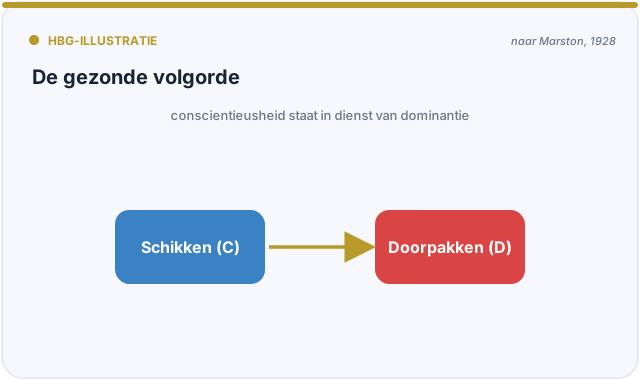
HBG-illustratie bij hoofdstuk IX, Dominantie en conformiteit samen
HBG-illustratie · door HBG toegevoegd om dit hoofdstuk toegankelijk te maken. Geen onderdeel van Marstons origineel.

In het kort

Dominantie en conscientieusheid horen bij elkaar. Ze wisselen elkaar af. Eerst schik je je even aan de tegenstander, daarna pak je door.

De volgorde is alles. Conscientieusheid moet in dienst staan van dominantie, niet andersom. In die volgorde blijft gedrag gezond en kom je verder.

In het vorige hoofdstuk bekeken we de mechanismen van dominantie en conformiteit, met enkele voorbeelden waarin die emoties zo zuiver mogelijk voorkwamen. Nu moeten we de normale verhouding tussen beide bekijken, eerst wanneer ze na elkaar optreden, daarna wanneer ze tegelijk optreden.

In dit hoofdstuk · 6 delen
  1. Dominantie is het natuurlijke evenwicht

  2. Wanneer conformiteit omslaat
  3. Dominantie vervangt altijd conformiteit

  4. Conformiteit beschermt je
  5. Conformiteit dient de dominantie
  6. De juiste volgorde
Deel 1 van 6

Dominantie is het natuurlijke evenwicht

HBG-beeld bij Dominantie is het natuurlijke evenwicht
HBG-toevoeging · samenvatting en beeld in onze stijl. Geen onderdeel van Marstons origineel.

In het kort, in onze taalJe systeem keert steeds terug naar dominantie als rusttoestand. Passieve dominantie houdt conformiteit tegen.

Passieve dominantie verhindert dat conformiteit ontstaat

Passieve dominantie kan worden opgeroepen door een geschikte prikkel, zonder dat er eerst conformiteit aan te pas komt. Houdt een baby zijn rammelaar stevig vast, en trekt de moeder er met minder kracht aan dan het kind kan uitoefenen, dan kan het zelf zich zo snel versterken dat de greep nooit losser wordt, tot het kind er zelfs aan blijft hangen. Dat is bijna zuivere passieve dominantie, want het zelf had de baan al in handen voordat de prikkel om de doorgang ging strijden, en bleef die de hele tijd verdedigen. Passieve dominantie is dus simpelweg verzet tegen de aanval van een tegenwerkende prikkel. Er komt geen conformiteit aan te pas, en de instelling van het organisme verandert niet, behalve dat er meer energie vrijkomt om de bestaande instelling te bewaren.

Dominantie is het natuurlijke evenwicht

Slaagt conformiteit erin, ook maar even, de dominante controle van het zelf over te nemen, dan zijn er twee mogelijkheden. Ten eerste kan de conformiteit ongestoord doorgaan tot de prikkel ophoudt sterker te zijn, zoals bij een esthetische reactie: dan is er conformiteit zonder dominantie. Dat lijkt op de zuivere passieve dominantie van zojuist, met een belangrijk verschil: deze aanhoudende conformiteit is actief, terwijl de aanhoudende dominantie passief was. Conformiteit kan het organisme namelijk alleen blijven besturen zolang ze het actief in een anti-dominante richting laat bewegen. Stopt dat actieve meebewegen, dan herstelt het natuurlijke reflexevenwicht zich vanzelf, en neemt dominantie het onvermijdelijk over.

Een prachtig schilderij kan de aandacht en de ontlading naar de organen beheersen zolang het harmonieuze volume groter is dan dat van het zelf. Maar gaat het licht in het atelier tanen, of raken de zintuigen vermoeid, dan roept de prikkel geen groter volume meer op. Het actieve meebewegen houdt op, de tonische prikkels komen vrij, en het zelf herneemt vanzelf de controle. Dat herstel is een vorm van actieve dominantie, en wordt meestal gevoeld als kritiek op of verveling met het schilderij. Een andere manier waarop dominantie zich na esthetische conformiteit herstelt, is een plotseling besluit om het bewonderde voorwerp te bezitten, gevolgd door gedrag dat op aankoop is gericht.

Deel 2 van 6

Wanneer conformiteit omslaat

HBG-beeld bij Wanneer conformiteit omslaat
HBG-toevoeging · samenvatting en beeld in onze stijl. Geen onderdeel van Marstons origineel.

In het kort, in onze taalLoopt conformiteit te ver op, dan slaat ze om in dominantie. Marston koppelt die omslag aan zelfbehoud.

Actieve conformiteit kan steeds meer van het zelf tegenwerken tot het dominantie oproept

Mag conformiteit ononderbroken doorgaan tot de prikkel uitgewerkt is, dan volgt onmiddellijk dominantie, alleen al door de automatische terugkeer van het natuurlijke evenwicht. Maar er is een tweede manier waarop conformiteit eindigt, zoals bij het schilderij dat eerst esthetisch werd bewonderd en daarna dominant werd begeerd. De conformiteit liep niet zomaar af, ze bracht de dominantie voort die haar opvolgde. Het mechanisme is dat van een grens die wordt overschreden: een prikkel kan sterker zijn dan een klein deel van het zelf, maar werkt hij steeds meer van het zelf tegen, dan komt er een punt waarop het betrokken deel van het zelf sterker wordt dan de prikkel. Op dat punt verandert de prikkel van een conformiteitsprikkel in een dominantieprikkel, en slaat de reactie van conformiteit om in dominantie.

Bij het schilderij beheerste de conformiteit het organisme dus alleen zolang een klein deel van het zelf erbij betrokken was. Toen de reactie zich in de hogere centra verbreidde en een groter deel van het zelf meedeed, was dat deel niet langer geschikt voor conformiteit, maar wel voor dominantie. Bij milde prikkels bestaat steeds de kans dat de prikkel ineens als zwakker dan het zelf wordt gevoeld. De esthetische houding is daardoor uiterst onstabiel en moeilijk lang vol te houden. Bij zeer getrainde estheten kan die omslag lang uitblijven of nooit komen, maar bij de gewone mens stapelt het zelf zich tijdens een lange conformiteit op tot het overloopt en de conformiteit omslaat in even sterke of sterkere dominantie.

De omslag bij het hele zelf is het zelfbehoudinstinct

Dat ratten vechten als ze in het nauw zitten, is spreekwoordelijk geworden. Ik denk dat dat hetzelfde mechanisme is als de omslag van esthetiek naar dominantie. De rat schikt zich naar de sterkere vijand door weg te rennen, zolang maar een klein deel van zijn zelf wordt overweldigd. Maar is elke vluchtweg afgesneden, dan komt zijn hele zelf in het geweer. Op zijn maximale kracht, met het hele zelf in de strijd, blijkt dat sterker dan alle prikkels die zelfs de gevaarlijkste vijand kan opwekken. Dat is het zogenoemde zelfbehoudinstinct, dat ook de schuchterste mens toont wanneer hij plotseling voor een gevaar staat waaraan niet te ontkomen is. Je zou het kunnen omschrijven als de omslag van conformiteit naar dominantie op het punt waarop genoeg van het zelf in het conflict betrokken raakt om sterker te zijn dan de prikkel. De bijbehorende bewustzijnstoestand heet vaak wanhoop.

Deel 3 van 6

Dominantie vervangt altijd conformiteit

HBG-beeld bij Dominantie vervangt altijd conformiteit
HBG-toevoeging · samenvatting en beeld in onze stijl. Geen onderdeel van Marstons origineel.

In het kort, in onze taalUiteindelijk neemt dominantie het altijd weer over. Conformiteit is de opmaat, niet het eindpunt.

Dominantie vervangt altijd conformiteit

Wordt actieve conformiteit hoe dan ook gevolgd door een dominant herstel van de controle, dan mogen we de regel zo formuleren: actieve conformiteit wordt normaal gevolgd door actieve dominantie. Hetzelfde geldt voor passieve conformiteit: wordt het zelf door een sterkere prikkel gedwongen bepaalde banen op te geven, dan herneemt de tonische ontlading die banen zodra de barriere weg is. Wel met deze kanttekening: was het zelf eerst sterk versterkt om voorwerp A te domineren, en moest het passief wijken voor prikkel B, dan keert het na het wegvallen van B niet per se terug naar die verhoogde sterkte, maar naar zijn normale sterkte, en niet per se naar het domineren van A, dat inmiddels uit de omgeving verdwenen kan zijn. Passieve conformiteit kan dus worden gevolgd door een meer passieve dan actieve dominantie, al zit er altijd enige actieve dominantie in het herstel van het evenwicht. Uit de aard van dominantie als handhaving van het normale evenwicht volgt dat ze actieve of passieve conformiteit uiteindelijk altijd vervangt.

Deel 4 van 6

Conformiteit beschermt je

HBG-beeld bij Conformiteit beschermt je
HBG-toevoeging · samenvatting en beeld in onze stijl. Geen onderdeel van Marstons origineel.

In het kort, in onze taalJe schikken naar een sterkere vijand beschermt je organisme. Het is een slimme, tijdelijke stap.

Conformiteit beschermt het organisme tegen sterkere vijanden

Deze opzet zorgt voor maximale efficientie. Is een dier of mens al goed genoeg aangepast om zijn houding te bewaren ondanks alle tegenwerking, dan vangt passieve dominantie kleine schommelingen op die geen nut hebben. Is een tegenstander daarentegen sterk genoeg om het organisme te vernietigen of ernstig te beschadigen, dan laat de conformiteit de sterkere zijn kracht besteden aan het verplaatsen van het organisme in plaats van aan het vernietigen van een deel van het zelf, dat het hele leven de bron en steunpilaar van al het gedrag moet zijn. Zonder die conformiteit zou een sterkere prikkel uiteindelijk de hele tonische ontlading kunnen blokkeren, met zeer ernstige gevolgen.

Deel 5 van 6

Conformiteit dient de dominantie

HBG-beeld bij Conformiteit dient de dominantie
HBG-toevoeging · samenvatting en beeld in onze stijl. Geen onderdeel van Marstons origineel.

In het kort, in onze taalConformiteit heeft waarde zolang ze een doeltreffende dominantie mogelijk maakt, en niet verder gaat dan dat.

Conformiteit heeft selectieve waarde voor een efficiente dominantie

Dat het dominante evenwicht zich na conformiteit altijd herstelt, geeft de tussenliggende conformiteit nog een belangrijke waarde. De afzonderlijke conformiteitsreacties werken als selectie: ze wekken juist de tonische reflexen op die precies tegenover de conformiteitsreflexen staan. Bij passieve dominantie is de versterking van het zelf algemeen en niet gericht. Maar laat je de prikkel eerst een conformiteit oproepen, dan kun je juist die delen van het zelf versterken die het best geschikt zijn om de prikkel weg te nemen, wat energie spaart en de dominantie efficienter maakt.

De vingers die zich strekken om een voorwerp te grijpen, schikken zich naar dat voorwerp en versterken zo precies de grijpreflexen die het best bij dat voorwerp passen. Hoe vollediger de hand zich naar vorm en grootte van het voorwerp schikt, hoe efficienter het daarna wordt beheerst. Het verschil tussen baby en volwassene is hier duidelijk: een baby opent zijn hand wijd en strekt alle vingers gelijk, ongeacht de vorm, of strekt ze juist te weinig. Conformiteit is immers aangeleerd, en dus bij volwassenen veel verfijnder. Het mooie is dat die verfijnde conformiteit automatisch de daaropvolgende dominantie sterker en effectiever maakt. Alle fijnere en krachtigere aanvalsbewegingen, in een gevecht op leven en dood of in een sport als tennis, danken hun precisie aan de voorafgaande conformiteit. De speer moet zich met een nauwkeurige conformiteit naar het lichaam van de tegenstander richten, en de kracht van de stoot hangt vast aan de mate waarin de arm eerst is teruggetrokken. In tennis gaat een eindeloze reeks subtiele conformiteitsreacties vooraf aan elke krachtige slag. Alle voorbereiding bestaat uit conformiteit, die als selectiemiddel de meest effectieve dominantie uitkiest. De normale verhouding is dus dat conformiteit in dienst staat van het slagen van de dominantie.

Conformiteit mag niet verder gaan dan haar nut voor dominantie

Twee kanttekeningen. Ten eerste kan conformiteit zo ver doorschieten dat ze de dominantie te lang uitstelt of het zelf te zwak maakt. Een honkbalslag die te lang is voorbereid, mist zijn timing; een worstelaar die een ledemaat te ver terugtrekt, kan het niet meer met volle kracht terugbrengen; en een estheet kan zich zo laten meeslepen dat hij daarna de kracht mist om zijn kunstcollectie naar eigen genot te ordenen. Ten tweede kan het organisme zich schikken naar een tegenstander die het zelfs op zijn sterkst niet kan domineren. Een zwemmer die zich te ver van de kust laat meevoeren door de stroming, heeft zich geschikt naar een kracht die zijn beste vermogen overtreft, en staat dan afgesneden van de kust door een barriere van water die hij niet kan overwinnen. In beide gevallen is conformiteit, hoewel in dienst van dominantie, zo ver doorgevoerd dat ze de latere dominantie verzwakt of onmogelijk maakt.

Deel 6 van 6

De juiste volgorde

HBG-beeld bij De juiste volgorde
HBG-toevoeging · samenvatting en beeld in onze stijl. Geen onderdeel van Marstons origineel.

In het kort, in onze taalGezond gedrag: eerst schikken, dan doorpakken. Conformiteit gaat vooraf aan dominantie en is eraan aangepast.

Conformiteit gaat normaal vooraf aan dominantie en is eraan aangepast

Wil dominantie maximaal efficient zijn, dan moet er conformiteit aan voorafgaan, maar niet te ver en niet te lang. De eenvoudigste gezonde combinatie is dus: eerst een conformiteit die is aangepast aan de dominantie die volgt. Marston vat dat samen in de formule C plus D, waarbij de volgorde de tijdsvolgorde aangeeft en het plusteken betekent dat de eerste reactie is aangepast aan de tweede. In C plus D is conformiteit dus zowel aangepast aan dominantie als eraan voorafgaand.

Waar wij afwijken van Marston: de onderbouwing met tonische ontlading en motorische banen is verouderd. Het gedragsinzicht klopt nog steeds: toegeven kan een slimme zet zijn die je daarna laat doorzetten, en het zelfbehoudinstinct is herkenbaar als de omslag waarbij iemand die in het nauw zit ineens vol in de aanval gaat.

Bron en verantwoording

Controleer dit hoofdstuk aan de bron

Deze hertaling volgt hoofdstuk IX van Emotions of Normal People (William Marston, 1928, publiek domein). Hieronder lees je de volledige originele Engelse tekst van dit hoofdstuk, met de oorspronkelijke paginanummers, zodat je alles kunt nalezen en verifieren. Je kunt ook de volledige woordgetrouwe Nederlandse vertaling en het Engelse origineel downloaden.

De woordgetrouwe NL-vertaling, het Engelse origineel, de HBG-versie en Marston 2.0 zijn gratis te downloaden zodra je een HBG-account aanmaakt en je e-mailadres bevestigt. Zo blijft dit gedachtegoed beschikbaar voor iedereen die er echt mee aan de slag wil.

Lees de originele Engelse tekst van hoofdstuk IX · Marston, 1928
Dit is de oorspronkelijke Engelse tekst zoals Marston die in 1928 schreef, inclusief de originele paginanummers. Onze Nederlandse hertaling hierboven volgt deze tekst getrouw. Zo is elke passage terug te leiden naar de bron.

We have considered in the last chapter the integrative mechanisms which are responsible for the emotional responses of dominance and compliance, and we have analysed a few simple illustrations of actual human behaviour exemplifying the occurrence of these emotions in as isolated a form as possible. We have still to consider the normal inter-relationship between dominance and compliance when the two emotional responses occur successively. We have also to consider, thereafter, the normal integrative combinations of dominance and compliance when these two emotional responses occur simultaneously.

Passive Dominance Prevents Compliance From Being Evoked

The response of passive dominance may be evoked by an adequate dominance stimulus without previous intervention of any compliance response. If, for example VJ an infant is holding tightly to its rattle, and if the mother tries to pull the toy from the child, exerting less force upon the rattle than the infant is able to exert in holding it, the child's motor self may simply reinforce itself so promptly and efficiently that the infant's actual grip upon the rattle is never loosened. This result may be carried to the point where the infant actually suspends his own weight from a rod or stick, which he was grasping firmly at the time the experimenter started to pull it away. Such a response represents almost pure passive dominance because the motor self was in control of the disputed efferent channels of motor discharge before the motor stimulus began its contest for these paths, and

pagina 297

throughout the response the motor self similarly continued to resist all encroachments upon its occupied territory. In short, passive dominance consists of simple resistance to the attack of an antagonistic motor stimulus upon the motor

self. No compliance whatever enters into this type of emotional response, and the general motor set of the organism is not changed in any way by reaction to the environmental stimulus except that more effort, or energy, has been released to preserve the pre-existing set.

Dominance Represents the Natural Equilibrium of the Organism

If compliance response actually succeeds, even momentarily, in supplanting the dominant control exercised by the motor self over the final motor paths of the organism, then two integrative possibilities appear. First, the compliance emotion may continue undisturbed until the environmental stimulus has ceased to evoke a motor stimulus of superior intensity or volume. In this case, which might consist, for example, of an aesthetic response, the emotion experienced is one of compliance without the admixture of dominance. This corresponds, it would seem, to the situation just considered where pure dominance emotion of passive type remained uninterrupted. Ihere is one important difference. The compliance emotion which persists without any ad-

pagina 298

mixture of dominance is an active compliance response whereas the uninterrupted dominance just considered was of passive type only. In short, compliance can continue to rule the subject organism only for so long as it keeps the organism actively moving in an anti-dominant way. The moment the organism ceases to comply actively witli a given stimulus, the natural reflex equilibrium automatically re-establishes itself, and dominance emotion inevitably supplants

For example, a beautiful picture may control the attention and main avenues of involuntary motor discharge to the viscera so long as the harmonious volume of motor stimulus evoked by the art object is sufficiently superior to the volume of the motor self. But if the studio light begins to wane, or if the individual sense organs become fatigued in gazing at the picture, the environmental stimulus at once ceases to evoke a motor stimulus of superior volume. The immediate result of this change in the motor stimulus is to bring about a cessation of active compliance motor discharge of an antitonic sort. This, of course, frees the tonic impulses from their previous restraint and the motor self automatically re-establishes its control of the efferent centres. This process

of re-establishing control constitutes a response of active dominance. It will be felt by the subject himself in most instances of the type cited as a feeling of active criticism of, or boredom with, the picture (this of course assumes that no other stimulus intrudes to claim the subject's attention).

pagina 299

Another type of reassertion of dominance after aesthetic compliance with an art object might consist of a sudden determination to possess the admired object, followed immediately by behaviour appropriately directed toward its purchase or acquisition.

Active^ Compliance may Oppose More and More of the Motor Self Until it Evokes Dominance

If, then, compliance is permitted to continue without interruption to the point where the stimulus ceases to be effective, it must necessarily be followed immediately by dominance emotion accompanying the mere automatic return of the organism's natural integrative balance. A second type of termination of compliance appears in the case last mentioned, where continued aesthetic compliance with a beautiful picture was superseded by dominant attempt to possess the picture itself. It seems clear that the compliance response did not merely run itself out but rather brought about the dominance emotion which superseded it. The mechanism for this type of integrative causation would sem to be a sort of passing of the quantitative limit beypnd which the motor self cannot comply with the motor stimulus because a large enough proportion of the motor self has become involved in the reaction to make it superior in strength to opposed motor stimuli. That is to say, if the motor stimulus opposes only a comparatively small portion of the motor self the stimulus may be more powerful than the self; but, when the same stimulus opposes more and more of the self a point sooner or later reached where the increment of motor self involved in the conflict has become more powerful than the motor stimulus.

pagina 300

At that point the stimulus becomes an adequate dominance stimulus instead of an adequate compliance stimulus, and the subject's response similarly transforms itself from compliance into dominance.

In the instance where the subject first feels aesthetic compliance emotion toward a picture, and later, as the response progresses, suddenly assumes a dominant attitude toward

the picture in trying to acquire it for himself, it seems reasonable to assume that the original compliance with volume response was able to control the organism for only so long a time as a comparatively small portion of the motor self was engaged in compliance. When the reaction to the picture had spread sufficiently in the higher motor centres of the central nervous system and a larger portion of the motor self consequently became involved, this total increment of the motor self was no longer of suitable size for compliance response, but rather proved sufficient for dominance over the picture.

In instances like this, where the intensity of the* environmental stimulus, and consequently the intensity of the motor stimulus is comparatively slight, there would be an ever present likelihood throughout the response that the strength of the stimulus might be felt at any moment as inferior to the strength of the motor self. The aesthetic attitude, in other words, is an extremely unstable one and difficult to maintain over any considerable length of time of response. That is, there seems to come a point in any compliance re-

pagina 301

sponse where the environmental stimulus ceases to be felt as an adequate compliance stimulus, and in the type of instance now under examination, its effect upon the organism in ^ evoking compliance response appears to endow it subsequently with positive potency as an adequate dominance stimulus. !n persons of extreme aesthetic training, it is true, this change from aesthetic reaction to dominance response might be long deferred or might, in fact, never occur. But with the ordinary individual there seems to be a certain piling up, or summation of the motor self during an extended compliance response, which, when the point of overflow is reached, transforms the compliance emotion into dominance of equal or greater strength.

The Shift from Compliance to Dominance When the Whole Motor Self is Opposed is " Instinct of Self-Preservation "

The fact that rats will fight when cornered has become proverbial. I would suggest that this response is probably expressive of the same mechanism as that underlying the change from aesthetic to dominance response just considered. The rat complies with the antagonist of superior strength by running away from his opponent. This con-

tinues' for as long a period as the proportion of the rat's motor self which is overwhelmed by his superior enemy is a comparatively small one. When, however, every avenue of escape is cut off, the animal's entire motor self is brought to bay, as it were. The full intensity of this animal's motor self when increased by its reinforcement mechanism to

pagina 302

maximum strength, and when the entire motor self is involved in the conflict, evidently proves stronger than the sum total of motor stimuli which can be evoked by the most dangerous foe. This is the so-called " instinct of self-preservation ". It is a type of behaviour shown frequently by the most timid of human beings when suddenly confronted by an extreme danger from which there is no possible escape by flight. In fact the " instinct of selfpreservation " might be defined as a change from compliance response to dominance response at the point where a sufficient proportion of the motor self becomes involved in conflict with the stimulus to render motor self more Powerful than motor stimulus. The state of emotional consciousness involved in this shift is frequently termed " desperation ".

Dominance Always Replaces Compliance

If, then, active compliance is followed in any event by a dominant re-establishment of control of the organism by the motor self, it might be permissible to formulate the -rule in some such way as follows : Active compliance is normally followed by active dominance.

The same rule evidently holds also with respect to passive compliance. That is, if the motor self is compelled by a stimulus of greater intensity to give up control of certain disputed paths, the tonic discharge will automatically reassume control of these paths as soon as the prohibitory barrier has been removed, even though the contest has been a mutual stand-off, as it were, and the motor stimulus has not succeeded in itself moving the organism actively. There seems, however, this qualification to be made concerning

pagina 303

the reversion to dominance following compliance of passive aspect only. If the subject's motor self happened, in the first place, to be in a condition of marked reinforcement, or increased intensity for the purpose of dominating object A, and if the motor self were compelled passively to comply with stimulus B by giving up its dominance over object A

then should stimulus B cease to operate, the motor self would not necessarily return to its previous condition of increased intensity, but only to its normal strength when no antagonistic motor stimulus was operating upon it. Nor would the motor self necessarily return to the process of dominating object A, which might by that time have passed entirely out of the subject's environment. Passive compliance, therefore, might be followed by a state of dominance more passive than active, though there must always be some active dominance m the process of re-establishing reflex equilibrium after the compliance stimulus has ceased to operate. It seems, in short, to follow from the very nature of dominance response as an enforcement of the integrative system's normal equilibrium that dominance must always eventually supersede active or passive compliance.

Compliance Protects the Organism Against Superior Foes

Such an arrangement obviously makes for maximal efficiency in adapting the organism successfully to its environment. If an animal or human being is already well enough adapted to his surroundings to be able to maintain his existing posture and position despite the utmost antagon-

pagina 304

istic influence which can be brought to bear against him at any* given moment, the mechanism of passive dominance provides ? means for counteracting minor fluctuations of posture and position which could serve no useful purpose, and which would result only in disturbing the progress of the organism's vital functions. On the other hand, if any antagonistic factor in the subject's immediate physical environment be sufficiently powerful to destroy or seriously injure the subject's organism, the compliance mechanism permits the stronger antagonist to expend its force in moving the subject rather than in destroying part of the motor self which must serve throughout life as the dynamic source and main-stay of the subject's entire behaviour.

Were it not for this possibility of integrative compliance, an antagonistic motor stimulus of superior intensity, operating through a centre of the central nervous system above the tonic centre, might eventually succeed in inhibiting the entire mass of tonic discharge in toto, with extremely serious consequences to the organism.

igo EMOTIONS OF NORMAL PEOPLE

Compliance Responses Have Selective Value in Evoking Maximally Efficient Dominance Responses

The tendency of the dominant balance of the organism always to re-establish itself following compliance response gives to the intervening compliance reaction another important value. The separate compliance emotions enforced

pagina 305

by an antagonistic environmental stimulus act as selective agents arousing to special activity the specific tonic reflexes recriprocally opposed to the intervening compliance reflexes. That is to say, in the response of passive dominance there appears a general blanket type of reinforcement of the motor self, not specifically directed against the environmental stimulus which is being responded to. But, if the environmental stimulus in question is permitted first to effect a compliance response, then selective reinforcement of those portions of the motor self best adapted to oppose and remove the antagonistic stimulus can be made, with resultant conservation of energy and increasing efficiency of the dominance response. Examples of this selective value of initial compliance with a stimulus which is later to be dominated are to be found in all the rudimentary behaviour patterns of the human organism in which tonic and phasic reflexes alternate to bring about progressive movement of the body or limbs.

The fingers of the hand, for instance, if extended in compliance with the object to be grasped, automatically bring about the reinforcement of the particular tonic grasping reflexes best adapted to seize and handle that particular environmental object. The more completely extension of the hand is permitted to comply with the size, shape, and position of the object to be grasped, the more efficiently will that object subsequently be mastered or dominated. The difference in this respect between infant and adult behaviour is well marked. When an infant naively extends his fingers to grasp a proffered object of very small size, he opens his hand wide, extending all the fingers equally regardless of the shape and small size of the thing to be grasped. In other instances infants may fail to extend the fingers sufficiently to surround the object to be grasped.

pagina 306

In either case, the extending of the hand would seem to be more in nature of general, unselective reaction to the obiect.

than a compliance response closely controlled by the object itself.

We have noted several times previously that compliance is a learned response, and so when we compare the behaviour of infant subjects with the reactions of adults we should expect to find compliance response much more highly developed in the latter as, in fact, it is, in nearly all types of reaction. The interesting point for the purpose of our present discussion is that such increase in delicacy and completeness of compliant response to any given object automatically produces corresponding increase in the strength and effectiveness of the dominance response which follows. Any number of examples of this increase of dominant efficiency following increased learning of compliance might be cited. All the finer and more powerful movements of attack upon an opponent, whether in mortal combat, or in some ultra-civilized sport like tennis or baseball, depend for their accuracy and power upon the completeness of the preceding compliance responses.

In savage combat, the spear must be directed toward a vital spot in the antagonist's body by a careful and accurate compliance response, evoked by the antagonist's body itself. The power of the dominant driving home of the attacker's weapon bears a fixed and constant relationship of dependence upon the extent and intensity of the preceding compliance

pagina 307

response o,f withdrawing the arm and hand holding the spear in an initial direction away from the individual to be attacked. In tennis a never-ending series of very subtle compliance reactions must be performed in order to bring the body, arm, and racquet into postures which themselves determine maximally effective dominance reactions to follow. All preparedness, in short, consists of compliance reactions, whose principal function is to serve as selective agents within the integrative centres of the subject's organism, to pick out the dominance reactions most effectively antagonistic to the compliance responses themselves. The normal relationship, then, between compliance and dominance emotion is a relationship in which compliance is used for the success of the dominance responses. We may say that active dominance is effective in reaching its antagonist directly in proportion as it is immediately preceded by compliance with the opponent.

192 EMOTIONS OF NORMAt PEOPLE

Compliance Must Not Be Carried Beyond Its Usefulness to Dominance

It is necessary to qualify this statement in two particulars. First, compliance response may be carried to such an extreme that it postpones the ultimate dominant reaction too long for maximum efficiency, or lowers the strength of the motor self to such a degree that it is unable to cope with the antagonist. Secondly, the organism may comply with an antagonist which it has not the strength to dominate, even when the motor self is at its maximum intensity. An illustration of the first qualification to the usefulness of compliance

pagina 308

as a servant of dominance may be found in over-careful adjustment of bodily position, in baseball or tennis, before the actual swing of the bat or tennis racquet toward the ball is begun. The timing of the stroke has been delayed too long for success, by an over extensive preparatory compliance response. In wrestling or boxing, it frequently happens that one contestant withdraws an arm or leg too far, so that the tonic muscles, which otherwise would have brought the limb back with maximum force, are no longer able to exert maximally efficient leverage upon the limb in question. Or, in terms of nerve impulses, the same result may occur when an aesthete permits such volume of compliant motor discharge to control his organism that he subsequently finds himself lacking in strength to arrange his art collection in a manner most effective for his own aesthetic enjoyment...

Illustrating the second qualification placed upon the value of compliance to dominance, we may cite the very common instance of an individual who allows himself, while swimming, to be carried too far from the shore by the current. Such a person has complied with a force stronger than his own physical power at its best. He finds himself, therefore, shut off from shore by a barrier of water which it is beyond his physical strength to conquer or dominate. In both types of instances cited, compliance, though undertaken in the service of dominance, was carried to such an extreme that the compliance response had the effect of rendering subsequent dominance less effective, or altogether impossible.

Compliance Normally Precedes and Is Adapted to Dominance It seems clear from the foregoing analysis, that if dominance

pagina 309

is to maintain maximal efficiency, it must be preceded by compliance response. But the compliance must not be carried too far or continued for too long a period. In short, the simplest normal combination between dominance and compliance responses beneficial to the organism consists of initial compliance response adapted to dominance emotion to follow. This relationship between these two primary emotional responses may conveniently be expressed by the simple formula C -f D. When this formula is used, it should be understood that the order of the letters represents the temporal order in which the emotinal responses occur, and the plus sign represents the relationship of adaptation of the, response indicated by the first letter to the response symbolized by the following initial. Thus, in the formula C + D, C,, compliance is adapted to D, dominance, as well as occurring prior to the beginning of D, the dominance response.

Veelgestelde vragen

Hoe werken dominantie en conformiteit samen?
Ze wisselen elkaar af. Eerst schik je je even aan de tegenstander (conformiteit), daarna pak je door (dominantie). In die volgorde blijft gedrag gezond en doeltreffend.
Waarom is de volgorde belangrijk?
Omdat conformiteit in dienst moet staan van dominantie, niet andersom. Draait de volgorde om, dan ontstaat er een conflict, en daaruit komen later emoties als woede en angst voort.
Wat gebeurt er als de volgorde omdraait?
Dan verlamt de conformiteit je daadkracht, of je daadkracht bijt zich vast in iets wat het niet kan overwinnen. Dat zijn de omkeringen die in hoofdstuk XVII worden behandeld.