Ik ben een…Trainer · CoachHR · Team · LeiderDistributeur
Emotions of Normal People · hoofdstuk VII van XVIII ← Overzicht van alle hoofdstukken
Deel 2 · De botsende drijfveren
VII
Dominance

Dominantie

De prikkel is een zwakkere tegenstander. Het zelf overwint en houdt de controle.

Je leest op deze pagina hoofdstuk VII van het boek Emotions of Normal People van William Marston, de oerbron van DISC.

HBG-toevoeging · leeswijzer in onze taal
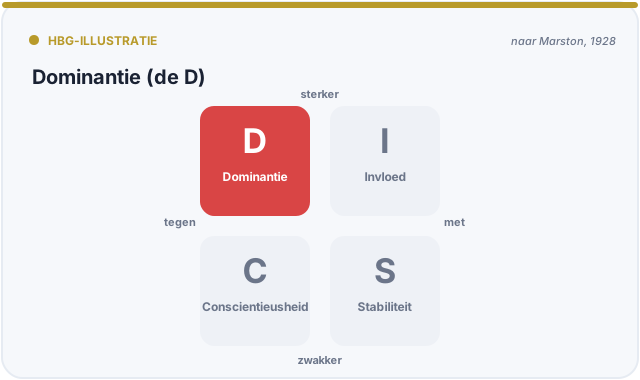
HBG-illustratie bij hoofdstuk VII, Dominantie
HBG-illustratie · door HBG toegevoegd om dit hoofdstuk toegankelijk te maken. Geen onderdeel van Marstons origineel.

In het kort

Dominantie is de drijfveer van de aanpakker. Zie je iets als een probleem dat je moet overwinnen, en voel je je daar sterk genoeg voor, dan pak je aan. Je stuurt, je hakt knopen door, je gaat op het doel af.

De kracht is duidelijk: zonder dominantie komt er weinig van de grond. De valkuil ligt er vlak naast. Wie te veel duwt, behandelt mensen als obstakels. Dan win je de discussie en verlies je de relatie.

Tot nu toe leek het opbouwen van een grondslag voor de primaire emoties vooral een logische analyse van neurologische resultaten. Toch ontdekte ik de vier knooppunten oorspronkelijk langs een heel andere weg. Ik had jaren gewerkt met systolische bloeddruk, reactietijd en andere fysiologische maten van emotie, en een flinke berg ongepubliceerd materiaal verzameld. Het bleek onmogelijk die gegevens te duiden zonder een houdbare hypothese over de psycho-neurale mechanismen van de emotie.

Zo'n hypothese bestond niet. De literaire namen voor de emoties waren verwarrend, overlappend en misleidend. In mijn leugendetectie-onderzoek vond ik bijvoorbeeld duidelijke aanwijzingen voor twee tegengestelde emotionele invloeden in het bedrieglijke bewustzijn. Die twee tegengestelde toestanden, met waarneembaar tegengestelde effecten op het gedrag, samen op een hoop gooien en die onbekende grootheid angst noemen, vond ik wetenschappelijk onverdedigbaar. Tegelijk leveren bloeddruk- en reactietijdmetingen op zichzelf veel te weinig houvast voor zo'n hypothese.

De beste aanpak leek mij twee soorten onderzoek te combineren. Ten eerste een reeks klinische studies van het gedrag van kinderen en volwassenen, enigszins in de stijl van Watson. Ten tweede een objectieve analyse van dat gedrag om de gemeenschappelijke factoren te vinden. Bij dat werk, dat ik in 1922 begon, hielpen vrijwillige studentassistenten mij enorm, die vaak een oprechter wetenschappelijke houding bleken te hebben dan onderzoekers die zich aan de gevestigde methoden moeten houden.

Ik had ook het geluk veel emotioneel gedrag in zijn ruwe vorm te kunnen waarnemen, tijdens een onderzoek naar de geestelijke gezondheid van schoolkinderen in New York en een soortgelijk onderzoek in gevangenissen in Texas. In New York bestudeerde ik onder leiding van Edith Spaulding ongeveer tweehonderdvijftig kinderen met gedragsproblemen. In Texas namen we de gebruikelijke intelligentietesten af bij gevangenen in dertien gevangenisboerderijen en in de gevangenis van Huntsville, en daarna interviewde ik elke veroordeelde afzonderlijk, met zijn volledige dossier voor me: zijn misdrijf, zijn eigen verklaring, zijn gedrag in de gevangenis, een lichamelijk onderzoek en zijn testuitslagen. Zo bestudeerde ik 3.451 gevangenen, voor ongeveer negentig procent mannen. Deze groep mag gelden als redelijk typerend voor wie in de dunner bevolkte streken van de Verenigde Staten in asociaal gedrag verzeild raakt. Ik kreeg een aardig beeld van hun houding tegenover hun eigen daden en tegenover de samenleving.

Tijdens die studies in Texas kregen de vier primaire emoties hun vorm. Ik bracht de belangrijkste gedragsneigingen terug tot vier grondklassen, die ik toen verwervingsdrang, dominantie, creatie en aanpassing noemde. Daarna paste ik die vier mechanismen toe op klinische gevallen tijdens een jaar als raadgevend psycholoog, en het jaar erop in een studentenkliniek aan Tufts College. Daar kwamen niet alleen aanpassingsproblemen aan bod, maar ook geldzorgen en hartsaangelegenheden, soms met ernstige gevolgen. In een bijbehorende cursus analyseerden studenten hun eigen gedrag en dat van elkaar, eerst rond werk, daarna rond thuis en liefde. De vier mechanismen werden verder verhelderd en bijgesteld. Daarna besteedde ik nog een half jaar aan het samenvoegen van alle resultaten en het zoeken naar de neurologische grondslag van de gemeenschappelijke noemer. Het geheel daarvan is dit boek.

Een van de meest treffende dingen die ik bij al die waarnemingen zag, was de sterke gelijkenis tussen bepaalde menselijke reactieneigingen en de algemene beginselen in het gedrag van de natuurkrachten.

In dit hoofdstuk · 8 delen
  1. Dominantie in de natuur
  2. Dominantie bij mens en kind
  3. Waar gezond overgaat in ongezond
  4. Mildere en jagende vormen
  5. Destructief en competitief
  6. Hoe volwassen dominantie ontstaat
  7. Wanneer dominantie prettig is
  8. Zo herken je dominantie
Deel 1 van 8

Dominantie in de natuur

HBG-beeld bij Dominantie in de natuur
HBG-toevoeging · samenvatting en beeld in onze stijl. Geen onderdeel van Marstons origineel.

In het kort, in onze taalDominantie is geen menselijke uitvinding. Ze bestaat al in de krachten van de natuur. Marston onderscheidt de prikkel van binnen van die van buiten.

Dominantie in de natuurkrachten

Het is een spreekwoord geworden dat water de weg van de minste weerstand volgt, oftewel domineert. Vergelijk je de door de zwaartekracht gedreven stroom met de tonische ontlading van het organisme, dan blijken beide volgens vrijwel dezelfde beginselen op tegenstand te reageren. Tegenstand die zwakker is dan het stromende water wordt door de stroom overheerst, ongeveer in verhouding tot het verschil in kracht. En naarmate de tegenstand wordt overwonnen, wordt de stroom krachtiger. Verwijder je het obstakel volledig, dan stort het water naar beneden met enorme kracht, als de Niagara-watervallen. Andere natuurkrachten reageren net zo. Elektrische ladingen kiezen de geleider met de minste weerstand, gassen zetten uit naar waar de minste tegendruk is. Steeds neemt de kracht toe naarmate de tegenstander wordt overwonnen. De prikkel tot de dominante reactie van een natuurkracht is, net als bij de mens, een tegenwerkende kracht die zwakker is dan de reagerende kracht zelf.

Het overheersen van de zwakkere kracht door de sterkere lijkt vanzelfsprekend. Toch is het belangrijk te zien dat juist de zwakte van de ene kracht de selectieve prikkel vormt die de dominantie van de sterkere oproept. En wint de sterkere kracht er iets bij tijdens het overheersen? Ja. De sterkere kracht neemt toe met ongeveer de kracht van de overwonnen tegenstander. Een rivier die op een dam stuit, stuwt zich op met toenemende druk. Hoe hoger de dam, hoe meer water zich erachter ophoopt en hoe meer druk de rivier uitoefent. Wanneer de rivier eindelijk over de dam stroomt, is de kracht van het overstromende water groter dan die van de oorspronkelijke, niet-gestuwde rivier, met een toename die ongeveer gelijk is aan de kracht van de overwonnen dam. Kortom: de zwakte van de mindere kracht is de prikkel tot dominantie, en de sterkere kracht groeit tijdens het overheersen met ongeveer de overwonnen tegenkracht.

Het verschil tussen motorische prikkels en omgevingsprikkels

Passen we deze dominantievergelijking toe op het zelf, dan moeten we scherp onderscheid maken tussen omgevingsprikkels en motorische prikkels. De hoeveelheid dominantie-emotie en de hevigheid van het dominante gedrag weerspiegelen niet de reactie van het zelf op de zichtbare omgevingsprikkel, maar de reactie op de motorische prikkel die, door eerdere ervaring, door een ogenschijnlijk onbenullige omgevingsprikkel kan worden losgemaakt.

Zo wordt soms een doodslag gepleegd als reactie op een onschuldig gebaar van iemand naar zijn heupzak. De omgevingsprikkel was verwaarloosbaar en waarschijnlijk niet eens vijandig. Maar bij eerdere gelegenheden was het grijpen naar een heupzak waar een revolver zat een prikkel die een snelle, gewelddadige dominantie vergde. Door dat leerproces had die milde omgevingsprikkel de macht gekregen om motorische prikkels op te roepen die het zelf tegenwerken. Die motorische prikkels zijn heftig, maar toch zwakker dan de versterkingen die het zelf kan oproepen, en dus genoeg om een uiterst gewelddadige dominantie uit te lokken. De toename van het zelf wordt hier gemeten aan de heftigheid van de motorische prikkel, en staat geheel los van de sterkte van de omgevingsprikkel. Dit voorbeeld is extreem, maar zulke discrepanties tussen omgevingsprikkel en motorische prikkel moet je in elk gedrag zoeken.

Deel 2 van 8

Dominantie bij mens en kind

HBG-beeld bij Dominantie bij mens en kind
HBG-toevoeging · samenvatting en beeld in onze stijl. Geen onderdeel van Marstons origineel.

In het kort, in onze taalBij mens en dier zie je dominantie duidelijk terug, en bij jonge kinderen ontwikkelt ze zich al vroeg.

Dominantie bij mens en dier

Dominantie lijkt het meest fundamentele en oorspronkelijke type emotie bij dier en mens. De hond of aap zonder grote hersenen toont een typische dominantie tegenover elke tegenwerkende prikkel die zwakker is dan zijn motorische zelf. Goltz vond dat zo'n hond geen enkele emotie toonde behalve wat hij woede noemde, een zeer ongeremde, agressieve vorm van dominantie. Het verschil met een normaal dier was dat bij dit dier geen prikkel kon worden opgeroepen die sterker was dan het hele zelf. Dat was te verwachten zonder de hogere centra: conformiteit en de hogere genotsemoties van de liefde, invloed en stabiliteit, konden onmogelijk optreden. Het enige intacte mechanisme was de versterking van de tonische uitstroom tegen een zwakkere tegenstander, en dat leverde een ongeremde aanval op, met als enige overgebleven emotie zuivere dominantie.

Bij menselijke baby's is dezelfde dominantie een van de eerste emoties die zich ontwikkelt. Watson meldt zelfs dat ze aangeboren is, en noemt haar, in navolging van de dichters, de emotie van de woede. Maar zowel volgens mijn waarnemingen als die van Watson zit er bij de zuivere zuigelingen-dominantie aanvankelijk geen geblokkeerd element in. Dat sluipt er pas geleidelijk in naarmate de emotie haar hoogtepunt nadert. Watson omschrijft de prikkel als het belemmeren van de lichaamsbeweging: hij hield het hoofdje vast, drukte de armen tegen de zij, of hield de beentjes bijeen. Het kind voelt dat als tegenstand, maar die tegenstand is zwakker dan zijn tonische zelf, want anders zou de houding veranderen. In plaats daarvan verstijft het hele lichaam, slaan de handjes en beentjes wild, en houdt het kind zijn adem in. Dat zijn allemaal versterkingen van de bestaande houding. Het zelf neemt dus toe terwijl het een zwakkere belemmering overwint.

Tot dat punt is er niets dan zuivere dominantie. Eerst is er geen gehuil, zegt Watson, dan gaat de mond wijd open en wordt de adem ingehouden tot het gezicht blauw ziet. Gillen en huilen komen er pas bij nadat het geblokkeerde element is begonnen. Dat geblokkeerde element behandel ik later uitgebreider. Voor nu volstaat het onderscheid tussen zuivere dominantie en dominantie plus blokkade. Dat laatste mag je woede noemen, want daar past de literaire betekenis redelijk bij. Goed waarneembare dominantie vind je dus al bij dieren zonder grote hersenen en bij baby's van tien tot vijftien dagen oud.

De ontwikkeling van dominantie bij jonge kinderen

Bij het gemiddelde kind ontwikkelt dominantie zich de eerste twee, drie jaar grotendeels ongeremd. Watson noemt de onvergetelijke ervaring waarbij hij bij zijn tweejarige dochter extreme dominantie opwekte tijdens het oversteken van een drukke straat. Het kind trok haar vader plotseling de andere kant op. De vader trok haar kort en scherp terug en hield haar arm vast. Daarop verstijfde het kind, begon uit volle borst te gillen, ging midden op straat zo stijf als een plank liggen en gilde met wijd open mond tot het blauw zag en geen geluid meer kon maken. Watson geeft dit als voorbeeld van woede, en er zit inderdaad zoveel blokkade in dat het woord woede op zijn minst een deel van het tafereel terecht beschrijft.

Toch zie ik onder de hele reactie een grondslag van maximaal intense dominantie. Elke handeling, ook het gillen, was een versterking van het zelf om de tegenstand van de vader te overwinnen. Het kind was simpelweg vastbesloten haar zin te krijgen, en riep haar versterkingsmechanisme tot het uiterste op. En voor zover Watson ons vertelt, kreeg ze haar zin ook. Dat ze lichamelijk de gewenste kant op gedragen had kunnen worden, hoeft geen nederlaag voor haar dominantie te zijn geweest. Alleen een omgevingsprikkel die motorische prikkels kon opwekken die sterker waren dan haar zelf, had haar dominantie kunnen doen omslaan.

Naar mijn waarneming ontwikkelen meisjes rond de eerste tekenen van seksuele ontwikkeling, vanaf het derde jaar, elementen van invloed en stabiliteit. Jongens daarentegen krijgen een toename van dominantie, ongeveer parallel aan de andere secundaire geslachtskenmerken. In sommige gevallen zag ik bij jongens een gestaag groeiende dominantie van geboorte tot puberteit. Bij een goed opgevoed kind wordt die in toom gehouden door het parallel aanleren van conformiteit. Maar bij jongens met gebrekkige opvoeding kan dominantie op zeer jonge leeftijd zo ver doorschieten dat geen enkele omgevingsbeperking haar nog kan beteugelen, hoe fysiek overweldigend ook.

Ik observeerde eens een jongetje van vijfeneenhalf, dat de zomer doorbracht bij een dolverliefde maar onbekwame moeder. Het kind had niet meer dan een normale mate van dominantie, maar door het volledig ontbreken van emotionele opvoeding wekte geen enkele omgevingsprikkel motorische prikkels op die sterker waren dan zijn eigen vastbeslotenheid om te doen wat hij wilde. Hij negeerde alle bevelen van zijn moeder. Op een dag zocht ze hem lang, en zag een groepje kinderen op het strand. Is Edgar daar, riep ze. Nee, hij is er niet, antwoordde Edgars stem vanuit het groepje. Voor Edgar was een opgewonden, fysiek sterke moeder een tegenstand die hij met een kleine toename van zijn zelf opzij kon schuiven, genoeg om een paar woorden van afwijzing te spreken.

Toen kwam de vader voor twee weken vakantie. Hij was van ander emotioneel maaksel. De eerste week joeg hij Edgar systematisch na, droeg hem met geweld weg van zijn spel en pakte verboden speelgoed met flink wat geweld af. Maar een week zo had geen merkbaar effect. Als de vader een stuk speelgoed uit zijn hand griste, viel het kind met beide vuisten zijn been aan en huilde om teruggave. Ik zag dit zo'n twintig keer gebeuren, zonder enige afname van zijn dominantie. Pas toen de vader het kind werkelijk pijn deed met iets wat op een stevige knuppel leek, verschenen de eerste tekenen van conformiteit. Geleidelijk, voortgezet door beide ouders, begon de jongen de kracht van de tegenstand af te wegen. Achtte hij zijn ouders dichtbij en emotioneel hevig genoeg voor een pak slaag, dan gehoorzaamde hij onbekommerd en was hij het gehoorzaamste kind ter wereld. Klonk de stem van een ouder, vooral van zijn moeder, zwak genoeg in verhouding tot zijn eigen rensnelheid, dan rende hij de andere kant op en trotseerde het bevel net zo onbekommerd. Wel toonde hij nu een veel grotere toename van zijn eigen energie dan aan het begin van de zomer.

Ik geef dit voorbeeld uitgebreid, niet omdat het ongewoon is, maar omdat het de natuurlijke ontwikkeling van ongetrainde dominantie bij een volkomen normaal jongetje goed illustreert. Het laat ook het verschil zien tussen een omgevingsprikkel die sterker is dan het zelf van het kind, en een die alleen lichamelijk sterker is dan zijn lichaam. Bij Edgar moest het lichaam werkelijk pijn worden gedaan voordat de opgewekte motorische prikkels sterker waren dan zijn zelf. Wijzere ouders hadden dat humaner en sneller kunnen bereiken, maar dat is niet eenvoudig zodra dominantie zich buiten verhouding tot de andere emoties heeft ontwikkeld.

Deel 3 van 8

Waar gezond overgaat in ongezond

HBG-beeld bij Waar gezond overgaat in ongezond
HBG-toevoeging · samenvatting en beeld in onze stijl. Geen onderdeel van Marstons origineel.

In het kort, in onze taalEr ligt een grens tussen gezonde dominantie en doorgeschoten dominantie. Marston laat zien waar die grens ligt.

De grens tussen normale en abnormale dominantie

Edgar was, voor zover ik in drie maanden kon vaststellen, een volkomen normaal kind. Is een kind emotioneel abnormaal, bijvoorbeeld door een voortdurende inwendige prikkeling als een overactieve klier, dan is dominantie nog moeilijker te beheersen. Veel van de kinderen die als gedragsprobleem naar ons werden gestuurd, vielen daar ongetwijfeld onder. Een jongen van tien, elf jaar had een opvallende voorliefde voor bendegevechten met jongens van zijn eigen leeftijd en ouder. Hij was bijzonder slim, alert en aantrekkelijk, en best meegaand als een lerares hem vriendelijk om goed gedrag vroeg. Maar zijn opvoeding was jammerlijk tekortgeschoten, en volgens de arts had hij een hormonale disbalans. De aantrekkingskracht die elke vorm van tegenstand op zijn dominantie uitoefende, was verbluffend. Hoe sterk de prikkel ook, hij riep altijd dominantie op. Hij leidde zijn bende in een aanval op een groep veel oudere jongens die hen bijna twee tegen een in aantal overtrof. Stenen, messen en knuppels leken hem bijna bovenmenselijke kracht te geven. Een tegenwerkende prikkel werd nooit als sterker dan zijn zelf gevoeld. De extra hevigheid registreerde alleen als meer tegenstand.

Jack vertegenwoordigt het type waarbij de dominantie, kennelijk door een hormoonafwijking, zo ver is doorontwikkeld dat geen enkele prikkel motorische prikkels kon opwekken die sterker waren dan zijn zelf, zelfs niet bij ernstig lichamelijk letsel. Ik noem hem om de grens te markeren tussen onevenwichtige dominantie door gebrek aan opvoeding, die nog in conformiteit is om te zetten door de prikkel sterk genoeg te maken, en onevenwichtige dominantie die abnormaal door een voortdurende inwendige prikkeling overprikkeld blijft. Dat laatste is duidelijk abnormaal, want het laat zich niet in conformiteit omzetten, zelfs niet door een prikkel die lichamelijk letsel veroorzaakt. Er zijn nog andere manieren om dominantie te beheersen, die ik later bespreek. Hier gaat het mij alleen om de kenmerken en grenzen van de dominantie zelf.

Samenvatting en analyse

Samengevat herkennen we in elk geval dezelfde drie elementen: een tegenwerkende prikkel die zwakker is dan het zelf, een dominante reactie daarop, en een toename van het zelf die gelijk is aan de overwonnen tegenstand. Bij de dieren zonder grote hersenen wekte elke prikkel motorische prikkels op die het zelf tegenwerkten en zwakker waren dan de tonische ontlading, en het zelf nam zichtbaar toe in verhouding tot de prikkel. Bij Watsons baby's was de prikkel het belemmeren van de beweging, steeds zwakker dan het zelf, en nam het zelf toe ongeveer in verhouding tot de opgelegde tegendruk. Genoeg druk om alle beweging te stoppen, was op zichzelf niet genoeg om prikkels op te roepen die sterker waren dan het zelf.

Bij het tweejarige meisje dat midden op straat ging liggen, zagen we een buitengewone toename van het zelf. Mogelijk berustte die op een aangeleerde discrepantie tussen omgevingsprikkel en motorische prikkel. Een korte, scherpe ruk blijkt namelijk een prikkel die nog sterkere motorische prikkels oproept dan het simpelweg stoppen van de beweging, en werd dus als sterkere tegenstand gevoeld, al was hij nog steeds niet sterker dan het zelf. Bij Edgar zagen we hoe hoog de drempel ligt voordat een prikkel in een normaal kind sterker wordt dan het zelf: pas bij echt lichamelijk letsel. Niet de ruk en het schudden, en zelfs niet de pijn van een zweep, haalden bij hem de conformiteitsdrempel. Pas letsel deed dat, mogelijk evenzeer door het besef dat er iets ernstigs was gebeurd als door de pijn zelf. Op dat punt werd Edgars gedrag een mengsel van dominantie en conformiteit, en dat illustreert de grens van normale, naieve dominantie. Bij Jack lag die drempel zo hoog dat zelfs letsel hem niet haalde, wat bij een kind voor de puberteit vrijwel altijd wijst op een abnormaal grote dominantieprikkeling in verhouding tot de andere emoties.

Deel 4 van 8

Mildere en jagende vormen

HBG-beeld bij Mildere en jagende vormen
HBG-toevoeging · samenvatting en beeld in onze stijl. Geen onderdeel van Marstons origineel.

In het kort, in onze taalDominantie kent zachtere vormen, en de opgewonden dominantie van de jacht.

Dominantie in mildere vorm

De voorbeelden tot nu toe waren allemaal heftig, met overduidelijke symptomen. Maar ook in gewoner gedrag is de dominantie goed te herkennen aan de lichaamsreactie en aan de verhouding tot de prikkel. Laten we enkele mildere gevallen bekijken.

Zodra de grijpreflex zich kort na de geboorte ontwikkelt, valt de versterking op. Probeer je een staafje weg te trekken dat de baby vasthoudt, dan grijpt hij steviger om je tegen te houden. Daar zie je het zelf zijn kracht vergroten om een zwakkere tegenstand te overwinnen, soms tot het kind aan het staafje zijn eigen gewicht hangt. Oudere baby's tonen in hun spel voortdurend dominantie. Een jongetje van drie of vier kan een kwartier volhouden om een loopfietsje in een te kleine ruimte te duwen. In een geval dat ik zag, lukte het uiteindelijk, ten koste van een gebroken wiel. De prikkel was duidelijk tegenwerkend, maar voor het kind, met zijn beperkte ervaring, leek hij zwakker dan hijzelf, en dat was hij ook, want het kind hield vol zonder zijn aanpak te veranderen.

De dominantie van de jacht

Een vorm van dominantie die voorkomt bij dieren, kleine kinderen, volwassen mannen en sommige vrouwen, bestaat uit het najagen van alles wat wegloopt. Wegrennen maakt de vluchteling tot een perfecte prikkel voor de dominantie van de achtervolger. Het maakt de vluchtende tegenwerkend, want hij onttrekt zich aan het zicht, en het bestempelt hem tegelijk als zwakker. Zodra de achtervolging begint, is het dominante doel de vlucht te stoppen. De vluchteling werkt dat tegen door te blijven rennen, en geeft daarmee voortdurend zijn eigen zwakte toe. Het zelf reageert met de zuiverst mogelijke dominantie: het neemt bij elke stap toe, en de tegenstelling tot de vluchteling groeit mee.

Deze dominantie van de jacht is vaak het jachtinstinct of de doodsdrift genoemd, maar er is niets meer nodig dan de eenvoudigste dominantie om haar te verklaren. De opvallende eenvormigheid in jachtgedrag komt doordat dit soort prikkel zo bij uitstek zuivere dominantie oproept, en doordat mens en dier ook een conformiteitsmechanisme hebben dat hen, ongetraind, doet wegrennen als de kracht van een ander onbekend is. Zo lokt de drijfveer van het ene dier onvermijdelijk de jachtdominantie van het andere uit. Berry meldde dat kittens zonder leermeester geen moeite deden om muizen te vangen die niet wegliepen. Maar zodra een muis wegrent, zorgen de tonisch en dominant versterkte lichaamsbouw van de kat ervoor dat de vluchtende muis wordt gevangen en gedood. Diezelfde bouw doet de kat ook een mechanische muis of een prop papier aan een touwtje najagen. Het is het mechanisme van de dominantie dat wordt geerfd, niet het doden zelf. Is de bouw, zoals de klauwen en tanden van een kat, geschikt om een kleiner dier te vangen, dan gebeurt dat. Een naief kind, zonder zulke bouw, doet geen moeite om een gevangen kitten te verscheuren, al kan het het dier wel ruw beetpakken. Katten jagen op muizen, honden op katten, kinderen op katten en honden, en volwassen mannen op vrouwen en wild. Soms wil de vluchteling juist worden achtervolgd, dieren om te spelen, vrouwen om de liefde, omdat de ervaring leert dat vluchten vrijwel zeker de dominantie van de jacht oproept.

Deel 5 van 8

Destructief en competitief

HBG-beeld bij Destructief en competitief
HBG-toevoeging · samenvatting en beeld in onze stijl. Geen onderdeel van Marstons origineel.

In het kort, in onze taalTwee scherpere vormen: dominantie die vernietigt, en dominantie die per se wil winnen van een ander.

Destructieve dominantie

Een andere uiting, vooral bij jongens van twee, drie jaar tot het einde van de puberteit, is wat je destructieve dominantie kunt noemen. Een kind kan een uur aan een bouwwerk van blokken werken, om het dan met groot geweld en zichtbaar genot om te gooien. De blokken zijn tegenstanders geworden door hun weerbarstigheid tijdens het bouwen, terwijl de voltooide stapel een prikkel is die veel zwakker is dan zijn arm. De dominantie die volgt is juist zo bevredigend omdat de hevigheid van de emotie buiten verhouding staat tot de zwakke tegenstand die overwonnen hoeft te worden. Op latere leeftijd kan dit gevaarlijke vormen aannemen: lege huizen worden ingegooid, en ik heb gevallen gekend waarin jongens van tien tot dertien verlaten schuren in brand staken, kennelijk uit pure destructieve dominantie. Steeds gaat het om een overdracht waarbij onschuldige voorwerpen de neiging krijgen om heftige, tegenwerkende prikkels op te roepen.

Competitieve dominantie

De dominantie die door competitie wordt opgeroepen, is belangrijk in de klas en op het speelveld. De kern van competitie is dat elk kind elk ander kind in dezelfde taak als tegenstander ervaart, maar een zwakkere tegenstander. Ik heb dat element eens weggenomen door een jongen overtuigend te laten zien dat zijn tegenstander beter werk kon leveren. Zodra hij dat geloofde, verloor hij alle interesse en leverde nog maar half zo goed werk als voorheen. Omgekeerd verbeteren testscores vaak als je benadrukt dat de groep een goede kans heeft een rivaal te verslaan. Dat zag ik vooral bij groepen gevangenen en in het legeronderzoek. En slechte scores komen vaak voort uit het vooraf weten dat men het slechter doet dan anderen.

Beide elementen, de rivaal als tegenstander en als minder bekwaam zien, zijn bij vrouwen veel moeilijker op te wekken dan bij mannen. Een kunststudente van onmiskenbaar talent weigerde steevast te werken onder competitie, omdat de situatie haar meteen het gevoel gaf dat het werk van anderen beter kon zijn, waardoor de prikkel zijn dominantie-werking verloor. Meisjes lijken vaak even tevreden met een slecht als met een goed resultaat, en aanvaarden strenge kritiek zonder zelf ook maar enige tegenstand aan te nemen. Twee meisjes scoorden op de testen in de klasse van de zwakbegaafden, met een IQ van rond de vijfenzestig en onder de vijftig. Tijdens een persoonlijkheidsgesprek, niet om de score te verbeteren, bracht ik er een zover bijna alle vragen die bij haar leeftijd pasten juist te beantwoorden. De ander beantwoordde er in die vriendelijke setting maar de helft van, maar daarvan ruim vijfentachtig procent goed. Kortom: ze reageerden normaal op een vriendelijke prikkel, maar helemaal niet op tegenstand of rivaliteit.

Deel 6 van 8

Hoe volwassen dominantie ontstaat

HBG-beeld bij Hoe volwassen dominantie ontstaat
HBG-toevoeging · samenvatting en beeld in onze stijl. Geen onderdeel van Marstons origineel.

In het kort, in onze taalMarston beschrijft hoe dominantie zich bij volwassenen vormt, en de sekseverschillen die hij ziet. Dat laatste is sterk van zijn tijd.

Hoe volwassen dominantie wordt gevormd

Bij volwassenen is dominantie bijna altijd sterk gewijzigd door twee soorten leren. Ten eerste zijn de meeste volwassenen de meeste omgevingsprikkels als sterker dan zichzelf gaan zien, zodat die conformiteit oproepen in plaats van dominantie. Ten tweede hebben de meeste volwassen mannen geleerd dominantie te tonen tegenover bepaalde prikkels die met hun werk te maken hebben. Vooral artsen zijn daar een voorbeeld van. Voorbeelden van heftige dominantie bij volwassenen vind je makkelijk in beslissende situaties in iemands werk. Hoort een zakenman dat een rivaal hem de loef afsteekt, dan zet hij meteen al zijn energie en geld in om de rivaal te overweldigen en de markt terug te winnen. Zo werd in de pers gemeld dat Henry Ford, bedreigd op de markt voor goedkope auto's, zijn hele fabriek ombouwde tegen een geschatte kostprijs van honderd miljoen dollar, om zijn greep op de markt te herstellen. De prikkel van General Motors en andere rivalen was zonder twijfel tegenwerkend en zo sterk dat hij bij vrijwel iedereen conformiteit zou opwekken. Maar Ford, wiens zelf te meten valt aan zijn rijkdom en zijn buitengewone vermogen, voelde de rivaal als zwakker en reageerde met een toename van zijn eigen kracht.

Mannen tonen dominantie ook sterk in de sport. Internationale tenniswedstrijden, polo en de Olympische Spelen boeien de meeste mannen, hoe weinig ze zelf ook sporten. De onderliggende drijfveer is dominant. In een Davis Cup-wedstrijd is de beste speler iemand met buitengewone reserves aan tonische energie, en zijn tegenstander is door de spelregels en de botsende nationale belangen volledig tegenwerkend gemaakt. Elk moet de ander als zwakker zien, anders zou zijn zelf op het beslissende moment toegeven in plaats van toenemen. Daarbovenop geeft de pers van de rivaliserende landen elke speler een enorm zelf mee, door de nationale dominantie achter de persoonlijke dominantie te scharen. Zo kunnen miljoenen zelven meedeinen met de spanning op de baan. Dit is vrijwel de enige situatie waarin de dominantie van enorme aantallen mensen niet alleen wordt gebundeld, maar zelfs gelijkgeschakeld.

Sekseverschillen in dominantie

De sekseverschillen in volwassen dominantie zijn over het geheel genomen minder uitgesproken dan bij kinderen en jongeren. Vrouwen nemen steeds meer deel aan zaken en sport, en de emotionele training die ze daardoor krijgen, brengt hun dominantie dichter bij die van mannen. Toch blijft de voornaamste uiting van vrouwelijke dominantie, net als in de dagen van de Romeinse intriges, het zoeken van sociaal aanzien. Rivaliserende dames vormen tegenwerkende prikkels van wisselende sterkte, maar zelden sterker dan het zelf van de gezelschapsdame. Zij reageert met meer uitbundig vertoon, duurdere japonnen en kostbaarder bezit, om zo alle rivalen van haar pad te vegen en de ongrijpbare society te beheersen. Omdat de prijs die ze zoekt zelf op andere emoties berust, kom ik daar later op terug. Deze uitspraken over mannen en vrouwen zijn sterk van hun tijd; wij lezen ze als tijdsbeeld.

Deel 7 van 8

Wanneer dominantie prettig is

HBG-beeld bij Wanneer dominantie prettig is
HBG-toevoeging · samenvatting en beeld in onze stijl. Geen onderdeel van Marstons origineel.

In het kort, in onze taalEen samenvatting, en de vraag wanneer dominantie prettig aanvoelt en wanneer niet.

Samenvatting

Samengevat is dominantie een emotionele reactie die wordt opgeroepen door een tegenwerkende prikkel die zwakker is dan het zelf. Vaak is er een opvallende discrepantie tussen de aard en sterkte van de omgevingsprikkel en de hevigheid van de dominantie. Die discrepantie betekent simpelweg dat eerdere ervaring een onbeduidende prikkel de macht heeft gegeven om sterke tegenwerkende motorische prikkels op te roepen. Het dominante karakter wordt bepaald door de zwakte die de prikkel in vergelijking met het zelf bezit, terwijl de toename van het zelf ongeveer gelijk is aan de prikkel die de dominantie moet overwinnen. Je vindt dominantie in de natuurkrachten, bij dieren zonder grote hersenen, bij baby's die zich aan hun greep ophangen, bij jongeren en bij volwassenen van beide seksen, vooral mannen.

Dominantie is verreweg het grootste en belangrijkste element in het gedrag van alle kinderen in hun eerste drie tot vijf jaar, en van de meeste mannen van geboorte tot dood. Omdat onze beschaving door mannen is gemaakt, is dominantie waarschijnlijk de emotie die door beide seksen het meest wordt bewonderd. Ze is het thema van talloze monumenten, beelden en kunstwerken. Van al die verheerlijkingen is Henleys Invictus misschien wel de bondigste.

Het maakt niet uit hoe smal de poort, hoeveel straffen de rol ook telt: ik ben de meester van mijn lot, ik ben de kapitein van mijn ziel.W. E. Henley, Invictus, geciteerd door Marston, hertaald

De prettigheid en onprettigheid van dominantie

Het bewustzijn tijdens dominant gedrag varieert sterk in prettigheid, naar gelang wie het beschrijft. Jack Dempsey, oud-wereldkampioen zwaargewicht, zei tegen vrienden dat hij een gevecht van begin tot eind leuk vindt, maar dat zijn grootste kick komt op het moment dat hij de beslissende klap uitdeelt. Soms geniet hij na een overwinning van het enthousiasme van het publiek, soms niet. Zijn plezier lijkt eerder af te hangen van het besef van persoonlijke dominantie dan van de houding van anderen.

Hoeveel van dat plezier werkelijk voor de knock-out werd gevoeld, en hoeveel er achteraf in is gelegd, is moeilijk te zeggen. Uit mijn eigen introspectie en die van studenten die geoefender waren in zelfwaarneming dan Dempsey, zou ik zeggen dat het begin van een uiteindelijk gewonnen strijd een mengsel van prettig en onprettig is. Er zit een grimmigheid, spanning en wanhoop in de eerste fase van elke langdurige dominante strijd die duidelijk onprettig is. Tegelijk is er een prettigheid die voortkomt uit het gevoel dat mijn eigen kracht toeneemt om het gevaar het hoofd te bieden, en die toeneemt naarmate de tegenstander zwakker wordt. Zolang de uitkomst onbeslist is, woedt er een vrij gelijke strijd tussen prikkel en zelf, en die voelt onprettig. Verschillende bekende footballspelers schreven dat de onprettigheid van succesvol college-football de prettigheid ervan ruim overtreft.

Mijn conclusie is dat dominantie door en door een mengsel van prettig en onprettig is. Zelfs na de knock-out blijft er een zweem van herinnerde tegenstelling die de uiteindelijke prettigheid haar dominante smaak geeft. Is de tegenstand veel zwakker, zoals de blokkenstapel of de ramen van een leeg huis, dan is de aanvankelijke onprettigheid gering en komt de prettigheid van de overwinning snel, maar ook bescheiden, want de toename van het zelf is dan klein. De onprettigheid ontstaat in de strijd tussen prikkel en zelf, de uiteindelijke prettigheid in de toegenomen uitstroom van het zelf. Ik heb in mijn klinische werk veel vrouwen gevonden die weigeren een zakelijke situatie maximaal te domineren, kennelijk alleen omdat de dominantie hun te onprettig is. Ik denk dat de meeste mannen hun leven aan dominantie wijden, niet omdat ze het prettig vinden, maar omdat ze niet anders kunnen.

Deel 8 van 8

Zo herken je dominantie

HBG-beeld bij Zo herken je dominantie
HBG-toevoeging · samenvatting en beeld in onze stijl. Geen onderdeel van Marstons origineel.

In het kort, in onze taalHet herkenbare karakter van de rode D: doelgericht, snel en op resultaat uit.

Het herkenbare karakter van dominantie

Wat men als de eigen kwaliteit van dominantie ervaart, is in de literatuur en de psychologie met talloze namen aangeduid: ego-emotie, agressie, woede, zelfbevestiging, initiatief, wil, vastberadenheid, moed, lef, durf, doelgerichtheid, volharding, onoverwinnelijkheid, doorzettingsvermogen, karakterkracht, kracht, macht, pioniersgeest, koppigheid, vechtinstinct, zelfbehoud, superioriteitscomplex, minderwaardigheidsgevoel, en nog veel meer. Soms wordt de passieve kant benadrukt, het standhouden tegen de tegenstander, soms de actieve kant, het wegruimen ervan. Soms klinkt dominantie verachtelijk, meestal als de schrijver zich verslagen voelt, soms juist verheven, zoals in de loftuitingen op Lindbergh na zijn oceaanvlucht. Maar wat de naam ook is, de gemeenschappelijke noemer is steeds dezelfde: dominantie, de toename van het zelf om een tegenstander te overwinnen.

Alle verslagen zijn het erover eens dat de kern van dominantie een gevoel is van een uitbarsting van energie om tegenstand weg te nemen. Dat gevoel, vermengd met onprettigheid voor zover de energie wordt gehinderd, en met prettigheid voor zover de energie toeneemt, vormt samen de dominantie.

Waar wij afwijken van Marston: zijn voorbeelden over jongens tegenover meisjes en over mannelijke tegenover vrouwelijke dominantie zijn stellig en van hun tijd. Wij koppelen drijfveren nooit aan sekse. De kern blijft: dominantie is een gezonde drijfveer, geen karakterfout, en iedereen heeft er meer of minder van.

Bron en verantwoording

Controleer dit hoofdstuk aan de bron

Deze hertaling volgt hoofdstuk VII van Emotions of Normal People (William Marston, 1928, publiek domein). Hieronder lees je de volledige originele Engelse tekst van dit hoofdstuk, met de oorspronkelijke paginanummers, zodat je alles kunt nalezen en verifieren. Je kunt ook de volledige woordgetrouwe Nederlandse vertaling en het Engelse origineel downloaden.

De woordgetrouwe NL-vertaling, het Engelse origineel, de HBG-versie en Marston 2.0 zijn gratis te downloaden zodra je een HBG-account aanmaakt en je e-mailadres bevestigt. Zo blijft dit gedachtegoed beschikbaar voor iedereen die er echt mee aan de slag wil.

Lees de originele Engelse tekst van hoofdstuk VII · Marston, 1928
Dit is de oorspronkelijke Engelse tekst zoals Marston die in 1928 schreef, inclusief de originele paginanummers. Onze Nederlandse hertaling hierboven volgt deze tekst getrouw. Zo is elke passage terug te leiden naar de bron.

ALTHOUGH the method pursued in building up an integrative basis for primary emotions may have seemed to consist, up to this time, of making a purely logical analysis of neurological results, I may say that the discovery of the four nodal points of primary emotion was the result, originally, of quite a different type of analytical procedure. I had worked for a number of years with systolic blood pressure and reaction-time deception tests, and other physiological measures of emotion, amassing a considerable quantity of unpublished material. I found it impossible to interpret or understand this data without the aid of some tenable hypothesis of basic psychoneural mechanisms of emotion.

No such hypothesis existed. The literary names for various emotions popularly used were utterly confusing, overlapping, ami misleading. I had found in the deception test results, for example, what seemed to me clear enough indication of two antagonistic emotional influences concerned with the " deceptive " consciousness. To lump these two opposite emotional states, which appeared to manifest observably contrary effects upon bodily behaviour, into a single unanalysed compound, and to label this unknown quantity " fear ", seemed to me scientifically inexcusable. At the same time, systolic blood pressure and reaction-time measurements of emotion, by themselves, do not offer nearly meaningful enough a basis for construction of such a hypothesis as seemed necessary.

pagina 191

It appeared to me that the procedure best adapted for forming a tenable hypothesis of emotional mechanisms would necessarily contain two types of research. First, a series of clinical studies of child and adult behaviour, somewhat after the Watsonian fashion. Second, an objective analysis of the behaviour observed with a view to discovering its

ii 4 EMOTIONS OF NORMAL PEOPLE

common factors and least common denominators, if any such existed.

I have been greatly aided in this process, begun in 1922, by volunteer student assistants, who invariably manifest keen interest in emotional behaviour, and who frequently seem to possess more genuinely scientific attitude in report iid analysis of such behaviour than do persons more highly trained in research who are compelled, perhaps, to conform to conventional methods of already established schools of scientific thought.

I was also fortunate in being able to observe a great deal of emotional behaviour " in the raw " during a mental health survey of school children in New York City, and a similar survey of penitentaries in the state of Texas. During the New York survey it was my good fortune to make individual personality studies of approximately two hundred and fifty children who represented school behaviour-problems, of one sort or another, under the able leadership and tutelage of Edith R. Spaulding, M.D., who directed the survey. 1 Doctor

pagina 192

Spaulding's keen insight into emotional problems of delinquent behaviour revealed in her report of the Bedford Hills studies,* coupled with her clinical work in endocrine diagnosis and treatment, suggested new and constructive points of view in analysis of emotional behaviour.

During the Texas survey, we administered the usual intelligence tests to prisoners in thirteen prison farms scattered throughout the state, and to the prisoners confined in the penitentary proper, at Huntsville. After scoring and classifying the group tests of all the prisoners held at a given place of confinement, I was given the opportunity to interview each convict individually for the purpose of making a separate study of each individual. While interviewing the prisoner I had before me his complete record. This included a brief account of the crime of which he was convicted, his own statement regarding guilt or innocence, his behaviour record while in prison, a special physical examination record, and his intelligence and performance-test records. 3,451 convicts were studied in this way, approximately ninety per cent, of

1 This survey was conducted under the auspices of the National Committee for Mental Hygiene.

"Edith R, Spaulding, An Experimental Study of Psychopathic Delinquent Women, New York, 1923.

whom were men. 1,591 of the subjects were negroes, 364 Mexicans, while the balance were American born, or natives

pagina 193

of English-speaking European countries. The largest occupational group was that of the farmers, who numbered 656. Fifty-eight per cent, of the prison inmates admitted having been arrested more than once, while forty per cent, claimed that they had never previously been charged with criminal behaviour. Altogether, this group of prison inmates may be taken as fairly typical of prisoners caught in asocial behaviour in the less densely populated regions of the United States. I was able to make rather satisfactory studies of the prisoners attitudes toward their own conduct, their views of Society and its treatment of them, and also of the homo-sexual relationships inevitable in prison life.

During the personality studies of Texas prisoners, the four primary emotions suggested in the last chapter began to take definite shape. I classified the main behaviour trends of the prisoners, so far as these trends could be reduced to emotional common denominators, into four primary classes which I then termed " acquisitiveness ", " dominance ", " creation ", and

After conclusion of the prison survey, I applied these four primary emotional behaviour mechanisms, as suggested by the previous work with students, and the survey studies, to clLikal subjects during a year's practice as consulting psychologist.

The folloW&ig year, I conducted a student's clinic at Tufts College, Massachusetts. During this clinical work we used a somewhat amended version of the four primary emotions concepts previously mentioned. The problems which came to us included not only student difficulties of adjustment to

pagina 194

college work and environment, but also the students' economic problems, and affairs of the heart, which in some instances, had serious ramifications. Parallel with the student clinic, a course was given in emotional analysis of normal persons. The first half year was devoted to analysis of emotional behaviour concerning remunerative work which the students had done or desired to do. The second half-year was given over to behaviour studies concerning home and love adjustments. A great deal of worth-while material was discovered and reported upon by the students in the course of attempted analysis of themselves and of their fellow students. The four

n6 EMOTIONS OF NORMAL PEOPLE

primary emotion mechanisms received further clarification, and revision, the term " adaptation " taking the place of " acquisitiveness ".

I spent another half-year in fitting together the various types of results at hand, and in attempting to work out a definite neurological basis upon which the " emotional common denominator ", which seemed clearly to appear in the clinical results, might most probably be based. The results of the entire procedure as outlined are being reported in this volume.

One of the most striking aspects of human behaviour throughout the series of observations seemed to me to be a close resemblance between certain human reaction tendencies and the general principles observable in the behaviour of the physical forces of nature.

pagina 195

Dominance in the Behaviour of Forces of Nature

It has become a proverb that a stream of water flows over (i.e. dominates) the course of least resistance. If we compare the gravity-impelled onrush of the water to the tonic motor discharge of the human organism, we find that the reactions of the two toward opposing obstacles follow much the same principles. Opposition which is weaker than the rushing water is dominated by the stream roughly in proportion to the difference between the strength of the current and the weakness of the opposition offered. Moreover, in propoitton as the opposition is overcome the stream grows more powerful. When the obstacle offered by a river bed is completely removed, the falling water rushes downward in a cataract of terrific force, like Niagara Falls. Other forces of nature react in the same way toward opposing forces. Electric charges, like streams of water, selectively dominate those conducting materials which present the least opposition. Gases expand into those areas where there is least opposing gaseous pressure. The intensity, or power of all these reacting forces, each in its individual way, increases in proportion as its opponent is overcome. The stimulus to the dominant reaction of any natural force may be defined in the same way that we defined an adequate stimulus to the dominant response of a human being, that is, an opposing force of less power than the reagent.

So far our observation concerning the reaction of one physical force to another merely amounts to defining the relationship between two physical forces, which obtains

pagina 196

when one force acts as adequate stimulus evoking dominance from the other. The domination of the weaker force by the stronger one seems so wholly axiomatic that it hardly needs comment. Nevertheless, looking at the weaker or less complex force as a mechanistic-type cause, it is important to observe that by its very element of weakness relative to a stronger or more complex physical force, it is able to control the latter by causing the stronger force to select this particular weaker force to dominate. Granting that the weakness of one force constitutes the selective stimulus evoking dominance response from a stronger physical force, what do we find to^be the measure of increase, if any, which the stronger force gains in the process of dominating the weaker one ? That is, in so far as interactions between physical forces go, does the dominant reagent increase its power in the course of dominating its weaker opponent ? It would seem to be the fact that the stronger reagent does increase its force in the process of dominating its weaker opponent, and that the increase is approximately equal to the strength of the vanquished antagonist.

A river, for instance, when opposed by a dam, piles itself up against the barrier with accumulative increase of water pressure exerted against its opponent. This increase in the riser's power, in the form of water pressure, increases in proportion to the increase of the opponent's force. The higher the dam, the more water accumulates behind the dam, and the more total pressure is exerted by the river against

pagina 197

its opponent. When, at last, the river rises above the dam and begins to flow over it (or when an opening is offered through or around the barrier) the river's domination of its weaker opponent is consummated. The force then exercised by the water pouring over or through the conquered barrier will be greater than the original force of the undammed river by an increment of increase approximately equal to the opposing force of the dam which the river was obliged to overcome in attaining its dominant end.

We may summarize by the statement that, as far as the physical forces go, it would seem to be the attribute of relative weakness in the inferior force that constitutes the adequate stimulus to dominance reaction by the stronger force. The stronger force increases its power during the process of dominating the weaker by an amount approximately equal to the

u8 EMOTIONS OF NORMAL PEOPLE

opposing power of the weaker force which was overcome in the process of domination.

Contrast between Motor Stimuli and Environmental Stimuli

When we apply this dominance equation to dominance reaction of the motor self to motor stimuli of inferior intensity we must first of all distinguish sharply between environmental stimuli and motor stimuli. The amount of dominance emotion which will exist upon the appropriate motor psychons of the central nervous system and the intensity of the dominance behavieur expressive of this dominant psychonic energy will

pagina 198

represent not the reaction of the motor self to the observable environmental stimulus, but rather the response of the motor self to the motor stimulus which, as a result of past experiences, may be released by a seemingly trivial environmental stimulus.

For example, homicide is not infrequently committed as a reaction to an environmental stimulus furnished by the gesture of a perfectly harmless person toward his hip pocket. The environmental stimulus in such cases was of negligible intensity and probably not even antagonistic in its relationship to the subject. But upon previous occasions the gesture of reaching toward a hip pocket where a revolver was carried constituted an environmental stimulus requiring prompt and violent dominance response to overcome it. Thus, as a matter *of learning or conditioning by past experience, this mild environmental stimulus had become endowed with % ihe power to evoke motor stimuli antagonistic to the subject's motor self. These motor stimuli, though of great intensity, are yet known to be less powerful than the available motor reinforcements at the subject's command. Therefore, these motor stimuli are adequate to evoke a dominance response to maximal violence, and this response is called forth by an environmental stimulus of totally different nature.

In such an instance the great discrepancy between environmental stimulus and motor stimulus is clearly evidenced by the nature of the resulting behaviour. It should also be noted that in such an instance the increase of the intensity or strength of the motor self which reacts dominantly toward the environmental stimulus is measured by the intensity of the antagonistic motor stimuli, and has no relation whatever

pagina 199

to the strength of the environmental stimulus which sets off the reaction. Though the case cited is no doubt rather an

extreme one, incongruities of the same nature between environmental stimulus and motor stimulus should be looked for in every instance of behaviour analysed.

Dominance in Human and Animal Behaviour

Dominance seems to comprise the most fundamental and primitive type of emotional integration found in animals or human beings. As we have already noted, the decerebrate dog and monkey manifest a typical domination emotion in response to any antagonistic motor stimulus possessing less integrative power or intensity than the reacting motor self of the animal possesses.

Goltz found that a decerebrate dog manifested no emotion except what Goltz described as " rage "^ This response as described in the animars behaviour seems to have constituted a very uninhibited and aggressive type of dominance emotion. The difference between this dog and a normal animal, which evidently accounted for the absence of other emotional responses, was the fact that no motor stimulus could be evoked, in the decerebrate animal, which was integratively stronger than the entire motor self.

This effect, of course, was to be expected in the absence of higher integrative centres of the cerebral hemispheres. -^ motor stimuli, moreover, would effect the motor self as

pagina 200

opposition stimuli, for the same reason. Overwhelming of minor units* of tonic discharge on the one hand, and alliance with minor units on the other could only occur at motor psychons below the level of the tonic centres. Such interruptions or facilitations therefore, would be unable to effect an antagonistic dimunition or an allied increase in the motor self, or total tonic discharge. Hence, according to our foregoing integrative analysis, compliance emotion on the one hand, and the higher pleasure emotional elements of love or " sex " (i.e. inducement and submission), on the other hand, could not possibly occur. This was precisely the result reported by Goltz. The only integrative mechanism intact in this animal would apparently be reinforcement of the tonic outflow in response to an integratively weaker opposition motor stimulus. This response would remain so long as the tonic reinforcement mechanisms themselves remained un-

1 F. Goltz, " Der Hund ohne Grosshirn, Arch, fur d. gesam. Physiol. 1892, vol. i. p. 570.

impaired. The behaviour resulting would be an uninhibited aggressive attack upon the environmental stimulus, and the only emotion remaining would be pure dominance.

When we examine the behaviour of human infants, we find, similarly, that this same type of dominance emotion is among the first to develop. In fact, Watson reports 1 that this dominant type of behaviour constitutes an inherent or unlearned emotional response. Watson, following the literary

pagina 201

precedent, refers to this reaction as " the emotion of rage ". Were it not that the behaviour as described by Watson seems clearly Jo indicate both pure dominance response and complicated factors of a thwarted nature, there would be no especial objection to following the lead of the poets and terming the whole response " rage ". There is, however, distinct evidence of a baffled or thwarted element which is not normally present in the infant response of dominance at its inception, both according to my own observations, and to those of Watson. This element creeps into the child's reaction more or less gradually as the emotion proceeds toward its climax.

Watson describes the environmental stimulus to " rage " response as " hampering of bodily movement ". He used the method of holding the infant's head tightly between the hands, pressing the arms to the sides, or holding the legs tightly together. These environmental stimuli, of course, a^e felt by the child as opposition forces. But the opposing stimuli are integratively inferior to the tonic me tor self of the infant, for otherwise the pre-existing bodily position or attitude would be altered, and new anti-tonic types of bodily movement would appear. Instead, however, there is a " stiffening of the whole body, free slashing movement of the hands, arms and legs, and the holding of the breath ". All these symptoms constitute enhancement or exaggeration of the previously maintained tonic posture and movement, which the opposition stimulus hampers but does not integratively interrupt. In short, the motor self of the infant increases in the process of overcoming an opposing or hampering force of less integrative force than itself.

Up to this point there is no evidence of any integrative phenomenon except that of pure dominance. " There is no crying at first ", says Watson, " then the mouth is opened

pagina 202

to the fullest extent and the breath is held until the face

1 J. B. Watson, Behaviorism, 1925, New York, p. 122.

appears blue ". Screaming and crying may also enter the total response after the thwarted or baffled element has begun to manifest itself. The nature of this complicating element of thwartedness will be described at greater length in a succeeding chapter. For the present it is sufficient to distinguish clearly between pure dominance of child behaviour, and dominance plus thwartedness. The latter may accurately enough be termed " rage ", since literary meaning seems to accord fairly well with the psycho-physical fact at this point.

Easily observable dominance emotion, then, is to be found in decerebrate animals and in human infants ten to fifteen days after birth.

Development of Dominance Response in Young Children

In the average child dominance emotion seems to develop unchecked, for the most part, during the first two or three years of infancy. Watson mentions " the never to be forgotten experience " of arousing extreme dominance in his two year old daughter while walking across a crowded street. The child suddenly pulled her father in an opposite direction to that in which she was being led. The father " quickly and sharply jerked her back, and exerted steady pressure upon her arm to keep her straight ". The child then " suddenly

pagina 203

stiffened, began to scream at the top of her voice, and lay down stiff as a ram-rod in the middle of tl^e street yelling with wide open mouth until she became blue in the face, and continuing to yell until she could make no further sound ". This bit of behaviour is given by Watson as illustrative of " rage " and there certainly seems to be a definite amount of baffledness or thwartedness in the total response which justifies use of the term " rage " to characterize a part, at least, of the episode.

But the entire reaction seems to me to reveal an underlying basis of maximally intense dominance throughout. Every action, even including the screaming, constituted an increase of the force of the motor self, to overcome the opposition stimulus represented by the father. The child was simply determined to " have her own way ", as the current phrase puts it, and she called on her motor reinforcement mechanism to its utmost possible power to accomplish this result. Moreover, so far as Watson informs us, the child did have her own way. The fact that she might have been carried bodily; in

the direction the father desired need not, and probably did not operate as an integrative defeat to her unchecked dominance. Only an environmental stimulus capable of producing motor stimuli more powerful than the motor self of the child could have operated to turn her dominance emotion into

According to my own observation, little girls are apt to

pagina 204

develop certain emotional elements of inducement and submission about the time the earliest indications of sexual development appear. This may occur from the third year on. Bays, on the other hand, appear to suffer an accession of dominance practically parallel with the appearance of other secondary sex characteristics. I have observed in some cases what seems to be a continuously cumulative development of dominance in male children from birth to adolescence. In a properly trained child this dominant development may be fairly well controlled by a parallel learning of compliance response. But in male children of inadequate home training, dominance may develop, at an extraordinarily early age, to an extreme where it cannot thereafter be checked by environmental restraint, no matter how physically overwhelming the restraining influence may be.

I once had occasion to observe a boy, five and a half years old, who was spending the summer in care of an adoring feit incompetent mother. This child seemed to possess no more than a normal male complement of dominant emotion. Yet a total absence of emotional training had brought the boy to the point where no environmental stimulus which could be inflicted upon him evoked motor stimuli more powerful than his own determination to do as he pleased. He paid no attention whatever to his mother's commands to give up other children's toys, or to come home for meals. One day the mother had been searching some time for her small son, when she noticed a group of children playing on the beach.

" Is Edgar there ? " she called.

" No, he is not ", replied Edgar's voice from the midst of the group on the beach.

pagina 205

To Edgar, an excited and physically powerful mother represented an opposition stimulus capable of being brushed aside by the slight increase in his own motor set necessary to speak a few words of reproving denial. This was the sort

of thing that went on in Edgar's case throughout the greater part of the summer.

Then the child's father came down to the shore for a two weeks' vacation. The father was of different emotional mould from the mother. During the first week of his vacation he systematically chased Edgar, carrying him off forcibly from his play when called, and taking away forbidden toys with a considerable excess of violence when the child refused to give them up. But a week's treatment of this sort had no observable effect on Edgar. When his father snatched a toy out of his hand, the child attacked the father's. leg with both fists, howling the while for the return of his plaything. I saw this occur perhaps twenty times, with no diminution whatever in the boy's dominance. Then Edgar's father decided that it was time for sterner measures. But these likewise had no effect for some time.

Finally, the father actually injured the child by whipping him with what looked like a good sized club. After this, the first evidences of compliance began to appear in the child's behaviour toward his father. Gradually under this method of training, continued by the mother as well as by the father, the boy began visibly to weigh in the balance the strength of

pagina 206

the opposition which he would be called upon to face in case lie, failed to obey. If he decided, on the basis of his new experience, that his parents were within easy reaching distance of himself,*and that they were worked up emotionally to an intensity of feeling likely to result in a whipping, Edgar would trot along, unconcernedly, in obedience to their commands. On such occasions he appeared to be the most docile child in the world. If, on the other hand (especially in the case of his mother) the tone of voice or physical pre-occupation of a parent seemed to argue comparative weakness in relation to Edgar's own running ability, the boy would dash off in an opposite direction, defying the parental dictum quite as unconcernedly as he had previously obeyed it. Edgar now invariably manifested, however, a very much greater increase in his own motor energy than he had displayed in resisting commands at the beginning of the summer.

I have given this example of child behaviour at length, not because it is unusual in type but because it seems to illustrate rather completely the natural development of untrained dominance in a perfectly normal male child.. It

I2 4 EMOTIONS OF NORMAL PEOPLE

also illustrates rather well, the difference in emotional meaning between environmental stimuli which are more integratively powerful than the child's motor self and those which are merely more powerful physically than the child's body. In this case of Edgar, actual injury was done to the child's body before the resulting motor stimuli evoked within his central nervous system proved to be more intense than his motor self. Had the

pagina 207

parents been wiser, of course, they might have been able to devise environmental stimuli of superior intensity in a more humane and expeditious manner. But this result is not an easy one to accomplish once the dominance response is permitted to develop in excess of the other primary emotions.

Borderline between Normal and Abnormal Dominance

It should again be emphasized that Edgar was, as far as I could determine during a rather careful study of three months, a perfectly normal child. When a child is emotionally abnormal, especially as a result of some continuous internal stimulation like hypersecretion of a glandular substance, control of dominance emotion may be still more difficult. Many of the children who were sent to us as behaviour problems in the public schools undoubtedly fell into this classification.

A boy between ten and eleven years of age, for instance^ had developed a singular predeliction for " gang " warfare with boys of his own age and older. This youngster was particularly bright mentally as indicated by the Stanford- Binet test, and also by teachers' reports and school records. He was alert, and attractive in physical appearance. Moreover, he possessed a certain amount of tractibility when asked by a woman teacher, as a personal favour, to behave himself in school; and when under the influence of older persons whom he liked during outside activities. But his home training had been woefully deficient, and in addition to this lack of emotional training, he was also suffering from endocrine imbalance, according to the medical diagnosis. The emotional appeal which any sort of opposition exercised over this lad's dominance was truly astounding. An opposi-

pagina 208

tion stimulus aroused a dominant response no matter how intense or physically powerful the environmental stimulus might be. For example, this boy led his own " gang " into a deliberate attack upon a rival group of youths many years

older than the subject's crowd, and outnumbering the younger boys almost two to one. When stones, knives, or heavy sticks were used in a fight it seemed to stimulate the boy Jack to almost superhuman strength and aggressiveness. In short, an opposition environmental stimulus was not ever felt as stronger than the boy's own motor self. The added environmental intensity seemed to register only as an increase in the opposition or antagonism.

Jack represented a type of boy whose dominance had been developed, evidently by endocrine abnormalities, to a degree where no amount of intensity in the environmental stimulus was capable of evoking motor stimuli more powerful than the boy's motor self, even though severe physical injury might be inflicted by the environmental stimulus. This case is cited here merely to mark the border line between unbalanced dominance emotion resulting from lack of training, yet susceptible to being turned into compliance merely by intensifying the environmental stimulus sufficiently; and unbalanced dominance emotion abnormally maintained in a state of hyper-excitability by continuous intraorganic stimulation. This type of over-dominance is definitely abnormal because it is incapable of integrative conversion into compliance by means of increasing the strength of the environmental stimulation applied, sufficiently to cause bodily injury.

pagina 209

* There are other methods of controlling dominance, besides this compulsory transition to compliance, which will be discussed later. In the present chapter, however, we are concerned, primarily, not with the methods of emotional education, but merely with tracing the characteristics and limits of dominance emotion as it appears in various types of human behaviour.

Summary and Analysis

Summarizing our analyses of dominant behaviour up to this point, we may detect in every instance the following elements :

(1) An antagonistic motor stimulus of less intensity than the motor self.

(2) A dominance type of response evoked by this type of stimulus, including,

(3) An increase in the strength of the motor self equal to the intensity of the opposition stimulus dominated.

In the decerebrated animals studied by Sherrington and

Goltz, deprivation of the integrative motor centres possessing ascendency over the tonic centres presumably caused every environmental stimulus to evoke motor stimuli antagonistic to the motor self of the animal, and of inferior integrative potency to the free tonic discharge, enhanced as it was by removal of cortical inhibition. The animals manifested

pagina 210

typical domination response to these inferior antagonistic motor stimuli. The increase of the tonic discharge in each case was easily observable and was apparently proportionate to the exaggerated intensity of the intervening motor stimuli.

In Watson's observation of unlearned rage emotion in young babies, we find first of all an antagonistic environmental stimulus consisting of " hampering of the child's movement ". As above noted, the motor stimuli evoked by this type of environmental stimulus must be less intense at all times than the child's motor self since the previously existing motor set or attitude was not altered. The response evoked was purely dominant in type, at least at its inception. The increase in the intensity of the motor self, in this type of reaction, seems to approximate very closely the measurable intensity of the environmnetal stimulus administered. That is, the observed increase in strength of the child's muscular contractions runs closely parallel to the increase in weight or other types of antagonistic pressure which the child is compelled to overcome in trying to carry out his former movements. It may >te noted in connection with this type of dominance response that opposition pressure sufficient to stop all movenfent of the child's arms and legs does not suffice by itself to evoke motor stimuli of superior intensity to the child's motor self.

In the case of the two year old child who lay down in the crowded street rather than yield to guidance which was opposed to her own pre-existing motor set, we find an extraordinary increase of intensity of the child's motor self occuring in the course of her dominant behaviour. It is, of course, possible that this marked increase in intensity of the motor self represents a learned incongruity between environmental stimulus and the motor stimulus which, through previous experience, it had acquired power to evoke. On the other

pagina 211

hand, if we assume that the child had not had previous experience with " quick, sharp jerks ", administered by an apprehensive parent, by naughty boys in the course of play, or by experimenting psychologists in the course of testing her

" rage " emotions, we may regard her excessively intense dominance response as approximately equal to the antagonistic motor stimuli which would probably be evoked by the environmental stimulus consisting of a " quick sharp jerk ".

In considering the " rage " emotion of fifteen-day-old babies, we noted that opposing pressure sufficient to prevent all movement did not evoke motor stimuli of superior intensity to the motor self. A " quick sharp jerk " seems to be an environmental stimulus peculiarly well adapted to evoking motor stimuli still more intense than those resulting from mere stopping of the movements. The " quick sharp jerk " then, evidently was felt by the child as more intense opposition to her motor self than a more steady, continuous pressure, sufficient to prevent her from moving as she desired. Yet, this quick, sharp jerk did not suffice, apparently, to evoke motor stimuli more intense than the child's motor self. The dominance response still appeared with an increase in the intensity of the motor self again approximately proportionate to the antagonistic environmental stimulus, even though this time the stimulus quickly and sharply jerked the child's whole body antagonistically to the maximal opposition of the motor self.

pagina 212

With Edgar, the five and a half year old child whose dominar*C had been allowed to develop unchecked, we may note the intensity threshold of environmental stimulus necessary to evoke mctor stimuli more intense than the motor self in a normal organism. In Edgar's case, at least, this threshold was not passed until actual injury had been done to the subject's body. Not only did " quick sharp jerks " and shakings fail to register in Edgar's organism as more powerful than his own motor self, but even a considerable amount of pain stimulation inflicted with a small whip and moderate sized sticks similarly failed to pass what may be called " the compliance stimulus threshold ". The intensity of the motor stimuli evoked by an injury to the child's body may have arisen quite as much from the idea that something very serious had happened to him, as from the actual pain experience accompanying the injury itself. The pain, however, was undoubtedly more severe than that which the child had experienced from previous whippings. At any rate, bodily injury giving rise to considerable pain did succeed, apparently,

in making itself felt by the child as a stimulus more intense than his own motor self.

At the point of passing this threshold, Edgar's behaviour became a mixture of dominance and compliance. Evidently part of the environmental stimulus was still felt as of inferior intensity, while the other part had passed the threshold and had ceased to evoke dominance response at all. This case illustrates, in all probability, the limit of normal, naive domin-

pagina 213

ance, pretty much unmodified by admixture of other primary emotions.

In the case of Jack, the youthful gangster, we find an abnormal condition of the dominance mechanism which raises the compliance stimulus threshold to a point where it could not be passed even by environmental stimulation consisting of bodily injuries (of which Jack had received a number). In short, no possible intensity of environmental stimulus seemed capable, in Jack's behaviour, of evoking motor stimuli more intense than the child's motor self. When such a condition of the dominance mechanism is found in a child below the age of adolescence, it almost inevitably indicates that the child has experienced or is experiencing continuously, an amount of dominance stimulation abnormally great in proportion to adequate stimulation of the other primary emotions.

Dominance Behaviour of Less Extreme Character, e

The instances of dominance emotion so far considered have all shown dominance responses of extreitfe intensity, with behaviour symptoms the character of which was obvious. When dominance occurs in more ordinary and usual behaviour, its emotional quality is still easily discernible from objective analysis of bodily response, and from its relation to the environmental stimulus. We may note a few such instances.

When the infant grasping reflex develops, almost immediately after birth, the reinforcement of this response is particularly notable. An attempt to pull away from the baby a rod or stick which he has grasped, or about which his fingers have been passively pressed by the experimenter 1 will be felt by

pagina 214

the baby's grasping the stick more tightly, to resist the experimenter's attempt to take the stick away. There we have the motor self increasing its own intensity in order to overpower

1 Watson states that he employs this method of evoking the reflex in the first place. J. B. Watson, Behaviorism, p. 98.

an antagonistic stimulus of less intensity than itself. This dominance response may continue until the child is actually suspending its own weight by means of his grasp on the rod. Older infants, in their play, continually manifest dominance emotion. A small boy of three or four years may persist for a quarter of an hour or more in trying to push a velocipede or toy wagon into a space too small for the toy. In one instance of this sort which I happened to observe, the child finally succeeded in this effort at the cost of a broken wagon wheel. The environmental stimulus in this case was clearly antagonistic, and to the child, with his limited experience concerning the strength of environmental opponents, the stimulus seemed weaker than himself. At any rate, the motor stimuli which the wagon evoked actually proved weaker than the child's motor self since he persisted in his action without change of method.

Dominance of the Chase

One type of dominance response common to animals, young children, adult males, and some women, consists of chasing anything that runs away from the subject. Running

pagina 215

away is a type of behaviour which makes the fugitive a perfect stimulus to the dominance emotion of the pursuer. On the one hand, it makes the fleeing animal antagonistic td (| the subject, because it diminishes the subject's visual and other sensory perception of the disappearing object, and may also indicate that the running animal is being driven away by the subject's antagonistic influence. On the other hand, it clearly stigmatizes the fugitive as inferior in strength to the subject. Once the subject begins pursuit, his dominant purpose is to stop the flight of the fugitive. The fleeing animal opposes this purpose by continuing to run, while, all the time, he admits himself weaker than the pursuer by his very flight. The subject responds with the purest possible type of dominance response; his motor self increasing, cumulatively, and his antagonism to the fugitive correspondingly increasing at every stride.

This type of dominance response may aptly be called " dominance of the chase ". It has most frequently been regarded as " hunting instinct ", or " the instinct to kill ". Nothing more elaborate than the simplest type of dominance integration seems necessary to explain the phenomenon in

its entirety. The feature that has led to such striking uniformity in hunting behaviour of men and animals is the peculiar aptitude of this type of stimulus to evoke pure dominance response; and the existence of a compliance response mechanism also in men and animals, the untrained

pagina 216

development of which causes them to run away if the strength and nature of another creature is unknown. Thus the primary emotional response mechanism of one animal inevitably causes it to stimulate another animal to dominance of the chase.

Berry reported that kittens which had been given no opportunity to learn from older cats, made no effort to catch or kill mice when the mice did not run away from the kittens. 1 Yerkes and Bloomfield, upholders of instinct, reported that one kitten out of four (younger than those studied by Berry) chased a mouse spontaneously, and after some practice caught and killed a mouse. 2 But as nearly as one can tell from their report, the moiise ran away first. And the other mice did not happen to run away from the other kittens. Once dominance of the chase is evoked by a mouse running away, the bodily structures of the cat, tonically innervated, and dominantly reinforced, seem sufficient to result, inevitably, in catching and killing the fugitive mouse. These same structures, activated by dominance of the chase response, also cause the cat to chase and " kill " a fugitive mechancdal mouse, or a wad of paper on a string. It is the integrative mechanism of dominance emotion which is inherited, and which activates, because of its connection with the motor self, all body structures tonically innervated, whatever those structures may be in any animal species. If the structures are adapted as are the muscles, claws, and teeth of a cat, to catching and killing a smaller animal, then the fugitive is caught and killed. A naive human child, without such bodily structures, makes no effort to tear apart or kill a fugitive kitten or dog which he has caught, though he may maul the animal about in the manner to which the tonically innervated muscles of his hands and arms are best adapted.

pagina 217

1 C. S. Berry, " An Experimental Study of Imitation in Cats/ 'Journal of Comparative Neurology and Psychology, 1908, vol. XVIII, p. I.

2 R. M. Yerkes and D. Bloomfield, " Do Kittens Instinctively Kill icg ? " Psychological Bulletin, 1910, vol. VII, p. 253,

Cats chase mice, dogs chase cats, young children chase cats and dogs, and adult males chase women and wild animals. In every case, running away is the stimulus which evokes dominance of the chase. In several of the cases cited, the fugitive wants to be chased, (animals for purposes of play, women for purposes of love), and runs away because experience has taught that dominance of the chase can almost certainly be evoked by flight, and that this response once evoked, nearly always supercedes all others in controlling the subject's emotions.

" Destructive Dominance "

Another form or expression of dominance emotion which frequently appears in the behaviour of boys from the ages of two or three to the end of adolescence, is what might be termed " destructive dominance ". A young child may spend an hour or more erecting a structure of blocks, only to knock it down with great violence and apparently with great satisfaction. The blocks have worked themselves

pagina 218

into the position of antagonists to the child by virtue of their refractory behaviour when he tried to place them in unbalanced positions, in the course of his building activities. The completed pile, however, represents an environmental stimulus known to be very much weaker than the child's good right arm. There follows, then, a dominance response peculiarly satisfying to the child because the intensity of the emotion is out of all proportion to the intensity of the environmental stimulus as it then presents itself, which is all the opposition that need be overcome to give the child a dominant triumph over environment. The intensity of the dominance emotion thus expressed is the product of motor stimuli aroused by past building difficulties, and transferred to the blocks by a process of learning, or reflex conditioning.

At a later age, destructive dominance of this same type may reach rather dangerous heights. Vacant houses are pretty sure to have their windows and doors thoroughly smashed if there are any number of male youngsters in the neighbourhood. I have known several instances where deserted barns and outbuildings have been set on fire by boys ten to thirteen years old, apparently as an expression

of sheer destructive dominance. 1 All dominant behaviour of this type manifests, of course, a variety of emotional transfer by which harmless environmental objects acquire the tendency to evoke intense antagonistic motor stimuli.

Competitive Dominance

pagina 219

The dominance response evoked by competition with other youngsters is of great importance, both in the school room and on the play ground. The essence of competition seems to be an arrangement of the total environment situation in such a way that each child feels every other child engaged in the same task or game to be his antagonist, yet an antagonist of inferior ability or strength. I have made the experiment of removing this element from a competitive situation by demonstrating conclusively to one of the competitors that his opponent could undoubtedly do better work than himself. Once the boy became really convinced of this fact he lost all interest in the competition and turned in a result (arithmetical sums) only about fifty per cent, as good as his previous average under former conditions of competition.

I have also observed, in giving mental tests both to adults and to children, that the test scores apparently can be greatly improved by emphasizing the possibility that the group to be tested has an excellent chance of bettering the scsolre made by another rival group. This result was especially notable in certain convict groups and in the army testing. I have also many times observed the converse situation where unusually poor test scores appear to result from initial knowledge that the individuals tested do not compare well in test passing ability with other persons tested.

In general, moreover, the two elements of the competitive situation, antagonism to rivals and regarding the rival of inferior ability, are very much harder to establish with groups of women than with male subjects of similar qualifications. In one instance, a girl art student of unquestionably superior ability, habitually refused to work if required to do so under

pagina 220

conditions of competition. The explanation of this girl's

1 Of course, it might be more exciting to suppose, as some psychoanalysts do, that all incendiary behaviour is expressive of suppressed " sex desire ". But we must sometimes sacrifice " mental sex-stimulation " to truth,

behaviour seems to be that the competitive situation immediately imposed upon her the feeling that the work of the other students might be better than her own. This interpretation of the stimulus situation totally eliminated its character as an adequate stimulus to dominance. Again, the explanation of female incompetence in passing a mental test may very frequently lie in the subject's seeming inability to regard fellow students as rivals, or to feel any element of opposition in either the test itself or the examiner. Girls frequently appear just as weU satisfied with a poor record as with a good one, and seem willing to submit to any degree of harshness of criticism, or reproof from the teacher or examiner without themselves assuming the least antagonism of attitude.

An illustration of this type of behaviour may be found in the case of two girls whose test scores in both the group tests and individual Stanford-Binet tests placed them in the feeble-minded class. The IQ of one of these girls, figured from total test results, was about sixty-five. The other

pagina 221

showed an IQ of less than fifty. In the course of a personality analysis, and not for the purpose of rectifying test results, I induced one of these girls to answer accurately nearly all the Stanford-Binct questions appropriate to her physical age (the child having had no opportunity to learn the correct answers, since the personality interview immediately followed the Binet test). The other girl could not be induced to answer more than half the questions, even under the conditions of the personality conference. Of those she answered, more than eighty-five per cent, were answered correctly. In short, these children responded normally to a friendly, or allied environmental stimulus, but they did not respond at all to the element of antagonism or rivalry in any stimulus presented to them.

Conditioning of Adult Dominance Responses

In adult life dominance is almost always found to be verymuch modified as a result of two types of emotional learning. First, nearly all normal adults have come to regard a great majority of the environmental stimuli presented to them as more powerful than themselves. The motor stimuli evoked by most environmental situations, therefore, are more intense than the motor self of the adult subject. As a

result, the stimulus evokes compliance rather than dominance.

Secondly, nearly all normal adult males have learned to express dominance toward certain special types of environmental stimuli connected with their business or principal

pagina 222

occupation. Doctors, especially, exemplify this type of emotional learning. It seems significant in this connection that the central tendency of mental tests scores found among medical officers in the army was notably lower than the central tendency of test scores among most other classes of army officers. The doctors, in other words, had become more highly specialized with regard to the class of environmental stimuli capable of evoking dominance response than men of education in other occupations.

Examples of intense dominance emotion in adults are very easy to find by analysis of crucial situations occurring in the course of the subject's special business, or other occupation. If a business man learns that a rival is getting the best of him in competing for a certain market, he immediately releases his utmost personal energy and financial power to overwhelm the rival and recover the market. It has been frequently stated in the press, for example, that Henry Ford, finding himself in danger of being outdone in the cheap car market, has reorganized and retooled his entire manufacturing plant at a cost estimated at $100,000,000, for tfce purpose of re-establishing his control over the car market. This seems in point as an example of sheer doitiinance response. The environmental stimulus represented by General Motors and other rival car interests was unquestionably antagonistic to Ford, and was, moreover, of such intensity that it would have evoked motor stimuli stronger than the motor self in nearly all individuals. Ford, however, the strength of whose motor self may be measured in terms of both his enormous wealth and his extraordinary personal ability, felt his rival to be less powerful than himself, and responded to the challenge with an increase of his own power which may well prove sufficient to overcome the opposition offered. (There is also, of course, in Ford's behaviour, a

pagina 223

large element of compliance which we may refer to again in the next chapter).

Adult males manifest dominance emotion to a considerable extent in sports as well as in business. International tennis matches, polo matches, swimming competitions, and

Olympic games are of absorbing interest to a great majority of men in the competing countries, no matter how little inclined these men may be to engage personally in athletics of any kind. The social or vicarious element in this attitude will be dealt with in a later chapter. But at the present moment we may note that the underlying emotional interest which supports international athletic competitions is a dominant one. Such athletic events merely represent highly specialized and selective competitive stimulus situations. In a Davis Cup tennis match, for example, the best player on both sides is necessarily a man who possesses extraordinary reserve reinforcements of tonic energy. His opponent is an environmental stimulus rendered completely antagonistic both by the rules of the game, and by the conflicting personal and national interests involved. Each antagonist must regard his opponent as less powerful than himself, for otherwise, his motor self would comply instead of increasing its intensity at the crucial moment of the game. Each endeavours to reinforce his motor self, then, by an increment of energy sufficient to overcome his rival and reap the honours in store for the winner. In addition to this rather naive dominance response, manifested by the players themselves,

pagina 224

the popular press of the rival nations involved in the tournar^ent endows each of these best players with a motor self of enormous proportions, by the systematic alignment of the national dominance, so to speak, behind the individual dominance of the players. Thus, millions of individual motor selves may actually be fluctuating with the changes in the tonic energy experienced by the men on the court. This situation is practically the only one to be found in which the dominance response of enormous numbers of people not only can be combined, but also even synchronized. A large amount of compliance is involved in the athletic competition situation, just as in the business behaviour mentioned. The compliance elements remain to be considered in the next chapter.

Sex Differences in Dominance

Sex differences in adult dominance emotion are perhaps, on the whole, less pronounced than are sex differences in the dominance responses of children and adolescents. Women are now engaging more and more extensively in business and

136 EMOTIONS OK NORMAL PEOPLE

sports. The emotional training which they thus receive tends, apparently, to enhance their dominance emotion and to place it more nearly on a par with that of men. The effect of this development is now beginning to make itself apparent in the emotional training of the younger generation. Adolescent girls and very young women are pre-empting the spot light of publicity in national sports contests to nearly as great a degree as adult murderesses, mistresses of kings,

pagina 225

and other notable female characters pre-empted it in former generations.

The mainstay of adult female dominance emotion, however, still remains, to a considerable extent, the same in this generation as it was in the days of Roman intrigue and Alexandrian revelry. That is, the seeking of " social " prestige probably represents the most usual female expression of dominance. Rival matrons and debutantes represent antagonistic stimuli of varying intensity, but always seem incapable of evoking motor stimuli superior in strength to the " society woman's " motor self. The lady in question responds to such a stimulus by increasing her social energy in the form of more lavish display and so-called " entertainment ", or by the purchase of more expensive and fashionable gowns or other possessions. By this increase in her motor self, the seeker for social prestige purposes to sweep all rivals from her path, and to control that extremely intangible but much-talked-of " society ". Since the prize sought is itself based upon other emotions than dominance, we may defer further analysis of this type of dominance response until a later chapter.

Summary

In summary, we may define dominance as an emotional response which is evoked by an antagonistic motor stimulus of inferior intensity to the motor self of the subject.

There frequently appears a marked incongruity between the nature and intensity of the environmental stimulus and the resulting intensity of dominance emotion expressed in dominance behaviour. This incongruity simply means that the animal or human being has undergone previous ex-

pagina 226

periences which have endowed an inadequate environmental stimulus with the ability to evoke, in the subject organism, antagonistic motor stimuli of an intensity corresponding

to the dominance increase in the strength of the motor se*f actually manifested in the instance observed. The dominant character of the emotion is determined by the inferiority of strength which the motor stimuli are felt to possess in comparison with the motor self. But the amount of intensity increase shown by the motor self in the dominance response approximately equals the intensity of the motor stimulus which the dominance reaction is intended to overcome.

Dominance response possessing the characteristics just defined is to be found as a behaviour principle in the interaction between inanimate forces of nature, in decerebrate animals, in children immediately after birth (suspending self by reinforcement of grasping reflex), in adolescents, especially boys, and in adults of both sexes, principally males.

Dominance emotion may be said to constitute by far the largest and most important element in the emotional influence upon the behaviour of all children for the first three to five years of life, and of a great majority of males from birth to death. Since our civilization is man made, dominance is probably the emotion most universally admired by both sexes.

Dominance is found to be the theme expressed in countless monuments, sculptures, musical compositions and other

pagina 227

wqrks of art. Of all these glorifications of dominance, Henley's " Invictus " is perhaps the most succinct and complete.

Out of the night that covers me,

Black as the Pit from pole to pole, I thank whatever gods may be

For my unconquerable soul.

In the fell clutch of circumstance

I have not winced nor cried aloud. Under the bludgeomngs of chance

My head is bloody, but unbowed.

It matters not how strait the gate,

How charged with punishments the scroll,

I am the master of my fate; I am the captain of my soul.

The Pleasantness and Unpleasantness of Dominance The consciousness experienced during dominant behaviour

of the kind described, varies considerably in its pleasantness or unpleasantness, according to introspective reports of

pagina 228

different observers. Jack Dempsey, former heavyweight boxing champion, has stated (to friends, and not for publication), that he " likes " a fight, from beginning to end : but that his " biggest kick " comes at the moment he delivers a knock-out " sock ". Sometimes he enjoys the crowd's enthusiasm after a victory, but sometimes he does not. As far as one can judge, the degree of pleasantness that Dempsey says he feels depends rather upon his consciousness of personal dominance over his opponent, than upon the attitude of other people toward him as victor. Another type of pleasant emotional response is no doubt felt upon the receipt of the cash won by the fight in one way and another, but that need not be considered here.

It is hard to say how much of this subsequently reported pleasantness was actually felt prior to the knock-out, and how much of it has been retrospectively injected into experiences which were, at the time, unpleasant. From my own introspection, and from the reports of students (one a professional wrestler) who were more highly trained in self observation than was Dempsey, I should say that the early portion of an ultimately successful, dominant contest is felt as a mixture of pleasantness and unpleasantness. Tliftre is a certain " grimness ", " strain ", " over-tension ", or " desperation " about any protracted dominant struggle, in its initial stages, that is distinctly unpleasant. At the same time, there is also a distinct pleasantness normally felt by a truly dominant contestant, which seems to spring from the feeling of " my own strength increasing " to meet the danger, and which seems unmistakably to increase in proportion to the subject's success in reducing the strength of his opponent.

pagina 229

Dempsey's report that his greatest pleasantness is felt as he delivers a blow which finally puts his opponent out of the fight is probably accurate. But so long as the issue of ascendancy between the antagonistic environmental stimulus (the opposing contestant) and the subject's own physical powers is undecided, there is apt to exist a parallel struggle, on fairly balanced terms, between the antagonistic motor stimulus and the motor self. This struggle is felt as 4 distinctly unpleasant, according to the concensus of the

self -observations of subjects who have no end to serve by pretending otherwise, and who are sufficiently trained in self-observation to make their introspections worth while. Several American football players of note have published articles, within the last few years, setting forth their opinions that the unpleasantness of successful college football greatly exceeds its pleasantness.

It is my own conclusion that dominance emotion is a mixture of pleasantness and unpleasantness throughout each dominant response. Even after the " knock-out " of an opponent, there remains a certain tinge of remembered antagonism which gives the final pleasantness its distinctly dominant savour. If the strength of the obstacle to be overcome is markedly inferior to the strength of the subject (like the child's block pile, or the windows of an empty house), the initial unpleasantness of undecided conflict may be comparatively slight, with the nearly unalloyed pleasantness of final success reaching a speedy climax. It must be remem-

pagina 230

bered, however, that the unpleasantness has its origin in the psychonic struggle between motor stimulus and motor self, while the final intense pleasantness has its source in the facilitation clue to increased out-pouring of tonic energy (motor self) through the motor centres. If the initial unplew^antness of dominance emotion be slight, because an opponent is weak, the final accession of pleasantness due to increase of &ie motor self necessary to overcome this obstacle will prove correspondingly inconsiderable. // the dominance response is successful, it will contain a much larger comparative percentage of pleasantness at the end than it did at the beginning.

The proportion of unpleasantness may reach a climax, in some instances of dominant response, at the point where self and opponent are most evenly matched, the proportion of pleasantness increasing thereafter, and the proportion of unpleasantness decreasing, in parallel degree with the increase of unhampered outflow of the motor self and the defeat of the antagonist. It is an interesting result of my own clinical researches that I have found many women subjects who repeatedly refuse to dominate business situations to the maximum of benefit to themselves, apparently for no other reason than that the dominance emotion involved is too unpleasant to them. I think that most

men devote their lives to dominance not because they actually find it pleasant, but because they can't help it.

pagina 231

Distinctive Conscious Characteristics of Dominance Emotion

What is thought of, introspectively, as the peculiar emotional quality of dominance emotion has been variously characterized in literature, pseudo-psychology, and psychology. It has been named " ego-emotion ", " aggressiveness ", " fury ", " rage ", " self-assertion ", " initiative ", "will", "determination", "high spirit", "self seeking", " courage ", " nerve ", " boldness ", " dare-deviltry ", " purposiveness ", " persistency ", " unconquerableness ", " stickto-itiveness ", " go-getiveness ", " force of character ", " force ", " power ", " pioneer spirit ", " strength of character ", " strength ", " stubbornness ", " bulldog character ", " doggedness ", " fighting instinct ", " instinct of self-preservation ", " superiority complex ", " inferiority feeling ", (Alfred Adler), " ego-centricity ", and many other nom-deplumes. Sometimes the passive aspect of dominant resistance to the antagonist is emphasized, sometimes the active aspect of dominant removal of the opponent from the subject's path is stressed. Sometimes the term used carries the suggestion that dominance is despicable (this is usually when the writer feels himself or his hero to have been dominated), and sometimes the word employed implies a certain sanctification of dominance (as in the press enconiums tff Lindbergh, following his flight over the Atlantic, or in the religious praises of the " Almighty "). But whatever attitudinal meanings may be included in the term used, and whatever aspect or behaviour expression of the emotion ma> be selectively suggested by the word used, the common denominator of emotional meaning is always dominance emotion, consisting oj increase of the self to overcome an opponent,

pagina 232

Introspectively, there is unanimous agreement among reports obtained from many different types of subjects that the essence of dominance emotion (no matter what name the subject may know it under), is a feeling of an outrush of energy to remove opposition. This feeling, with an admixture of unpleasantness accompanying the obstruction of the outrushing energy in so far as it is obstructed, and an admixture of pleasantness accompanying the increase of energy outrush in so far as it is increased, constitutes dominance emotion.

Veelgestelde vragen

Wat is dominantie in DISC?
Dominantie, de D, is de drijfveer waarmee je een tegenstander overwint waar je je sterker dan voelt. Je pakt aan, stuurt en gaat op het doel af. Kracht: daadkracht. Valkuil: mensen als obstakels behandelen.
Wanneer werkt dominantie goed en wanneer niet?
Dominantie werkt uitstekend tegen problemen en slecht tegen mensen, want mensen laten zich niet graag domineren. Wie te veel duwt, wint de discussie en verliest de relatie.
Hoe herken je dominant gedrag?
Aan snelheid, lef en resultaatgerichtheid, en aan de neiging de leiding te nemen en knopen door te hakken. Onthoud dat het gaat om gedrag in een situatie, niet om een vast type mens.