Ik ben een…Trainer · CoachHR · Team · LeiderDistributeur
Emotions of Normal People · hoofdstuk XIII van XVIII ← Overzicht van alle hoofdstukken
Deel 3 · De verbindende drijfveren
XIII
Inducement and Submission

Invloed en stabiliteit samen

Samen vormen invloed en stabiliteit de gezonde leerrelatie.

Je leest op deze pagina hoofdstuk XIII van het boek Emotions of Normal People van William Marston, de oerbron van DISC.

HBG-toevoeging · leeswijzer in onze taal
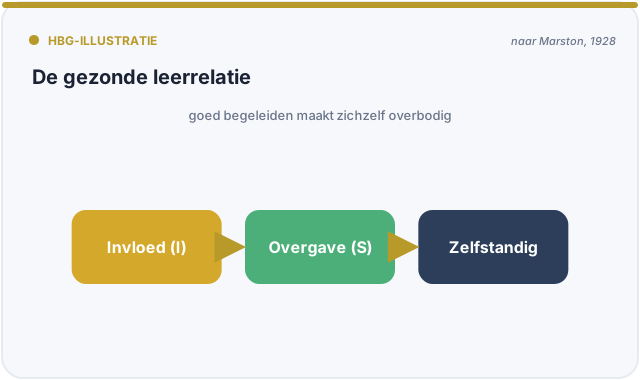
HBG-illustratie bij hoofdstuk XIII, Invloed en stabiliteit samen
HBG-illustratie · door HBG toegevoegd om dit hoofdstuk toegankelijk te maken. Geen onderdeel van Marstons origineel.

In het kort

Invloed en stabiliteit vormen samen de gezonde leerrelatie. De een neemt mee, de ander volgt met vertrouwen. Zo leren mensen zonder pijn.

Het mooiste idee: goed begeleiden maakt zichzelf overbodig. De leraar maakt de leerling zo sterk dat de leerling hem uiteindelijk gaat sturen. Het doel is geen blijvende controle, maar een blijvende bondgenoot.

Een kind dat zich actief overgeeft aan de bevelen van zijn moeder, plaatst zijn eigen bewegingszelf onder de sturende controle van de prikkels die de moeder oproept. Die controle bestaat er in de eerste plaats uit dat de moeder bepaalt welke delen van het bewegingszelf versterkt moeten worden. De oorzaak die het kind ertoe brengt de spieren van zijn greep aan te spannen, is dan het bevel van de moeder, niet het voorwerp dat wordt vastgepakt.

In dit hoofdstuk · 7 delen
  1. Teddy en het reisdeken
  2. Rust versus onrust
  3. Invloed en overgave horen bij elkaar
  4. Zo leer je zonder pijn
  5. Het recht verbiedt dwang tegen mensen

  6. Het recht in het zakenleven
  7. Leren volgens de wet
Deel 1 van 7

Teddy en het reisdeken

HBG-beeld bij Teddy en het reisdeken
HBG-toevoeging · samenvatting en beeld in onze stijl. Geen onderdeel van Marstons origineel.

In het kort, in onze taalMet een klein voorbeeld, een kind dat een deken helpt opvouwen, laat Marston zien hoe overgave en invloed samenwerken.

Teddy en het reisdeken

Houdt een baby een stok vast en wordt die stok in de tegengestelde richting getrokken, dan versterkt zijn bewegingszelf zich als antwoord op de prikkels van die tegenwerkende stok. Maar stel dat het kind een uiteinde van een reisdeken vasthoudt, dat het zijn moeder helpt opvouwen na een picknick op het strand. Het deken is zwaar, en de moeder moet er flink aan trekken om het glad te krijgen. Het kind heeft geen dominante instelling of primaire emotie tegenover het deken, en laat het daarom een stukje door zijn vingers glijden terwijl het gewicht en de trek van de moeder het in een richting bewegen die ingaat tegen zijn greep.

Hou het goed vast, Teddy, beveelt de moeder. En Teddy versterkt meteen zijn greep op het deken tot hij het hele gewicht draagt zoals gevraagd. Hier reageert het kind vrijwel volledig met een overgave-reactie op de moeder, en niet met een dominantie-reactie op het deken. Later leert Teddy misschien zijn dominante reacties te gebruiken om zijn overgave uit te voeren, dus dominantie plus stabiliteit, en dan zou hij wel een echte dominantie-reactie op het deken tonen, aangepast aan zijn overgave aan de moeder.

Deel 2 van 7

Rust versus onrust

HBG-beeld bij Rust versus onrust
HBG-toevoeging · samenvatting en beeld in onze stijl. Geen onderdeel van Marstons origineel.

In het kort, in onze taalStabiliteit geeft je systeem rust, invloed vraagt juist voortdurende inspanning. Ze vullen elkaar aan.

Dominantie plus stabiliteit geeft het organisme een rustend evenwicht

We kunnen aannemen dat de prikkels van het moederbevel, die in elk opzicht bondgenoot zijn van het bewegingszelf van het kind, tegelijk met de eigen tonische impulsen van het kind ontlading vonden over de banen naar de grijpspieren die het deken vasthielden. De toegenomen spanning in die spieren versterkt vervolgens langs reflexweg juist dat deel van de tonische ontlading dat naar diezelfde spieren terugloopt, deels doordat de spierreceptoren extra prikkeling geven bij toenemende spanning, deels via bijbehorende centrale versterkingsmechanismen. Dat verklaart, zo lijkt het, de actieve overgave, die daarmee de natuurlijke bondgenoot en aanvulling van de dominantie-reactie blijkt te zijn.

Het bewegingszelf van de persoon raakt tijdens de overgave-reactie op geen enkel moment uit zijn natuurlijke reflex-evenwicht in de sturing van het organisme. Toch kan de totale tonische ontlading zich vanbinnen herverdelen, met gepaste versterking en vermindering hier en daar, volgens de aanwijzingen van de overgave-prikkel. Om volledig bondgenoot te blijven van het bewegingszelf, is die prikkel wel gedwongen om steeds de meest harmonieuze en doelmatige aanpassing aan de hele omgeving voor te schrijven. Zo vervangt de overgave-prikkel eenvoudig de prikkels uit de omgeving die anders dominantie en conformiteit zouden oproepen, en zorgt hij voor een volmaakte aanpassing van het bewegingszelf, dat juist door zijn overgave aan die sterkere bondgenoot des te beter in zijn natuurlijke evenwicht blijft. Dit is een rustend evenwicht van het bewegingszelf, aangevuld en verzekerd door de sturende aanwezigheid van zijn meerdere bondgenoot.

Invloed vraagt juist een onstabiel evenwicht

Bij invloed is het beeld heel anders. Invloed is een reactie die de aanwezigheid van een bondgenoot binnenhaalt in bepaalde uitgekozen delen van het ontladingspatroon van het bewegingszelf. Invloed is geen rustende aanpassing aan de hele omgeving. Het bewegingszelf moet zelf zijn aanpassing aan de omringende dominantie- en conformiteitsprikkels tot stand brengen. Bovendien moet het zich op een verhoogd krachtsniveau handhaven, om de zwakkere bondgenote impulsen aanwezig te houden in juist die delen van het patroon waar ze gevangen en gestuurd moeten worden.

Kijk naar de moeder uit het voorbeeld, die met succes overgave opriep bij haar zoontje voor het opvouwen van het deken. De moeder merkte eerst dat haar zwakkere bondgenoot, Teddy, te zwak werd om zijn alliantie met haar in het gezamenlijke werk vol te houden. Haar taak was dus haar eigen bewegingszelf zo te vergroten en te herschikken dat de bondgenoot versterkt werd. Die vergroting en herschikking vond plaats toen ze het kind beval zijn greep te versterken. De rest van het opvouwen door moest ze zich op dezelfde manier voor Teddy blijven inspannen: aanwijzingen geven over de bewegingen die ze van hem wilde, en steeds toezien dat hij de juiste beweging op het juiste moment maakte.

De moeder moet haar kracht bovendien uitoefenen in overeenstemming met Teddy's organisme, niet alleen met dat van haarzelf. Een bevel om het deken met zijn tanden of voeten vast te houden zou zinloos zijn. En elke verslapping van de invloed zou Teddy's hulp meteen beeindigen, want hij reageerde op de moeder en niet op het deken zelf. In de moeder moet dus twee dingen gebeuren. Eerst moet haar bewegingszelf toestaan dat de zwakkere bondgenote prikkels die Teddy vertegenwoordigen, de delen van haar eigen ontladingspatroon uitkiezen waar prikkel en zelf elkaar voortdurend kunnen versterken. Ten tweede moeten de delen van haar bewegingszelf die die banen al bezetten worden versterkt, zodat de weerstand in de gedeelde banen genoeg daalt om de zwakkere bondgenote prikkels binnen te laten. Zolang die toestand aanhoudt, blijven de zwakkere prikkels bondgenoot in de gedeelde banen, maar alleen zolang het bewegingszelf zichzelf selectief in het vereiste patroon versterkt houdt.

Deze toestand van invloed is noodzakelijk onstabiel, door de voortdurende neiging van het bewegingszelf om terug te keren naar zijn natuurlijke rusttoestand en zo weg te vallen uit de tijdelijk aangenomen, selectieve verhoging die de zwakkere bondgenoten in captivatie houdt. De enige manier om de aanpassing van de moeder blijvend en stabiel te maken, is de bondgenote prikkels te versterken tot een niveau waarop ze niet alleen vanzelf in hun alliantie blijven, maar ook zelf de banen kunnen kiezen waar het bewegingszelf van de moeder verminderd moet worden.

Met andere woorden, het natuurlijke evenwicht van de moeder kan pas echt tot rust komen wanneer Teddy zijn deel van het opvouwen volmaakt heeft geleerd en bovendien zelf het initiatief kan nemen om de bewegingen van zijn moeder zo te sturen dat ze volledig met de zijne samenwerken. Dat betekent een omkering van de oorspronkelijke verhouding: nu geeft de moeder zich over en oefent het kind invloed uit. Vanuit de moeder gezien herstelt dit einde van de invloed, vervangen door overgave, niet alleen haar evenwicht, maar bereikt het ook blijvend waar de invloed naar streefde, namelijk een blijvende bondgenoot in die bezigheid.

Deel 3 van 7

Invloed en overgave horen bij elkaar

HBG-beeld bij Invloed en overgave horen bij elkaar
HBG-toevoeging · samenvatting en beeld in onze stijl. Geen onderdeel van Marstons origineel.

In het kort, in onze taalInvloed staat tot overgave zoals conscientieusheid tot dominantie: de een gaat vooraf, de ander volgt.

Invloed staat tot overgave zoals conformiteit tot dominantie

Als de voorgestelde mechanismen ongeveer kloppen, dan staat invloed tot overgave, wanneer ze na elkaar optreden, in dezelfde verhouding als conformiteit tot dominantie. Invloed kan alleen de sturende primaire emotie blijven zolang de invloed-prikkel uit de omgeving het organisme actief bezig houdt met het in alliantie houden van die prikkel. Stopt de invloed, en blijft het bewegingszelf op dezelfde bondgenote maar zwakkere prikkel reageren, dan neemt het vanzelf de toestand aan die het nauwst bij die prikkel aansluit, zonder nog moeite te doen de prikkel dichter naar zich toe te trekken. Dat is passieve overgave. De bondgenote prikkel heeft dan genoeg macht om het bewegingszelf in een door de prikkel bepaald patroon te trekken, maar niet genoeg om het binnen dat patroon actief te laten handelen. Actieve invloed wordt dus vanzelf gevolgd door overgave.

Slaagt de invloed wel, zoals bij de moeder die haar kind stuurde, dan roept juist dat volledige succes onmiddellijk daarna een houding van actieve overgave op. Invloed heeft namelijk als uiteindelijk doel de bondgenote prikkel zo te versterken dat die sterker wordt dan het bewegingszelf in plaats van zwakker. Denk aan het aangeboren gedrag dat Watson beschrijft, waarbij de baby handen of voeten uitsteekt om prikkeling uit te lokken, of spontaan zijn moeder omhelst als uitnodiging om door te gaan met aaien. Zo is de invloed erop gericht de bondgenote prikkel zo te versterken dat het kind zich er opnieuw aan kan overgeven.

Deel 4 van 7

Zo leer je zonder pijn

HBG-beeld bij Zo leer je zonder pijn
HBG-toevoeging · samenvatting en beeld in onze stijl. Geen onderdeel van Marstons origineel.

In het kort, in onze taalOnderwijzen is invloed plus overgave. Leren via verbinding is prettig, leren met vallen en opstaan doet pijn.

Onderwijzen is invloed plus overgave

Elk onderwijs dat de kennis of het kunnen van een leerling wil vergroten, mikt uiteindelijk erop dat de leerling, zodra hij genoeg heeft geleerd, zelf de leraar kan vragen om precies die verdere uitleg die het best bij zijn eigen behoeften en gaven past. De vaardige leraar oefent alleen zoveel aanvankelijke invloed uit als nodig is om de leerling op een niveau te brengen waarop de leraar zich doeltreffend aan hem kan overgeven. Zo bestaat de inleidende cursus, althans in Amerika, vooral uit hoorcolleges en voorgeschreven aanwijzingen om de basistechniek van een vak onder de knie te krijgen. De meest gevorderde cursussen in datzelfde vak bestaan vooral uit werkgroepen en onderzoek, waarin de student eigen onderzoek doet of eigen theorieen uitwerkt, en de hoogleraar en medestudenten alleen om hulp en kritiek vraagt op de punten waar dat nodig is.

Kijken we naar de sturende emoties van de student, dan zien we dat de kenniszoeker eerst enige invloed op de leraar moest uitoefenen voordat die instemde met het geven van onderwijs. Die eerste invloed was betrekkelijk kort: het betalen van het lesgeld, het regelen van de aanmelding en inschrijving, en misschien het vragen van de persoonlijke toestemming van de hoogleraar. Maar als die korte invloed slaagde, maakte ze de hoogleraar meteen sterker dan de student, waardoor de docent invloed kon uitoefenen en de student zich kon overgeven gedurende de hele studieperiode. De hele reeks van reacties ziet er dan zo uit.

Ten eerste, de student beweegt de hoogleraar hem toe te laten tot de cursus. Ten tweede, de hoogleraar geeft zich over aan die invloed door hem aan te nemen. Ten derde, de hoogleraar beweegt de student tot het voorgeschreven werk. Ten vierde, de student geeft zich over door dat werk te doen. Ten vijfde, in gevorderde cursussen beweegt de student de hoogleraar tot bijzondere hulp bij zijn eigen vraagstukken. Ten zesde, de hoogleraar geeft zich over door die hulp te geven. Ten zevende, de student geeft zich over door zijn aanpak aan te passen. In deze reeks, en ook in de reeks van babygedrag, vallen twee dingen op. Ten eerste vervangt overgave uiteindelijk altijd de invloed. Ten tweede werkt invloed als kiezende kracht die de aard en sterkte van de erop volgende overgave bepaalt.

Leren via invloed en overgave is prettig, leren met vallen en opstaan is pijnlijk

De juiste verhouding tussen invloed en overgave is voor het hele organisme uiterst belangrijk en heilzaam. Op deze manier kan het organisme leiding en hulp zoeken bij mensen die op een bepaald punt verder ontwikkeld zijn. Daarna kan het zich overgeven aan de gegeven onderwijzing zodra die verder ontwikkelde persoon is bewogen om alle leiding te geven die nodig is. Juist met dit mechanisme, dat overgave en invloed in de juiste verhouding samenbrengt, bereiken mensen, en in mindere mate dieren, zonder lijden dezelfde of betere resultaten dan met de harde weg van afgedwongen conformiteit gevolgd door compenserende dominantie. Die tweede manier van leren heet ervaring, of leren met vallen en opstaan.

Zonder invloed en overgave zou het toch al grote lijden van mens en dier onvoorstelbaar toenemen. Elke aangeleerde conformiteit naar hevigheid brengt tijdens het leren een zekere onvermijdelijke onprettigheid of pijn met zich mee. De dominantie die daarop moet volgen om die afgedwongen conformiteit te compenseren, is vaak nog heviger onprettig dan de conformiteit zelf. Tegenover die dubbele dosis onprettigheid bij de weg van conformiteit en dominantie staat het mechanisme van invloed en overgave, dat het vereiste kunnen zelfs doeltreffender kan bijbrengen, met een dubbele dosis prettigheid bij het leren.

Invloed en overgave kunnen, in de juiste verhouding, het hele leerproces een aanhoudend prettige achtergrond geven. Conformiteit naar hevigheid, aangeleerd in de zogenoemde strijd om het bestaan en onder de regel van het overleven van de sterkste, gaat meestal gepaard met werkelijke vernietiging van belangrijke delen van lichaam en bewustzijn van de lerende. Vrijwel alle onprettige, afwijkende gevoelens van de kindertijd, en de verwrongen, overdreven reacties van overconformiteit en overbodige dominantie die iemand later naar de arts of psychiater brengen, kunnen gezien worden als verwondingen opgelopen bij het leren via afgedwongen conformiteit. Leren via invloed en overgave brengt daarentegen nooit letsel of functieverlies aan lichaam of bewustzijn met zich mee, mits invloed en overgave in de juiste verhouding blijven. Heeft de gekozen leraar een verkeerde of gebrekkige kennis, dan kan de student, na het aanleren van diens foute techniek, alsnog schade oplopen bij het toepassen ervan, dus bij het bewerken van de omgeving met ontoereikend gereedschap. Maar dan lag de fout in de verkeerde keuze van leraar, terwijl het letsel zelf weer optreedt tijdens conformiteit en dominantie die de vermeende kennis probeert te gebruiken.

Deel 5 van 7

Het recht verbiedt dwang tegen mensen

HBG-beeld bij Het recht verbiedt dwang tegen mensen
HBG-toevoeging · samenvatting en beeld in onze stijl. Geen onderdeel van Marstons origineel.

In het kort, in onze taalMarston ziet zijn model terug in het recht: dwang tegenover mensen is verboden, invloed en overgave zijn de norm.

Het recht verbiedt dominantie tegenover mensen

Je kunt de normale reacties van mensen op andere mensen scherp onderscheiden van hun reacties op de levenloze voorwerpen van de natuur, door het verschil te zien tussen prikkels die conformiteit en dominantie oproepen en prikkels die overgave en invloed oproepen. De hele grondslag van de beschaving, met haar wetten en sociale instellingen, blijkt te rusten op een verbod op conformiteit en dominantie tegenover mensen, en op een verplichting tot invloed en overgave in alle sociale verhoudingen. Het gewoonterecht, de bron van het Engelse en Amerikaanse recht, probeert met zijn strafrecht het gebruik van dominante dwang in zakelijke en economische verhoudingen tussen mensen te voorkomen. Onbeteugelde dominantie mag volgens dit recht alleen door de staat zelf worden uitgeoefend, en die staat handelt, althans in theorie, in overgave aan de hoogste behoeften van het grootst mogelijke deel van zijn burgers wanneer hij hen tot conformiteit dwingt.

De grondwet van de Verenigde Staten bevat de bekende bepaling dat geen burger van leven, vrijheid of het streven naar geluk mag worden beroofd zonder eerlijke rechtsgang. In termen van primaire emoties beschermt dit tegen conformiteit naar hevigheid, zowel wanneer medeburgers die dominantie zouden willen uitoefenen als wanneer de agenten van de staat dat zouden proberen. De mens heeft een aangeboren recht om niet tot dominante conformiteit te worden gedwongen door welke andere mens dan ook, behalve als straf voor eenzelfde daad tegen een medeburger. Bekentenissen die met marteling of geweld zijn verkregen, zijn in theorie niet toelaatbaar in de rechtszaal. De politie mag gehoorzaamheid niet afdwingen met zoveel geweld dat het conformiteit afdwingt, tenzij zijzelf of andere burgers met soortgelijk geweld worden bedreigd.

Ook ouders en leraren mogen van de wet geen conformiteit afdwingen bij een koppig kind met zoveel pak slaag dat het gehoorzaamt. Het kind moet voor de rechter komen, en die mag het in toom houden maar niet slaan. Legt de ouder toch lijfstraf op die zwaar genoeg is om conformiteit af te dwingen, dan is het vaak de ouder die op beschuldiging van wreedheid voor de rechter komt. Dit verbod op dwang via dominantie gaat zelfs zo ver dat het ook verboden is bij het africhten of behandelen van dieren. Vrijwel alle Amerikaanse staten stellen straf op dierenmishandeling.

De mens mag niet alleen zijn medemens niet met dezelfde dominantie behandelen die tegenover levenloze voorwerpen wordt aangemoedigd, hij mag in handel en verkeer ook geen misbruik maken van bepaalde dwang die natuurkrachten op andere mensen uitoefenen. De Amerikaanse Sherman Anti-Trust Act verbiedt bepaalde afspraken die de handel beperken. Die wet erkent dat dominantie ook indirect op het publiek kan worden uitgeoefend, door een groep die het monopolie op een noodzakelijk goed heeft verkregen. Kan een trust dat goed opkopen en de prijs op een woekerbedrag vastzetten, dan kunnen de wetten van het menselijk organisme grote aantallen mensen dwingen die uitgeperste prijs te betalen.

Het vaststellen van maximumprijzen voor voedsel, huur en kleding door de overheid werd tijdens de wereldoorlog een aanvaard rechtsbeginsel. Ook daar zien we de bescherming van mensen tegen lichamelijke dwang, zelfs wanneer die dwang wordt uitgeoefend door hun eigen lichaam, door het klimaat of door andere tegenwerkende natuurkrachten, en vervolgens wordt uitgebuit door winstbeluste medemensen. Zelfs de mate waarin de staat zelf dominante dwang op een overtreder mag uitoefenen, wordt nu ingeperkt door menselijker opvattingen en wetten. De doodstraf, waarvan de gedachte is dat de dreiging van volledige vernietiging de sterkst mogelijke dwang op toekomstige moordenaars uitoefent, wordt in de Verenigde Staten afgeschaft. Martelingen en wrede, ongebruikelijke straffen zijn allang uit het Amerikaanse recht verdwenen, als methoden die de staat niet mag inzetten om conformiteit af te dwingen, voor noch na een veroordeling.

Deel 6 van 7

Het recht in het zakenleven

HBG-beeld bij Het recht in het zakenleven
HBG-toevoeging · samenvatting en beeld in onze stijl. Geen onderdeel van Marstons origineel.

In het kort, in onze taalOok het handelsrecht rust op de juiste volgorde van invloed en overgave.

Het recht handhaaft de verhouding invloed en overgave in het zakenleven

Ook in het handelsrecht, waaronder het overeenkomstenrecht en het kooprecht, blijkt de grondslag te rusten op stilzwijgende erkenning van de juiste, natuurlijke verhouding tussen opeenvolgende invloed en overgave. Het gewoonterecht eist in het algemeen dat levering van goederen of betaling van geld voortvloeit uit een overeenkomst daartoe, of uit een werkelijke verrijking van de ene partij ten koste van de andere, mits die verrijking is aanvaard. In termen van primaire emoties werkt dat zo. Verkoper A beweegt koper B om zich aan A over te geven door een bepaald bedrag te betalen voor goederen die A later zal leveren. De wet eist natuurlijk niet dat A B beinvloedt, of dat B zich overgeeft. Maar zodra B zich aan A heeft overgegeven, eist de wet dat A B's betaling opvat als een invloed-prikkel waarop A moet reageren met overgave, namelijk het leveren van de goederen. Deze wettelijk afgedwongen volgorde is juist de integratief correcte. A's invloed is geslaagd, dus moet hij die laten volgen door overgave aan de persoon die hij zelf tot een geschikte overgave-prikkel heeft gemaakt. Het is opmerkelijk dat de beginselen van de primaire emoties al zo fijn in het recht waren vastgelegd, honderden jaren voordat die emotiemechanismen zelf werden voorgesteld.

Geeft A zich helemaal niet over aan B, die A tot een geschikte overgave-prikkel heeft gemaakt, en blijkt dat A dat ook nooit van plan was voordat hij B bewoog, dan zou zowel het Engelse als het Amerikaanse recht A waarschijnlijk schuldig achten aan het onder valse voorwendselen verkrijgen van goederen. Was A wel te goeder trouw van plan zich over te geven, maar werd hij verhinderd door omstandigheden buiten zijn macht, dan kan B alleen een civiele vordering tegen A's bezit instellen, geen strafzaak tegen A's persoon. Ook hier klinkt het juiste onderscheid door tussen reacties op dingen en op personen. Heeft A B niet als een ding behandeld, dan helpt de staat B niet om A op dezelfde wijze te straffen. Maar A wordt geacht zijn voorrang op het ding dat hij bezit te hebben verspeeld doordat hij dat bezit niet naar behoren voor B heeft beheerd. B mag dan, via de overgave-verhouding die A op zich heeft genomen, de zaken die A bezit dwingen zich naar B te voegen zoals A had beloofd.

Er zijn strikte grenzen aan hoe volledig A's overgave met zijn invloed moet overeenstemmen. De regel koper, wees op uw hoede komt voort uit het geval waarin B, de bewogen partij, meer overgave aanbiedt dan redelijkerwijs aan A's oorspronkelijke invloed valt toe te schrijven. A zegt: ik heb het wonderbaarlijkste horloge ter wereld te koop. Hij toont B het horloge en doet daarbij overdreven uitspraken over de kwaliteit ervan. Zulke invloed kan volgens de wet op zichzelf niet de overgave oproepen om een woekerprijs te betalen die past bij het verkooppraatje, want B wordt geacht met gemengde emoties te handelen, waaronder dominantie, en wordt niet geacht toe te geven aan de volle kracht van A's invloed, tenzij het aangeboden voorwerp B zelf tot dominantie prikkelt, en de opgewekte begeerte de gevraagde prijs rechtvaardigt. Zo erkent de wet opnieuw dat begerige dominantie een juiste, prijzenswaardige reactie op dingen is, terwijl ze tegelijk een correcte volgorde van invloed en overgave eist in de menselijke verhoudingen die bij de handel in dat levenloze ding ontstaan.

Deel 7 van 7

Leren volgens de wet

HBG-beeld bij Leren volgens de wet
HBG-toevoeging · samenvatting en beeld in onze stijl. Geen onderdeel van Marstons origineel.

In het kort, in onze taalHet recht erkent invloed plus overgave als de gezonde manier om te leren en te vormen.

Het recht erkent invloed plus overgave als de juiste manier van leren

Ten slotte is het aardig te zien dat de wet in aanzienlijke mate de waarde erkent van verhoudingen van invloed en overgave tussen bepaalde groepen mensen van vermoedelijk rijpere ontwikkeling en andere, minder ontwikkelde groepen. Via de verhouding van invloed en overgave is immers allerlei leren mogelijk zonder het lijden dat onvermijdelijk is in de school van de ervaring, waar dominantie en conformiteit heersen. Het gewoonterecht voorziet, klaarblijkelijk op dit beginsel gebaseerd, in allerlei verhoudingen die juist deze manier van vorming en bescherming vereisen. Zo'n verhouding heet in het recht een status. De rechten die bij een status horen, ontstaan niet uit losse afspraken van invloed en overgave tussen de betrokkenen, maar uit de status zelf, en ze zijn tamelijk vast en blijvend tot de status wordt ontbonden.

Een kind onder de wettelijke leeftijd heeft volgens het gewoonterecht de status van minderjarige. Tegenover een minderjarige moeten de ouders of voogden reageren met allerlei vormen van invloed en overgave. Ze moeten het kind bewegen naar school te gaan, de wet te gehoorzamen, voldoende goed voedsel te eten, gezond te blijven en zich zo te gedragen dat het de aanvaarde fatsoensregels van de gemeenschap niet schendt. Al die van de ouders geeiste reacties zijn eenvoudige vormen van invloed. Het kind moet zich op zijn beurt aan de bevelen van zijn ouders overgeven op al die punten. Het moet zich ook overgeven aan diverse anderen die tegenover hem invloed uitoefenen, zoals zijn leraren, de gemeentearts en de gezondheidsdienst. Bereikt de minderjarige de wettelijke leeftijd van zestien, achttien of eenentwintig jaar, dan houdt zijn overgave-status tegenover ouders en anderen op, net als hun status van vereiste invloed.

Andere gevallen waarin de wet een status van invloed en overgave vastlegt, zijn die tussen politie en burgers, tussen een land en zijn burgers, tussen man en vrouw, al worden in die laatste status tegenwoordig vrijwel gelijke vormen van invloed en overgave van beide partijen gevraagd, en tussen gevangenisbewaarders en gevangenen. Het is bijzonder dat de beginselen van het recht, die zich vrijwel zonder hulp van de wetenschap hebben ontwikkeld, zo nauwkeurig de grondbeginselen van invloed en overgave tussen mensen weerspiegelen. Deze wettelijke verhoudingen kunnen, goed gebruikt, zowel volwassenen als kinderen vormen via de weg van invloed en overgave, de enige normale weg voor menselijk leren. Wie op een bepaald punt minder ontwikkeld is, wordt door de wet zo verbonden met wie vermoedelijk verder ontwikkeld is, dat het onvermijdelijke lijden van het overleven van de sterkste wordt vermeden, of althans verzacht.

Waar wij afwijken van Marston: Marston koppelt zijn hele betoog aan het Angelsaksische recht van de jaren twintig, met voorbeelden als de doodstraf, monopolievorming en de toen scherp verschillende status van man en vrouw. Wij nemen zijn kernidee over, dat gezonde samenwerking rust op invloed en overgave in plaats van dwang, maar niet zijn juridische en maatschappelijke aannames van die tijd. Het beeld dat wetgeving zonder meer de natuurlijke werking van emoties weerspiegelt, zien wij als een idee van zijn eeuw, niet als bewijs.

Bron en verantwoording

Controleer dit hoofdstuk aan de bron

Deze hertaling volgt hoofdstuk XIII van Emotions of Normal People (William Marston, 1928, publiek domein). Hieronder lees je de volledige originele Engelse tekst van dit hoofdstuk, met de oorspronkelijke paginanummers, zodat je alles kunt nalezen en verifieren. Je kunt ook de volledige woordgetrouwe Nederlandse vertaling en het Engelse origineel downloaden.

De woordgetrouwe NL-vertaling, het Engelse origineel, de HBG-versie en Marston 2.0 zijn gratis te downloaden zodra je een HBG-account aanmaakt en je e-mailadres bevestigt. Zo blijft dit gedachtegoed beschikbaar voor iedereen die er echt mee aan de slag wil.

Lees de originele Engelse tekst van hoofdstuk XIII · Marston, 1928
Dit is de oorspronkelijke Engelse tekst zoals Marston die in 1928 schreef, inclusief de originele paginanummers. Onze Nederlandse hertaling hierboven volgt deze tekst getrouw. Zo is elke passage terug te leiden naar de bron.

IT is evident that a child, in actively submitting to its mother's commands/^ must place its motor self under the iiitegrative control of motor stimuli evoked by the mother. This control consists, in the first place, of dictation by the mother as to which parts of the motor self shall be reinforced. That is to say, the determining cause which influences the child to reinforce the motor discharge innervating his grasping muscles

pagina 428

will consist of the mother's command rather than the object which is grasped. If the infant is grasping a rod and the rod is pulled in a direction opposite to the child's grasp upon it, his motor self reinforces itself as a response to motor stimuli evoked by the antagonistic moving of the rod. Let us suppose, on the other hand, that the child is holding one end of a steamer rug, which he is helping his mother to fold after a picnic on the beach. The rug is heavy, and the mother must exert a considerable pull on her end of the rug in order to straighten it out. The child, having no dominant set, or primary emotional response toward the rug, allows it to slip a little way through his fingers, as the weight of the rug and the mother's pull upon it move it in a direction antagonistic to his grasp.

" Hold it tight, Teddy," commands the mother. And Teddy immediately reinforces his grasp upon the rug until he supports its entire weight in the manner required. In this case the child responds almost exclusively with a submission response to the mother, rather than with a dominance response toward the rug. Later, of course, Teddy may learn to use his dominant responses to carry out submission reactions (D -f S), in which case Teddy would express a true dominance response toward the rug adapted to his submission response to the mother.

pagina 429

D + S Gives Organism a Resting Balance

We might suppose in this instance, that the motor stimuli evoked by the mother's command, being in jevery respect allied with the motor self of the child, were able to gain motor discharge simultaneously with the child's own tonic impulses over the efferent paths leading to the grasping muscles which held the rug. The increased tension of these muscles which follows, would reflexly reinforce the particular portion of the tonic motor discharge leading back to the rug-grasping muscles, both through the operation of the muscular proprioceptors giving additional stimulation when the tension of the muscles increases, and also through corresponding centra] reinforcement mechanisms. This would account adequately, it seems, for active submission responses which would thus appear to be the natural ally of, and complement to dominance reactions.

The motor self of the subject would not, at any time during submission response, be thrown out of its natural reflex balance in control of the organism. Yet within itself, the total tonic discharge might be redistributed with appropriate partial reinforcement and dimunition according to the dictates of the submission stimulus. This stimulus, in turn, in order to remain in complete alliance with the motor self would be compelled to dictate to the motor self the most harmonious and efficient adjustment possible to the total environment. Thus the submission stimulus would simply supplant the environmental stimuli to dominance, and compliance, in evoking perfect adjustment of the motor self to the total environmental stimulus situation, the motor self remaining in its natural or normal balance more effectively by virtue

pagina 430

of its submissive relationship to the submission stimulus. This integrative condition would represent, then, a resting balance of the motor self, supplemented and made secure by the directing presence of its superior ally.

Inducement Response Requires an Unstable State of Reflex Equilibrium

With regard to inducement response, the integrative picture must be quite different. Inducement is a type of reaction which seems to procure the presence of an ally within certain selected portions of the total discharge pattern of the motor self. Inducement is not, primarily, a resting adjustment of the motor self to total environment. The motor self must bring

about its own adaptation to surrcxinding dominance and compliance stimuli. It must also maintain itself at an increased level t of strength, in order to secure the continued presence of the weaker, allied impulses in those portions of the tonic motor discharge pattern where the allied impulses are to be captured and controlled.

Let us attempt to reconstruct the integrative situation which must obtain within the organism of the mother, who in the submission incident just analysed, induced submission successfully from her small son with respect to the folding up of a rug. The mother in that instance first observed that her weaker ally, Teddy, was growing too weak to maintain his alliance with her in their joint project. Her problem, then, was one of increasing and rearranging her own motor self in

pagina 431

such a way that the ally might be strengthened. This increase and rearrangement of strength took place when the mother commanded her child to strengthen his grip on the rug. Throughout the remainder of the process of folding the rug, the mother must similarly have continued to exert herself on Teddy's behalf, to the extent of issuing instructions as to the movements she wished the child to make, together with a continuous supervising attitude, making sure that Teddy was performing the appropriate movement at the proper time.

The mother must, moreover, exert her power upon Teddy in accordance with Teddy's organism, as well as her own. A command, for example, directing the child to ftold the rug with his teeth or with his feet would be futile. Again, any relaxation of the influence exerted upon Teddy would bring his assistance to an end, since he was responding to the mother and not to the rug itself. First then, within the mother's own organism, her motor self must permit the allied, weaker, motor stimuli representing Teddy, to select those parts of her own total motor discharge pattern wherein motor stimuli and motor self may continuously reinforce one another. Secondly, the parts of the mother's motor self already occupying these paths must be strengthened, in order to reduce the resistance in the common paths sufficiently for the weaker allied motor stimuli to enter them. \Vhile this condition persists, the weaker motor stimuli would be kept as allies in the common paths; but only so long as the motor self keeps itself selectively reinforced in the requisite pattern.

This integrative condition of inducement response must be an

pagina 432

unstable one due to the constant tendency on the part of the motor self to return to its natural resting state or equilibrium, thus lapsing from its temporarily assumed, selective increase, which alone holds the weaker allied impulses in a state/)f captivation. The only way in which the mother's integrative adjustment could be made permanent, or stable, would be through the strengthening of the allied motor stimuli to a level where they would not only remain in their present state of alliance without assistance, but also would be able actively to select the paths of alliance wherein the mother's motor self should be decreased or diminished.

In other words, the mother's natural reflex equilibrium could not be restored to a completely resting, or balanced condition, until Teddy had learned to perform his part of the rug-folding process perfectly, and was further able to take the initiative in directing his mother's movements so that they would co-operate completely with his own. This, of course, would constitute a reversal of the initial relationship between mother and child, with the mother submitting and the child inducing. Looked at from the point of view of the mother, this termination of inducement response by supplanting it with submission would not only restore her integrative equilibrium to its natural, or resting state, but it would also accomplish in a permanent way the need for which the inducement response was striving; namely, the acquiring of a permanent ally in tfiat particular undertaking.

/ is to S as C is to D

If the suggested mechanisms by which inducement and

pagina 433

submission responses are brought about are approximately accurate, then inducement bears the same relationship to submission, when the two occur successively, that compliance bears to dominance response. Inducement can persist as the controlling primary emotional response of the organism only so long as the environmental inducement stimulus keeps the organism actively engaged in holding the stimulus in allied relationship. When this inducement reaction stops, the motor self, if it continues to react to the same environmental stimulus, which is allied, though weaker than itself, will automatically assume the state of adjustment most closely allied with the environmental stimulus as it then is, without any

effort to bring the stimulus into closer alliance with itself. This condition would constitute a stale of passive submission response. The allied stimulus, in such a case, would possess sufficient powe^r to attract the motor self into a pattern determined by the stimulus; but it would not exert sufficient power over the motor self to compel it to perform actively within that pattern. Active inducement response, therefore, tends to be followed automatically by submission.

If, on the other hand, inducement is successful, as in the instance of the mother directing her child in folding the rug, the complete success of the inducement response itself would tend to bring about an attitude of active submission immediately following ttye successful inducement. Inducement response contemplates, as its ultimate purpose, the increasing of the

pagina 434

strength of the allied stimulus to such a degree that it will become superior in strength to the motor self, rather than inferior to it. Consider, for example, the unlearned child behaviour reported by Watson wherein the infant extends its feet or hands to invite stimulation, or spontaneously hugs its mother as an inducement to her to continue petting the child. In such cases the inducement response is designed to increase the strength of the allied stimulus to a point where the child may submit once more to the stimulus thus increased.

Teaching is I + S

Any teaching which has for its purpose the increasing of a student's own knowledge or ability to deal successfully with a certain type of subject matter tends to bring about the ultimate result that the student, when he has increased his knowledge sufficiently, will be able to call upon the teacher for such further instruction as may be best suited to the student's principal needs and abilities. The skilful teacher exercises only sufficient initial inducement to raise the pupil to an intellectual strength where the teaoher can submit to him effectively. Thus, we find the elementary college course, in America at least, consisting largely of lectures and arbitrary instructions to the student as to required procedures necessary to master the elementary technique of a given subject. The most advanced courses in this same field will be found to consist largely of seminars and research work, in which the student undertakes original investigations or theoretical expositions of his own devising, calling upon the professor and upon his

pagina 435

fellow students for help and criticism at the points where such assistance is needed.

Again, if we consider the student's controlling emotional responses in the behaviour mentioned, we discover that the seeker after knowledge has been obliged to offer inducement of some sort to the teacher, before the latter agreed to undertake the instruction of the student at all. This first inducement response on the part of the prospective student was a comparatively brief one, possibly consisting of paying the requisite fee to the college, arranging the proper application and registration for the course in question, and perhaps, asking the professor's personal consent to the student's enrolment in that course. This brief inducement behaviour, Jiowever, if successful, resulted immediately in an increase in the strength of the professor as compared to the student, which enabled the instructor to induce and the student to submit throughout the academic period set for the study in question. Thus the total series of prevailing responses, in this type of behaviour, might be listed thus :

(1) Student induces professor to accept student's enrolment in the professor's course.

(2) Professor submits to student's inducement by accepting him as requested.

(3) Professor induces student to follow certain mental behaviour prescribed as work in the course.

pagina 436

(4) Student submits by performing this work.

(5) Student, in advanced courses following, induces professor to give special assistance in student's own problems.

(6) Professor submits by giving help required.

(7) Student submits by altering his methods accordingly. In the above series of inducement-submission responses,

as also in the series of infantile inducement responses before mentioned, two aspects of the relationship between inducement and submission might be noted. First, submission in all cases eventually supercedes inducement. Secondly, inducement responses act as selective agents determining the nature and strength of the submission responses which follow.

Learning by I 4- S is Pleasant; Learning by Trial and Error

(C + D) is Painful

The proper relationship between the primary emotional responses of inducement and submission, as analysed above,

zw EMOTIONS OF NORMAL PEOPLE

is a 'most important and beneficial one to the organism as a whole. By this method, the organism is permitted to seek guidance and help from persons more developed in some particular than the subject. The subject, thereafter, is enabled

pagina 437

to submit to the instruction imposed, or assistance given, as soon as the more highly developed person has been induced to give all the leadership required by the subject. It is by this emotional mechanism, combining in proper relationship the responses of submission and inducement that human beings and animals, to a lesser extent, are enabled to accomplish without suffering the same or better results than those attained by the harsh method of compulsory compliance, followed by compensatory dominance. The latter method of learning is known as " experience ", or " the trial and error method ".

Without inducement and submission responses, the pain and suffering of human and animal life, great as it already is, would be inconceivably increased. Every acquired response of compliance with intensity entails a certain amount of inevitable unpleasantness or suffering while it is in the process of being learned. The dominance response, moreover, which must follow and counteract this enforced compliance, is often more intensely unpleasant than was the original compliance. In contrast to this double dose of unpleasantness, experienced in learning by the C -f D method, we find, in the inducementsubmission mechanism, a possible method for acquiring the requisite action ability even more effectively, so far as ewl result goes, with a double dose of pleasantness attached to the process of learning.

Both inducement and submission responses, when, in the proper relationship one to the other as analysed above, are capable of rendering sustained pleasantness of motation as a background to the entire learning process. Compliance with

pagina 438

intensity responses acquired by animals and human males in the course of the " struggle for existence ", and under the rule of " survival of the fittest ", usually entail positive destruction of important portions of the learner's body and consciousness. Nearly all the unpleasant, abnormal feelings of childhood, and the perverted and exaggerated reactions of over compliance and needless dominance which eventually lead to the office of a physician or psychiatrist in adult life, may be classed as injuries received in the process of learning by the compulsory compliance method. Learning by the

inducement submission method, on the other hand, never entails injury or loss of function to body or consciousness, provided only that inducement and submission responses are kept in proper relationship one to the other. If the teacher selected for learning by inducement-submission method possesses an erroneous or inadequate knowledge of his subject, the student, after learning the teacher's faulty technique, may suffer injury in attempted application of his false knowledge, that is, in trying to manipulate the environment with inadequate tools. But in that case, though a wrong choice of inducer was originally at fault, the actual injury is suffered as before, in the course of compliance and dominance behaviour which attempts to utilize the supposed knowledge.

Anglo-American Law Forbids Use of Dominance Toward Human Beings

pagina 439

It is possible to differentiate sharply between the normal reactions of human subjects to other human beings, and the normal reactions of human subjects to the inanimate objects of nature, by discovering the difference between environmental stimuli adequate to compliance-dominance responses, and environmental stimuli adequate to submission-inducement reactions. 1 It can be shown that the basis of civilization, including its laws and all its social institutions, rests upon a prohibition of the use of compliance-dominance behaviour toward kuman beings, and compulsory use of inducementsubmission behaviour in all social relationships. The common law, which has been the source of English and American jurisprudence, attempts, by its law of crime and punishment, to prevent the use of dominant compulsion in business and economic relationships between human beings. Unrestrained dominance can only be exercised over human beings, according to common law principles, by the state itself; and the state in thus compelling its citizens to comply with its intensity is acting, at least theoretically, in submission to the highest needs of the greatest possible proportion of those human beings who constitute its citizenry.

The constitution of the United States, embodying this principle, contains the well known provision that no citizen

1 The author has in preparation a volume dealing with problems of social psychology, based upon this differentiation between responses to people and reactions to things.

pagina 440

shall be deprived of life, liberty, or f the pursuit of happiness " without due process of law ". In terms of primary emotional responses, this protects from compliance with intensity, not only when their fellow citizens might attempt to exercise such dominance over them, but also in case the agents of the state itself should attempt to do so. The individual human being is conceived of as possessing an inherent right not to be made to comply with dominant intensity imposed upon him by any other human being, except as a punishment for having committed a similar act against some other citizen. Confessions obtained by torture and physical violence are not admissible, theoretically at least, in court proceedings. Police are not permitted. by law to compel obedience to their commands by direct imposition of physical attack of sufficient intensity to compel compliance, unless they themselves or some other citizens are threatened with similar violence by an offender against the peace of the community.

Parents and teachers are not allowed by law to compel compliance from unruly children by whippings of sufficient intensity to enforce compliance upon a stubborn child. The child must be brought to court, and the court may restrain, but cannot whip the child. If the parent does impose physical punishment of intensity sufficient to compel compliance from the child, it is frequently the parent who is brought to court on criminal charges of cruelty to the child. This provision against compulsion by dominance is evep carried to the point of forbidding the use of this method in the training or treatment of animals. Statutes in nearly all American states provide criminal penalties for "cruelty to animals ".

Not only is man, under the common law, prohibited from

pagina 441

responding to his fellow man with the same dominance response that he is encouraged to use against inanimate objects, but also, in matters of commerce and trade, he is forbidden to take full advantage of certain dominant compulsions which forces of nature may exert upon other human beings. The United States' statute called the Sherman Anti- Trust Act, forbids certain " combinations in restraint of trade ". This federal statute recognizes that dominance may be exerted upon the public indirectly, by a group of people who have obtained a monopoly of a certain commodity which has become necessary to the comfort and well-being of the community. If some " trust " is able to corner this commodity

and fix the price upon it at an exhorbitant figure highly profitable to itself, the psycho-physiological laws oi the human organism may compel large numbers of people to pay the extortionate price demanded.

Maximum price fixing on food, rentals, ancf clothing, by government regulation, became a well accepted legal principle during the world war. There, again, we find recognized the principle of protecting human beings against physical compulsion, even when such compulsion is actually exercised by their own bodies, by the climate, and by other antagonistic forces of the environment, and is subsequently taken advantage of by profiteering fellow humans. Even the extent to which the state can go in exercising dominant compulsion upon an offender against its laws is now being limited by humane public opinion and legislative enactment. Capital punish-

pagina 442

ment, the theory of which is that threat of complete destruction will exercise the maximum possible dominant compulsion upon prospective killers, is being abolished in the United States. Tortures, and " cruel and unusual punishments " have long been abolished by American law, as methods which the state may not employ to compel compliance, either before or after conviction for a crime.

Common Law Enforces the I + S Relationship in Business

Following our analysis of common law principles into the field of Commercial law, including the law of contracts, and the law of sales, we find that the basis of business law appears to rest upon taci t recognition of the proper and normal relationship between successive inducement and submission responses. Common law, in general, requires that delivery of goods, or payment of money must follow either a contractual agreement to make such delivery or payment, or an actual enrichment of one party to the proceeding at the expense of the other party, if such enrichment is accepted by the person enriched. In terms of primary emotions, the legal principle of contract and sale reveals itself as follows : The seller A, induces the buyer B, to submit to A by paying over a certain sum of money for goods which A is to deliver to B at a subsequent date. The law does not, of course, require that A shall induce B, or that B must respond by submitting to A's inducement. But once B has responded by submitting to A, the law requires that A must regard B's payment as an inducement stimulus, to

pagina 443

which A must respond by submission consisting of delivering over the goods in question. We have already noted that this legally enforced succession of inducement-submission responses is the integra^tively correct one. A's inducement having been successful, he must follow his inducement by a submission response to the individual whom he himself has made into an adequate submission stimulus to himself. It is curious indeed that the integrative principles of primary emotions should be found thus deftly formulated into the principles of jurisprudence, hundreds of years before the primary emotion mechanisms themselves were suggested.

If the subject, A, fails completely to submit to the person B, whom A has indeed induced into becoming an adequate submission stimulus to himself, and if it can be demonstrated that subject A never intended to submit to B even before he had induced B to submit to him, then both English and American law would probably hold A guilty of a crime called " obtaining goods under false pretences ". If, on the other hand, A intended in good faith to submit to B after B had submitted to him, but was prevented from doing so by circumstances outside A's control, then it is clear that B would be able only to bring a civil action against A's property, and not a criminal action against A's person. In this distinction we may trace another recognition of the proper distinction between primary emotional responses to things and persons. If A has not offended against B by treating B as a thing, B is not aided by the state to punish A by similar treatment. But A is considered to have forfeited his preferential rights over the thing, or property, in his own possession by having failed to control this property properly in B's behalf. B is thereupon permitted, through the submission relationship which A has incurred toward him, to compel the things possessed by A to

pagina 444

conform to the relationship to B which A had undertaken to enforce upon the property in question, but had failed to carry out.

There are strict legal limits, moreover, to the completeness with which A's submission must correspond with his inducement. The maxim, " Caveat Emptor ", arose from the situation wherein B, the person induced, volunteers a certain amount of submission to A, over and above the amount which should reasonably be attributed to A's original inducement. That is, A says, " I have for sale the most marvellous watch

in the world ". He then^shows B the watch, making the while, certain exaggerated statements concerning the merits of the time piece. This type of inducement, the law says, is not capable, per se, of evoking the submission response of paying an exhorbitant price for the watch corresponding in amount to the selling talk of A; because B is presumed to be acting with mixed emotional responses of dominance and B is not expected to yield to the full strength of A's inducement unless the article put up for sale itself stimulates B to a response of dominance toward the watch, which, by the degree of desire it evokes, justifies payment of the price demanded. Thus the law again recognizes that appetitive dominance is a proper and commendable response toward things,.which are the ultimate objects of trade; while, at the same time, requiring that an integratively proper sequence of inducement-

pagina 445

submission responses must be employed in the human relationships arising during the course of mutual dealings with the inanimate object.

Law Recognizes I -f S as Proper Learning Method

Finally, in this connection, it is interesting to note that the law recognizes, to a considerable extent, the merits of inducement-submission relationships between certain classes of persons, of supposedly mature development, and other classes of less developed individuals. It will be remembered that, b^n virtue of the inducement-submission relationship, learning of diverse sorts can be obtained without the suffering inevitable in the " school of experience ", where dominancecompliance learning methods prevail. The common law, seemingly basing itself upon this integrative principle of the primary emotions, provides for the existence of various relationships, designed to require this type of training and protection by the inducement-submission method of learning. Such a relationship is legally known as a "status". The legal rights pertaining to a certain status do not arise from particular agreements, consisting of isolated inducement and submission responses between the persons concerned. The legal rights and duties pertaining to a given status arise from the status itself, and are of comparatively fixed and constant nature, until the status is dissolved.

A child below " legal age " is regarded by the common law as occupying the status of a " minor." Toward a minor, the

pagina 446

parents or guardians are required by law to respond with various types of inducement and submission reactions. They are required, for instance, to induce the child to attend school, to obey the law of state; and community, to eat proper food in sufficient quantity, to sustain health, and to behave, in general, in such a way as not to offend the currently accepted proprieties and conventions of the community in which the child and his parents reside. All these reactions toward the child which are required of the parents by law are simple inducement responses. The child, on the other hand, is also required by law to submit to his parents' commands in respect to all the points of behaviour mentioned. He is also required to submit to various other persons who are placed in relationships where they express inducement toward him, such as his teachers in school, the city doctor, health authorities, and others. When the minor passes the legal age of sixteen, eighteen, or twenty-one as the case may be, his submission status to his parents and other persons ceases as does their status of required inducement toward the child.

Other instances in which an inducement-submission status is established by law are police and private citizens; a country and its citizens; husband and wife (though in this status, at the present time, practically identical inducements and submissions are required mutually of both parties); and prison authorities and prisoners.

It seems an extremely interesting fact that the principles of jurisprudence, which have evolved practically unaided by science, should reflect thus accurately the fundamental principles of inducement-submission relationships between human beings. These legally devised relationships are able, if rightly utilized, to bring about the teaching and training of

pagina 447

both adult and juvenile individuals by the I + S method, the only normal method for human learning. Persons inferior in some particular are thus related by law to persons of presumably superior development, in such a way as to avoid, or at least to mitigate, the inevitable suffering entailed in the dominance-compliance " survival of the fittest ".

Veelgestelde vragen

Hoe vormen invloed en stabiliteit de leerrelatie?
De een neemt mee (invloed), de ander volgt met vertrouwen (stabiliteit). In die verhouding ontstaat gezond leren: de leraar maakt de leerling zo sterk dat die het uiteindelijk zelf kan.
Waarom is leren via verbinding prettiger dan via dwang?
Leren via invloed en stabiliteit voelt prettig en beschadigt niets. Leren via dwang, met conformiteit en dominantie, brengt onvermijdelijk pijn met zich mee. Verbinding is de gezonde weg.
Wat betekent dit voor coaching en onderwijs?
Dat je mensen het best laat groeien door ze mee te nemen en daarna los te laten, niet door ze te dwingen. Goed begeleiden maakt zichzelf uiteindelijk overbodig.