Dit is de oorspronkelijke Engelse tekst zoals Marston die in 1928 schreef, inclusief de originele paginanummers. Onze Nederlandse hertaling hierboven volgt deze tekst getrouw. Zo is elke passage terug te leiden naar de bron.
IN the preceding discussion we have attempted to discover the normal relationship between dominance and compliance when th/ise responses occur successively. We have now to discover the normal relationship between compliance and dominance when these emotions occur simultaneously. In the first place, there are certain logically conceivable simultaneous combinations of dominance and compliance which may be eliminated by brief consideration of the behaviour elements involved. Active compliance and active dominance,
pagina 310
for example, may occur simultaneously as an emotional mixture but not as an emotional compound. When active dominance and active compliance, evoked by the same stimulus, take place simultaneously, they tend to cancel each other out, or at least, mutually to modify one another in such a way that the integrative description of the resultant emotional state would consist of a relationship between the motor self and the motor stimulus which would be half way Between the nodal points, C and D as indicated on the emotion circle diagram (see Chapter IV).
Dominance and Compliance Responses Toward the Same Object Blend or Inhibit One Another
For instance, a person when confronted by a dangerous animal several yards distant, would undoubtedly feel the environmental stimulus to be an antagonistic one and would assume in response, an attitude of antagonism. This element of antagonism, would, however, be common to both dominant and compliant types of response. If it was perfectly clear to the subject that the animal was a fox, or other prey distinctly weaker than himself, his response would tend to be a dominant advance upon the animal with the purpose of attacking it, that is, a dominance of the chase. On the other hand, if the subject were equally sure that the animal was a mountain cat
or tiger, distinctly stronger than himself, this response would,
pagina 311
no doubt, be the compliant one of moving away from the animal cautiously, and as rapidly as possible. In the instance supposed, the animal is at such a distance from the subject that he cannot be sure whether the environmental stimulus is weaker or stronger than himself. In such a case, or in an instance where the animal is actually recognized, and is known to be stronger than the subject in some particular, and weaker in others, both active dominance and active compliance may tend to be evoked simultaneously. If these reaction tendencies are equal and perfectly simultaneous, they will counterbalance one another and the subject will go on about his previous business without either attacking or running away from the animal.
Dominance and Compliance May Exist Simultaneously in Different Centres
If different parts of the same environmental stimulus evoke different primary emotional responses, these two may well occur simultaneously in comparatively unrelated motor centres, without forming integrative relationships one with the other. This may be called an emotional mixture rather than an emotional compound. Dominance and compliance might thus occur in an emotional mixture. For example, while fleeing on horse-back from a pursuing enemy, a man might tur.i in his saddle and shoot at the pursuer. His compliance flight need not be broken, or altered in any way by this simultaneous attack upon his enemy. Yet, the emotional consciousness evoked does not constitute any new, compound, emotional quality, or characteristic. Dominance and compliance may alternate in the fugitive's consciousness; they may modify one another to the point of eliminating one or both for a brief interval; or they may co-exist in con-
pagina 312
sciousness simultaneously as responses to different portions of the same stimulus. The pursuer's superior physical strength may evoke compliance response, while his lack of firearms and conspicuous position against the sky line might evoke dominance in the form of a rifle shot. Simultaneous feeling of being overpowered by an opponent in one particular, while attacking the antagonist with intent to dominate him in some other respect, are not at all unusual or difficult to account for. But, they do not constitute a truly compound emotional
quality or integrative picture, because the two primary emotional elements are integratively unrelated.
Active Dominance and Compliance Toward Different Objects Cannot Co-exist In Same Centres
One more set of logical possibilities of simultaneous combination of dominance and compliance responses may also be eliminated by examination of the integrations involved. Such an examination leads to the discovery that active dominance and active compliance with different objects cannot occur simultaneously in the same, or closely related motor centres. If we suppose that the tonic motor discharge innervates extensor muscle A 1, then any dominance reaction, no matter what object it may be directed toward, must utilize the final common cfierent path to contract the muscle A 1, while any compliant response involving the same motor mechanism must use the final common path to contract the reciprocally opposed flexor muscle B 1. If, then, the organism
pagina 313
attempts simultaneously to dominate environmental stimulus A by contracting the extensor A 1, and to comply with the environmental stimulus B by permitting it to contract the flexor muscle B 1, there will result a conflict in the entrant motor psychons, which must be resolved definitely in favour of one or the other opponent before either the dominant, or the compliant response can occur. In cases where final common paths or closely related motor centres arC, involved, therefore, it would seem impossible to form an integrative compound from active dominance and active compliance reactions no matter how diverse the environmental stimuli evoking these responses may be.
Similarly, it will be found impossible, integratively, to combine passive compliance and passive dominance even though these responses be directed toward different environmental stimuli. If, for example, environmental stimulus A evokes a reaction of passive dominance with respect to the muscle A 1, it simply means that the tonic innervation of muscle A 1 is increased sufficiently to resist any attempt of stimuli evoked by object A to utilize the final common path to contract muscle B 1. If, then, object B tends to evoke a reaction of passive compliance in this same motor centre, it will be seen that the stimulus B tends to prevent any dominant reinforcement of the tonic contraction of muscle A 1. We should, then,
have the same conflict in the common motor centres in the case of a passive dominance response and a passive
pagina 314
response, evoked simultaneously in this common centre, by different environmental stimuli, that we had in the case of active dominance and compliance response simultaneously evoked by different objects. The passive dominance response to object A would be attempting to prevent the passive compliance evoked by object B from utilizing the common efferent path, and the passive compliance response would similarly be acting to inhibit reinforcement of the path to muscle A 1 called for by the compliance response before mentioned. It would not seem possible, therefore, for passive compliance to co-exist in the same or closely related motor centres with passive dominance response, even though opposing reactions were evoked by different objects.
Illustrations in human behaviour of the incompatability between simultaneous dominance and compliance responses are not far to seek. If a metal container full of some attractive food or drink is set to heat upon the stove, then the food, when heated, will tend to evoke dominance response consisting of grasping the pan, and moving it toward the lips. The stove's heat, however, and the heat from the metal pan itself will bring about the compliance response of withdrawing the hand from the pan. In this case active compliance triumphs over act/ve dominance, when both are simultaneously aroused. In the ca^e where a baby has grasped one of its playthings and the mother raps the child's hand with a ruler, to compel it to release its grip upon the toy, we have a contrast between passive dominance and passive compliance. The mother's antagonistic pull upon the toy in trying to remove it from the child's hand evokes simple resistence or passive on the part of the infant. The rap on its knuckles, however, tends to make the child comply passively by giving up its grip upon the toy. In many instances of this sort which I
pagina 315
have observed the passive dominance response is successful in the contest with its passive compliant antagonist. The child retains its grip upon the toy.
Possible Combinations
What possibilities remain for simultaneous combinations of dominance and compliance responses ? Two further possibilities of such combination may be considered. First, we
may examine the possible compounding of passive with one object and active dominance toward another object. Secondly, we may consider the compounding of active compliance with one object while simultaneously reacting with passive dominance toward another object.
A dive Dominance and Passive Compliance May Form an Emotional Compound
Any situation in which we are confronted by an antagonistic force stronger than ourselves, and to escape from which we are obliged to seek the aid of another opposite force of our environment, weaker than ourselves, is based upon the mingling or compounding of passive compliance and active dominance for just so long as we are seeking and obtaining the weaker environmental object. Let us cite a concrete example. A man is walking through the forest toward some important
pagina 316
objective, such as a settlement where he plans to obtain supplies. He comes out upon the bank of a swift stream, and finds himself confronted with a barrier which it is beyond his own unaided strength to pass. The strength of the current and the jagged rocks over which the stream is rushing make it absolutely impossible for him to swim the river and come out alive upon the other bank. Here is an antagonist stronger than the subject, yet one that docs not compel the subject to perform any positive action, but only to give up a typ'e 'of dominance behaviour in which he was previously engaged. The subject must, for the time being, comply passively with the impassable river by giving up his journey toward the settlement.
But the man sees a tree on the bank of the stream winch, if felled, would stretch from bank to bank. The tree in question is growing out at a precarious angle from the river bank over the stream, its roots clinging insecurely to the shallow soil. The tree in this unstable position seems to represent an antagonist stronger than the river but weaker than the man. If, then, the subject can dominate this weaker antagonist by pushing it down, across the river, he will immediately be in a position to cross the hitherto unconquerable barner. In pushing or dominating the tree, the subject, of course, must continue to comply passively with the nver by refraining from all actions incompatible with the force exerted by the stream upon his organism, throughout his dominance response
directed against the tree. In short, this subject complies
pagina 317
passively with a stronger antagonist, the river, simultaneously with his attempted dominance over the weaker antagonist, the tree.
Integratively, there is no difficulty in the simultaneous occurrence of passive compliance response to one stimulus and active dominance response to another within the same or closely allied motor centres, provided only that the motor stimulus to be dominated is not one of those which the passive compliance response requires the motor self to give up dominating. There might be, conceivably, a large number of motor stimuli which might be dominated by the motor self without running counter to the superior motor stimulus simultaneously influencing the same motor centres. Or, as in the case mentioned, there might exist but a single motor stimulus (evoked by the one available environmental stimulus, the overhanging tree) which the superior motor stimulus enforcing passive compliance permitted the motor self to dominate. The psychonic picture might be thought of as an inhibitory control of the crucial group of psychons by the compliance stimulus excitation of great intensity which, however, was not capable of exercising its inhibitory influence upon one or more selected types of motor stimuli. These motor stimuli, therefore, might be conceived of as energizing the motor psychons simultaneously with the compliance stimulus. Undoubtedly the actuai/y existing integrative picture is a far more complicated one, involving different levels of the central nervous system and a multitude of cross connective nerve paths and psychons. But with this complex picture reduced to diagrammatic form it might be represented in some such way as suggested.
pCaD is Desire
pagina 318
A compound emotional quality of consciousness comes into existence as a result of the integrative compounding of pabsive compliance and active dominance. This compound emotion is popularly termed " desire ". " Desire " (the integrative formula for which may be written pCaD) contains two types of conscious elements so intricately intermingled and interdependent that it becomes exceedingly difficult to analyse them with introspective clearness.
From the self observations of many subjects, I have found
that two types of consciousness are nearly always recognized in the emotional state of " desire ". First, there seems to be a feeling of restless seeking, dissatisfaction with the existing state of dominance activity, and a feeling of necessity to satisfy some arbitrarily prescribed inner requirement. This somewhat laboriously expressed aspect of desire seems to comprise the passive compliance element altered somewhat, and carrying new emotional qualities as a result of its integrative compounding with active dominance. Secondly, self-observations indicate the existence of a somewhat more definite and active aspect of desire consciousness. Introspective reports upon this element may be boiled down to " wanting to dominate " a particular environmental stimulus. This active determination to possess or to change a given object in some way seems attributable to the active dominance emotion modified and given new qualities by its integrative compounding with
Desire, as a unit emotional response, may be characterized,
pagina 319
because of its prevailing active dominance, as the active aspect of the entire emotional consciousness connected with the using of an environmental object of inferior strength to overcome an environmental antagonist superior in strength to the subject. That is to say, of the two possible combinations between dominance and compliance, the combination of passive compliance with active dominance produces a compound emotion in which the motor self is more active tfcin in the compounding of active compliance and passive dominance.
Passive Dominance and Active Compliance May Form an Emotional Compound
Let us continue, then, to analyse the compounds of dominance and compliance contained in the incident discussed above. As soon as the man who had been stopped, on his journey, by a river too swift to cross, has succeeded in pushing the over-hanging tree across the river, a complete shift of emotional responses occurs. The strength of the tree trunk lying across the river from bank to bank may now be added to the strength of the subject in his struggle with the swiftflowing stream. In order to increase his own strength, however, the subject must comply with the fallen tree. The tree trunk, instead of representing an antagonist of inferior intensity, now represents an environmental stimulus of superior
volume to the subject's motor self, because its strength is measured by its ability to overcome the river which the subject
pagina 320
himself did not previously possess. In short, the superiority of volume of the fallen tree over the motor self of the subject has been transferred, like most superiorities of volume, from the superior intensity of the antagonistic river. The entire volume of fallen tree stimulus is superior to and, therefore, takes the place of the superior intensity of the river. This effect is exactly the same as that previously considered in the cases of children or prisoners whose motor selves might be initially over-powered with the whip, and might thereafter learn to regard as of superior volume the environmental stimulus of useful work to be performed. Compliance with this work, once it is learned, would be a pleasant compliance with volume, and not an unpleasant, or at best indifferent compliance with intensity. So in the situation of the traveller who has pushed a tree across the hitherto impassable river compliance with the volume of the fallen tree represents a learned or transferred response, acquired in the course of this single emotional experience.
Integratively, we may think of the motor stimuli aroused by the river and thereafter taking the position of intcgrative control as the motor centres formerly occupied by the merely inhibitory excitations constituting the original passive compliance. The motor stimuli representing the fallen tree or bridge we uld then find the way clear to free, efferent discharge; and the behaviour result of such discharge would be active compliance with the tree in place of the previous passive compliance with the river. This active compliance would, at the same time, remove the over-intense motor stimuli evoked by the river and permit the motor self to go on dominating its original avenues of discharge (that is, the interrupted journey for supplies). In short, active compliance with the tree reduces the strength of the opposing river to that of an antag-
pagina 321
onistic inferior to the motor self in intensity. The motor self then immediatel)' is enabled to resist the influence of the motor stimuli evoked by the river, which constitutes the emotional response of passive dominance.
The traveller then complies actively with this tree-bridge, by walking across it to the opposite bank of the river. Throughout this activity he is passively dominating the river by resisting its antagonistic influences upon the conduct of
the journey on which he had been initially engaged. Here, then, we find a simultaneous combination of active compliance and passive dominance. Neither of these responses need interfere with the other, even though both occur through the mediation of the same or allied motor centres. The active compliance, though superseding active dominance directed toward the accomplishment of the journey, is nevertheless of such a nature that it performs the passive part of the motor self's task by successfully resisting the river's intensity. The motor stimuli evoking active compliance may be thought of, schematically, as permitting the motor self to resist certain selected antagonists just as the motor stimuli to passive compliance, in the last instance, permitted the motor self actively to dominate certain selected stimuli. Reducing this type of integration to diagrammatic simplicity, we might think of the motor stimuli evoked by the tree-bridge as controlling the psychon for the same purposes of conduction into their own paths of discharge; while, at the same time, this controlling excitation did not exert any antagonistic influence
pagina 322
upon the increase of the motor self impulses necessary to check antangonistic excitations which had previously inhibited them together.
aCpD is Satisfaction
^ r*
The integrative compounding of active compliance and passive dominance gives rise to distinctive emotional consciousness customarily called " satisfaction ". Just as in the case of desire, introspective analysis of satisfaction is usually difficult because the two compounded primary emotions each give and receive new qualities in the process of integrative compounding. Consensus of self observations, however, indicates, as before, a certain possible separation of two aspects of satisfaction, the first attributable to active compliance and the second resulting from passive dominance. The first aspect of satisfaction is variously reported as " quiet pervasive pleasantness ", " acquisitiveness ", " enjoyment of gifts ", " acceptance of assistance ", and " aesthetic pleasantness ". Perhaps the phrase most expressive of this aspect of satisfaction according to my own observations is " pleasant active acquisitiveness ". This phase of satisfaction emotion seems attributable to active compliance modified and given special qualities by its integrative compounding with passive dominance.
The remaining aspect of satisfaction is a more easily distinguishable one to most subjects. It has been regarded
pagina 323
as " relief ", " triumphant self expansion ", " pleasant selfenlargement ", " owning the world ", " being on top of the world ", and " elation ". These introspective characterizations seem to refer especially to the aspect of satisfaction attributable to passive dominance, which consists, it must be remembered, of the motor self enlarged and made able to resist successfully its previous victorious antagonist. " Triumphant self enlargement " seems to me to characterize this aspect of satisfaction acceptably.
The compound emotion, satisfaction (the integrative formula for which can be expressed by aCpD) is distinctly a passive type of response with respect to the motor self as contrasted to desire, in which the motor self is the active agent.
Desire and Satisfaction Compose Appetite
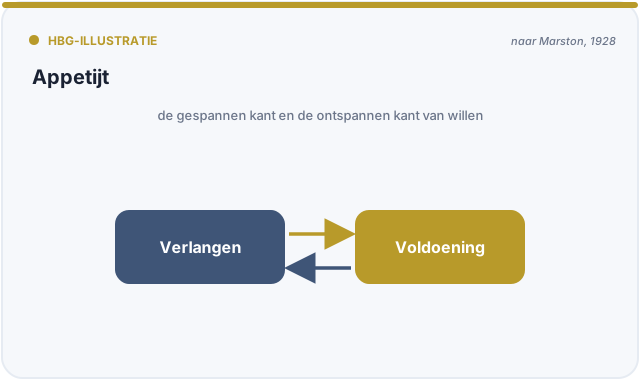
In proportion as satisfaction is attained, it replaces and supersedes desire. Desire is related to satisfaction, integratively, in a way not hitherto considered. We noted, in the last chapter, that compliance normally precedes dominance (when in successive combination with it), is adapted to dominance and finally is superseded by dominance. This same relationship appears to exist between the active dominance of desire, expressed toward the object needed (a tree-bridge, in the illustration used), and the active compliance of satisfaction, expressed toward this same object. An identical relationship, moreover, seems to appear between the passive compliance of desire expressed toward the river-barrier, and the passive dominance of satisfaction expressed toward this same stimulus, now no longer an obstacle to progress.
There is a sort of kaleidoscopic shifting of emotional pattern,
pagina 324
from desire to satisfaction, wherein the controlling element, dominance, becomes passive instead of active, and the subsidiary response, compliance, changes from a passive to an active type of emotion. The active compliance, also, is compliance with volume (object of desire) which is very pleasant, as contrasted to the replaced passive compliance with the intensity of a superior antagonist, which is distinctly unpleasant throughout a major portion of its duration. This change gives a gradual elimination of sharp, decisive unpleasant-
ness, 'and a gradual gaining of deep pervasive pleasantness. The change from active to passive dominance gives a gradual elimination of restless, active, craving, and a gradual gaining of restful passive, self -sufficiency.
Still another series of changes may be noted in the succession of satisfaction to desire. Desire is an emotion wherein there is felt a continuous demand upon the external environment, and a forced harmony with the demands and requirements of the organism's own, inner purpose (completing the interrupted journey). Satisfaction gradually reverses this situation, until, when it has wholly supplanted desire, there is felt a grateful harmony with the external environment (helpful tree bridge), and a stabilized successful dominance over the subject's own inner purpose (completing journey).
The blending of desire in satisfaction, as thus analysed begins at the very moment when the possibility of conquering
pagina 325
the river with the tree is first perceived; and the blending continues until the river is actually crossed, and the traveller looks back at it safely, from the other side. Only at the very first of the whole proceeding, when the subject is balked by the river and has not yet realized the possibilities of the leaning tree, is desire alone experienced. Only after crossing the river and looking back at it is satisfaction alone felt. During all the time in between, desire is being gradually adapted to satisfaction and supplanted by it. This complex inter-relationship of the two compound emotions, Desire and satisfaction, may aptly be termed the emotion of appetite. Appetite emotion, because of the blending and ordered transition of its compound elements, attains a certain new, characteristic emotional quality of consciousness, not discoverable in either of its elements when experienced separately. A formula conveniently symbolizing appetite emotion may be devised, using the formula for desire pCaD, and the formula for satisfaction aCpD, with a plus sign ( -h ) between signifying that desire precedes and is adapted to satisfaction. Appetite would then be represented by the complex formula pCaD+aCpD. Since the active element of appetite, is desire, it might be written aA; and since satisfaction is the passive appetitive emotion unit, it might be written pA. Appetite would not, then, be symbolized by the formula aApA but by the formula aA+pA.
The term " appetite " receives dictionary definition as
follows : " A physical craving, as for food a mental craving
pagina 326
longing ". This definition suggests at least two limitations, which must be eliminated in the use of " appetite " as an emotional term in the way proposed. First, appetite as defined and customarily used, refers principally to a series of bodily hunger mechanisms. While the emotional compounds evoked during the satisfaction of bodily hunger conform precisely to the emotion of appetite as above analysed and defined, it is by no means possible or desirable to limit the use of the emotional term appetite to physical ingestion of food. Appetite, as we shall hereafter use it, is to be taken as the name of an emotion made up of the compound emotion desire and satisfaction whether these emotions be aioused by physical hunger stimulation, or by other stimuli of vastly different type such, for instance, as the river and tree in the instance analysed, or desire for money and property, and the acquisition of such objects.
The second difficulty suggested by the dictionary definition of appetite is to be found in its disproportionate stressing of the desire aspect of appetite, rather than its satisfaction aspect. This difficulty, however, is not serious, and needs no corrective comment beyond the statement that appetite as a unit emotion is not to be taken as terminating at the beginning of satisfaction, but must rather be considered as persisting until satisfaction is finally completed. As already noted, desire may predominate throughout the early stages of appetitive behaviour, and satisfaction may predominate throughout the later period. But both must be present in proper inter-relationship to give the characteristic emotional quality recognized as appetite emotion. Neither desire alone, nor satisfaction alone constitutes appetite emotion.
pagina 327
What literary usage has been made of the term appetite as designating a definite emotional state has been based, for the most part, upon introspective recognition of the typical emotional experience connected with physical hunger and its satisfaction. This use of the term appetite is quite in accord with its meaning as defined above, provided only that physical hunger be considered as only one among many conditions giving rise to appetite emotion.
Summary In summary, then, we may define dominance and compliance
as primary emotions, expressed conveniently by the letters D and C. Each of these primary emotions possesses an active and passive aspect. Active aspects may be expressed by the small letter a, and passive aspects, by the small letter p, immediately preceeding the emotion symbol to which the a or p is intended to attach. Thus " aD " indicates active dominance, and " pC " passive compliance.
pCaD indicates a simultaneous combination of passive compliance and active dominance. The emotion thus integratively compounded may be called " desire ". aCpD represents an emotion integratively compounded in the same way, which may be called " satisfaction ".
When the symbol for one emotion is placed immediately before that for another emotion, with a plus sign between, the relationship between the two thus indicated is a successive occurrence, or combination of the emotions, in the order
pagina 328
in which the letters occur, and the plus sign placed between signifies that the first emotion is adapted to its immediate successor. Thus, C + D indicates compliance followed by dominance, with the compliance adapted to the dominance. Such a successive combination and relationship between desire and satisfaction may be indicated by the formula pCaD 4- aCpD. According to this formula desire precedes and is adapted to satisfaction.
This successive combination of compound emotions may be termed appetite, " A ". Desire constitutes the active aspect of appetite and satisfaction its passive aspect. Thus the formula pCaD might be written instead aA, and the formula aCpD might be written pA. Activity and passivity, when used as descriptive of the emotion A, refer to the relative activity and passivity of the motor self in the particular aspect of the total emotional response indicated.
There seems to be little doubt but that the emotion of appetite is an acquired, or learned response in the same sense that compliance emotion must be learned. I have emphasized elsewhere, the fact that all the mechanisms of physical appetite were inherent in the organism, 1 including the adequate, intra-organic stimuli causing hunger pangs. This inherency of stimulating mechanism is quite a different
1 W. M. Marston, " A Theory of Emotions and Affection Based Upon Systolic Blood Pressure Studies," American Journal of Psychology, 1924, vol. XXXV, pp. 469-506,
pagina 329
matter from the conceivable inheritance of neural patterns, upon which many physiologists have based their theories of emotion. It is against the inherent existence of any such predetermined neural pattern, in the case of any emotion save dominance, that I wish particularly to inveigh. The pattern of dominance, depending as it does upon the tonic discharge pattern, must be truly inherited; or at least, the neural structures upon which it is based must be energized by environmental stimuli prior to the birth of the child. With regard to the other emotional patterns, it would be my own suggestion that the structures of the integrative mechanisms alone are inherited, while the actual integrative patterns constituting the emotions themselves are actually formed after birth, by the reactions of the organism to environmental stimuli.
Hunger as Teacher of Appetite Emotion and Behaviour
The role of the bodily hunger mechanisms by which human beings and animals are compelled to seek and eat food at regular intervals throughout life, is to be thought of as that of a teacher of appetite emotion. Even though the organism comes ready equipped with integrative mechanisms capable of producing dominance emotion, compliance emotion and the two simultaneous compounds of dominance and cornpliaiico already designated as active and passive appetite, the actual initiation and development of all these emotional responses would be a very haphazard matter nevertheless, if the new born human being or animal were dependent upon chance stimulation from the environment to evoke the various emotional patterns in adequate sequence and degree. Such is not the case, however. Not only are
pagina 330
animals and human beings equipped, at birth, with integrative mechanisms capable of manufacturing D, C, and A, but also their organisms are equipped with chemicophysiological stimulating mechanisms which automatically compel the formation of the emotional patterns pCaD and aCpD. The stimulus mechanism of hunger continues to evoke appetite emotion with its constituent primary emotional patterns, at regular intervals of two to five hours throughout the life of the organism. It would seem, then, that the natural, or normal pattern of appetite emotion is properly to be learned only from a study of the integrative patterns
imposed by this inherent hunger mechanism of the organism itself. In studying adult appetitive behaviour we must recognize the possibility that chance environmental stimulations, rather than the bodily hunger mechanism, may have determined the appetitive emotional pattern in whole or in part. The results of these environmental influences, in so far as they differ from the hunger-model are to be regarded rather as perversions or variations imposed upon the natural pattern, than as norms on which description of appetite emotion should be shaped. It is my own suggestion, therefore, that our understanding of the natural or normal appetitive pattern be based upon examination of inherent integrative emotional mechanisms, already considered, and upon physiological accounts of how these integrative patterns are arranged by the equally inherent orgemic mechanisms of hunger stimulation.
Physiology of the Hunger Stimulus
pagina 331
Carlson and Ginsburg have shown that hunger pangs occur in infants two hours after birth and in pups born eight to ten days before term. 1 Contractions of the infants' stomachs resembled those of adults except that the infant hunger contractions showed relatively gi eater vigour and frequency. Carlson and Luckhardt have shown that these hunger contractions may be started up in the full stomach of a dog just after feeding, by injection of blood taken from an animal kept in a state of hunger for several days. 2 These results indicate that the hunger contractions of the stomach may be set up, at least partially by a " hunger hormone ", generated by body tissues in need of nourishment. The authors cited state their belief, however, that the origin of hunger pangs is also to be attributed in part to a specific nervous automatism, both central and peripheral, independent of afferent impulses. Cannon and Washburn 3 first showed that these contractions
1 A. J. Carlson and H. Ginsburg, " The Tonus and Hunger Contractions of the Stomach of the New Born," American Journal of Physiology, 1915, vol. 38, p. 29.
a A. J. Carlson and A. B. Luckhardt, " On the Chemical Control of the Gastric Hunger Mechanism,' 1 American Journal of Physiology, 1914, vol. 36, p. 37.
8 W. B. Cannon and A. L. Washburn, American Journal of Physiology,
pagina 332
vol. XXIX, p. 441. ' ' ' '
of the stomach were felt by the human subject as hunger pangs, followed by a desire for food. Carlson and Ginsburg showed that such hunger pangs occurred in the stomach of both human infants and animals before any food had been taken into the stomach.
As a result of the researches mentioned, therefore, we may summarize the inherent, appetitive, stimulating mechanism of the body as follows : A hunger hormone, together with an inherent nervous automatism, initiate stomach contractions, in both animals and human beings. Such contractions may occur immediately after birth and before any food has been taken into the stomach. These hunger contraction? begin as a constriction in the cardiac end of the stomach, and sweep rapidly toward the pyloric end, increasing in strength as they proceed. 1 These automatically initiated hunger contractions are the organic sensations which are felt by the normal adult as hunger pangs, followed by desire for food.
Motor Self Discharge Predominantly Sympathetic
Bearing in mind, then, these automatic hunger contractions as an environmental stimulus, we must next determine the nature of the motor stimuli evoked by hunger contractions. In order to discover whether the motor discharge from hunger contractions is antagonistic to the motor self, we must also
pagina 333
examine the natural tonic condition of efferent discharge over final paths common to the motor self and to the motor stimuli evoked by hunger. In other words, it is necessary, first, to discover the discharge paths of the motor self; and then to examine the effect of the motor stimuli of hunger upon the tonic discharge.
Cannon has shown 1 that wherever the viscera are innervated by both sympathetic and vagus impulses the sympathetic impulses prevail. That is, the tonic balance maintained by the motor self distinctly favours sympathetic motor discharge as against vagus innervations. The esophagus, stomach, and intestines are, in general, contracted by vagus impulses, and inhibited by sympathetic motor discharge. Both these influences are probably exerted upon the digestive tract
1 A. J. Carlson, Control of Hunger in Health and Disease, Chicago, 1919, p. 60.
W. B. Cannon, Bodily Changes in Pain, Hunger, Fear, and Rage, Chapter I, " The Effect of the Emotions on Digestion."
P'
2io EMOTIONS OF NORMAL PEOPLE
continually to a certain extent as shown by Patterson. 1 But Cannon has shown that emotions which are followed by sympathetic discharge tend to inhibit the vagus contractions of the stomach, slowing up digestion or abolishing it altogether.
pagina 334
All these effects seem to be results of the simple fact that sympathetic impulses to the viscera naturally dominate vagus or cranial impulses. We might express this fact, in our own terms, by saying that the motor self tends to energize the blood vessels and other viscera contributing to activity of the skeletal muscles predominantly at the expense of the blood vessels and smooth muscles used in the process of digestion.
Motor Stimuli Discharging Through Cranial Channels Would be Antagonistic to the Motor Self
Thus, reinforcement of the motor self would be expected to lead to increased supply of blood to the skeletal muscles, increase of adrenalin in the blood, and other visceral preparation for activity of the skeletal muscles. Reinforcement of the motor self would be expected, similarly, to inhibit the movements of the esophagus, stomach and intestines, to slow up or stop altogether the secretion of gastric juice, and to interfere with the normal output of saliva into the mouth and throat. Any motor stimulus which had the effect of increasing the flow of saliva and gastric juice, and of enhancing the digestive movements of the stomach and intestines would be described, in our own terminology, as a motcr stimulus antagonistic to the motor self.
Such an antagonistic motor stimulus would throw the reflex balance over to the vagus side, as opposed to the natural reflex equilibrium where sympathetic impulses predominate. If a motor stimulus could be shown to tend toward this vagus outlet of discharge, but only resulted in an increased sympathetic motor discharge, we might assume that the motor stimulus though antagonistic to the motor self, was of inferior intensity. The increased energy in skeletal muscles and
pagina 335
sympathetically innervated viscera might be taken as evidence of a dominance response, wherein the motor self had reinforced itself in order to maintain its natural reflex balance despite the attempted upsetting of this balance by the weaker antagon-
1 L. L. Patterson, " Vagus and Splanchnic Influence on Gastric Hunger Movements of the Frog," American Journal of Physiology. vol. 53, p. 239.
istic motor stimulus. If, however, we found an initial reinforcement of motor discharge through sympathetic channels, followed by a marked decrease in this sympathetic outflow together with a sudden appearance of vagus motor discharge, evidenced by increased secretion of saliva and similar symptoms, we might assume that the antagonistic motor stimulus had proved of superior intensity to the motor self. As a consequence of its superior strength, such a motor stimulus might force its way through the barrier which the motor self sought to set up, the superior, antagonistic motor stimulus finally expressing itself through its own vagus channels. Such an occurrence, in short, would constitute an emotional response of compliance with intensity.
Autonomic Cliannels of Motor Self and Motor Stimuli Summary
We may summarize as follows : the natural reflex balance maintained by the motor self seems to call for a predominance of sympathetic motor discharge over vagus discharge. Sym-
pagina 336
pathetic motor impulses inhibit digestive movements and gastric secretions, while at the same time increasing blood supply to the muscles and release of adrenin into the blood stream. Sympathetic visceral impulses of this sort have also been shown to run parallel, usually, to tonic impulses increasing the tonus of the skeletal muscles.
V^gus impulses increase the digestive processes, and tend to inhibit^ blood supply and tonic impulses to the skeletal muscles. A motor stimulus, therefore, which sought vagus channels of discharge would be antagonistic to the motor self. Such a motor stimulus would tend to upset the natural reflex equilibrium maintained by the motor self in which sympathetic impulses predominated. If an antagonistic motor stimulus were weaker than the motor self, we should expect to find exaggeration of the natural reflex equilibrium; that is, increased nervous energy sent through sympathetic channels. If, on the other hand, an antagonistic motor stimulus were stronger than the motor self, we should expect to find, first, an attempted reinforcement of sympathetic resistance by the motor self; and secondly, a marked decrease in sympathetic motor discharge accompanied by a corresponding increase of vagus discharge, swinging the reflex balance over to the vagus side, and signalizing a defeat of the motor self by the antagonistic motor stimulus.
212 EMOTIONS OF NORMAt PEOPLE
Increase of sympathetic discharge would, in short, indicate a successful dominance response of the motor self; while initial
pagina 337
increase of sympathetic discharge followed by decrease of sympathetic discharge and corresponding ascendency of vagus discharge would constitute a compulsory response of compliance with intensity.
Hunger Pangs Evoke Motor Stimuli Antagonistic and Superior to the Motor Self
With the situation thus outlined, we may hope to discover whether -the motor stimuli evoked by hunger pangs are antagonistic to the motor self; and, if they are, whether they are stronger or weaker than the tonic motor discharge. Carlson, of Chicago, with his collaborators, has made a series of studies of the effect of hunger pangs upon various other functions of the body. 1 Carlson was fortunate in obtaining a subject, Mr. F. V., who had a complete closure of the esophagus and a permanent gastric fistula. When eleven years old, this subject accidentally drank a strong solution of caustic soda, and ever since that time, for more than twenty years, has fed himself through the gastric fistula. Carlson reports that F.V. has enjoyed good health through this period and is in every respect, with the exception of the closed esophagus, a normal individual. Stomach balloons and other recording devices could be inserted very easily into the stomach through the gastric fistula, which opened into the fundic end of the stomach, without producing the somewhat abnormal condition of consciousness necessarily caused by swallowing a stomach balloon with connecting tubes. In this way Carlson and his associates have been able to make studies of extraordinary accuracy and reliability, and they have given us a rather complete picture of the different types of motor stimuli, or motor discharge resulting from hunger
pagina 338
contractions of all degrees of intensity.
In the first place, Carlson has shown that no marked hunger is felt unless the stomach contractions are very strong. Accompanying strong hunger contractions the following phenomena have been found :
1 The results of these studies are found in A. J. Carlson's Control of Hunger in Health and Disease, Chicago, 1919, which is cited as authority lor the account of Carlson's findings here rendered.
(1) Increased knee jerk,
(2) increased heart rate,
(3) increased blood volume of the arm,
(4) a brief gush of saliva at the maximum point of each
strong contraction,
(5) marked irritability, restlessness, and inability to retain
fixed attention.
The blood volume of the arm increases up to a point near the height of the stomach contractions, and then begins to diminish
pagina 339
before the contraction is complete. The knee jerk has been found by Lombard to be less during hunger than after satisfaction of hunger (although Carlson holds that it is greater during hunger than when neither hunger nor satiety is present). All these physical symptoms, taken together, present a clear picture symptomatic of antagonistic motor stimuli, superior in intensity to the motor self. The gush of saliva, and irritability and restlessness (evidently representing an interference with energy to the skeletal muscles) appear only at the height of strong hunger contractions. Salivary secretion is produced by vagus innervation only, and interruption of sympathetic impulses by vagus discharge might also account adequately for the interruption of previous dominant activities in which the subject had been engaged, as evidenced by restlessness and irritability. The blood volume of the arm also increased by sympathetic innervations during the early part of each hunger contraction, begins to shrink before the contraction reaches its maximum height indicating once more a triumph of vagus over sympathetic innervations. The results of Lombard, if verified, might indicate that the knee jerk, though enhanced by hunger contractions, was reduced below its possible maximum by partially successful vagus opposition. Measurement of the knee jerk, however, is scarcely fine enough a determination to make comparison of this sort absolutely accurate. The heart rate is frequently found to increase pari passu with a decrease in strength of the heart beat, as evidenced by dimunition of blood volume in an arm or leg, or by systolic blood pressure measure at the brachial artery. The only dependable measurements of bodily changes caused by hunger pangs indicate exaggeration of the tonic balance (dominance response) up to a point close to the maximal intensity of the stimulus. At this point, the antagonistic motor stimuli evoked by the pangs seem to break through the
pagina 340
214 EMOTIONS OF NORMAE, PEOPLE
barrier set up against them by the motor self, just sufficiently to compel the motor self to give up its previous dominance response, and to seek some form of dominant activity which will be compatible with the hunger pang stimulus. This analysis indicates that hunger pangs constitute a stimulus antagonistic to the motor self and of superior intensity nicely calculated to compel a response of passive compliance with intensity. (Passive because only sufficient victory is attained by vagus impulses to compel the motor self to give up its previous dominance).
Subject Passively Complies with Hunger Pangs and Actively Dominates Food (Desire)
This analysis seems to be confirmed by examination of certain subjects with very strong stomach contractions, who experienced only nausea, weakness, and faintness during the contractions. Boring 1 and Carlson have both reported subjects of this type. I myself studied a woman subject of this type for about a year and a half. During stomach contractions she felt nausea and marked bodily weakness. At such times systolic blood pressure measurements showed marked drops apparently parallel with the stomach contractions. Because of the absence of conscious hunger, and the presence of nausea during hunger contractions, this subject could eat very little food, and was in an under-nourished physical condition. She had consulted a number of medical specialists* and bad tried various diets without result. After analysing her emotional responses, I came to the conclusion that the case
pagina 341
was a psychological rather than a medical one. It seemed to me that she had developed compliance to a point where compliance response was controlling the visceral functions which normally are not under voluntary control. The case seemed not unlike that of the Hindu adept, with the additional complication that her excessive bodily compliance was not suited to an active strenuous life, and was not, in fact, physically possible under conditions of dominant occidental civilization. Treating the case on this theory, I induced the subject to take an active, aggressive attitude toward her stomach pangs, regarding them as opponents which she must destroy
1 E. G. Boring, " Processes Referred to the Alimentary and Urinary Tracts : A qualitative Analysis," Psychological Review, 1915, vol. XXII, P- 320.
by forcing food into her stomach, even though nausea made this very difficult (the esophagus also seemed to be in a hypertonic condition). At first the subject experienced great difficulty, and frequently could not retain the iood swallowed. Eventually, however, under repeated suggestion, she began to regard the stomach pangs with aggressive antagonism. Soon after this she was able to swallow food with no great difficulty, her hunger pangs coming at two hour intervals. Within six months, feelings of nausea and faintness which had formerly accompanied the pangs had turned into feelings of ravenous hunger and appetite for food. Upon several occasions, J observed this subject in such an aggressive condition
pagina 342
of hunger that she seized a loaf of bread and bit into it-savagery, without being able to wait for the bread to be cut and buttered. At this point in the case, the subject began to put on weight; and about three and a half months later she had gained fifty-one pounds.
My own analysis of this case just described was that the element of active dominance had been eliminated from the subject's emotional response to the hunger pang stimulus. As we have noted above, active appetite consists of simultaneously compounded passive compliance (in this case with the hunger pangs) and active dominance (directed toward seizing and biting food). The woman subject in question had so traiaed herself in schools of occultism and esoteric religion that she was able to comply actively with any antagonistic motor stimulus, no matter how intense this stimulus might be. But her compliance training had been carried too far, and had not included a proper combination of dominance with compliance in the compound emotion of appetite. This additional training I was able to supply, and the result seemed to justify my analysis.
We may summarize then, as follows : Hunger pangs, consisting of sudden stomach contractions beginning at the fundic end of the stomach, constitute an inherent stimulating mechanism. This inheient, automatic stimulus evokes in the normal individual motor stimuli antagonistic and of superior intensity to the motor self. The resulting emotional response is one of compliance with intensity. The superiority of strength in the motor stimuli, however, is nicely adjusted to produce passive compliance only, permitting the motor self to react dominantly toward a single type of environmental
pagina 343
stimulus, food. Thus in the total response of active physical appetite, the individual is reacting simultaneously with passive compliance toward the hunger pangs and active dominance toward the food.
Subject Actively Complies with Food and Passively Dominates Hunger Pangs
Selection of food as an object toward which dominant activity can be directed evidently depends primarily upon the power of the chemical stimuli of smell and taste to inhibit the hunger pangs. It will be recalled that the hunger pangs themselves are not attributable to motor discharge into the central nervous system since it has been proved that hunger pangs may occur normally in a stomach which has been completely disconnected from all nerve connection with the central nervous system. We find, therefore, a situation wherein antagonistic stimuli of superior intensity evoked by hunger pangs cause motor discharge through vagus channels; while a second antagonistic stimulus, food, while causing motor discharge through these same channels inhibits or removes the first antagonistic stimulus, hunger pangs. For the sight and smell of food have been proved by Cannon, Carlson, and others to result in (i) inhibition of hunger contractions of the stomach and (2) in vagusly innervated secretion of saliva and gastric juice, with decrease of blood supply to the skeletal muscles, and increase of blood to the digestive viscera^ Chewing of food, and swallowing of saliva and food have also been
pagina 344
shown to inhibit hunger pangs by means of vagus discharge. The motor stimuli evoked by food are thus superior in integrative strength to the motor stimuli arising from hunger pangs.
The food when thoroughly smelled, chewed, and taste^L evokes motor stimuli which are superior in volume to the motor self, and for this reason may be pleasantly complied with. Thus, we have a total picture of food stimulation evoking antagonistic motor stimuli of superior volume but inferior intensity to the motor self. At the same time, these motor stimuli evoked by food are enabled to gain an initial victory over the motor self by virtue of the fact that they utilize the identical motor channels followed by efferent discharge from hunger pang stimuli, which were of sufficient intensity originally to overcome the motor self.
Finally, we find that, in proportion as the motor stimuli
evoked by food inhibit and reduce in intensity the hunger pangs themselves, the motor self is enabled to re-establish its successful resistance to the motor stimuli from hunger pangs. In this situation we find active compliance of the motor self with the food stimuli simultaneously compounded with passive dominance directed toward the antagonistic motor stimuli evoked by hunger pangs. The activity of the response of compliance with food is made up of unchecked vagus discharge, resulting in tremendously increased secretion of saliva and gastric juice,
pagina 345
and digestive movements of the stomach and intestines accompanied by transfer of the major blood supply from the skeletal muscles to the digestive viscera. In short, the active compliance with food consists of an entire shift in the natural reflex balance of the organism from sympathetic preponderance to vagus preponderance. Yet this shift of reflex balance is accomplished by a large volume of antagonistic motor stimuli which are of moderate intensity only, permitting the motor self to continue to control its own normal motor channels, with even some increase in its own volume (as indicated by a slight increase in systolic blood pressure level of six to eight mm, on the average, after a full meal has been eaten.) Thus a response of compliance with volume toward food is compounded with a response of passive dominance toward hunger pangs.
Spread of Active Compliance, During Satisfaction to Other
Environmental Stimuli Besides Food
My own studies of satisfaction of physical appetite have shown that passive appetite (that is, satisfied hunger as above described), carries with it an emotional attitude of active compliance toward nearly aJ] environmental stimuli, besides food itself; and also an emotional attitude to expansive selfsatisfaction frequently expressed in talkativeness, mild boasts of the subject^ accomplishments, and friendly condescension toward table companions. It is not by accident, apparently, that business men follow the custom of inviting to luncheon an important business connection from whom they hope to obtain a large order, or business contract favourable to
pagina 346
themselves. I have studied at least a score of instances where a business man who, during the forenoon, rejected with great firmness the proposals of salesmen or business associates, yielded to these same proposals of salesmen with hearty good will after eating to the point of satiety at lunch (no liquor
218 EMOTIONS OF NORMAft PEOPLE
having been taken). Following a satisfactory meal, the active compliance with which the subject responds to his food seems nearly always to extend itself toward other stimuli of appetitive nature, such as business deals and joint undertakings, conviviality, and amusements of various sorts. If precautions are taken by the salesman, or business man desirous of having his proposition accepted, not to increase the intensity of his proposals too greatly (that is not emphasizing his own ego or business strength unduly) this extended active compliance may be utilized to great financial advantage.
Passive dominance also plays its part in rendering the average male susceptible to appetitive stimuli after the satisfaction of physical appetite. The subject feels much more sure of himself and nearly always possesses a distinct consciousness of having mastered all threatening or dangerous antagonists. While this element of passive dominance is really felt toward the physical hunger pangs, it nevertheless tends to extend itself toward elements in the business situation under discussion, which had seemed, before luncheon, formidable and dangerous to the subject's own business security. While the state of physical satisfaction persists, however, the
pagina 347
man is apt to feel much more secure, and able to undertake hazardous enterprises.
Summary of Physical Appetite c -
We may summarize, then, as follows. Food is,, the only environmental stimulus toward which the subject is able to react dominantly while hunger pangs are enforcing passive compliance with themselves upon the organism.
Once the food has been dominated, however, and placed within stimulating distance of the nose or mouth, it evokes motor stimuli antagonistic to the motor self and superior to it in volume, though of only moderate intensity. This superior volume of motor stimuli evoked by food is able to control its vagus channels of discharge freely because the over-intense motor stimuli from hunger pangs have already opened these vagus channels, in spite of the resistance of the motor self. The food stimuli, moreover, reduce by inhibition the strength of the hunger pangs themselves, to a point where the hunger pangs motor stimuli can be successfully resisted by the motor self. This simultaneous combination of active compliance with food and passive dominance
toward hunger pangs constitutes passive appetite emotion, or satisfaction.
Both the active compliance and passive dominance elements of this emotional compound tend to respond to many other appropriate types of environmental stimuli besides food,
pagina 348
during the persistence of satisfaction emotion which was actually brought about by removal of hunger pangs by food.
Characteristics of Dominance and Compliance Revealed in Eating Behaviour
I have had occasion to study some cases showing interesting personality traits easily detectable by analysis of behaviour during eating. For instance, many male subjects, both adolescent and adult, possess personalities in which active dominance is very highly developed at the expense of active compliance. Several subjects of this type were college students whose eating behaviour I was able to observe at a college cafeteria five or six days a week. Out of seven subjects thus studied, five invariably " bolted " their meals, attacking the food much as they would attack an opponent of the athletic field. They almost always swallowed the food very hurriedly and with unnecessary energy, by the process popularly known as " gulping it down ". Two, at least, of these subjects had serious digestive difficulties apparently due to insufficient secretion of saliva and gastric juice, anc 1 also to inadequate chewing of the food before swallowing. One other subject, out of the seven, ate in a similar way whenever he was in a hurry to get to some class or engagement; while on other occasions he ate more rapidly than the average person. This type of behaviour in eating seems clearly to reveal an imperfect, or altogether lacking active compliance with food, coupled to an excess of active dominance which the subject continued to express toward the food even after he had it completely captured on the table in front of him. The spread of this over-dominance and under-active compliance through the personalities of these college students was very striking.
pagina 349
Adult males, especially business men, sometimes carry active dominance toward business to such an extreme that their food, even when thoroughly chewed, is reported as tasteless and " like sawdust ". In two such cases I have been able to restore pleasurable taste in eating to the subjects
by inducing them to learn active compliance with food. Flow of saliva generally increases in response to sight, smell, and taste of food, and " taste " and enjoyment of the food increases correspondingly. Various other types of business men, and especially " white collar " employees whom I have studied, experience considerable pain and discomfort in digestion of their food, apparently because they will not give up physical activity of the skeletal muscles after eating. In other words, they may actively comply with their food during the meal itself, but immediately rush away to make the most of their noon hour in some physically active way. Or, in the case of business men of this type, they return to business calculations and planning immediately after eating. Active compliance with food, to be successful, must be continued for twenty minutes to three quarters of an hour after finishing the meal, if a proper pattern of passive appetite emotion is to be built up in the natural way, by full satisfaction of the physical hunger mechanism.
Hunger Pangs Can Build Up Model Inlegrative Pattern for Appetite Emotion
In concluding our initial study of appetite emotion the nature of the role played by the bodily hunger pang mechanism
pagina 350
should again be emphasized. Countless other environmental stimulus situations besides physical hunger are perfectly adequate to evoke simultaneous passive compliance and active dominance which constitute the active element of appetite emotion. Many stimulus situations other than satisfaccion of physical hunger pangs are adequate to evoke the simultaneous combination of active compliance and passive dominance which together comprise passive appetite emotion. The hunger pang mechanism, however, represents an inherent adequate stimulating mcc/iamsm, which if intelligently studied and permitted to control the organism is capable of building up a perfectly normal and well balanced integrative pattern for the emotion of appetite, in both its active and passive p}iases.
Active and passive appetite, moreover, are brought together and fitted into one another by the physical hunger mechanism, in a maximally well ordered manner. Active appetite gradually gives way to, and is supplanted by passive appetite, as the food is taken into the alimentary canal for
ingestion. Moreover, this inherent emotional stimulating mechanism, hunger pangs, repeats its stimulation at periods three to five hours apart throughout the waking life of a normal human being, from birth to death. Such continually repeated enforcement of the entire, evenly balanced, integrative pattern of appetite emotion furnishes a condition for the proper learning of appetite that could scarcely be found in any other series of experimental stimuli which could be devised for purposes of appetitive training. Surely,
pagina 351
the average person would scarcely be expected to experience such a series of perfectly arranged stimuli in the more or less casual and haphazard environment met with in ordinary life. The hunger pang mechanism, therefore, should be accepted as the teacher of appetitive emotion, and environmental stimuli devised for teaching appetite emotion either to children or to adults should be patterned upon it.