Ik ben een…Trainer · CoachHR · Team · LeiderDistributeur
Emotions of Normal People · hoofdstuk IV van XVIII ← Overzicht van alle hoofdstukken
Deel 1 · De vraag en het fundament
IV
Motor Consciousness as the Basis of Feeling and Emotion

Motorisch bewustzijn als basis van gevoel en emotie

Gevoel ontstaat in hoe je zenuwstelsel zich klaarmaakt om te bewegen.

Je leest op deze pagina hoofdstuk IV van het boek Emotions of Normal People van William Marston, de oerbron van DISC.

HBG-toevoeging · leeswijzer in onze taal
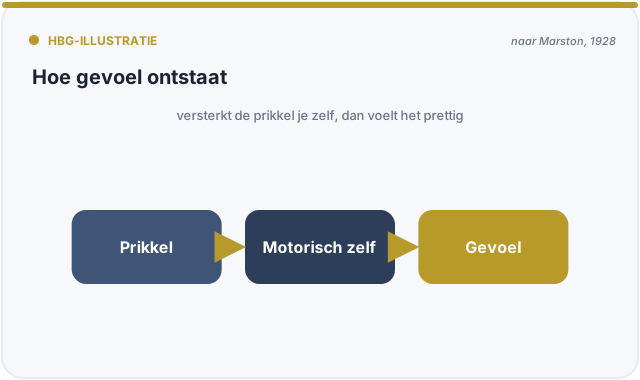
HBG-illustratie bij hoofdstuk IV, Motorisch bewustzijn als basis van gevoel en emotie
HBG-illustratie · door HBG toegevoegd om dit hoofdstuk toegankelijk te maken. Geen onderdeel van Marstons origineel.

In het kort

Hier legt Marston de bouwstenen onder alle emoties. Centraal staat wat hij het motorische zelf noemt: de voortdurende spanning in je zenuwstelsel die je klaarmaakt om te bewegen.

Gevoel ontstaat volgens hem in de verhouding tussen dat zelf en de prikkels die binnenkomen. Versterkt een prikkel je, dan voelt het prettig. Werkt hij je tegen, dan voelt het onprettig. Zo eenvoudig is de basis.

Het belang van een tastbare psycho-neurale hypothese van de emotie kan voor de psychologie nauwelijks worden overschat. Op dit moment dobberen de onderzoekers van de emotie tussen de Scylla van het James-Lange-denken en de Charybdis van jeugdige avonturiers die ons willen overhalen alle theorie en alle eerdere resultaten overboord te gooien en alleen nog statistisch te tellen hoe alle mensen onder alle mogelijke omstandigheden reageren. Deze jonge piraten verkondigen de onweerlegbare stelling dat geen enkele kennis absoluut is, en concluderen dan dat elke poging om losse emotiegegevens tot iets wetenschappelijks te ordenen op sentimentaliteit neerkomt.

Dat hernieuwde aandringen op de heiligheid van het losse feit is prijzenswaardig voor zover het de objectiviteit van de methode benadrukt. Maar de geschiedenis van de oudere zusterwetenschappen, en zelfs van de psychologie zelf, laat een zekere afhankelijkheid van dragende theorie zien. De wetten van Newton zijn door Einstein en anderen ingrijpend bijgesteld, en toch twijfelt niemand aan hun centrale belang voor de natuurkunde. De atoomtheorie is misschien ontoereikend, en toch klom de scheikunde op haar steigers naar haar huidige hoogte. Zo is het ook met de James-Lange-theorie van de emotie. De psychologie ontgroeit haar misschien net, maar moeten we ons daarom meteen overgeven aan een orgie van onwetenschappelijke wanorde? Er is een zekere gemakzucht in het presenteren van resultaten zonder theorie, en je loopt minder kans te worden tegengesproken. Maar wil de psychologie dezelfde soort wetenschap worden als de neurologie en de fysiologie, dan moet iemand het risico nemen en grondtheorieen bouwen.

In dit hoofdstuk · 7 delen
  1. De oude gevoelstheorie klopt niet
  2. Gevoel zit in beweging
  3. Aanwijzingen dat dit klopt
  4. Waarom niemand dit eerder zag
  5. De prikkel komt van binnen
  6. Van prikkel naar beweging
  7. Samengevat
Deel 1 van 7

De oude gevoelstheorie klopt niet

HBG-beeld bij De oude gevoelstheorie klopt niet
HBG-toevoeging · samenvatting en beeld in onze stijl. Geen onderdeel van Marstons origineel.

In het kort, in onze taalDe fysiologen weerleggen het idee dat gevoel puur uit lichaamssignalen komt. Er moet iets anders aan de basis liggen.

De fysiologen weerleggen de James-Lange-theorie

James gaf zijn theorie twee radicaal verschillende formuleringen. De eerste luidde eenvoudig: we zijn bang omdat we wegrennen, we zijn boos omdat we aanvallen. Met die stelling, mits goed afgebakend, ben ik het volledig eens, en dit boek is gewijd aan de uitwerking ervan. Maar toen James zijn radicale gedachte moest verdedigen, gleed hij af naar een heel andere theorie, die in grote lijnen overeenkwam met die van Lange. Hij had waargenomen dat lichamelijke veranderingen rechtstreeks volgen op de waarneming van het opwindende feit, en dat het gewaarworden van die veranderingen, terwijl ze gebeuren, de emotie is. Maar toen hem werd gevraagd hoe we ons van die veranderingen bewust konden worden, vond James alleen zintuiglijke termen om dat te beschrijven. Als we geen gewaarwordingen van de onmiddellijke lichamelijke veranderingen hadden, hoe konden we ons er dan bewust van worden?

Daarom moest James aannemen dat de eerste lichaamsveranderingen zintuiglijke uiteinden in spieren en organen prikkelen, die een tweede reeks reflexbogen opwekken die lichamelijke gewaarwordingen voortbrengen. Daarmee ontkende hij echter zijn eigen grondstelling dat de emotie het gewaarworden van de veranderingen is terwijl ze gebeuren. Want als de emotie uit gewaarwording bestaat, dan zijn de belangrijke gewaarwordingen die welke pas na de eerste lichaamsveranderingen optreden. Die zintuiglijke versie van de James-Lange-theorie laat zich dus weerleggen door te laten zien dat de emotie blijft bestaan nadat de gewaarwordingen waaruit ze zou bestaan zijn uitgeschakeld.

De resultaten van Sherrington

Dat onderzoek deed Sherrington. Hij voerde ruggenmergdoorsnijdingen uit bij honden, waardoor de gewaarwordingen uit de organen en de meeste bewegingsgewaarwordingen na een emotionele prikkel verdwenen. Toch bleven de emoties van de honden, te oordelen naar hun gedrag, onveranderd. Een dier kreeg hondenvlees aangeboden, een prikkel die het voor de operatie nooit had gehad. Onmiddellijk verschenen tekenen van wat Sherrington walging noemt. Herinnering aan eerdere gewaarwordingen of eerdere conditionering konden hier geen rol spelen. Sherrington concludeerde dat de emotie wel kan worden aangevuld door gewaarwordingen van lichaamsveranderingen, maar daar niet wezenlijk uit bestaat.

De resultaten van Goltz

Goltz bewees omgekeerd dat alle emoties behalve woede verdwenen na het verwijderen van de grote hersenen bij honden. Bij zo'n dier bleven volgens James-Lange de gewaarwordingen waaruit emotie zou bestaan intact, maar waren de hogere centra weg. Er was geen plezier, geen seksuele reactie en zelfs geen genot in voedsel meer op te wekken. Goltz concludeerde dat ook woede een product van het centrale zenuwstelsel is, maar op een lager niveau dan de andere emoties.

Het werk van Langley en van Cannon

Langley beschreef de autonome bezenuwing van de organen, en liet zien dat als een deel van de ingewanden voldoende geprikkeld wordt, grote samenhangende gebieden identieke veranderingen ondergaan en dus identieke gewaarwordingen geven. Cannon paste dit als eerste toe op de James-Lange-theorie. Nadat hij experimenteel had bewezen dat tijdens woede, pijn en angst vrijwel identieke veranderingen in de organen optraden, wees hij erop dat de bewuste kwaliteiten die deze belangrijkste emoties onderscheiden onmogelijk konden afhangen van zintuiglijke verschillen die er niet waren. Cannon concludeerde, net als Sherrington en Goltz, dat de emotionele reactie een patroonreactie is, waarbij prikkels door bijzonder samenwerkende groepen zenuwcellen flitsen, plotseling en op een manier die de wil niet precies kan herhalen.

Voor een onbevangen geest zouden deze fysiologische resultaten een afdoende weerlegging zijn van het idee dat emotie uit gewaarwording bestaat. Toch wijzen aanhangers van de gewaarwordingstheorie steeds op een uitweg. Al kan van een gegeven emotie worden aangetoond dat ze niet van gewaarwording afhangt, misschien is ze oorspronkelijk wel opgebouwd uit gewaarwordingen met minieme verschillen, die later bij dat soort prikkel werden herinnerd. Maar dan zouden die gewaarwordingscombinaties al voor de geboorte gemaakt moeten zijn, want Watson liet zien dat menselijke baby's van nature al ten minste drie emotionele reacties tonen, woede, angst en liefde, zonder enig leerproces.

Het onopgeloste probleem

Zo keren we noodgedwongen terug naar James' eenvoudiger stelling: we voelen op een bepaalde manier omdat we op een bepaalde manier handelen, en ons gewaarworden van die reactie terwijl ze gebeurt is de emotie. Tenzij we, zoals Watson, ontkennen dat gewaarwording of bewustzijn een fysiek verschijnsel is dat de psycholoog moet beschrijven, staan we voor precies hetzelfde probleem dat James in zijn onhoudbare zintuiglijke formulering dreef. Het probleem is: hoe kun je het gewaarworden van een reactie, terwijl ze gebeurt, in psycho-neurale termen beschrijven?

Deel 2 van 7

Gevoel zit in beweging

HBG-beeld bij Gevoel zit in beweging
HBG-toevoeging · samenvatting en beeld in onze stijl. Geen onderdeel van Marstons origineel.

In het kort, in onze taalMarstons antwoord: gevoel ontstaat in hoe je zenuwstelsel zich klaarmaakt om te bewegen. Dat noemt hij motorisch bewustzijn.

De theorie van het motorisch bewustzijn

Weet iemand waarom het zo algemeen mode is geworden om aan te nemen dat alle bewustzijn in wezen zintuiglijk is? Is het ontkennen van het motorisch bewustzijn niet juist het spook waar de Watsoniaanse behavioristen voor vluchten, terwijl ze onophoudelijk hameren op het belang van de motorische kant van gedrag? Watson keert zich met nadruk tegen gewaarwordingen en hun spookbeelden. Dit ding dat we bewustzijn noemen, zegt hij, valt alleen door introspectie te ontleden. En het is waar dat veel basisaannames van de huidige psychologie stilzwijgend zijn overgenomen op grond van gebrekkig introspectief bewijs. Misschien is het niet-bestaan van het motorisch bewustzijn juist zo'n onterechte beperking. We hebben in het vorige hoofdstuk al een flinke reeks aanwijzingen gezien voor een onmiskenbaar affectief gewaarworden van reacties terwijl ze gebeuren. Laat ik Watsons stelling, dat bewustzijn alleen door introspectie te ontleden is, weerleggen met een objectieve analyse van het bestaan van motorisch bewustzijn.

In het vorige hoofdstuk concludeerden we dat de energie tussen neuronen, die volgens Sherrington heel andere kenmerken heeft dan de verstoringen binnen de cel, psychonische energie genoemd mag worden, en dat er goede gronden zijn om aan te nemen dat die psychonische energie het bewustzijn is. Overigens zou het objectieve bewijs voor motorisch bewustzijn niet minder treffend zijn als we een andere theorie over de aard van het bewustzijn zouden aannemen. De algemene bouw van het centrale zenuwstelsel en de overige argumenten blijven even goed van toepassing.

Deel 3 van 7

Aanwijzingen dat dit klopt

HBG-beeld bij Aanwijzingen dat dit klopt
HBG-toevoeging · samenvatting en beeld in onze stijl. Geen onderdeel van Marstons origineel.

In het kort, in onze taalMarston draagt bewijzen aan dat dit motorische bewustzijn werkelijk bestaat.

Bewijzen voor het bestaan van motorisch bewustzijn

Ten eerste, biologisch gezien is de motorische functie primair en zijn de zintuiglijke en verbindende mechanismen secundair. Sponzen, zegt Parker, hebben onder hun cellen wel effectoren, maar geen ontvangers of regelaars. Ze vormen het begin van het zenuw-spiermechanisme doordat ze het oudste bestanddeel ervan bezitten, de spier, waaromheen de rest zich pas later ontwikkelde. Spierweefsel kan zelfs zonder zenuwen werken, zoals in de menselijke iris. Het zou hoogst onverwacht zijn als juist het motorische element, waarvan de zintuiglijke en verbindende weefsels slechts lichte wijzigingen zijn, helemaal geen vertegenwoordiging in het bewustzijn zou hebben.

Ten tweede, motorische neuronen verschillen in het menselijk zenuwstelsel van zintuiglijke, zowel in celbouw als in synaptische ordening. Motorische cellen hebben grotere cellichamen en een rijkere voorraad prikkelbare stof, in afzonderlijke korrels gerangschikt voor een snellere en krachtiger ontlading. De motorische baan bevat een minimum aan tussensynapsen, zodat de grote, krachtige groepen motorische prikkels met zo min mogelijk onderbreking naar hun organen stromen. Motorische cellen zijn dus gebouwd voor grotere, krachtiger eenheden energie, terwijl de zintuiglijke banen kleinere maar gevarieerdere prikkelgroepen dragen. Waarom zou je aannemen dat de kleinere eenheden psychonische energie bewustzijn vormen en de grotere niet? Het contrast tussen motorisch en zintuiglijk suggereert juist het contrast tussen de krachtige maar eenvoudige golf van de belangrijkste emoties en het minder opdringerige maar gevarieerdere gewaarworden van afzonderlijke gewaarwordingen.

Ten derde, motorische verschijnselen kunnen optreden los van zintuiglijke prikkeling. Een prikkel kan bij de ingang van een gemeenschappelijke motorische baan worden geblokkeerd, niet door rivaliserende prikkels, maar door de al bestaande scheikundige toestand in het zenuwmateriaal zelf. Als gewaarwording het enige bestanddeel van bewustzijn was, zouden zulke verschijnselen nooit bewust kunnen worden, want ze leiden alleen tot afwezigheid van gewaarwording. Maar is die afwezigheid verenigbaar met het feit dat de persoon ze vaak nauwkeurig kan benoemen?

Ten vierde, de gevoelstoestanden die motorische ontlading vergezellen zijn veel gevarieerder dan de daaropvolgende gewaarwordingen van lichaamsveranderingen ooit kunnen zijn. Omgekeerd melden veel onderzoekers een grote verscheidenheid aan lichaamsveranderingen bij vrijwel gelijke gevoelstoestanden. Het is vermakelijk te zien hoe zelfverklaarde ongelovigen in het bestaan van bewustzijn vol vertrouwen een emotie benoemen bij hun proefdier, louter op grond van een waargenomen motorische houding, zonder enig instrument. Vertrouwen deze cynische objectivisten soms op hun eigen introspectie? Als we aannemen dat zulke verslagen enig objectief bewijs leveren voor een emotioneel bewustzijn dat sterk verschilt van de gewaarwordingen maar nauw aansluit bij de motorische houding, dan is dat bewustzijn moeilijk met gewaarwordingen in verband te brengen, maar gemakkelijk te verklaren als we het koppelen aan motaties, de eenvoudige eenheden van motorisch bewustzijn, en hun onderlinge verhoudingen in het motorische patroon.

Ten vijfde, heb ik proeven gezien die dit ondersteunen. Sommige mensen ervaren geen onprettigheid bij hongerkrampen, maar in plaats daarvan flauwte en passiviteit. Ik begeleidde drie jaar lang zo iemand en leerde haar zo om dat hongerkrampen nu juist intens onprettig aanvoelen, met een opvallende omslag van passieve naar sterk voedselzoekende houding, ook zichtbaar in haar bloeddruk. In een andere proef boden we mensen waterstofsulfide aan in een parfumflesje, als een nieuw parfum. Bij niemand kon prettigheid worden opgewekt, maar een restauranthouder verloor na een omslag van afweer naar acceptatie zozeer zijn afkeer dat hij niet begreep waarom klanten zijn zaak verlieten nadat hij het flesje tijdens de lunch had geopend. Zintuiglijke gewenning valt af te wijzen, want er zat een dag tussen de prikkels. Zulke resultaten zijn moeilijk te verklaren met enkel veranderingen in zintuiglijk bewustzijn, maar wel met de aanname van een grondbewustzijn van motaties en hun verhoudingen. Conflict tussen motaties, zichtbaar in een afwerende houding, voelt onprettig, en het wegnemen ervan neemt de onprettigheid weg.

Ten zesde, het werk van Head en Holmes laat zien dat affectief bewustzijn afhangt van de vrijheid van motorische uitweg en het aantal motorische conflicten en allianties in het zenuwstelsel. Wordt de remmende werking van de grote hersenen weggenomen door een beschadiging van de thalamus, dan treden tegelijk overreactie en toename van affectief bewustzijn op. Ik heb bijna een jaar geprobeerd dit te verklaren zonder de modieuze aanname los te laten dat bewustzijn enkel uit gewaarwordingen bestaat. Pas met de psychon-theorie wordt het aannemen van motorisch bewustzijn als grondslag van gevoel en emotie niet alleen mogelijk maar noodzakelijk. Door het aantal grondelementen van bewustzijn te verdubbelen, halveren we niet alleen onze complicaties, we laten alle omslachtige invloeden van motorische houding op gewaarwording verdwijnen, en kunnen motatie met dezelfde objectieve eenvoud behandelen als gewaarwording.

Deel 4 van 7

Waarom niemand dit eerder zag

HBG-beeld bij Waarom niemand dit eerder zag
HBG-toevoeging · samenvatting en beeld in onze stijl. Geen onderdeel van Marstons origineel.

In het kort, in onze taalHet verband tussen beweging en gevoel was nog niet eerder gelegd. Marston legt uit waarom.

Motorisch bewustzijn werd niet eerder met gevoel verbonden

Maar we staan nog tegenover het zware geschut van de heersende opinie, want de psychologie ontkent op dit moment ondubbelzinnig het bestaan van motorisch bewustzijn. Waar komt die houding vandaan? De officiele reden, uit de oude dagen toen men de kwestie nog besprak, was het ontbreken van introspectief bewijs dat je losse elementen van motorisch bewustzijn kon aanwijzen bij een beweging. Beweeg een arm of been van iemand bij wie de bewegingsgewaarwordingen waren uitgeschakeld en die zijn beweging niet kon zien, en hij kon niet zeggen of er iets bewogen had. Sommige van die proeven werden betwist, en Wundt en anderen noemden gevallen van verlamde patienten die juist bezenuwingsgevoelens meldden bij hun wil om te bewegen, terwijl geen beweging mogelijk was. Zulke twijfelachtige verslagen verschenen af en toe, maar de kwestie maakte plaats voor eenvoudiger geschillen, en de psychologie ging rustig verder met een enkele grondcategorie, de gewaarwording, waarin alle ervaring werd geperst, hoe vervormd ook.

Eigenlijk hebben psychologen het motorisch bewustzijn al die jaren niet gevonden, simpelweg omdat ze niet wisten waarnaar ze zochten, en motatie dus niet herkenden toen ze er steeds mee werden geconfronteerd. Vanouds wordt beweerd dat gevoelstoon in de gewaarwording zit, dat prettig en onprettig integrale delen van zintuiglijke ervaring zijn. Die band tussen gevoelstoon en gewaarwording bleek zo hecht dat geen analyse hem kon scheiden. Vreemd genoeg is het deze analytici niet ingevallen om in de gevoelstoon juist de eenvoudigste vorm van motorisch bewustzijn te zien. Men dacht aan motatie als een zintuiglijk gewaarworden van beweging, en zocht haar in de onmogelijke vorm van een bewustzijn van het passeren van motorische prikkels, een soort motor-zenuwgewaarwording. Maar zo'n bezenuwingsgevoel, als het bestond, zou zelf zintuiglijk zijn, een mengsel van ingebeelde bewegingsgewaarwordingen en het gevoel van een voorwerp dat de beweging tegenhoudt. De psychologie zocht naar een nieuw soort wezen in de gedaante van een man met drie benen, zonder te beseffen dat zo iemand slechts een misvormd exemplaar van het bekende ras zou zijn.

Deel 5 van 7

De prikkel komt van binnen

HBG-beeld bij De prikkel komt van binnen
HBG-toevoeging · samenvatting en beeld in onze stijl. Geen onderdeel van Marstons origineel.

In het kort, in onze taalEmotionele prikkels ontstaan centraal, in het systeem zelf, niet zomaar van buitenaf.

Emotionele prikkels zijn centraal, nooit uit de omgeving

Er is nog een psychologische reden voor de obsessie met gewaarwording. De prikkel tot gewaarwording is een duidelijke, uit de omgeving komende prikkel, terwijl de prikkel tot motatie, als motatie psychonische energie in de motorische centra is, verborgen en ontoegankelijk is. De motorische prikkels die in de synaps de motatie vormen, komen voort uit een prikkel die binnen het zenuwstelsel verborgen ligt, namelijk de verwerking van de zintuiglijke prikkels die door de oorspronkelijke omgevingsprikkel zijn opgewekt. Het is bekend dat een gegeven omgevingsprikkel telkens vrijwel dezelfde gewaarwording oproept, maar dat die gewaarwording de ene keer door prettigheid en de andere keer door onprettigheid gevolgd kan worden. De motorische prikkels in beide gevallen zijn niet rechtstreeks waar te nemen, al is er indirect bewijs dat er telkens andere motorische prikkels worden opgewekt wanneer er een andere gevoelstoon ontstaat.

Het is niet verwonderlijk dat de psychologie de schijnbaar makkelijkste uitweg koos en alle aanspraken vanuit die verborgen bron negeerde. Zo zochten psychologen, door de centrale motorische prikkel geheel te negeren, een valse eenvoud die gevoel en emotie in zintuiglijke termen zou vatten. Toch zal de psychologie het probleem van de grondbeginselen van zowel zintuiglijke als motorische integratie uiteindelijk niet ontlopen. Door die integratie worden de binnenkomende prikkels, mechanistisch veroorzaakt door de omgeving, tot zintuiglijke psychonische eenheden, gewaarwordingen, gemaakt. En door de nu nog verborgen eigenschappen van die centraal gevormde eenheden worden alle verbindende en motorische integraties vitalistisch veroorzaakt.

Deel 6 van 7

Van prikkel naar beweging

HBG-beeld bij Van prikkel naar beweging
HBG-toevoeging · samenvatting en beeld in onze stijl. Geen onderdeel van Marstons origineel.

In het kort, in onze taalMarston schetst de hele keten, van een prikkel in de omgeving tot een beweging van het lichaam.

De keten tussen omgevingsprikkel en lichamelijke beweging

De centrale, psychonische prikkels die op de zenuwen inwerken, hebben even eigen en aanwijsbare kenmerken als die welke we nu aan zintuiglijke prikkels toeschrijven. Ze zijn tussenliggende, vitalistische oorzaken in de hele keten van omgevingsprikkel naar uiteindelijk gedrag. Hun aard, en dus hun invloed op de motorische ontlading, is niet voorspelbaar uit de omgevingsprikkel, want er liggen te veel tussenoorzaken die door de eigen wetten en de toestand van het organisme worden bepaald. Een volledige beschrijving zou de volgende schakels moeten bevatten. Eerst de mechanistische oorzaken: de omgevingsprikkel, die de aanvoerende zintuiglijke zenuwprikkels veroorzaakt, die de gewaarwordingen veroorzaken, oftewel psychonische prikkels in de zintuiglijke centra. Dan de vitalistische oorzaken: de gedachten, psychonische prikkels in de verbindingscentra, die de motaties veroorzaken, psychonische prikkels in de motorische centra, die de afvoerende motorische prikkels veroorzaken, die het lichamelijk gedrag voortbrengen.

De oude introspectieve scholen sprongen van de gedachten meteen naar de motorische prikkels en lieten de motaties weg. Tegenwoordig durven zelfs de psycho-fysiologen de gewaarwordingen en gedachten niet meer te noemen, omdat beide met introspectie besmet zijn, zodat het gat nog groter wordt en men van de zintuiglijke prikkels meteen naar de motorische springt. De Watsoniaanse behavioristen zijn de behendigste springers van allemaal: zij springen juichend van de omgevingsprikkel rechtstreeks naar het gedrag. Wat een wereld aan moeite denken ze zich te besparen. Maar welke onoverbrugbare gaten zouden ze in de keten laten. Het zou zijn als een paar druppels zuur in een enorm vat onbekende, kokende chemicalien gooien, en dan een monster van het mengsel ontleden om te bepalen welke controle het zuur over de oorspronkelijke inhoud uitoefende.

De fout van de grondleggers van de psychologie lag niet in het beschrijven van te veel oorzaken, maar in het weglaten van een cruciale oorzaak, de motatie. Want de motorische zenuwen en synapsen hebben een eigen, unieke bouw en vragen om beschrijving als een grondtype oorzaak. Bij zowel reflexen als bewuste reacties, zegt Herrick, verandert de aard van het zenuwproces abrupt zodra het de bocht omgaat, van de aanvoerende naar de afvoerende tak van de boog.

De houding van de psychologie laat zich vergelijken met die van een kind dat het verband tussen zijn speelgoed en de bezorger wel begrijpt, maar niet snapt waar de nieuwe baby vandaan komt. Het denkt dat iemand die gebracht moet hebben, net als het speelgoed, en is tevreden als het hoort dat de dokter het zusje bezorgde. De psychologie kon haar gewaarwordingen verbinden met oorzaken die je kunt zien en aanraken, maar niet haar gevoelens met verborgen, ontoegankelijke oorzaken. Dus nam ze genoegen met de gedachte dat haar gevoelens kant-en-klaar worden aangeleverd door hetzelfde bekende soort middel, de omgevingsprikkel, en dat alles wat zo wordt verkregen, ook de emotie, een soort gewaarwording moet zijn.

Als de psychologie volwassen wordt, zal ze leren dat er bepaalde eindproducten uitsluitend thuis worden gemaakt. Bij de gewaarwording ligt de prikkel buiten het lichaam en de reactie, het zintuiglijk bewustzijn, binnenin. Maar bij de motatie, de emotie, ligt de prikkel, het verbindend-motorische bewustzijn, binnen het lichaam, en de reactie, het gedrag, buiten. Beide soorten prikkels en reacties moeten met dezelfde objectiviteit worden beschreven. De gemakkelijk waarneembare omgevingsprikkel tot gewaarwording is een oorzaak, de goed meetbare lichaamsreactie op motatie een gevolg. Wie die verhouding helder ziet, kan de onbekenden in beide vergelijkingen betrekkelijk eenvoudig invullen.

Deel 7 van 7

Samengevat

HBG-beeld bij Samengevat
HBG-toevoeging · samenvatting en beeld in onze stijl. Geen onderdeel van Marstons origineel.

In het kort, in onze taalDe kern: alle gevoel is terug te voeren op het motorische zelf en de prikkels die het tegenkomt.

Samenvatting

Ik heb in dit hoofdstuk geprobeerd het beroepsmatige taboe op het motorisch bewustzijn te weerleggen. Of je het bewustzijn nu volgens de psychon-theorie of de fysiologische theorie objectief analyseert, er zijn niet minder dan zes soorten bewijs die naar de conclusie wijzen dat motorisch bewustzijn moet bestaan, even belangrijk als het zintuiglijke. Omdat de motorische mechanismen wezenlijk anders gebouwd zijn, moet motorisch bewustzijn als een aparte oorzaak worden bestudeerd. We hebben de keten van oorzaken tussen omgevingsprikkel en eindreactie op een rij gezet, en daarin een schakel gevonden, het motorisch bewustzijn, die door alle scholen tot nu toe is genegeerd. Waarschijnlijk is het niet herkend omdat niemand op het idee kwam het met gevoel en emotie gelijk te stellen. Men zocht naar bezenuwingsgevoelens en zintuigachtig bewustzijn van beweging, in de hoop daar het motorisch bewustzijn te vinden. Maar daar zat het niet. Motorisch bewustzijn is affectief bewustzijn. De eenvoudigste eenheden van motatie zijn de gevoelens van prettig en onprettig, en daarna, complexer, komen de primaire emoties.

Aan het begin van dit hoofdstuk lieten de fysiologische weerleggingen van James-Lange zien dat het belangrijkste vraagstuk in de psychologie van de emotie precies het probleem is dat James als eerste herkende en daarna verkeerd beantwoordde: hoe kun je het gewaarworden van een motorische reactie, terwijl ze gebeurt, in psycho-neurale termen beschrijven? Dit hoofdstuk biedt daar een nieuw antwoord op. We zijn ons van onze motorische reacties bewust terwijl ze gebeuren, door middel van motorisch bewustzijn, oftewel motatie, oftewel affectief bewustzijn, allemaal woorden voor hetzelfde. Motorisch of affectief bewustzijn is psychonische energie die vrijkomt in het verbindingsweefsel van de motorische synaps van het centrale zenuwstelsel.

Waar wij afwijken van Marston: de fysiologische details, zoals motorisch bewustzijn dat in de motorische synaps zou ontstaan, zijn door de moderne wetenschap achterhaald. Wat overeind blijft, is zijn gedragsidee: emotie is een verhouding tussen jou en de prikkel, niet een vast kenmerk dat in je zit.

Bron en verantwoording

Controleer dit hoofdstuk aan de bron

Deze hertaling volgt hoofdstuk IV van Emotions of Normal People (William Marston, 1928, publiek domein). Hieronder lees je de volledige originele Engelse tekst van dit hoofdstuk, met de oorspronkelijke paginanummers, zodat je alles kunt nalezen en verifieren. Je kunt ook de volledige woordgetrouwe Nederlandse vertaling en het Engelse origineel downloaden.

De woordgetrouwe NL-vertaling, het Engelse origineel, de HBG-versie en Marston 2.0 zijn gratis te downloaden zodra je een HBG-account aanmaakt en je e-mailadres bevestigt. Zo blijft dit gedachtegoed beschikbaar voor iedereen die er echt mee aan de slag wil.

Lees de originele Engelse tekst van hoofdstuk IV · Marston, 1928
Dit is de oorspronkelijke Engelse tekst zoals Marston die in 1928 schreef, inclusief de originele paginanummers. Onze Nederlandse hertaling hierboven volgt deze tekst getrouw. Zo is elke passage terug te leiden naar de bron.

MOTOR CONSCIOUSNESS AS THE BASIS OF FEELING AND

EMOTION

THE importance to psychology as a whole of obtaining a tangible psycho-neural hypothesis of emotion can hardly be

pagina 93

exaggerated. At the moment, investigators in the field of emotions find themselves at sea between the Scylla of James- Langeism, and the Charybdis of youthful-minded adventurers in psychological research who would persuade us to hoist the Jolly Roger, abandon all theories, and all previous results and undertake statistical correlations of how all people react under all possible circumstances. These young pirates urge the irrefutable thesis that no knowledge is absolute, and themselves conclude that any attempted formulation of disconnected emotional data into anything resembling scientific law must be nothing short of maudlin.

Such new-found insistence upon the sanctity of unrelated fact is commendable in so far as it places just emphasis upon objectivity of research method. But the history of psychology's elder sisters among the sciences, and even of psychology herself, reveals a certain dependence upon constructive theory. The laws of Newton, for example, have received important modification at the hands of Einstein and others; yet who can doubr the central importance of Newton's hypothesis to the growth of physics, and allied sciences ? The atomic theory may be inadequate as a formulation of present-day chemical data; yet modern chemistry has climbed to its present height upon the scaffolding of that same atomic theory. So it is with the James-Lange theory of emotions. Psychology may be just at the point of outgrowing it, but must we abandon ourselves, forthwith, to an orgy of unscientific disorganization ?

Clearly, efforts are being made to drive the psychology of emotion in that direction. There is a certain self-important

pagina 94

ease and nonchaiance to be obtained by the method of putting out one's research results bare of theoretical analysis that has its appeal. And there is less danger of being contradicted. Yet, if psychology is to become the same sort of science that neurology and physiology are, for example, it seems to be necessary for somebody to take a chance and construct basic theories.

Physiologists' Disproof of James-Lange Theory

James* theory of emotion received two radically different formulations at his hands. The first formulation was contained in the simple statements : " We are afraid because we run away. We are angry because we attack." With this theory duly qualified, I am in entire agreement, and this book will be devoted to an attempted elucidation thereof.

When faced with the necessity of explaining his radicalsounding thought, however, James slipped over into an entirely different theory of emotion which agreed, substantially, with that of Lange. It is easy to see how James was forced into this contradictory transition. He had observed, introspectively and objectively, that bodily changes " followed directly the perception of the exciting fact ", and that " awareness of these changes as they occur, IS the emotion ". But when called upon to state how we could be aware of thec changes occuring in our organism, as they occur, James found only sensory terms in existence with which to Ascribe the awareness in question. If we didn't have sensations of the

pagina 95

immediately resulting bodily changes, how could we become conscious of them at all ? So James was compelled to suppose that the initial bodily changes stimulated somatic sensory end organs, in muscles and viscera, setting up a second series of reflex arcs productive of bodily sensations. Shrewdly forecasting, perhaps, the reports of Lennander 1 and others concerning the paucity of visceral sensory mechanisms, James did not place the same emphasis upon visceral sensation as content of emotion as did Lange. Nevertheless, he accepted both visceral and kinaesthetic sensations as characteristic constituents. In so doing, we may note that James denied his primary thesis that " emotion IS the awareness of these bodily changes AS THEY OCCUR ". If emotion is made up of

1 K- G. Lennander, " Leibschmerzen, ein Versuch, einige von ihuen zu erklaren," Grenxgeb. d. Med. u. Chir., 1906, vol. XVI, 24.

MOTOR CONSCIOUSNESS 55

sensation, then the important sensations are those set up as a result of initial bodily changes, and these sensations can only occur after the primary bodily changes. The refutation of this sensory-content formulation of the James-Lange theory, then, could be accomplished by showing that emotion persists after the sensations of which it was said to be composed have been eliminated.

. Sherrington 1 s Results

pagina 96

This work was undertaken by Sherrington 1, who performed appropriate spinal transections upon dogs, eliminating visceral and most kinaesthetic sensations following emotional stimulation of the animals. Behaviouristic evidences indicated that the dogs' emotions remained unchanged. One animal was stimulated with dog-meat, a stimulus never applied to this dog prior to operation. Evidences of what Sherrington calls " disgust " immediately appeared. Neither memory of previous sensations nor previous conditioning of symptomatic behaviour could have taken place in this instance. Sherrington concluded that emotion might be supplemented by sensations of bodily changes, but was not essentially composed of such sensory content.,-^| */) a t3~P~

Goltz's Results l !

* Goltz proved, conversely, that all emotions but " rage " did disappear after decerebration of dogs, 2 an animal preparation permitting the sensations of which emotion is composed, according to James-Lange, to remain, but abolishing the higher correlation and motor centres. No pleasure, sex response, or even appetitive enjoyment of food could be aroused in an animal thus prepared. From various supplementary data, Goltz concluded that " rage ", also, was a product of the central nervous system, but at a lower level than that required for the other emotions. \ *._ <^.

Work of Langley and of Cannon

Another approach to the problem of determining the role that visceral sensations play in making up emotion was made

pagina 97

1 C. S. Sherrington, " Experiments on the Value oi Vascular and Visceral Factors ior the Genesis of Emotion," Proc. Roy. Soc., 1900, LXV1, 390.

F. Goltz, "Der Hund ohne Grosshirn," Arch, fur d. gesam. Physiol, 1892, vol. LI, 570.

possible by the work of Langley, 1 who described the " autonomic " innervation of the viscera. Langley's description indicated that if any part of the viscera were adequately inneivated, large allied areas must undergo identical changes, and would, of course, produce identical sensations.

Cannon* was the first to apply this neurological fact to criticism of the James-Lange theory. After proving experimentally that practically identical visceral changes did, in fact, occur during " rage ", " pain ", and " fear " responses of animal subjects, Cannon pointed out that the conscious qualities differentiating these " major emotions " could not possibly depend upon sensory differences which did not exist. Cannon concluded, as had Sherrington, Goltz, and others, that emotional " response is a pattern reaction... in which impulses flash through peculiarly co-operating neuron groups of the central nervous system, suddenly, unexpectedly, and in a manner not exactly reproducable by volition..."

To an unprejudiced mind, not " brought up on " the James-

pagina 98

Lange theory in its commonly accepted formulation, these physiological results would seem conclusive refutation of the idea that emotion consists of sensation. One loophole, however, has been pointed out frequently in discussion, by those who still cling to the sensation theory. Though any given emotion, experimentally tested, can be shown not to depend upon sensation, may not the emotion have been built up, originally, by compounding of sensations containing minute differences from other major emotional compounds, and subsequently remembered in connection with that type of stimulus ? If so, the sensation compounds must have been manufactured prior to birth. For Watson has shown 8 that human infants are inherently equipped to manifest at least three responses of an emotional nature, " rage ", " fear ", and " love ", without passing through any preliminary learning process.

Unsolved Problem Thus we return, perforce, to James' simpler statement of

1 J. N. Langley, " Sympathetic and Other Related Systems of Nerve* "; Schafer's Textbook of Physiol., vol. II, 616-697, 1900; also Ergebnisse der Physiologic, Wiesbaden, 1903, vol. II, 818.

* W. B. Cannon, Bodily Changes in Pain, Hunger, Fear and Rage, 1920, N.Y.

8 J. B. Watson and Rosalie R. Watson, " Studies in Infant Psychology/ 1 The Scientific Monthly, 1921, 493-515.

pagina 99

MOTOR CONSCIOUSNESS 57

his own theory : We feel in a given way because we act in a given way. And our awareness of our reaction as it occurs IS the emotion. Unless we choose, like Watson, to deny that " awareness " or " consciousness " constitutes a physical phenomenon which psychologists are called upon to describe, we find ourselves squarely faced with the same problem that forced James into that untenable sensory-content formulation of his theory which we have just discussed.

The problem is : * How can awareness of reaction as it occurs be described in psycho -neural terms ?

Motor Consciousness Theory

Does anyone know why it has become so uniformly the fashion to assume that all consciousness is sensory in its ultimate nature ? Is not the denial of the existence of motor consciousness the real bugbear from which Watsonian behaviourists are fleeing in their insatiable insistence upon the importance of the motor aspect of behaviour ? Watson, for instance, inveighs with particular emphasis against " such elements as sensations, and their ghosts, the images ". " This thing we call consciousness ", he says, " can be analyzed only by introspection a looking in on what goes on inside of us ". And it is true, of course, that many very basic presumptions of present-day psychology have been adopted by tacit assumption upon originally faulty introspective evidence. Perhaps the non-existence of motor consciousness may turn out to be one of these unwarranted, introspective limitations upon psychological theory. We have already, in fact, reviewed a

pagina 100

considerable line of emotional evidence plainly pointing to unmistakable affective awareness of reactions as they occur. Let me defy Watson's categorical statement that consciousness can be analyzed only by introspection, by attemping an objective analysis of the case for the existence of motor consciousness on the basis of the previously suggested objective description of consciousness itself.

We concluded, in the preceding chapter, that inter-neuronic energy, supposed by Sherrington and other neurologists to possess entirely different characteristics from the disturbances propagated within the individual neurones, may be called " psychonic energy ". The further suggestion was advanced that there is considerable evidence for tentative acceptance of the hypothesis that psychonic energy is consciousness.

Before continuing with this hypothesis, it might be said that the objective evidence for the existence of motor consciousness would not be any the less striking if we were to adopt other physical theories of the nature of consciousness, such as the physiological idea that consciousness inheres in every propagated neural disturbance. The general plan and structure of the central nervous system, and other points to be considered in favour of motor consciousness would remain equally applicable. Let us consider these points of objective evidence very briefly.

Proofs of Existence of Motor Consciousness

pagina 101

i. Biologically, motor function is primary and sensory and connector mechanisms secondary. Parker says 1 : " To state this conclusion in the terms used in the earlier part of this discussion, sponges may be said to have among their cell combinations effectors, but no receptors or adjusters. They mark the beginnings of the neuromuscular mechanism in that they possess the original and most ancient of its constituents, muscle, around which the remainder of the system is supposed subsequently to have been evolved/' " This last conclusion is reinforced ", says Herrick, " by citing a number of cases in the higher animals where muscle may act independently of nerves, as in the human iris/' Forbes, 2 in fact, has gonCj so far as to point out that muscle possesses capacity for the " single type of disturbance which seems to be a phenomenon common to muscle and nerve fibres/'

It would be most unexpected, though of course not impossible, to find that the motor element, of which sensory and connector tissues remain but slightly divergent modifications, should itself completely fail of representation in the product, consciousness.

2., ^lotor neurones, in the central nervous system of human beings, are distinguishable from sensory neurones both as to cell structure and as to type of synaptic organization. 8 Motor

1 Quoted by C. J. Herrick, Neurological Foundations of Animal Behavior, New York, 1924, p. 86. Quotation by Herrick, following taken irom same page.

* A. Forbes, " The Interpretation of Spinal Reflexes in Terms of

pagina 102

Present Knowledge of Nerve Conduction," Physiological Review, 1922, Vol. II, 361-414.

1 C. J. Herrick, ibid., p. 237.

MOTOR CONSCIOUSNESS 59

cells have been shown to possess larger cell bodies, with a richer supply of chromophilic substance. In fixed and stained preparations, this substance is seen arranged in definite, discreet granules, and not diffusely, evidently for the sake of facilitating more rapid and powerful nervous discharge. The motor pathway, moreover, contains a minimum number of subsidary synapses, the large and powerful groups of motor impulses thus sweeping onward to their appropriate organs of discharge with a minimum number of interruptions, once these impulse groups have won the right of way at the central synapses. The motor cells, in short, are constructed for carrying larger and more powerful units of energy; while the sensory tracts seem designed to carry smaller but more variegated impulse groups.

What reason is there to suppose that the smaller units of psychonic energy constitute consciousness, while the larger, simpler units do not ? Or, if consciousness is thought of as inherent in the nerve impulses themselves, why should more powerful accumulations of such impulses be supposed to have lost the conscious characteristic ? Moreover, the contrast between motor and sensory impulse characteristics, just emphasized, naturally suggests the corresponding contrast between the powerful but comparatively simple sweep of

pagina 103

'^major " emotions consciousness, and the less insistent but more variegated awareness of discreet sensations. If we find two types pf neurone, two types of synaptic arrangement, and two types of impulse groups, what objective reason can be found for granting consciousness to one and denying it to the other ?

3. Again, motor phenomena may occur independently of sensory stimulation. Any given impulse or battery of impulses may be blocked at its entrance to a common motor path, not by rival impulse groups, but by the pre>jjously existing chemico-physical conditions within the nervous material itself. If sensation is the sole element of consciousness, such phenomena could never attain conscious representation, for they could only result in absence of sensation on the arc ot stimulation. Is such an absence of awareness of motor obstruction compatible with the commonly observed ability of the subject verbally to report them accurately ?

4. Affective states accompanying motor discharge give

every evidence of being far more diverse than the ensuing sensations of resulting bodily changes could possibly be. 1 Conversely, many investigators report great diversity of bodily changes (with necessarily corresponding diversity of sensory awareness of these changes) resulting from motor discharge accompanied by approximately uniform emotional states.* The emotional consciousness, in both classes of cases, is evidenced by verbal report, and also by observed motor attitude,

pagina 104

or set of the subjects, both human and animal. It is amusing to note the confidence with which various experimenters purporting to be utter disbelievers in consciousness, name a given emotion, and assume its existence in the subject solely on the basis of a motor attitude naturalistically observed without instruments of precision of any sort. Can it be that these cynical objectivists are depending upon their own introspection ?

If, however, we assume such reports to offer some degree of objective evidence in favour of the existence of emotional consciousness radically differing from resultant sensations, but closely agreeing with the motor attitudes, or pattern of the primary response, it becomes exceedingly difficult to correlate such emotional states either with sensations or with the conscious relationships between sensations. It is very easy, on the other hand, to account for such emotional con sciousness if we are willing to correlate it with " motations ", or simple units of motor consciousness and their in^er-relations in the primary motor pattern.

5. Affective tone may, apparently, be changed by altering the motor set, without the slightest change in associated sensations. In a series of experiments upon myself lasting over a period of ten years, I have three times succeeded in eliminating altogether the unpleasantness of severe toothache by changing my " subconscious ", or " unconscious " motor set from one of resistance to one of complete acceptance of the stimuli imposed. Each time, this change of motor set has been objectively evidenced by faintness, pallor, and drops

1 W. B. Cannon, Bodily Changes in Pain, Hunger, Fear and Rage,

pagina 105

1920, New York.

* C. Landis, " Studies of Emotional Reactions," Jour. Comp. Psy. t 1924, Vol. IV, 447-509. (And other studies, all uniformly negative in findings).

MOTOR CONSCIOUSNESS 61

in systolic blood pressure; possibly to be accounted for by an opening of vagus channels of motor discharge hitherto closed against the pain stimuli. Twice the full unpleasantness returned upon resumption of resistant motor set.

Boring 1 and Carlson 2 both mention subjects in whom the unpleasantness of hunger pangs was absent. Instead appeared faintness, and passivity of motor attitude, nausea taking the place of food-seeking responses. I studied a subject of this type for three years, and succeeded in retraining her in such a way that hunger pangs now appear with very intense unpleasantness. The change in the subject's motor attitude, from passivity to extreme food-seeking activity, which has accompanied this restoration of unpleasantness, is very marked, and is, to some extent, verified, also, by systolic blood pressure readings. Another preliminary experiment, performed in 1926 under my direction, was the change in attitude of a number of subjects toward stimulation with hydrogen sulphide, presented at all times in a perfume bottle as a new type

pagina 106

of perfume. 8 No pleasantness could be induced. But one subject, owner of a restaurant, so far lost unpleasantness, following change of motor attitude from resistance to acceptance, that he failed to understand why several customers left his lunch room after the bottle had been freshly opened during meal hour. Olfactory fatigue or sensory adaptivity can be excluded because of the length of the interval, twentyfour hours between stimulations.

All these results are very difficult (although perhaps not altogether impossible) to account for on the basis of changes in sensory consciousness alone. But the simple, obvious, explanation would seem to be found in the assumption that there exists a basic awareness of motations and their interrelationships. Conflicts of motation, evidenced by resistant motor set, seem unpleasant : while removal of motor conflict seems to result in corresponding removal of unpleasant consciousness.

1 E. G. Boxing, " Processes Referred to the Alimentary and Urinary Tracts : A Qualitative Analysis," Psy. Rev. t 1915, vol. XXII, 306-331, at p. 320.

2 A. J. Carlson, The Control of Hunger in Health and Disease, Chicago, Second Edition, 1919* p. 92 ft.

8 Experiment performed by Tufts student, in 1925-1926, not yet published.

pagina 107

6. I have pointed out elsewhere 1 that the work of Head and Holmes* furnishes striking evidence of the dependence of effective consciousness upon freedom of motor outlet, and consequent increase in the number of motor conflicts and alliances taking place in the central nervous system. When the inhibitory effect of the cerebrum is removed, through thalmic lesion, over-reaction and increase of effective consciousness simultaneously occur. I spent nearly a year trying to work out an explanation of this and' similar phenomena without departing from the fashionable assumption that consciousness is made up of sensations and their inter-relations, and nothing else. Herrick and other neurologists have spent a much longer period upon the same problem, faced with the same bugaboo of denial of motor consciousness. 8 Yet adoption of some such simple platform as the psychonic theory of consciousness not only permits, but necessitates, acceptance of motor consciousness as the true basis of feelings and emotions. By doubling the number of psycho-neural elements of consciousness accepted as basic, we do much more than halve our resulting complexities ctf psychological theory. All rouud-about influences of motor set upon sensation vanish from discussion, and motation may be treated with the same objective simplicity as sensation.

But we have still to face the big guns of current psychological opinion, for psychology, at the moment, unequivocally denies the existence of motor consciousness in any form. Whence arises this attitude ?

pagina 108

Motor Consciousness Not Previously Identified with Affection

The ostensible reason for denying the existence of motor consciousness, as customarily given in the older days of psychology when it was thought necessary to discuss the issue at all, was the lack of introspective proof that discernable elements of motor consciousness could be identified in connection with resultant bodily movements. That is, in response to a given sensory stimulus, and with kinaesthetic sensations

1 W. M. Marston, " Thoery of Emotions and Affection Based Upon Systolic Blood Pressure Studies, 11 Am. Jour. Psv., 1924, vol. XXXV, p. 496 ff.

8 H. Head and G. Holmes, " Sensory Disturbances from Cerebral Lesions/' Brain, 1911, vol. 34, p. 109.

C. J. Herrick, Introduction to Neurology, Phil., Second Ed., 1920; see especially pp. 284-290.

MOTOR CONSCIOUSNESS 63

eliminated in one way or another, an arm or a leg might be moved, yet the subject, who was, of course, prevented from visual observation of his own movement, remained unable to say whether or not any part of him had been moved. To

pagina 109

be sure, the results of some of these experiments were seriously questioned; and cases, equally valid, at least, were cited by Wundt and others wherein certain paralyzed patients reported " innervation feelings " resulting from will to move the paralyzed members. "In these cases no actual movement or kinaesthetic sensations of movement were possible. 1

Similarly doubtful reports concerning observation of, or failure to observe the " innervation feeling " or supposed unit of pure motor consciousness, have been printed from time to time. But, of late years, the issue has given way to other controversies of more simple and immediate interest, and psychology has gone on, serenely, putting up as best it might with a single basic category of consciousness, sensation, into which all conscious experiences have been squeezed, no matter how distorted they become in the process. It is small wonder that many psychologists have found some comfort in assuming that meaning, intent, and purpose, and other conscious elements of obviously motor character must depend upon an immaterial basis 2, since all available material basis has been pre-empted by the greedy presumption of sensation, and to define motor experience in sensory terms is an agony no accurate introspection ist cares to endure.

Actually, psychologists seem to have failed to find motor consciousness, all these years, simply because they did not know what they were looking for, and consequently did not recognize motation as such, when it was repeatedly thrust upon their attention. From earliest known speculations concerning the nature of feeling tone, or affection, come repeated assertions that feeling tone inheres in sensation, or that the affective qualities of pleasantness and unpleasantness

pagina 110

are integral parts of sensory experience. So close has the introspectively observed union between feeling tone and sensation proven, that it has defied successfully the attempts of the most severe logical analysis to pull it apart. Curiously

1 For brief s ummary and discussion of this early controversy, see E. B. Titchner, Text Book of Psychology, New York, 1912, p. 169 ff.

8 Wm. McDougall, for instance, holds that meaning, value, purpose, and unity of consciousness have no physical correlates in the brain, W. McDougall, Body and Mind, 1918, pp. 175, 271, 298, etc. *

enough, it seems not to have accurred to these psychological analysts to perceive, in feeling tone, the simplest possible manifestation of motor consciousness, under normal conditions. Motation has been thought of as a sensory awareness of movement, and has, therefore, been sought in the impossible form of consciousness of passage of motor nerve impulses engaged in skeletal muscular innervations. Psychology has been looking for a sort of motor-nerve sensation, informing the subject whenever a motor impulse shall have passed over the nerve trunk under examination. Such awareness, if found, would still be sensory in nature. And were such an element of consciousness as an " innervation feeling " actually to be discovered, it must prove something of a mixture of imagined

pagina 111

kinaesthetic sensations informative of movement, and sensory awareness of the object resisting movement (whether a limb of the subject's own body, or an environmental object). Such a composite experience would not, by any means, justify separate classification as a basically unique type of motor consciousness, since all its constituent elements would be sensory. Psychology, it seems, has been searching for a new type of being in the guize of a three-legged man, not realizing that, were such a person found, he would represent merely a monstrosity of the race already known.

Emotional Stimuli are Central, Never Environmental

There is, in addition, a psychological reason for psychology's absorption in sensation to the exclusion of motation. The stimulus to sensation is an obvious, environmental one; while the stimulus to motation, assuming motation to be integrative, psychonic energy in the motor centres, is a hidden, inaccessable stimulus. The particular motor impulses which, in synaptic juncture, form motation, flow from a stimulus concealed within the central nervous system and consisting of tho resolution of sensory impulses evoked in the sensory centres by the initial, easily observed environmental stimulus. It is a commonly recognized fact that, while a given environmental stimulus always evokes virtually the same sensation on all occasions, these sensations may, at one time, be followed by feelings of pleasantness, and upon another occasion, by feelings of unpleasantness. The motor impulses evoked on either occasion can not be directly observed, though we have noted, earlier in this chapter, the possibility of indirect proof

pagina 112

MOTOR CONSCIOUSNESS 65

that different motor impulses are, in fact, evoked whenever different affective tones result.

It is not altogether surprising, therefore, that psychology, like Tito Melema in George Eliot's Romola, has taken the seemingly easiest way out of a difficult problem, by denying all claims for recognition emanating from the hidden source of its supply. Thus have psychologists unconsciously sought, by ignoring the central motor impulse situation altogether, to obtain a false simplicity of scientific description which should define feelings and emotions in terms of sensory consciousness.

Despite its present, fancied security, however, psychology cannot hope ultimately to escape the problem of determining the basic principles of both sensory and motor integration. It is by these integrative processes that the initial afferent impulses, mechanistically caused by environment, are manufactured into psyclionic sensory energy units or sensations. It is by the now hidden attributes of these centrally produced sensation units that all forms of connective integrations, and motor integrations, are vitalistically caused.

Analysis of Intervening Factors Between Environmental Stimulus and Bodily Movement

The central, psychonic energy stimuli, which act upon the Afferent nerves by exciting motor impulses within them, possess individual characteristics as distinctive and as definitely discoverable as those now attributed to sensory stimuli. They constitute intermediate, vitalistic-type causes in the

pagina 113

total chain of causation connecting environmental stimulus with final bodily behaviour. Their nature and, consequently, their influences upon motor discharge are not determined predictably by the nature of environmental stimuli which indirectly evoke them, because there are too many intervening causes which are shaped, primarily, by the integrative laws of the subject organism, and by the condition of the organism when stimulated. If all these variables were known, then a complete psycho-neural description would have to include the following items :

i Mechanistic-type causes;

(a) environmental stimulus, causing

(b) afferent, sensory, nerve impulses, causing

(c) sensations, i.e. psychonic impulses in sensory centres,

causing

F'

2 Vit alls tic-type causes;

(d) thoughts, i.e. psychonic impulses in connector

centres, causing

(e) motations, i.e. psychonic impulses in motor centres,

pagina 114

causing

(f) efferent, motor, nerve impulses, causing

(g) bodily behaviour.

The older, introspectionistic schools of psychology were inclined to skip from cause (d), thoughts, to cause (f) motor impulses, amalgamating cause (e), motations, with one or more of the foregoing units. It will hardly do, now-a-days, even foi psycho-physiologists, to consider causes (c) and (d), since both are damned by introspective colourings; so that a wider gap is now left, nearly all psycho-physical accounts jumping from cause (b), sensory impulses, to cause (f), motor impulses. In such accounts sensation and motations, both, are usually treated as occurring somewhere along the line of sensory excitations in the central nervous system. But the Watsonian behaviourists are the nimblest jumpers of all. They skip jubilantly from cause (a), the environmental stimulus, to final result (g), bodily behaviour. What a world of psychological trouble they think they are saving themselves ! But what unbridgable gaps would be left in the causal chain between stimulus and response, if these behaviourists really followed their own descriptive formula ! It would be like throwing a few drops of acid into a huge vat full of unknown, seething chemicals, and then analysing a sample of the vat mixture to determine the control which the acid-stimulus had exercised over the original contents of the vat.

The fault oi the fathers of psychology, the introspectionists, lay not in trying to describe too many causes in the psychoneural chain, but rather in omitting one very crucial cause, motation. For, as we have seen, the motor nerves and

pagina 115

synapses possess a unique structure and organization of their own, and therefore require analysis and description as a basic type of cause in the total picture. " In short ", says Herrick, 1 " in both reflex and deliberative (including voluntary) reactions we may say that the nature of the neural process is abruptly changed when it ' turns the corner ' from the afferent to the efferent limb of the arc."

J,C. J. Herrick, Neurological Foundations of Animal Behavior, New York, 1924, pp. 235-6,

MOTOR CONSCIOUSNESS 67

Reviewing psychology's attitude in denying motor consciousness, we may compare it to that of a little child who is able to appreciate the causal connection between his own toys and Santa Claus, or the delivery man who brought them to him, yet is utterly unable to understand where the new baby came from. He thinks someone must have brought it, as his toys were brought, and he is speciously satisfied when told the doctor delivered his little sister. Psychology has been able, so far, to connect its sensations with causes that it can see and touch, }et it seems unable to connect its feelings with causes that are hidden and inaccessible. So psychology is satisfied with the suggestion that its feelings are brought, ready-made, by the same general type of agent already known, that is, the environmental stimulus. And, psychology further reasons, anything thus obtained, including emotion, must be a kind of sensation.

pagina 116

When psychology grows up, it will learn that there exist certain end-products manufactured exclusively at home. It will learn that, in the study of sensation, the stimulus is outside the body, while the response, sensory consciousness, is within; but that, in the study of motation (emotion), the stimulus, connector-motor consciousness, is within the body, and the response, bodily behaviour, is outside. Both types o ^stimuli, and both types of responses must be described with equal objectivity. But easily observed environmental stimuli to sensation must be treated as causes, while readily measured bodily responses to motation must be treated as effects. If these underlying causal relationships are clearly understood and accepted, psychology should have a comparatively easy time of it figuring out the unknown quantities in both equations.

Summary

To summarize, I have tried in this chapter to set at nzyight the professional taboo upon motor consciousness. Analysing consciousness objectively according to either the psychonic or physiological theories, there are no less than six types of evidence tending toward the conclusion that motor consciousness must exist, constituting an equally important classification with sensory consciousness. Since the motor mechanisms of the central nervous system differ essentially in structure and organization from the sensory mechanisms, the suggestion Jias been made that motor consciousness in its physical machinery

pagina 117

must be studied as a distinct and separate cause within the total psycho-neural picture. We have tried faithfully to set forth in order the series of causes which connect the environmental stimulus with the final bodily response. We have found one link in this chain of causation, motor consciousness has been ignored, so far, by all schools of psychology. Upon enquiry as to the probable reason for psychology's odd conduct in this matter, it has seemed most probable that motor consciousness has not been recognized because it has never seemed to occur to anyone to identify it with feelings and emotion. Psychology has been searching " innervation feelings " and sensation-like awareness of movement upon the chance of finding motor consciousness concealed somewhere therein. Bilt, of course, it was not there. Motor consciousness is affective consciousness. The simplest units of motation or motor consciousness are the feelings of pleasantness and unpleasantness; while next in the complexity series of rnotations come the primary emotions.

At the beginning of this chapter our analysis of physiological refutations of the James-Lange theory showed that by far the most important and pressing problem in psychology of emotions is the same problem that James first recognized and then answered erroneously. That problem is, how can awareness of motor response as it occurs be described in psychor neural terms ? This chapter has proposed a new answer to tins problem. We are conscious of our motor responses as they occur through motor consciousness, motation, or affective consciousness which are all synonymous terms. Motor, or

pagina 118

affective consciousness is psychonic energy released within the psychonic, or connective tissues of the motor synapse of the central nervous system.

Veelgestelde vragen

Wat is het motorische zelf?
Het motorische zelf is Marstons naam voor de voortdurende, sturende spanning in je zenuwstelsel die je klaarmaakt om te bewegen. Gevoel ontstaat volgens hem in de verhouding tussen dat zelf en de prikkels die binnenkomen.
Hoe ontstaat gevoel volgens Marston?
Gevoel ontstaat in hoe je zenuwstelsel zich voorbereidt op beweging. Versterkt een prikkel je zelf, dan voelt het prettig. Werkt hij je tegen, dan voelt het onprettig. Zo eenvoudig is de basis.
Waarom is dit belangrijk voor de vier drijfveren?
Dit hoofdstuk levert de bouwstenen waaruit Marston straks de vier drijfveren opbouwt. Alles draait om de verhouding tussen jouw kracht en de prikkel die je tegenkomt.