Ik ben een…Trainer · CoachHR · Team · LeiderDistributeur
Emotions of Normal People · hoofdstuk III van XVIII ← Overzicht van alle hoofdstukken
Deel 1 · De vraag en het fundament
III
The Psychonic Theory of Consciousness

De psychon-theorie van het bewustzijn

Bewustzijn bestaat, en ontstaat op het verbindingspunt tussen zenuwcellen.

Je leest op deze pagina hoofdstuk III van het boek Emotions of Normal People van William Marston, de oerbron van DISC.

HBG-toevoeging · leeswijzer in onze taal
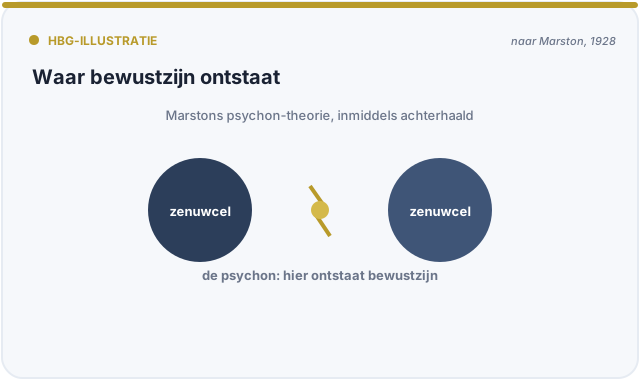
HBG-illustratie bij hoofdstuk III, De psychon-theorie van het bewustzijn
HBG-illustratie · door HBG toegevoegd om dit hoofdstuk toegankelijk te maken. Geen onderdeel van Marstons origineel.

In het kort

Dit is het meest technische hoofdstuk. Marston probeert bewustzijn een fysieke plek te geven. Volgens hem ontstaat het op het verbindingspunt tussen twee zenuwcellen, de synaps, die hij de psychon noemt.

De neurologie is sinds 1928 sterk veranderd, dus deze theorie is achterhaald. Wij nemen haar niet over als wetenschap.

De vraag Wat is bewustzijn? wordt al gesteld sinds het eerste ontwaken van het denken, maar is nooit beantwoord. Onze tijd kan bogen op een geheel eigen, nieuwe vraag: Bestaat bewustzijn wel? Voor wie zijn nuchtere leven buiten de academische luchtkastelen heeft geleid, klinkt die vraag belachelijk. Toch raken docenten van de oude school flink in verlegenheid wanneer ze een gezond sceptische jongere generatie ervan moeten overtuigen dat er zoiets als bewustzijn bestaat.

Wat is het dan? vragen de studenten die Watson lezen. Waar zit het? Bewijs me maar dat bewustzijn bestaat. Tevergeefs houdt de docent vol dat iedereen weet wat bewustzijn is, omdat iedereen bij bewustzijn is, en dat veel verschijnselen die je niet kunt aanstoten, schijnbaar de behavioristische toets voor echt bestaan, toch aantoonbaar bestaan. Heel goed, antwoorden de studenten, laat het ons dan zien.

Objectief bewijs voor het bestaan van bewustzijn moet noodzakelijk indirect bewijs zijn, net als bij elektriciteit, radiogolven en zelfs de voortplanting van prikkels in zenuwweefsel. Geen radiogolf, elektrische stroom of zenuwprikkel is op zichzelf tastbaar genoeg om met onze zintuigen en de beschikbare instrumenten te worden waargenomen. Maar de effecten van die krachten op waarneembare materie worden wel aanvaard, niet alleen als bewijs van hun bestaan, maar ook als wetenschappelijk beschrijvende maatstaven waarmee de aard van de onzichtbare oorzaak te bepalen is. Zo kan een elektrische stroom een volt- of amp, eremeter laten uitslaan, een radiogolf kan verschillen in geleiding in een radiobuis veroorzaken, en een zenuwprikkel kan leiden tot gemakkelijk te registreren samentrekkingen van een reepje spiervezel.

Als we het bewustzijn met diezelfde objectiviteit benaderen, moeten we aannemen dat het bewustzijn zelf, of het lichamelijke mechanisme dat het voortbrengt, een bepaalde fysieke kracht is, in staat om zijn aanwezigheid en aard kenbaar te maken door veranderingen in waarneembare materie te veroorzaken. En die kracht, als ze ergens bestaat, is te vinden in de complexere reacties van de normale, volwassen mens. In de termen van het vorige hoofdstuk: we moeten nu bewijzen dat een vitalistische oorzaak die bewustzijn heet werkelijk in een deel van het menselijk organisme bestaat, en dat die complexe energievorm een meetbare invloed uitoefent op eenvoudiger energie-eenheden binnen het lichaam, waarneembaar met onze zintuigen of met instrumenten.

De meeste mensen hebben, zonder hulp van een psycholoog, gemerkt dat sommige van hun handelingen voor henzelf bewuster aanvoelen dan andere. Gewoontehandelingen, zoals lopen, met een horlogeketting spelen of met een stok zwaaien, lijken vaak helemaal niet door bewustzijn vergezeld te gaan. Het nemen van gewichtige beslissingen, dat uren, dagen of weken kan duren, is daarentegen het soort handeling dat het meeste bewustzijn lijkt te bevatten. De vraag of gewoontehandelingen werkelijk geheel zonder bewustzijn verlopen, laten we hier even voor wat ze is. Als onze proefpersonen eensgezind melden dat het ene soort gedrag bewuster is dan het andere, en als daar objectief waarneembare effecten mee gelijk opgaan, dan is dat een wetenschappelijk aanvaardbaar bewijs dat bewustzijn een materiele kracht is die als vitalistische oorzaak op ons lichaam inwerkt. Precies zoals de uitslaande naald van een voltmeter geldt als bewijs van de onzichtbare elektrische stroom.

Onze eerste vraag luidt dus: welke veranderingen in het lichamelijk gedrag gaan kenmerkend samen met dit gemelde bewustzijn?

In dit hoofdstuk · 4 delen
  1. Bewijzen dat bewustzijn bestaat
  2. Niet in de zenuwcel zelf
  3. Wel op het verbindingspunt
  4. De psychon
Deel 1 van 4

Bewijzen dat bewustzijn bestaat

HBG-beeld bij Bewijzen dat bewustzijn bestaat
HBG-toevoeging · samenvatting en beeld in onze stijl. Geen onderdeel van Marstons origineel.

In het kort, in onze taalMarston begint met de vraag of bewustzijn echt is. Hij vindt van wel, en zoekt naar de fysieke plek waar het ontstaat.

Bewijzen van bewustzijn

1. Hoe bewuster een reactie, hoe trager ze is

Vaak is opgemerkt dat hoe bewuster een handeling is, hoe langer de waarneembare vertraging tussen de prikkel en de zichtbare reactie. Gewoontehandelingen volgen heel snel op de prikkel, terwijl bij gewichtige beslissingen de daadwerkelijke handeling dagen of weken kan uitblijven. Reflexen als de kniepeesreflex, waar de persoon zelf geen begeleidend bewustzijn bespeurt, hebben een nog kortere reactietijd dan gewoontehandelingen. En bepaalde denkactiviteiten, die urenlang kunnen aanhouden en de hele tijd als intens bewust worden ervaren, leiden soms nooit tot een waarneembare eindreactie. Een waarneembaar effect van bewustzijn op gedrag is dus een verlenging van de tijd tussen prikkel en reactie.

2. Hoe bewuster een reactie, hoe langer ze aanhoudt nadat de prikkel weg is

In scherp contrast met het eerste effect staat een tweede, even gewoon verschijnsel. Zuivere reflexen of gewoontehandelingen stoppen heel snel zodra de prikkel verdwijnt. Een machinist drukt de stophendel niet langer in nadat de machine stilstaat. Je maakt geen draaibewegingen met een horlogeketting meer als je in pyjama staat, en je beweegt je benen niet alsof je loopt zodra je languit in een stoel ligt. Maar hangt er meer bewustzijn aan een handeling, dan houdt die vaak veel langer aan nadat de prikkel volledig is weggevallen.

Stel dat een jongeman op de toevallige opmerking dat hij geestelijk niet in orde is, na weken nadenken besluit psychiater te worden. Dit is een echt geval uit mijn praktijk. Binnen enkele maanden gaat hij naar de medische faculteit, maar er volgen lange jaren opleiding voordat hij zijn eigen persoonlijkheid kan analyseren. In al die jaren heeft hij die suggestie misschien geen enkele keer opnieuw gehoord, en toch heeft zijn oorspronkelijke reactie, die gepaard ging met intens en langdurig bewustzijn, jarenlang onverminderd standgehouden nadat de prikkel was verdwenen. De meeste fysiologen zouden het erover eens zijn dat zo'n langgerekte reactie niet een enkele reactie is, maar een lange reeks. Aangezien die reacties grotendeels centraal worden aangestuurd en alle op een doel zijn gericht, moet de oorspronkelijke prikkel ergens in het centrale zenuwstelsel een grote hoeveelheid energie hebben opgewekt, die het gedrag jarenlang bleef sturen. Woodworth spreekt in dit verband van opgestuwde energie die maanden of jaren in het zenuwstelsel kan blijven, en in kleine stroompjes ontsnapt zodra de juiste prikkel de dam doorboort.

3. Hoe bewuster een reactie, hoe minder haar ritme samenvalt met dat van de prikkel

Bij gewoonte- of reflexhandelingen komt het ritme van de reactie veel nauwer overeen met het ritme van de prikkel dan bij bewustere reacties. Bij het zwaaien van een wandelstok of het bedienen van een halfautomatische machine passen de lichaamsbewegingen zich vanzelf aan het ritme van de prikkeling aan. Dat is nog sterker bij zeer ingesleten activiteiten als koordans, pianospelen of typen. Maar hoe bewuster de handeling wordt, hoe meer die vanzelfsprekende overeenkomst tussen het ritme van prikkel en reactie uiteenvalt. Laat de danseres zich plotseling bewust worden van haar passen, de typiste van de toetsen, de pianist van zijn noten, en het ritme is verbroken. Gratie verandert in houterige onhandigheid, snelle precisie in aarzelend geklungel. Mensen die veel zelfbewustzijn tonen terwijl ze reageren, zijn berucht onhandig in spel of beweging waarbij het ritme van het lichaam nauw moet aansluiten bij dat van de prikkel. Het toegenomen bewustzijn lijkt de overeenkomst tussen beide ritmes te verstoren.

4. Hoe bewuster een reactie, hoe minder haar sterkte samenvalt met die van de prikkel

Binnen grenzen komt de sterkte van eenvoudige reacties, met weinig bewustzijn, redelijk overeen met de sterkte van de prikkel. Een zanger zingt onbewust luider als het pianospel aanzwelt. Bij het lopen passen we onze bewegingen onbewust aan kleine verschillen in de druk van het pad aan. Maar bij reacties met veel bewustzijn kan er weinig of geen overeenkomst zijn tussen de sterkte van prikkel en reactie. Bij de jonge psychiater in spe was de toevallige opmerking over zijn mogelijke afwijking een prikkel van geringe sterkte. Dezelfde opmerking was waarschijnlijk over bijna al zijn vrienden gemaakt zonder enig gevolg, en toch maakte ze in dit geval een hoeveelheid bewuste energie los die duizenden keren sterker was dan de prikkel zelf.

Soms vermindert toegenomen bewustzijn de sterkte van de reactie juist, zoals wanneer de zanger denkt: de piano is te luid, ik zing pianissimo en dwing hem mij te volgen. Of de reactie wordt actief geremd. Een voorbeeld is het volledig wegvallen van een handeling door even na te denken na een irritante prikkel. Het ene kind geeft het andere een flinke klap. Indachtig de oude raad tel tot tien voordat je terugslaat, merkt het geslagen kind dat het na tien tellen helemaal geen zin meer heeft om terug te slaan. Bewust nadenken heeft de reactie op een sterke prikkel volledig weggenomen. Bewustzijn verandert dus duidelijk de overeenkomst tussen de sterkte van prikkel en reactie.

5. Hoe bewuster onderdrempelige prikkels, hoe sterker ze de neiging hebben op te tellen

Een prikkel die weinig of geen bewustzijn opwekt en te zwak is voor een reactie, leidt zelden tot die reactie, ook al wordt hij vaak herhaald. Tijdens mijn eerste twee jaar in New York passeerde ik het Metropolitan Museum zeker honderd keer met de bus of auto, zonder ooit aanstalten te maken naar binnen te gaan. Een metgezel had het me vroeg eens aangewezen, en ik had de gewoonte gekregen die kant op te kijken bij het passeren. Maar die latere visuele gewaarwordingen, al stuurden ze mijn oogbewegingen, wekten geen enkele gedachte of gevoel over het gebouw op. Kortom, het zien van het museum was een vrijwel onbewuste prikkel, te zwak om de reactie van naar binnen gaan op te roepen, en eindeloze herhaling bracht die reactie niet teweeg.

Na ruim twee jaar in de stad raakte een gast van elders in mijn bijzijn uitgebreid over de wonderen van het Metropolitan. Die prikkel wekte mijn belangstelling, en ging gepaard met veel bewuste gedachten, maar bleek toch te zwak om me naar het museum te krijgen. Ruim een maand later sprak een andere vriend zijn enthousiasme erover uit, wat nog meer bewustzijn opriep. Die prikkel, opgeteld bij de eerste bewuste prikkel, stuurde mij naar het museum. Het lijkt me hoogst onwaarschijnlijk dat de talloze gewoonteblikken hebben bijgedragen aan de uiteindelijke optelling van energie, of dat nog eens twee jaar dagelijks langs het gebouw rijden me erin had gekregen. Twee prikkels die veel bewustzijn opwekten, telden zich bij elkaar op tot een reactie, terwijl honderd nauwelijks bewuste prikkels datzelfde niet teweegbrachten. Je kunt dagelijks maandenlang onbewust naar een winkel kijken zonder binnen te gaan. Verschijnt er dan een bewegend reclamebordje in de etalage, dan word je je even bewust van een vraag hoe het werkt, en op de derde of vierde dag ga je naar binnen en koop je wat het bordje aanprijst. Bewust ervaren prikkels tellen zich bij herhaling sneller en effectiever bij elkaar op dan onbewust opgevangen prikkels.

6. Hoe bewuster een reactie, hoe meer ze aan vermoeidheid onderhevig is

Hoe meer bewustzijn een activiteit vergezelt, hoe sneller de vermoeidheid intreedt, of het nu om denken gaat of om zware lichamelijke inspanning. Menig hardloper voelde zich wonderbaarlijk opgefrist door iets langs de weg dat zijn aandacht van zijn eigen beweging afleidde. Zijn vermoeidheid neemt af zodra het bewustzijn rond zijn lopen afneemt. Wie voortdurend wetenschappelijk denkt, kan zijn aandachtsspanne vergroten en zijn geestelijke vermoeidheid verminderen door tijdens het denken niet op zijn eigen denken te letten, en zo mogelijk de helft van het begeleidende bewustzijn weg te nemen. Lichamelijke vermoeidheid door spierafvalstoffen komt natuurlijk onvermijdelijk, maar de onvermoeibaarheid van een goed getraind lichaam is verbluffend wanneer de taken als vanzelfsprekend en zo onbewust mogelijk worden verricht. De uithoudingsprestaties van pioniers en inheemse volken zijn daar voorbeelden van. Waar veel bewustzijn is, is ook veel vermoeidheid, en de grenzen van onbewuste activiteit zijn moeilijk te bepalen.

7. Hoe bewuster een reactie, hoe wisselender de drempelwaarde van haar prikkel

Bewustzijn maakt ook minder voorspelbaar hoe sterk een prikkel precies moet zijn om de reactie op te roepen. Eenvoudige reflexen zijn meestal op te wekken met prikkels van ongeveer gelijke sterkte. Er is wel enige speling: de kniepeesreflex wordt prikkelbaarder tijdens sterke hongersamentrekkingen van de lege maag, maar dat verschil is alleen in het laboratorium te meten. Iets complexere maar nog onbewuste handelingen hangen van een bepaalde prikkelsterkte af. De onbewuste reactie op het bestemmingsbord van de tram blijft vaak uit als de verlichting iets wordt gedimd. Mensen houden een tram niet aan omdat de letters voorop kleiner zijn dan ze gewend zijn. Een machinist die op een bepaald geluid afgaat om te schakelen, mist zijn moment als dat geluid iets zachter klinkt. Een huisvrouw die op het borrelen van de koffie afgaat, zet het apparaat niet op tijd uit als dat geluid minder hevig is dan gewoonlijk.

Bij sterk bewuste handelingen is er geen vaste prikkelsterkte aan te wijzen die de reactie altijd oproept. Neem een beslissing om te gaan tennissen of een rit van driehonderd kilometer te maken. De ene dag stemt iemand meteen in met een terloops voorstel, de volgende dag is geen overreding of zelfs vergoeding genoeg om dezelfde reactie op te roepen. Worden zulke handelingen gewoonte, dan daalt het bewustzijn eromheen sterk, en daarmee ook de speling in de prikkelsterkte. Het kernpunt is: bij veel bewustzijn kan dezelfde reactie de ene keer door een zeer zwakke prikkel worden opgeroepen en de andere keer een zeer sterke vergen, terwijl een gewoontehandeling steeds door prikkels van vrijwel gelijke sterkte wordt teweeggebracht.

8. Hoe bewuster een reactie, hoe makkelijker ze te remmen is

Sterk bewuste handelingen zijn gemakkelijker te remmen dan handelingen met weinig bewustzijn. Een liefdesreactie die het bewustzijn van een jonge vrouw dagen of weken heeft beziggehouden, wordt vaak volledig geremd door een toevallige frons of een ongeduldig gebaar van de geliefde. De felste, langdurige plannen van een volwassen man kunnen op een beslissend moment even gemakkelijk worden onderbroken, ook al is de storende prikkel niet sterker dan de afkeuring van een partner. Gewoontehandelingen als lopen of je weg vinden door het drukke verkeer van een grote stad worden daarentegen door de hevigste prikkel, zoals een zakelijk faillissement of het verlies van een geliefde, niet in het minst geremd. Ze worden alleen geremd wanneer ze door een luide claxon in het bewustzijn worden gebracht. Wie met het mes eet, kan die gewoonte alleen afleren door zich er elke keer volledig bewust van te maken. En wie een taak verricht waarbij hij elke zet moet bedenken, kan door een enkele opmerking van een ander de reactie geheel laten stokken. Bewustzijn gaat dus samen met gemakkelijke remming.

9. Hoe bewuster twee reacties, hoe sterker ze elkaar helpen of hinderen

Eenvoudige reflexen met weinig bewustzijn lijken weinig beinvloed te worden door andere reacties die toevallig tegelijk plaatsvinden. Sterk bewuste reacties worden daarentegen makkelijk geholpen of gehinderd door extra bewuste handelingen. Een geliefd experiment onder psychologiestudenten is jezelf leren automatisch te schrijven terwijl je sommen maakt of een oppervlakkig gesprek voert. Eenmaal geleerd, lopen twee zo onbewust mogelijke processen tegelijk, zonder elkaar merkbaar te beinvloeden. In het dagelijks leven zie je hetzelfde: iemand kan vlot over koetjes en kalfjes praten terwijl hij suiker in zijn thee doet, en een chauffeur stuurt, schakelt, geeft gas en bedient de koppeling vaak allemaal tegelijk, zonder onderlinge hinder.

Maar wat gebeurt er als een reactie veel bewustzijn vergt? Stel dat twee onderzoekers verdiept zijn in een gesprek over de apparatuur voor een proef. Een derde student brengt een apparaat binnen dat hij zelf heeft gebruikt. Het bekijken ervan vergt een nieuwe, ingewikkelde reeks reacties. Toch zullen die zich op de een of andere manier vermengen met het lopende gesprek. Past het apparaat bij de plannen, dan zwelt het gesprek meteen merkbaar aan. Brengt het onverwachte problemen aan het licht, dan botst de nieuwe reeks met de vorige, zichtbaar in aarzeling, discussie en onenigheid. Het is onwaarschijnlijk dat het bekijken van het apparaat geheel los van het gesprek kan verlopen. Wanneer lopende reacties veel bewustzijn aan zich binden, blijkt het meestal onmogelijk er tegelijk een nieuwe bewuste reeks bij te doen zonder elkaar te helpen of te hinderen. Hoe bewuster twee reacties zijn, hoe waarschijnlijker dat ze elkaar remmen, versterken door bondgenootschap, of door conflict in efficientie verminderen.

10. Hoe bewuster een reactie, hoe makkelijker ze door middelen wordt weggenomen of versterkt

Sterk bewuste reacties zijn met middelen volledig weg te nemen, terwijl reflexen met weinig bewustzijn onder een matige dosis verdoving nauwelijks afnemen. Bij ether worden eerst de reacties met het meeste bewustzijn uitgeschakeld. De onbewuste reacties lopen vrijwel ongehinderd door, ook nadat de patient alle verdoving heeft ingeademd die hij vrijwillig kan verdragen. Andere middelen, zoals bepaalde vormen van morfine en hennep, versterken in passende dosis juist de meest bewuste reacties enorm, terwijl ze nauwelijks effect hebben op het onbewuste gedrag. De sterk verbeeldingsrijke geschriften van De Quincey gelden als voorbeeld van intens bewuste reacties die, naar zijn eigen verslag, door zulke middelen sterk werden versterkt. W. W. Smith liet zien dat matige doses alkohol een alles, of, niets-effect hebben op de emotionele reacties: de sterk affectieve, zeer bewuste reacties vergen een veel sterkere prikkel om opgeroepen te worden, maar als ze eenmaal optreden, is hun hevigheid buiten verhouding tot de prikkel. Middelen oefenen hun invloed, in welke richting ook, het duidelijkst uit op de reacties met het meeste bewustzijn.

Samengevat zijn er tien gemakkelijk waarneembare, objectieve veranderingen in het menselijk gedrag die gelijk opgaan met een gemeld toenemend bewustzijn: een tragere reactie, een langer aanhouden nadat de prikkel weg is, minder overeenkomst tussen het ritme van reactie en prikkel, minder overeenkomst tussen de sterkte van reactie en prikkel, een sterkere neiging van zwakke prikkels om zich op te tellen, snellere vermoeidheid, een wisselender drempelwaarde, makkelijker remming, sterkere onderlinge hulp of hinder van gelijktijdige reacties, en een grotere gevoeligheid voor middelen.

Net als de vonken van Benjamin Franklins vliegertouw onthullen deze tien gedragsveranderingen een bepaalde, nog niet beschreven vorm van energie. Is die energie hetzelfde als bewustzijn? Er bestaat een logische mogelijkheid die we niet over het hoofd mogen zien: dat de genoemde effecten toe te schrijven zijn aan dezelfde vitalistische oorzaak die tegelijk het bewustzijn voortbrengt, in plaats van aan het bewustzijn zelf. Maar dat is meer een filosofische dan een psychologische kwestie. Alle genoemde effecten moeten, gezien hun stellige aard, aan een vorm van krachtige energie worden toegeschreven, en of die energie het bewustzijn veroorzaakt of het bewustzijn is, is voor de wetenschap een woordenkwestie. De tweede formulering is eenvoudiger en nauwkeuriger.

Als er dus ergens in het organisme een beschrijfbare vorm van energie bestaat die het gedrag op de genoemde manieren beinvloedt, en als die energie steeds gelijktijdig met het bewustzijn verschijnt, dan mogen we voor psychologische doeleinden stellen dat die energie het bewustzijn is. Denk aan een vergelijking. Bij de elektrolyse van water zijn twee verschijnselen waarneembaar: het vrijkomen van waterstof en het vormen van belletjes op de elektroden. Een tijdlang lopen ze parallel, en je zou de fout kunnen maken het ene aan het andere toe te schrijven, in plaats van beide als gevolg van een gemeenschappelijke oorzaak, de stroom, te zien. Na korte tijd echter hinderen de belletjes de stroom enigszins, zodat er minder waterstof vrijkomt naarmate er meer belletjes zijn. Die verandering in de verhouding verraadt meteen dat er een gemeenschappelijke oorzaak gezocht moet worden. Voor zover mijn onderzoek laat zien, is er geen aanwijzing dat de parallel tussen symptomatisch gedrag en bewustzijn op zo'n manier verandert. Bij een volledige overeenkomst tussen beide is de kans groot dat bewustzijn en die krachtige energie identiek zijn.

Deel 2 van 4

Niet in de zenuwcel zelf

HBG-beeld bij Niet in de zenuwcel zelf
HBG-toevoeging · samenvatting en beeld in onze stijl. Geen onderdeel van Marstons origineel.

In het kort, in onze taalHet bewustzijn zit volgens hem niet binnen de zenuwcel, maar ergens anders in het systeem.

Bewustzijn is geen energie binnen de zenuwcel

Wat is de aard van die bewuste energie, en waar is ze te vinden? De eenvoudigste suggestie is dat bewustzijn, fysiek gezien, gewoon energie binnen de zenuwcel is. Gevraagd waarom sommige reacties veel bewustzijn bevatten en andere weinig, antwoorden de fysiologen die hier graag van uitgaan dat alleen in de hoger ontwikkelde hersendelen voldoende zenuwenergie, of voldoende intensiteit, samenkomt om bewustzijn voort te brengen. Sommigen opperen dat er ergens in de hersenen een bijzondere zenuwcel zit die bewuste energie maakt, maar zo'n cel, wezenlijk anders dan de neuronen elders, is nooit gevonden. Dat is dus pure speculatie. Wat dan van het idee dat een voldoende massa zenuwprikkels op zichzelf het bewustzijn vormt?

Komt de geleiding door de zenuwstreng werkelijk overeen met bewustzijn? Daar staan veel bezwaren tegenover. Het belangrijkste: de tien genoemde effecten van bewustzijn hebben hun fysieke grondslag helemaal niet binnen de zenuwcel, maar bij de synaps. Sherrington noemt diezelfde tien effecten, en nog enkele, als eigen aan de reflexboog en niet aan de gewone zenuwstreng. Het kenmerk van reflexgeleiding is juist dat er synapsen in de keten zitten. Daar gebeuren de dingen die de genoemde effecten voortbrengen. Dus: hoe minder synapsen in een keten, hoe minder de voor bewustzijn typische effecten optreden.

Eenvoudige reflexen, met het minste bewustzijn, bevatten juist het grootste aandeel verstoringen binnen de zenuwstreng en de minste synapsen. Als die strengprikkels werkelijk het bewustzijn vormen, dan spreken bewijs en theorie elkaar volledig tegen. Waar het minste bewustzijn optreedt, vind je de meeste strengactiviteit, en omgekeerd. Het lijkt dus onmogelijk om bewustzijn te omschrijven als de energie binnen eenvoudig zenuwweefsel, want daar zitten de mechanismen voor de meest kenmerkende bewustzijnseffecten niet. Bovendien kunnen dezelfde zenuwstrengen voor meerdere doelen worden gebruikt. Volgens de alles, of, niets-wet reageert elke vezel volledig of niet. Als verschillende eenheden bewustzijn uiteindelijk via verschillende paden over korte stukjes zenuwstreng ontstaan, hoe konden ze dan sterk van elkaar verschillen terwijl het grootste deel van hun loutere strengbestanddelen identiek was? Pijnprikkels reizen aanvankelijk over dezelfde zenuwen als koude, druk, gehoor en zicht, die in het bewustzijn juist heel verschillend zijn.

Ten derde blijken vaak verschillende neuronen identieke bewustzijnselementen voort te brengen. De herinnering aan de kleur rood, of aan een vioolklank, kan in het bewustzijn niet te onderscheiden zijn van de oorspronkelijke gewaarwording, terwijl prikkels niet achterwaarts over de aanvoerende banen kunnen reizen. De prikkels achter de herinnerde gewaarwording moeten dus sterk verschillen van die van de oorspronkelijke. Bestond bewustzijn uit het totaal van de betrokken prikkels, dan zou herinnerd rood wezenlijk moeten verschillen van waargenomen rood, want de oorspronkelijke gewaarwording bevat de hele lange oogzenuwstreng-energie die de herinnering mist. Toch is dat verschil er niet.

Ten vierde gebeurt de eigenlijke verbinding tussen zenuwcellen per definitie in de synaps, buiten het binnenste van de cellen. Een stroom van bewustzijn kan dus niet aaneengesloten zijn als je hem zou opvatten als veranderingen binnen een zenuwcel, want telkens wanneer een prikkel van cel naar cel overspringt, is de overdracht van een totaal andere aard. Sherrington merkt op dat het inbrengen van een scheidingsvlak of membraan in de geleider de geleiding moet wijzigen, en dat juist daar de kenmerken ontstaan die reflexgeleiding van strenggeleiding onderscheiden. Bovendien gebeuren alle samenwerkingen en conflicten tussen prikkels die een gemeenschappelijke baan zoeken grotendeels in de synapsen. Zulke bondgenootschappen en tegenstellingen zouden geen tegenhanger in het bewustzijn hebben als bewustzijn beperkt bleef tot wat zich binnen de cel afspeelt. En juist de vaak gemelde gevoelens van conflict en geblokkeerdheid, en aan de andere kant van opluchting en harmonie, lijken af te hangen van precies die uitwendige verhoudingen tussen tegengestelde en bondgenote prikkels.

Ten slotte weten we dat verschillende ritmes van prikkeling, tegelijk toegediend langs dezelfde gemeenschappelijke baan, elkaar niet verstoren. Twee prikkels die tegelijk dezelfde neuronen gebruiken, versmelten dus niet binnen die cellen. Als dat zo is, dan zou de gelijkstelling van bewustzijn met veranderingen binnen de cel al die psychologische versmeltingen en herschikkingen van bewuste elementen, die vrijwel alle waarnemers melden, volledig onverklaard laten. Als zulke versmeltingen werkelijk in de synapsen plaatsvinden, dan kan geen enkele verandering binnen de afzonderlijke neuronen er ooit bewuste uitdrukking aan geven.

Deel 3 van 4

Wel op het verbindingspunt

HBG-beeld bij Wel op het verbindingspunt
HBG-toevoeging · samenvatting en beeld in onze stijl. Geen onderdeel van Marstons origineel.

In het kort, in onze taalBewustzijn ontstaat op de plek waar twee zenuwcellen elkaar raken, de synaps. Daar gebeurt het.

Bewustzijn is synaptische energie

Uit dit korte overzicht blijkt dat er stevige bezwaren zijn tegen het omschrijven van bewustzijn in termen van zenuwprikkels. De vraag blijft dus staan: wat is bewustzijn? Eerder noemden we tien effecten die bewustzijn op gedrag lijkt te hebben, als bewijs dat er ergens in het organisme een werkzame energie met de kenmerken van bewustzijn wordt opgewekt. We zagen dat die tien effecten hun oorsprong niet in de strenggeleiding hebben, maar in wat er bij de synaps gebeurt. Sherrington noemt zo'n dertien tot veertien verschijnselen als kenmerkend voor de synaptische invloed op de geleiding: een latente periode, naontlading, verlies van overeenkomst tussen het ritme van prikkel en eindeffect, hindering van de sterkte-afstemming, optelling in de tijd, vermoeibaarheid, een wisselende drempelwaarde, remming, onderlinge hulp en conflict van prikkels, en een toegenomen gevoeligheid voor middelen, plus onder meer de onomkeerbaarheid van de prikkelrichting, een uitgesproken refractaire periode, baanvorming, schok en afhankelijkheid van de bloedsomloop.
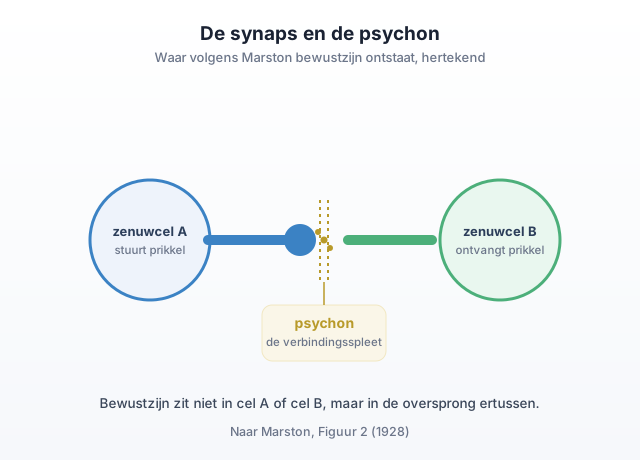
De synaps en de psychon, hertekend in HBG-stijl
Figuur 2, hertekend. De synaps tussen twee zenuwcellen. In de spleet ertussen, de psychon, ontstaat volgens Marston het bewustzijn.
Download de originele tekening (1928)
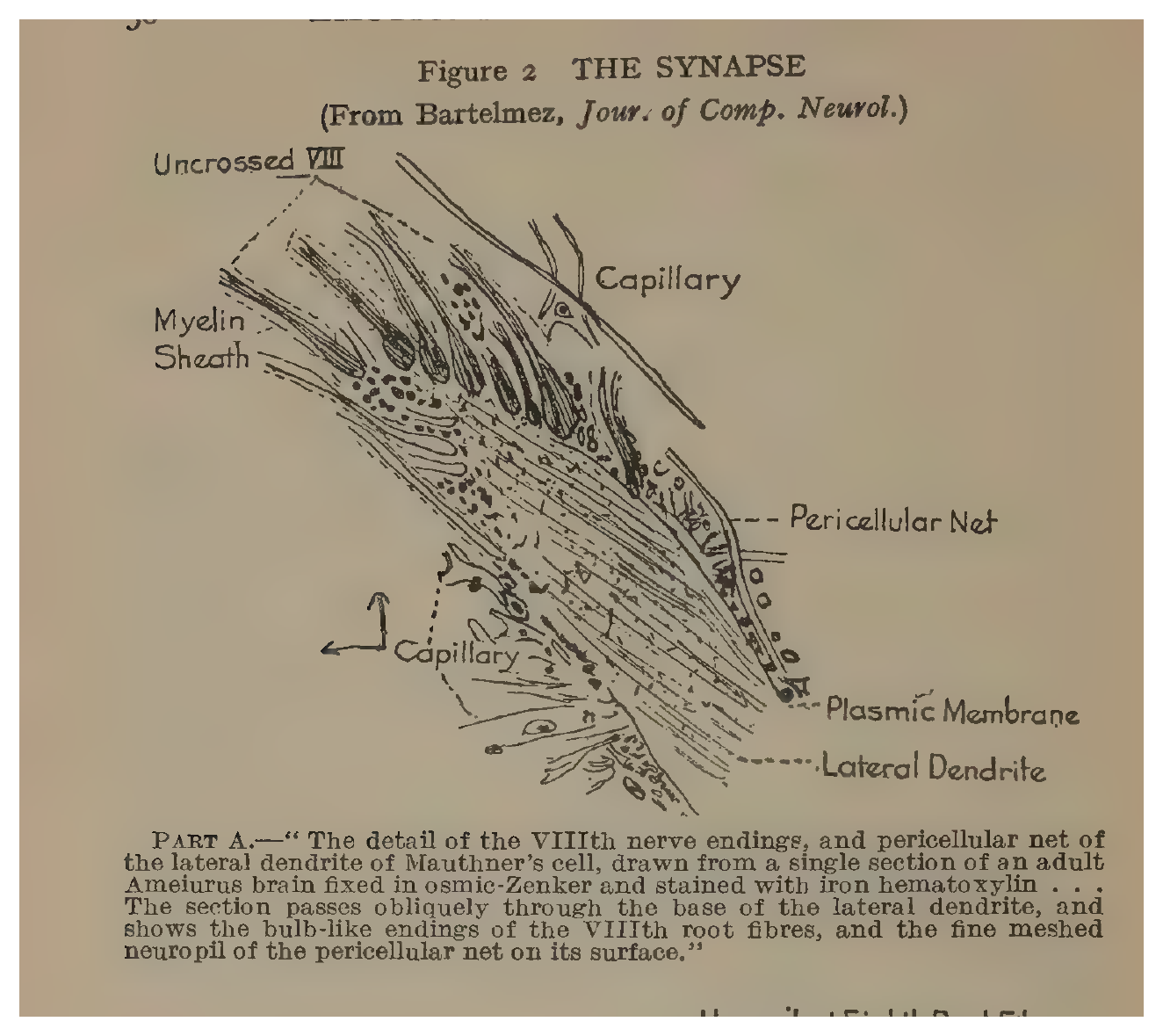
De eerste tien synaptische invloeden komen precies overeen met de tien invloeden die het bewustzijn op het gedrag uitoefent. Ook bij de overige synaptische invloeden is die overeenkomst gemakkelijk te vinden. Een verdere bespreking daarvan laten we achterwege om niet te technisch te worden.

Alle menselijke reacties, van de eenvoudigste tot de meest complexe, hangen waarschijnlijk af van geleiding via reflexbogen, en elke boog bevat volgens Sherrington minstens drie neuronen en dus twee synapsen. Hoe complexer de reactie, hoe complexer de betrokken bogen, en dus hoe meer synapsen er gepasseerd worden en hoe meer synaptische verschijnselen er optreden. Naarmate de boog complexer wordt, neemt het aandeel synaptische energie toe ten opzichte van de loutere strengenergie. En zoals we zagen: hoe complexer de reactie, hoe meer bewustzijn haar vergezelt. Eenvoudige reflexen en gewoontehandelingen komen tot stand met een maximum aan strengenergie en een minimum aan synaptische energie, en bevatten weinig of geen waarneembaar bewustzijn. Complexe, subjectieve reacties bevatten een maximum aan synaptische energie en een minimum aan strengactiviteit, en gelden juist als de reacties met het meeste bewustzijn.

De theorie dat bewustzijn binnen de zenuwcel zit, neemt aan dat bewustzijn alleen in de hogere hersencentra verschijnt, omdat alleen daar genoeg zenuwenergie samenkomt. Maar die hogere centra liggen in de grijze stof, en de grijze stof wordt juist gekenmerkt door een enorm aantal synaptische verbindingen. Ze bestaat vrijwel geheel uit microscopisch kleine neuronen die elk talloze synapsen vormen. De hersencentra waar sommige fysiologen het bewustzijn vermoeden, bestaan dus bijna volledig uit synaptische knooppunten. Als de fysieke basis van bewustzijn in die centra ligt, die grotendeels uit synapsen bestaan, en als de effecten van bewustzijn op het gedrag eveneens synaptisch zijn, dan leidt dat tot de conclusie dat bewustzijn samenvalt met synaptische energie.

Deel 4 van 4

De psychon

HBG-beeld bij De psychon
HBG-toevoeging · samenvatting en beeld in onze stijl. Geen onderdeel van Marstons origineel.

In het kort, in onze taalMarston noemt dat verbindingspunt de psychon. Zijn theorie is inmiddels achterhaald, maar zijn drang om gevoel concreet te maken is typerend voor het hele boek.

De psychon en de psychonische impuls

Synaptische energie is echter een wat vaag begrip. Een soort energie omschrijf je gewoonlijk door het soort materie te beschrijven waarin ze ontstaat. Het woord materie is wat uit de mode, nu men de materie zelf in termen van energie opvat. Toch blijft het een handig woord, als je er een energievorm onder verstaat die zo blijvend gevestigd is dat ze een betrekkelijk gelijkmatige ervaring oplevert. De hele natuurwetenschap gaat ervan uit dat er een soort materie in beweging is. Een samenhangende reeks veranderingen in een vorm van materie beschrijven, mag je het gedrag van die materie op dat complexiteitsniveau noemen.

De natuurkunde beschrijft het gedrag van materie in haar meest elementaire vormen, het proton en het elektron. De scheikunde begint waar de natuurkunde ophoudt en behandelt de wetten van atoom en molecuul. De biologie behandelt nog complexere eenheden, de levende organismen, met de plantkunde voor planten en de dierkunde voor dieren. Dieren zijn zo complex dat hun onderdelen het onderwerp van aparte wetenschappen worden. De fysiologie beschrijft bepaalde delen, de organen, en hun gedrag. De neurologie kiest de zenuwen, waarvan veel organen afhangen, en beschrijft hun gedrag. Bestaat er nu geen verdere materie-eenheid die het gedrag van neuronen kan wijzigen, dan is de psychologie, voor zover ik kan zien, overbodig. Zou ik daarvan overtuigd raken, dan zou ik de psycholoog tot de neuroloog moeten verhouden zoals de timmerman tot de architect, en zou ik proberen aan dat ambacht te ontsnappen door me op te werken tot mijn intellectuele meerderen.

Maar als er, zoals ik vermoed, nog een soort materie-eenheid voorbij het neuron bestaat, die haar eigen reeks veranderingen kan ondergaan, de bewuste of psychische veranderingen, en die daarmee het gedrag van neuronen kan wijzigen, dan en alleen dan is de psychologie werkelijk gerechtvaardigd om een eigen plaats onder de natuurwetenschappen in te nemen, naast de fysiologie en de neurologie.

Neurologen vertellen ons dat er bij de synapsen van alle zenuwstelsels boven dat van de holtedieren een specifieke geleidende structuur bestaat. Het wordt algemeen aangenomen, zegt Sherrington, dat de twee cellen niet werkelijk in elkaar overlopen, maar dat een oppervlak hen scheidt, en een scheidingsoppervlak is fysiek een membraan. Daar zou de zenuwgeleiding precies de kenmerken kunnen krijgen die reflexgeleiding van strenggeleiding onderscheiden. Herrick zegt dat er bij de meeste dieren boven de holtedieren een membraan is dat de neuronen scheidt. De aanwezigheid van die barriere betekent niet dat de neuronen niet in protoplasmatische samenhang staan, want het scheidende membraan is zelf levende stof. Wat ze wel aangeeft, is dat de fysisch-chemische aard van de geleidende stof bij de synaps verandert. Langley noemde die barriere het verbindingsweefsel, en aan het grote fysiologische belang ervan valt niet te twijfelen.

De fysiologen zijn het er dus over eens dat er bij de synaps een bijzondere materie-eenheid bestaat, die een bijzondere energie kan voortbrengen die wezenlijk van de zenuwprikkel verschilt. Over de precieze beschrijving van dat verbindingsweefsel zijn ze het minder eens. Bij de reuzencellen van Mauthner zijn de synapsen onder de microscoop te bestuderen. Bartelmez meldde aanvankelijk dat de knopvormige uiteinden van de axonvezels van de achtste zenuw in contact stonden met het oppervlak van de naburige cel, met een duidelijk membraan ertussen, en dat twee synaptische membranen pas energie moesten krijgen voordat de geleiding zich kon voortzetten. Marui daarentegen, die andere fixeer- en kleurmethoden gebruikte, meende kleine verbindingsvezels te kunnen volgen die door het buitenmembraan naar de naburige cel liepen, en concludeerde dat de vezels binnen en buiten de cel met elkaar in verbinding staan. Bartelmez bekritiseerde Maruis techniek en hield die verbindingsdraadjes voor kunstmatige artefacten van het fixeermiddel.

De exacte structuur van het verbindingsweefsel moet dus voorlopig onzeker blijven. Voor de hier voorgestelde theorie van het bewustzijn maakt het weinig uit of je je dat weefsel voorstelt als een paar plaatelektroden, gevormd uit de membranen van naburige vezels, of dat het later eerder met de wolfraamdraad van een gloeilamp te vergelijken blijkt. Welke waarneming ook het nauwkeurigst blijkt, het bewijs om het bewustzijn bij de synaps te plaatsen verandert er niet door.

Gezien al het bewijs stel ik het volgende voor: het geheel van energie dat in het verbindingsweefsel tussen twee neuronen ontstaat, telkens wanneer het verbindingsmembraan doorlopend wordt geladen, van de afgevende pool van de ene cel naar de ontvangende pool van de volgende, is in wezen het bewustzijn zelf.

Bij het uiteenzetten van deze theorie tijdens colleges bleek het handig om een eigen woord te gebruiken voor zo'n eenheid verbindingsweefsel. De neurologie noemt haar bouwsteen het neuron. In navolging daarvan heb ik de bouwsteen van de psychologie, die toch het psychische of bewuste gedrag bestudeert, de psychon genoemd. De voortplanting van energie op een psychon verschilt wezenlijk van de doorgang van zenuwenergie door een neuron. Een golf van fysisch-chemische opwinding die in een psychon ontstaat, mogen we daarom een psychonische impuls noemen.

Neurologen hebben vastgesteld dat de hoofdtaak van het neuron geleiding is. Mijn voorstel is dat de hoofdtaak van de psychon het bewustzijn is. Welke geleiding er ook over een psychon plaatsvindt, lijkt bijkomstig naast het grotere effect van het afremmen, regelen en wijzigen van die energie onderweg. De wolfraamdraad in een gloeilamp geleidt weliswaar wat stroom van pool naar pool, maar zijn hoofdfunctie is verlichting. Zo mogen we de psychon waarschijnlijk wel als een soort geleider van energie tussen neuronen beschouwen, maar zijn voornaamste eigenschap is naar mijn overtuiging alleen goed te omschrijven als het voortbrengen van bewustzijn.

Waar wij afwijken van Marston: zijn psychon-theorie, het idee dat bewustzijn letterlijk in de synaps wordt opgewekt, is door de moderne neurowetenschap achterhaald. Bewustzijn laat zich niet op een enkel punt lokaliseren. We nemen dit hoofdstuk mee als tijdsbeeld en als mooi beeld, niet als geldende hersenleer.

Bron en verantwoording

Controleer dit hoofdstuk aan de bron

Deze hertaling volgt hoofdstuk III van Emotions of Normal People (William Marston, 1928, publiek domein). Hieronder lees je de volledige originele Engelse tekst van dit hoofdstuk, met de oorspronkelijke paginanummers, zodat je alles kunt nalezen en verifieren. Je kunt ook de volledige woordgetrouwe Nederlandse vertaling en het Engelse origineel downloaden.

De woordgetrouwe NL-vertaling, het Engelse origineel, de HBG-versie en Marston 2.0 zijn gratis te downloaden zodra je een HBG-account aanmaakt en je e-mailadres bevestigt. Zo blijft dit gedachtegoed beschikbaar voor iedereen die er echt mee aan de slag wil.

Lees de originele Engelse tekst van hoofdstuk III · Marston, 1928
Dit is de oorspronkelijke Engelse tekst zoals Marston die in 1928 schreef, inclusief de originele paginanummers. Onze Nederlandse hertaling hierboven volgt deze tekst getrouw. Zo is elke passage terug te leiden naar de bron.

THE question, " What is consciousness ? " has been asked, but not answered, since the first dawnings of speculative thought. The present age, however, can boast of a new question all its own : " Does consciousness exist ? " To one whose common -sense life has been spent outside the intellectual fantasies of academic shades this question might seem ludicrous. Nevertheless, professors of the older school are beginning to experience a considerable degree of bepuzzlement when confronted with the task of convincing a healthfully sceptical younger generation that there is such a thing as consciousness.

" What is it ? " ask the student readers of Watson. " Where is it ? Prove to me that consciousness exists ! "

In vain does the instructor insist that " everyone knows what consciousness is, because everyone is conscious "; that " many phenomena which cannot be ' kicked ' (seemingly the prescribed behaviouristic test for recognizable beingj, can yet definitely be shown to exist."

" Very well ", reply the students, " show us, then."

pagina 51

Objective evidence of the existence of consciousness must necessarily be indirect evidence, just as is the case with electricity, Hertzian waves, and even disturbances of propagation in nervous tissue. No wireless wave, electric current, or nerve impulse is in itself sufficiently tangible to be made subject fo observation by human senses aided by such instruments as are at present available. The effects of these various forces upon observable materials, however, are accepted not only as proofs of the existence of the forces under

1 " The Psychonic Theory of Consciousness " made its first appearance in the Journal of Abnormal and Social Psychology for July, 1926. The theory was amplified in an article appearing in Psyche for July, 1927. Portions of both ai tides are reproduced in this chapter, and the author makers grateiul acknowledgment to the editors foi their kind permission to reprint the material.

examination, but also as scientifically descriptive criteria by which the nature of the unseen causes may be determined. Thus, an electric current may actuate a voltmeter or an ammeter; a Hertzian wave may produce differences of conductivity within an audion tube; and a nervous impulse may

pagina 52

result in easily recorded contractions of a strip of muscle fibre.

If, then, examination of consciousness is approached with similar objectivity, we must assume that consciousness itself, or the physical mechanism used to produce it, constitutes a definite, physical force, capable of registering its presence and nature by causing changes in some observable material. Further, this force, consciousness, if it exists anywhere, is to be found in the more complex reactions of the normal, adult, human being. In terms of the preliminary analysis of causation arrived at in our last chapter, we are now called upon to prove that a vitalistic-type cause called consciousness actually exists in some part of the human organism and that this supposedly complex form of energy exerts a measurable influence upon simpler energy units, within the body itself, capable of observation with the unaided senses or with laboratory instruments.

Most of the human family have observed, without the aid o* a psychologist, that some human activities seem to the subjects themselves to be more conscious than others. Habitual responses, luch as walking, twirling a watch fob, or swinging a stick, often do not seem to be accompanied by any consciousness whatever. On the other hand, the making of momentous decisions which may occupy many hours, days, or weeks, exemplify the type of human action which seems to include the greatest relative amount of consciousness. The question as to whether or not habitual actions are, in truth, totally devoid of consciousness may be regarded at the moment as t purely

pagina 53

academic. If our subjects unanimously report more of the phenomenon called consciousness in one sort of behaviour than in another, and if there are objectively observable effects which seem to proceed paripassu with the increase in consciousness, this constitutes scientifically acceptable proof that consciousness is a material force acting upon our bodies as a vitalistic-type cause. In exactly the same way, the fluctuating needle of the voltmeter is accepted as offering scientific proof of the invisible presence of an electric current acting as a

vitalis tic-type cause over the materials of the instrument. Should this causally effective force, consciousness, be identified later with nervous energy in some part of the brain, it would still remain a vitalistic-type cause, that is, a more complex form of energy than the materials moved. Moreover, when psychology has properly performed its task, we shall hope to find physical consciousness explicitly described in terms of physical energy units.

Our first question, then, is : What changes in bodily behavio.ur characteristically accompany this reported consciousness ?

Proofs of Consciousness

1. The more conscious a reaction is, the slower it is.

It has frequently been observed that the more conscious

pagina 54

an action is, the longer is the observable delay between reception of environmental stimuli and appearance of overt bodily responses. As already noted, habitual actions occur very quickly after contact with the stimulus; whereas, in the making of momentous decisions, overt activity may be delayed for days or weeks. Reflexes like the knee jerk, where no accompanying consciousness can be detected by the subject himself, manifest a still shorter reaction time than the habitual responses; while certain " thinking " activities, which may persist over a period of many hours, and which are, recognized as intensely conscious throughout the entire period, may never manifest a detectable ultimate response. One observable effect of consciousness upon bodily behaviour, then, would seem to be a lengthening of the time interval between stimulus and response.

2. The more consciousness accompanying a response, the longer ic persists after the stimulus is removed.

Quite in contrast to the first-mentioned result of the influence of conscious energy upon bodily behaviour is a second equally common effect. Strictly reflex, or habitual actions, tend to cease very quickly after the removal of the environmental stimulation that brought them about. For instance, a machine operator in a factory does not continue to press down the stopping lever of his machine after the machine has stopped. One does not continue to make watch-fob-twirling movements

when dressed in pyjamas, nor to swing the legs in a walking movement after stretching oneself out in an easy chair. On

pagina 55

the other hand, if a greater amount of consciousness is attached to a given action, the action is likely to persist for a much longer period after complete removal of the effective stimulus. Suppose a young man has responded to the stimulus of a chance remark that he is " mentally abnormal " by deciding, after some weeks of cogitation, to become a psychiatrist (an actual case which cajrie to my attention in clinic). He begins to act upon this remark within a few months by entering a medical school, but long years of training must follow before he can even begin to analyze his own personality. During these years he may not once have encountered any repetition of the suggestion that he is mentally unbalanced, but his original reaction, which was initially accompanied by intense and prolonged " consciousness " of both emotional and intellectual varieties, has persisted without abatement throughout a period of years after the disappearance of the environmental stimulus. Probably most physiological authorities would agree that such a tremendously extended response represents not a single reaction, but a long series of reactions. Since most of these responses are centrally initiated, and all are unified to accomplish a single purpose, the original stimulus must have evoked a large volume of energy somewhere in the central nervous system which continued to control behaviour for a long period of years. In conformance with this idea, R. S. Woexlworth 1 in his theory of " tendencies to action " and " preparatory reactions " holds that " damned up energy " may exist in the central nervous system for periods of months and years, escaping in tiny rivulets as the dam is punctured by appropriate environmental stimuli.

3. The more conscious a response is, the less its rhythm

pagina 56

corresponds with the rhythm of the stimulus.

Habitual or reflex actions show a much closer correspondence between the rhythm of end effect and the rhythm in which the stimulus is received than do more conscious responses. In the swinging of a cane or regulation of a semi-automatic machine, the rhythms of bodily response are adjusted automatically to the rhythms of stimulation. This type of adjust-

1 R. S. Woodworth, Psychology, New York, 1925, pp. 82-84..

3 o EMOTIONS OF NORMAL PEOPLE

ment is still more marked in such highly reflex activities as skilled chorus dancing, playing the piano, or using a typewriter. On the other hand, the more conscious the action becomes, the more the automatic correspondence between rhythm of stimulus and rhythm of response tends to be broken up. Let the dancer become suddenly aware of her steps, the typist of the keys, the pianist of his notes, and the established rhythm is shattered. Grace dissolves into jerky awkwardness, speedful accuracy into hesitant blundering and rhythmic harmony to lagging dissonance. " Introverted " persons, or. those customarily given to expressing a great deal of "selfconsciousness " while reacting to a stimulus, are notoriously awkward in games or physical exercises requiring close approximation of the rhythm of bodily responses to the rhythm of an environmental stimulus. Their physical actions are jerky, and indiscriminately slower or quicker than the rhythm of the physical stimulus to which they are attempting to adapt their own rhythms of action. The increased consciousness seems to interfere with the correspondence between rhythm

pagina 57

of stimulation and rhythm of response.

4. The more conscious a response is, the less its intensity corresponds with the intensity of the stimulus.

Within limits, the intensity of simple reactions, involving little consciousness, corresponds rather closely with the intensity of the physical stimulation. A vocalist unconsciously sings louder if the volume of the piano accompaniment is increased. Small adjustments in the reactions of walking are made " unconsciously " in response to differences in intensity of pressure stimulation presented by the path along which one is walking. A slight up grade which increases the intensity of the pressure upon the feet and also increases the intensity of muscular pressure upon the proprioceptive sense organs, is " unconsciously " followed by corresponding increase in the intensity of muscular exertion. But in responses which are reported as involving a great deal of consciousness, there may be little or no correspondence between the intensity of the stimulus and the intensity of reaction to the stimulus. In the case of the young psychiatric student just considered, the chance remark concerning his possible abnormality constituted a stimulus of slight intensity indeed. The same remark, or similar ones, had probably been made concerning nearly all of this young man's friends with no

particular effect, yet in the specific case cited it released a volume of energy regarded as " conscious ", which was probably many thousands of times as intense as the stimulus, and

pagina 58

which was also more intense than reactions to other stimuli much more intense than this stimulus. On the other hand, instances might be cited where increase of consciousness decreases intensity of response as compared with the intensity of the stimulus as when the singer thinks " The piano is too loud I will sing pianissimo and force him to follow ". Or the reduction in intensity of the response may be a positive inhibition this in turn to be accounted for by the positive agency of some active force within the organism. An example of an effect of this sort is to be found in the total elimination of overt actions which is caused by " pausing to think " after experiencing an irritating stimulus. One child may slap another child's face with considerable strength. Remembering the nursery adage of " count ten before you strike back ", the assaulted youngster finds that by the time he had counted ten he does not feel inclined to strike back at all. Voluntary increase of consciousness seems to have eliminated reaction to an intense stimulus altogether. Consciousness, then seems, on the whole, to alter markedly the correspondence between intensity of stimulus and intensity of respose.

5. The more consciousness attaches to subliminal stimuli, the greater is their tendency to summation.

A stimdlus evoking little or no consciousness, so far as the subject is able to observe, and which is too weak to produce a response, is not apt to bring about the reaction toward which it tends, even though the " unconscious " stimulus be repeated a large number of times. For instance, during my first two years of residence in New York City, I passed the Metropolitan Museum, riding in buses or automobiles, probably a hundred times or more, without making any move toward entering the building. On one of my earliest trips up-town a companion had pointed out the Museum, and I had formed a habit of

pagina 59

looking toward that side of the street in passing. But my subsequent visual sensations, though they controlled eye movements, evoked no thoughts or emotions concerning the building or its contents. In short, visual perception of the Metropolitan Museum constituted an almost " unconscious " Stimulus, of too slight intensity to arouse the reaction of

entering the building, toward which it tended; and constant repetition of this stimulus failed to bring about the final response. After more than two years of residence in the city, a guest from another part of the country chanced to expatiate, in my presence, upon the wonders of the Metropolitan Museum. This stimulus, though it intrigued my interest temporarily, and was accompanied by many fully conscious thoughts and feelings,also proved too weak a stimulus to result in a Museumseeing reaction. More than a month later another friend expressed enthusiasm concerning the Metropolitan, arousing still more consciousness concerning it. This stimulus, added to the first highly conscious stimulus, sent me to the Museum. It seems to me highly improbable that the numerous habitualview stimuli entered into the final summation of energy which brought about the response, or that another two years of viewing the building almost daily would have resulted in my entering it. One may argue, of course, that the two descriptions, by friends, of the museum's contents, were more intense stimuli than were mere views of the outside of the building; and so they were. But the point to be noted here is merely

pagina 60

that two stimulations which evoked much consciousness added themselves together to provoke a certain response, while a hundred little-conscious stimuli failed to bring about the same result. Many other instances of the same sort, from every-day life, might be cited. A person may gaze " unconsciously V at a store, as he walks by it, every day for months, without entering. A " window ticker " may then appear inUhe showwindow, and the subject may become conscious of a momentary wonder as to how the thing works. Next day this same consciousness concerning the ticker may again occur. On the third or fourth day the individual is likely to enter the store and purchase the cigarette or other article advertised by the ticket. It is not our present task to speculate as to how the additional consciousness was aroused by the advertising device; it is our present purpose to note that consciously experienced stimuli tend to add themselves together more quickly and effectively, upon repeated presentation, to evoke the reaction toward which they tend, than do stimuli " unconsciously " contacted.

6. The more conscious a response is, the more subject it is to fatigue.

The more consciousness accompanies any activity, the more quickly fatigue sets in, no matter whether the response is one of " thinking ", or one of violent physical exertion. Many a distance runner has found himself miraculously

pagina 61

refreshed by some sudden roadside occurrence that " takes his mind off " his own movements. His fatigue, in other words, becomes less when the consciousness attached to his own running is lessened. A person whose continuous occupation is " thinking " aloiig scientific lines may learn to increase his attention-span, correspondingly diminishing his mental fatigue, by ceasing to introspect upon his own thinking while he is doing it, thus cutting possibly in half the volume of consciousness accompanying his mental activity. Eventual physical fatigue is inevitable, of course, as a result of muscular fatigue products generated in the course of strenuous exercise or work; but the tirelessness of a well-trained and hardened body is amazing when the muscular tasks undertaken are regarded as mere matters of course, and are performed, as far as the subject can tell, unconsciously. The endurance feats of the American Indian, and the astonishingly continuous exertions of the pioneer type of person, in all lands, are illustrations in point. Where much consciousness is, there much fatigue will be, also; and the limits of endurance of unconscious activities, of all sorts, are difficult to determine.

rl

7. The more conscious a reaction is, the more variable is the threshold value of its stimulus.

Another easily observable effect which consciousness seems to have upon responses to which it attaches is to render less predictable the exact intensity of environmental stimuli necessary to bring about the reactions in question. Simple reflex reactions can usually be evoked by physical stimuli of approximately the same intensity. There is a margin of variability even here. The knee jerk, for example, as^Carlson 1

pagina 62

finds, shows marked increase of excitability, with presumable lowering of threshold stimulus intensity, during strong hunger contractions of the empty stomach. Nevertheless, even the difference caused by hunger pangs in the stimulus intensity necessary to call forth the patellar reflex, could not be measured outside the physiology laboratory.

1 A. J. Carlson, The Control of Hunger in Health and Disease, p. 85, Chicago, 1919.

Activities more complex than the simple reflex but still reported to be unconscious are definitely conditioned upon a specific intensity of stimulus. The unconscious response to the legend naming the destination of the street car or 'bus may frequently fail to occur if the electric illumination of the sign be reduced only slightly. Persons frequently fail to stop a street car because the letters of the legend on the front of the car are smaller than those to which they have accustomed themselves to respond. Machine operators who depend upon a certain sound in the machine they are operating to set off a reaction* of shifting gears, may fail to perform the required net if the sound has slightly less than the customary volume. A housewife, using an electric coffee percolator, and depending for a signal that the coffee is done upon a certain sound made by the bubbling water, may fail to turn off the electric current at the proper moment if the crucial bubbling sound be less in tense than usual.

pagina 63

On the other hand, where the activity is more highly conscious, it is impossible to name a fixed intensity of stimulus which will invariably set off a given reaction. Consider, for example, responses which necessitate a great deal of consciousness such as a decision to play tennis or to take a two hundred mile automobile ride. Upon one occasion a normal subject may assent immediately to a casual suggestion that the tennis be played or that the trip be undertaken. Next day, perhaps, no amount of persuasion or even moderate financial inducement would evoke the reaction bf playing tennis or driving the car. Should these very reactions become habitual, as a part of the subject's professional duties or principal life activity, his consciousness concerning the actions would be tremendously reduced, also the margin of variability of the intensity of stimulus to which he responded. Again, it is necessary to call attention to the fact that we are not considering at the moment the psycho-neural mechanisms by which these differences are brought about. The significant point seems to be that when a large amount of consciousness attends a given response it may be evoked at one time by a stimulus of very low intensity and at another time it may require an exceedingly intense stimulus; while if an action is habitual or " unconscious " it is brought about upon all occasions by stimuli of nearly equal intensity,.

8. The more conscious a response is, the more readily it can be inhibited.

pagina 64

Highly conscious actions are more easily susceptible to inhibition than are responses carrying little observable consciousness. A love response, for example, which may have occupied the consciousness of a young woman for many days or weeks, is frequently completely inhibited by a chance frown or impatient gesture, on the part of the loved one. The most fiercely aggressive purposes of an adult human male, carrying with them both prolonged and intense consciousness, may similarly be interrupted easily by inhibition at a crucial point, even though the intruding stimulus be of no greater intensity than the disapproval of a partner or the absence from the city of another individual concerned in the enterprise. On the other hand, habitual responses such as walking or finding one's way to one's place of business through crowded traffic of a great city, may fail to be inhibited or impaired in the slightest degree even by the most intense variety of stimulus such as business failure, or the loss of a loved member of one's family. They are inhibited only when brought into consciousness by the loud honk of an approaching motor. If an adult eats food with his knife, he can only overcome such a fixed habit by making himself fully aware of his act every time he performs it. If ^person is performing a task which requires him to think out every move, a single suggestion on the part of another may suffice to* inhibit the response altogether. Consciousness, then, seems to be associated with ready inhibition of response.

9. The more conscious two or more responses are, the more they tend to facilitate or to interfere with one another.

There is, we find, another characteristic propensity of conscious behaviour which very closely resembles the ease of inhibiting just considered. Reactions of a simple refl& type to which little consciousness is attached do not seem to be

pagina 65

markedly influenced by other responses which may happen to be simultaneously taking place. Highly conscious reactions, however, are readily facilitated or impeded by the addition of further conscious elements of behaviour. An interesting experiment, frequently performed by students of psychology, is to train oneself to write automatically while performing arithmetical sums, or while carrying on trivial conversation

with another person. When this ability has been acquired, we have a situation where two reflex processes, each as slightly conscious as it is possible to make them, proceed simultaneously without any observable influence one upon the other. Similar effects of the same sort are found in every day life. A person with very little social training can converse readily on superficial subjects, while dropping sugar or lemon in his tea. An automobile driver is required to manipulate the wheel with one hand, turn on the lights, perhaps, with the other hand, regulate the accelerator by pressing down with his right* foot, and let in trie clutch by raising his left foot from the floor of the car. Frequently he must perform all these actions simultaneously and without mutual influence one upon the other.

What happens when the response is necessarily accompanied by a great deal of consciousness ? Suppose that a couple ol research students are deep in discussion of the apparatus required for a given experiment. Another student brings into the room a piece of apparatus which he has used in his own

pagina 66

work. Inspection of his apparatus requires the initiation of a new and complicated group of reactions on the part of both students concerned in the original discussion. Yet their inspection responses will be sure to combine in some way with the discussion already going forward. The new apparatus may harmonize with the plans tentatively evolved. In that case a very noticeable increase in the vigour and vglume of the discussion will immediately occur. Or, as the apparatus is inspected, it may present hitherto unsuspected difficulties in the procedures under consideration. In that case the new set of reactions produced conflict with the preceding responses, the conflict manifesting itself to the casual observer in the form of hesitation, argument, and disagreement. There is little likelihood that inspection of the newly-presented apparatus can proceed simultaneously with the preceding discussion or that it even can alternate with this discussion without influencing it by way of facilitation or conflict or both. When responses already going forward attach to themselves much consciousness, it usually will be found impossible to undertake a new set of conscious responses simultaneously. If the super-added reactions fail to inhibit the preceding conscious behaviour altogether, which is always likely, the new reactions cojnbine with the old either by enhancing their efficiency

)r by introducing obvious conflicts. Whether this result is iue to what has traditionally been called " increase of associative connections " pari passu with increase of consciousness, :>r whether it is to be explained by some more explicit neurological mechanism, the fact remains that the more conscious my two reactions are, the more likely they are to inhibit one

pagina 67

another, to facilitate one another by alliance, or to diminish

one another's efficiency by conflict..

10. The more conscious a response is, the more easily it is abolished or enhanced by drugs.

Highly conscious responses may be abolished completely by the use of drugs, while reflex reactions of low order involving Little consciousness proceed with only slight diminution under moderate dosages of anaesthetic. In taking ether, the responses carrying the largest amount of consciousness are first abolished. The " unconscious " reactions proceed substantially undiminished after the patient has taken all the anaesthetic he is able voluntarily to inhale.

Other drugs, such as various forms of morphia and Indian hemp, in certain appropriate dosages, produce tremendous enhancement of the most highly conscious reactions while having a negligible effect upon the more unconscious types Df behaviour. The highly imaginative writings of DeQuincy triay be cited as examples of intensely conscious responses greatly enhanced, according to DeQuincy 's own report, by appropriate drugs. These same drugs at advanced stages of their influence upon the body may abolish or inhibit the habitual reactions, also; but the first effect to appear as well as the most quantitatively marked influence seems to be exercised upon the most highly conscious activities of the subject.

W. W. Smith has shown 1 that moderate doses of alcohol produce what he calls an " all or none " effect upon the emotional responses of his subjects. That is, the highly Affective

pagina 68

reactions carrying with them a great deal of consciousness require a much more intense stimulus to set them off. When, however, these highly conscious responses are evoked, their intensity is out of proportion to the intensity of the stimulus. We have already noted that conscious emotions were subject to greater variability of effective stimulus intensity and also to less close correspondence with stimulus intensity than are

1 W. W. Smith, The Measurement of Emotion, ch. viii., p. 124. *

the little conscious, or " unconscious " responses. Smithes work, therefore, seems to indicate that the influence of small amounts of alcohol is markedly apparent in those responses to which is attached the larger amount of consciousness. Drugs, then, whatever be the direction of their effect upon the body, appear to exercise their influence more clearly upon the reactions involving most consciousness.

In summary, there are ten easily observable objective changes in human behaviour appearing Simultaneously with the reported increase of consciousness, namely :

1. Logger period between application of the physical stimulus and appearance of bodily response.

2. Persistence of bodily responses after the physical stimulus has been removed.

3. Less correspondence between the temporal rhythm or intervals manifest in the reaction, and the time intervals at

pagina 69

which the environmental stimulus is received.

4. Less correspondence between the intensity of the final bodily response and the intensity of the stimulus.

5. Increased tendency for several stimuli, each too weak to arouse the response by itself, to add themselves together and jointly evoke the reaction toward which they tend.

6. Greater fatiguability.

7. Greater likelihood that the same reactions will occur, at different times, in response to stimuli of different intensity.

8. Increased tendency to be inhibited by stimuli of comparatively slight intensity.

9. Increased tendency to combine with, or to conflict with, simultaneously imposed responses.

10. Increased susceptibility to the influences of drugs. These ten behaviour variances, then, may be shown to

appear in human behaviour pari passu with the reported appearance of consciousness. Like the sparks from Ben Franklfn's kite-string they reveal a specific but as yet undescribed type of energy. Is this energy identical with consciousness ?

There is, of course, a logical possibility, not to be overlooked, that the effects noted may be ascribable to the same vitalistictype cause that simultaneously produces consciousness, instead of the effects being ascribable to consciousness itself acting as a vitalistic-type cause. Elaboration of this logical

pagina 70

issutf, however, is largely academic. All the effects noted

must be attributed, because of their positive nature, to some form of potent energy; and it is more of a philosophical than a psychological issue to decide whether this potent energy causes consciousness or is consciousness. The later form of expression seems, for scientific purposes, more simple and accurate.

If there exists, then, a describable form of energy somewhere within the human organism capable of influencing behaviour in the ways noted, and if this potent form of energy is always found appearing simultaneously with consciousness, we ma}' state, for psychological purposes at least, that lh form of energy thus discovered is consciousness. Should consciousness turn out to be an energy by-product of the primarily potent form of force producing effects enumerated, then we should find inevitably a new series of observable effects which the energy by-product, consciousness, exercises, both over the parent energy directly, or over the physical behaviour results supposed to be produced jointly with consciousness, indirectly.

Consider an analogous situation. During electrolysis of water, two sets of physical phenomena are readily observable the giving off of hydrogen gas, and the formation of bubbles on the electrodes. For a time, after the current is turned on, these two sets of changes run parallel to one another, and during that initial period the mistake might be made of attributing one phenomenon to the causal agency of the other,

pagina 71

instead of considering both as results of a common cause, the electric current. But, after a short time, the formation of bubbles interferes, slightly, with the passage of the current, so that the more bubbles are formed, the less hydrogen is given off. This change in relationship reveals, at once, that a common cause of both phenomena must be sought. So far as my own researches reveal, there is no indication of a change in the parallel relationship between symptomatic behaviour and consciousness, which might suggest that both are attributable to a common cause. In short, granted a complete correspondence between symptomatic behaviour effects, and the appearance of consciousness without subsidiary variance, there is strong likelihood that consciousness and the primarily potent energy cause of the behaviour symptoms are identical. When the nature of this energy is discovered, it can definitely be described, like any other form of energy.

Consciousness Is Not Intra-neuronic Energy

What, then, is the nature of this conscious-energy ? Where is it to be found ? The simplest suggestion, in answer to these questions, seems to be that consciousness, in its physical aspect, is merely intra-neuronic energy. When physiologists, who naturally tend toward this hypothesis, are asked to account for the presence of much consciousness in some responses, and little or no consciousness in others, they^reply that only in

pagina 72

the more highly evolved portions of the bVain is there a sufficient accumulation of nervous energy, or a sufficient intensity, or some other attribute ol nervous energy, to produce consciousness. A few theorists may, perhaps, suggest that somewhere in the brain is a special kind of nerve cell capable of manufacturing conscious energy; but, so far as reported to the literature, no new type of brain cell, differing basically from neurones in other parts of the central nervous system, has been discovered. Such a suggestion, therefore, represents sheer imaginative speculation, and need not be resorted to until all known sources have failed to yield a trace of identification of any known form of energy with consciousness. What, then, of the physiologist's proposition that a sufficient mass of nerve impulses, per se, may constitute consciousness ?

Does nerve trunk conduction actually correspond with consciousness ? There are many difficulties in the way of such a theory.

First, and most important, we find that the teij types of effect upon human behaviour enumerated above as probable results of consciousness, do not find their physical basis in intra-neuronic phenomena at all. They are, rather, attributable to synaptic influence. The ten varieties of end -effect mentioned, together with several other similar effects, are listed by Sherrington 1 as inhering in reflex-arc conduction only, and not in simple nervetrunk conduction at all. Sherrington further Ishows that the salient characteristic of reflex conduction is the fact that synapses are interposed in the total nerve impulse circuit. It is at these synapses that phenomena occur producing the effects reviewed. That is to say, the fewer synapses in any nervous circuit, the less prominently may we

pagina 73

expect the effects which we have seen to be typical of consciousness to appear.

1 C. S. Sherrington, The Integrative Action of the Nervous System, p. 14:

The simple reflex acts, characterized by least consciousness, would contain, on the other hand, by far the greatest proportion of intra-neuronic disturbances, or simple impulses of conduction within the nerve trunk, and by far the fewest synapses. If these nerve trunk impulses truly constitute consciousness, as some physiologists maintain, there is a complete contradiction between evidence and theory. Where least consciousness actually appears, the greatest proportion of nerve trunk activity is to be found, and vice versa. It seems impossible, therefore, to define consciousness as the totality of changes, or energy within simple nerve tisSue, since this does not contain the mechanisms for the effects most characteristic of consciousness in our every-day experience.. In the second place, the same nerve trunks may be used for several purposes, that is, to convey impulses ultimately associated with two or more diverse varieties of consciousness. By the all-or-none law, each nerve fibre must respond in toto if it reacts at all. If, then, different units of consciousness ultimately appear due to ultimately diverse paths over tiny lengths of nerve trunk in the brain, could they escape marked resemblances, one to the other, when the greater portion of

pagina 74

their purely intra-neuronic constituents had been identical ? Pain impulses, for example, seem to travel during the first part of their circuit, at least, over identical sensory neurones with cold, pressure, auditory, visual, and many other types of afferent excitations, modally distinct in consciousness one from the other.

This point 1 has been adversely criticised by A. Forbes, 8 of Harvard Medical School, who cites the work of Adrian and Zotterman. C. J. Herrick,' however, states, " From this it would appear that most sensory nerves may, upon occasion, function as pain nerves." Herrick holds that the painful quality of consciousness is superadded to the ordinary sensory consciousness of the receptor apparatus stimulated, unless the stimulation is excessively strong ". Moreover, according to both physiological and psychological theories of vision, and other senses, excitations ultimately producing different sensations may originate in the same sense organ, thus making the

1 The argument under discussion was advanced more briefly by the writer in " The Paychonic Theory of Consciousness," fourn. Abnormal and Social Psychology, July, 1926.

* In a letter to the writer.

8 C. J. Herrick, Introduction to Neurology, 1920, p, 277.

long, afferent conductor paths to the higher centres identical.

pagina 75

But no part of this identity seems to be left in the final sensory consciousness.

On the motor side, the term, " final common path ", speaks for itself. All motor impulses must travel final common paths with impulses originating from many different sources, so that all must have large identical elements of intra-neural excitement. Physiologists, to be sure, might attempt to avoid this further problem by denying the existence of such a thing as motor consciousness altogether, even though, in so doing, they introduce an inconsistency into their conception of consciousness by maintaining that half the nerve impulses of the body (motor nerves) are not conscious, while the other half (sensory impulses) are conscious. Without pursuing further, at this time, the arguments for and against motor consciousness, we may emphasize the fact that the lack of similarity in various sensory elements of consciousness initially employing identical afferent nerve paths still stands as evidence against the physiological theory that nerve-trunk excitement is consciousness.

In the third place, different neurons appear frequently to be used in manufacturing identical elements of consciousness. Centrally aroused sensation such as, for example, " memory " of the colour red, or of muscle sensations in the legjs or arms, or of the tone of a violin, may be consciously no whit different from the originals of these remembered.sensations when the sensations were evoked directly by environmental stimulation of appropriate sensory nerves. Yet we know that nervous impulses cannot travel backward down the afferent paths so that the actual nerve impulses responsible for the remembered sensations must differ greatly from the

pagina 76

intra-neuronic impulses which brought about the original sensations themselves. If consciousnass consisted of the actual totality of nervous impulses concerned, in each case, then a remembered red sensation might be expected to differ substantially from red sensations which resulted from nerve impulses travelling up the optic nerve. Granted that both environmentally aroused red and the remembered red sensation utilized the same final sensory paths in the visual centres of the brain, there would still be the entire amount of optic nerve trunk energy possessed by the original sensation but not by its memory. Is it probable to suppose that this added incre-

THE PSYCHONIC IHEORY OF CONSCIOUSNESS 43

ment of energy, if this energy were consciousness itself, would add nothing to the totality of consciousness in the original red sensation ?

This proposition might indeed contain greater probability were it not that the optic tract nerve trunks are of great length as compared to the microscopic lengths of conducting fibres in the higher centres of the brain. If each unit of nerve impulse energy is cQnscious, it is hard to see how the very short conductor tracts of* the cerebral centres could contribute a greater total amount of simple nerve impulse energy than could the long affeient nerve trunks; and it is still more difficult to guess how the relatively tiny conductor trunks in the brain could contribute enough nerve impulses to obscure altogether the quantity of intra-neuronic energy contribued by the

pagina 77

afferent nerve trunks. If, as previously noted, the presence of large identical units of nerve energy in the manufacture of different sensations does not make these different sensations in the least similar, no more does the presence of a considerable volume of nerve trunk energy in connection with a given sensation seem to cause the sensation to differ in the least from an identical sensation manufactured without a similar volume or locale of nerve trunk participation.

In the fourth place, although there seems to be a mnemonic factor intrinsic in the behaviour of a single neurone in forming habitual junctions with neighbouring cells 1 there clearly could exist no structural changes within the nerve itself which could actually constitute the process of functional conjunction, since this process by definition takes place in the synapse, externally to the intra-cellular protoplasms of all neurones concerned. Thus no train of consciousness could be consecutive or continuous, if it were regarded as being constituted by the changes within any nerve cell in a reflex arc, for whenever any nervous impulse passed from neurone to neurone the propagation of energy between the cells would be of a totally different nature 8 and so it would no longer be included in our

1 C. J. Herrick, Neurological Foundations of Animal Behavior, New York, 1924, p. 112.

2 C. S. Sherrington states : "... the intercalation of a trans - vcise surface of separation or rrembrane into the conductor must modify the conduction," and : "It (the synaptic membrane) would be

pagina 78

a mechanism where nervous conduction, especially if predominantly physical in nature, might have grafted upon it characteis ju3t such as those differentiating reflex-arc conduction irom nerve-tiunk> conduction." The Integrative Action of the Nervous System, p. 17.

definition of " consciousness ". Moreover, since all facilitations and conflicts between impulses seeking to use a common neural path must occur for the most part in the synapses between the antagonistic neurones and the cell which both sets of impulses are seeking to enter, such alliances and antagonisms could find no counterpart among " conscious " phenomena, were the latter confined to intra-neural activities. Yet frequently reported " feelings of conflict ", " conscious thwartedness ", and, on the other hand, "'relief " and " feelings of harmony " seem most probably to depend upon these very extrinsic relationships between opposed and allied nerve impulses which we have been considering.

Finally, we know that different rhythms of stimulation, simultaneously applied, and using the same final common path to evoke the same muscular response, do not interfere with each other or break up the existing rhythm of response. 1 This would indicate that two separate nervous impulses, though they may use the same neurones simultaneously, do not fuse or combine in any way within the conductor nerve cells. If this be so, then identification of " consciousness "

pagina 79

with intra-neuronic change would leave totally unaccounted for all those " psychological " fusions, alterations, and recombinations of " conscious " elements which are continually reported by nearly all observers. If such fusions actually do occur, as supposed, at the synapses, no possible change within the individual neurones in any reflex chain could ever give them " conscious " representation.

Consciousness is Synaptic Energy

We have seen, during the foregoing brief review, that there exist substantial objections to the definition of consciousness in terms ot nervous impulses. We have, therefore, the question still with us : What is consciousness ? Before discussing the intra-neuronic theory of consciousness, ten types of effect which consciousness seems to have upon human behaviour were mentioned. These ten types of influence were cited as proof that an active energy is generated somewhere in the human organism possessing the attributes of consciousness. During discussion of the first of our reasons for rejecting the intra-neuronic theory, the fact was disclosed that, although

1 C. S. Sherrington, The Integrative Action of the Nervous System, p. i&.

the ten types of conscious influence do not have their causal origin in nerve impulses of conduction, their origin is attributed by neurological authorities to whatever happens at the

pagina 80

synapse. Sherrington lists some thirteen of fourteen phenomena as characteristic of synaptic influence upon nerve conduction as follows 1 :

i latent period

2 after discharge

3 loss of correspondence between rhythm of stimulus and rhythm of end effect

4 interference with grading of intensity

5 temporal summation

6 fatiguability

7 variability of threshold value of the stimulus

8 inhibition

9 mutual facilitation and conflict of impulses (treated

separately in Sherrington 7 s original work) 10 increased susceptibility to drugs : also, irreversibility of direction of nerve impulses, marked refractory period, " bahnung ", shock, dependence upon blood circulation.

It will be noted that the first ten synaptic influences listed correspond to the ten influences consciousness exerts over human behaviour. It is quite easy, also, to discover close correspondence between consciousness and the other synaptic

pagina 81

influences mentioned. Such discussion of these further correspondences is omitted in order to avoid too technical an excursion into neurological subject matter.

While human reactions, from the simplest to the most complex, probably depend upon reflex arc conduction, each arc containing, according to Sherrington,* at least three neurones and, therefore, two synapses, the more complex the reaction, the more complex must be the reflex arcs involved. That is, the more synapses have to be passed in any response, tne more must be the synaptic phenomena under consideration. As the complexity of the arc is increased, the greater will be the volume of synaptic energy as compared to the volume of simple nerve trunk energy. And, as we have observed, the greater

1 C. S. Sherrington, The Iwtegrative Action of the Nervous System, p. 14.

1 "The reflex-arc consists, therefore, of at Jeast thre$ neurones," Sherrington, %bid t p. 35. *

46 JiMOJLlOWS OF JNUKMAL

the complexity of the reaction the more consciousness is to be found accompanying it. Simple reflexes and habitual actions are brought about by a maximum of nerve trunk energy and a minimum of synaptic energy. Simple reflex

pagina 82

responses contain little, or no, consciousness, which the subject himself can observe. Complex subjective responses involve a maximum of synaptic energy, and a minimum of nerve trunk activity. These are the responses which are uniformly regarded as containing a maximum amount of consciousness.

The intra-neuronic tlieoiy supposes that consciousness appears cnly in the higher centres of the brain, because in no other place is to be found sufficient concentration of nerve impulse energy which is regarded as a physical basis for consciousness. " The higher centres " referred to, however, are located in the grey matter of the brain, and the grey matter is characterized chiefly by the enormous number of synaptic connections which are there operative. The grey matter is, in fact, chiefly composed of microscopically small neurones, each forming a large number of synapses with many similar neurones. The cerebral centres, therefore, where some physiologists suppose consciousness to be, are composed almost entirely of synaptic junctures.

Granted that the physical basis of consciousness lies in tbe higher centres, made up chiefly of tremendous numbers of synaptic connections, this fact, together with the evidence offered that the effects of consciousness on human behaviour are also synaptic, lead to the conclusion that consciousness is to be identified with synaptic energy.

Concept of the Psychon, and of the Psychonio Impulse

" Synaptic energy " is, however, a somewhat vague term. Specific types of energy are customarily defined by describing the type of matter within which the energy in question takes its origin. " Matter " is a word that is somewhat out of

pagina 83

vogue, since it is now the fashion to conceive of matter itself in ultimate terms of energy. Nevertheless, if one understands by the word " matter " a form of energy so permanently established that it gives rise to a comparatively uniform sort of experience, it remains a very convenient word to use in a discussion such as the one we are now undertaking.

All physical science assumes that there is some sort of matter, moving. Description of any connected series of

changes in any form of matter and its movement may aptly be termed a study of its " behaviour " in that particular level of complexity. Physics seeks to present basic descriptions of the behaviour of matter in its most elementary forms, the proton and the electron, and to trace the behaviour propensities of larger material masses back to the interaction of proton and electron systems, within the atom. Chemistry begins where physics stops, and deals with the laws of behaviour of the atom and the molecule, each containing varying numbers of protons and electrons. Chemistry deals especially with the laws controlling the combinations of atoms and molecules into more complex forms of matter. Biology deals with the behaviour of still more complex matter units, usually called " living organisms " of various sorts. Biology includes botany, which describes the type of living organisms called " plants "; and zoology, which deals with another type of living organism called " animals ". Animals are matter-units

pagina 84

of such extreme complexity, that their component parts become subject matter for several specialized sciences. Physiology specializes in describing certain parts of the animal termed " bodily organs ", and their behaviour. Neurology selects matter-units called " nerves ", upon which the behaviour of many bodily organs largely depends, and attempts to describe the behaviour of these nerves or neurones. If, then, there exists no further type of matter-unit capable of modifying neuronic behaviour, psychology, for all I can see, is out of a job. Shomd I become convinced of this state of facts I should feel compelled to consider psychologists in the same relation to neurologists as are carpenters to architects, and I should, for my own part, try to escape the fixed limits of craftmanship by studying my way into the ranks of my immediate intellectual superiors.

But, if, as suggested, there exists still another sort of matter unit beyond the neurone, capable of undergoing iti, own particular series of changes called " conscious " or " psychical " changes, and capable of modifying, by these changes, the behaviour of neurones, then, and then only is psychology truly justified in assuming a definite place among the physical sciences by the side of physiology and neurology.

Neurologists inform us that a specific conductive structure does exist at the synapses in all types of nervous systems evolutionally above those of the coelenterates. " It is generally

4 8

pagina 85

Assignments of tKe Sciences

Dcscript/ons or the Behaviour or Eoc,rfc Unjfs or Progressive Levels of Complexity

Physics Profon-Eleclron

Figure i

admitted ", says Sherrington, 1 " that there is not actual confluence of the two cells together, but that a surface separates them; and a surface of separation is physically a membrane.... It would be a mechanism where nervous conduction, especially if predominantly physical in nature, might have grafted upon it characters just such as those differentiating reflex arc conduction from nerve trunk conduction. 1 '

" In most groups of animals above the coelenterates ",

pagina 86

says Herrick,* " the dells of which the nervous system is composed (or some of them) are related to each other quite differently from those seen in the mesh work of protoplasmic -strands which compose the nerve net... there is a membrane separating the neurones. The presence of such a barrier at the synaptic junction does not imply that the neurones are not in protoplasmic continuity, for the separating membrane itself is living substance. What it does indicate is that there is a change in the physico-chemical nature of the conducting substance at the synaptic barriers. Langley has termed this barrier ' junctional tissue ', and of its great physiological importance there can be no doubt."

Physiologists, then, agree that there exists a special type of matter unit at the synapse capable of giving rise to a special type of energy which differs, in essential respects, from the nervous impulse. Neurological authorities, however, are not in such close agreement concerning the physical description of this junctional tissue. In the case of the giant Mauthner's cells, synapses between these cells and adjacent neurones can be seen and studied under the microscope by means of preparations in which the material has been fixed and stained. G. W. Bartelmez originally reported 8 that the knob-like endings of the axone fibres of the eighth nerve were seen in contact with the surface of the adjacent cell. Bartelmez saw a distinct plasm, or membrane, over the root fibres; and, where the lateral dendrite was cut squarely, a smaller *aembrane could be distinguished around it. There is little delay at this synapse, yet Bartelmez found that two synaptic membranes forming a junction by contact with one another

pagina 87

1 C. S. Sherrington, Integrative Action of the Nervous System, p. 16.

2 C. J. Herrick, Neurological Foundations of Animal Behavior, 1924, pp. 104, 114, 115.

8 G. W. Bartelmez, "Mauthner's cell and the Nucleus Motorius Tegmenti," Jour. Comparative Neurology t 1915, vol. 25, pp. 87-128,

Figure 2 THE SYNAPSE (From Bartelmez, Jour, of Comp. Neurol.)

Uncrossed V3E

Capillary

Pen cellular Nef

^"Plasmic Membrane

pagina 88

-Lateral Dendrite

PART A. " The detail of the VHIth nerve endings, and pericellular net of the lateral dendrite of Mautlmer's cell, drawn from a single section of an adult Arneiurus brain fixed in osmic-Zenker and stained with iron hematoxylin... The section passes obliquely through the base of the lateral dendrite, and shows the bulb-like endings of the VIITth root fibres, and the fine meshed neuropil of the pericellular not on its surface."

Myelin 3heotK

Glia Cells

Uncrossed Eighth Root Fibr Lateral De.nd.rife

InferiorYenfrical Dendrite

pagina 89

SupenorVanfncal

PART B. " The right Mauthnor's cell from a young Ameiurus male, fixed In a formol-osmic-Zenker and stained with iron hematoxylln. A semidiagrammatio reconstruction of ten sections, 5/i thick, magnified 250 diameters, to show the relations of dondritoa and axone to the cell body and the two striking synapses of the cell, viz., the endings of the VHIth root fibres (Uncrossed VIII) upon the lateral dendrite, and the axone cap covering the medial surface of the cell. Only four of the cap dendrltes are shown."

had to be energized before conduction could continue through the recipient neurone. Marui, who used different fixing and staining solutions, reported, 1 on the other hand, that he was able to trace tiny connective fibres emerging through the outer membrane of the club endings, and that he traced these minute, protoplasmic threads into contact, at least, with the adjacent neurone. Says Marui, " it is clearly shown that the intra and extra cellular neural fibres communicate with each other ".

Bartelmez, in still a later paper 8, criticized Marui's technique on the ground that he had used formol in the staining solution,

pagina 90

and that the use of this fixative was responsible for the false appearance of intercellular fibres. Such connecting filaments, Bartelmez regards, therefore, as arte-facts. Sherrington 8 in a recent citation propounds a theory of synaptic phenomena which seems to assume the existence of a membrane similar to that described by Bartelmez. Forbes, 4 on the other hand, has propounded a theory of the synapse based upon the idea that the various synaptic phenomena are results of nerve impulses in adjacent neurones being compelled, at the synapses, to communicate their energy through intercellular fibres of much smaller dimensions than the nerve trunk fibres. This view would be in accord with Marui's description of the physical appearance of junctional tissue, rather than with the view of Bartelmez. The exact structural description of the connective synaptic tissue must, it would seem, be left in some doubt for the present. I believe that it will make little difference to the theor}' of consciousness, herein proposed, whether the junctional tissue be thought of as a pair of sheet electrodes formed from the surface membranes of adjacent fibres, or whether the junctional tissue may eventually be described by comparison to the Tungsten filaments of electric lamps. Whichever observation may turn out to be most accurate, the evidence for placing consciousness at the synapse remains unchanged.

1 K. Marui, Jour, of Comparative Neurology t Vol. 30, pp. 127-158.

8 G. W. Bartelmez, " The Morphology of the Synapse in Vertebrates,'* Archives of Neurology and Psychiatry, Vol. 4, pp. 122-126.

pagina 91

8 C. S. Shemngton, " Remarks on Some Aspects ot Reflex Inhibition." 1925. Proc. Royal Soc., VCII, 519.

A. Forbes. " The Interpretation of Simple Reflexes in Terms of Present Knowledge of Nerve Conduction," Physiological Reviews, Vol. II, No. 3, July, 1922, pp. 361-414. p

In view of all the evidence, I submit the suggestion that the totality of energy generated within the junctional tissue between any two neurones, whenever the junctional membrane is continuously energized, from the emissive pole of one adjacent cell to the receptive pole of the next, intrinsically constitutes consciousness.

In expounding this theory during lectures, I have found it very convenient to employ a single term descriptive of any particular unit of junctional tissue which may be under discussion. Neurology, the science of nervous behaviour, dubs its structural unit the "neurone". Following this analogy, I have ventured to term the structural unit of psychology, which, as a science, must surely undertake the study of " psychical " or " conscious " behaviour, the " psychon ".

Propagation of energy upon any psychon, or unit of junc-

pagina 92

tional tissue, is definitely dissimilar in nature to the passage of nervous energy through individual neurones. Following the neurological analogy to its logical completion, therefore, we may term any wave of physico-chemical excitation initiated within a psychon, a " psyihonic impulse ".

It is clearly established by neurologists that the principal function of the neurone is conduction. It is my suggestion that the principal function of the psychon is consciousness. Whatever conduction of energy may occur across a psychofi seems incidental to the modifying major effect of impeding, regulating, and generally psychon's that energy in the course of its passage. The Tungsten filament in an electric light bulb conducts, to be sure, a certain amount of electrical energy from electrode to electrode; but the principal function of the filament is, nevertheless, illumination. Thus, while we may probably regard the psychon as a certain sort of conductor of inter-neuronic energy, we may adequately describe its chief property only, I believe, as the generation of consciousness.

Veelgestelde vragen

Wat is een psychon volgens Marston?
De psychon is voor Marston de plek waar bewustzijn ontstaat: het verbindingspunt tussen twee zenuwcellen, de synaps. Zijn theorie probeert bewustzijn een fysieke basis te geven.
Klopt de psychon-theorie wetenschappelijk?
Nee, de neurologie is sinds 1928 sterk veranderd en Marstons psychon-theorie is achterhaald. De waarde zit in zijn ambitie om gevoel en gedrag terug te voeren op iets fysieks.
Waarom nemen jullie dit hoofdstuk toch op?
Omdat het laat zien hoe Marston dacht en hoe hij zijn hele emotiemodel wilde onderbouwen. Voor de volledigheid en verifieerbaarheid geven we ook zijn verouderde ideeen weer, met duiding.