Ik ben een…Trainer · CoachHR · Team · LeiderDistributeur
Emotions of Normal People · hoofdstuk XVII van XVIII ← Overzicht van alle hoofdstukken
Deel 5 · Als het omslaat
XVII
Reversals, Conflicts, and Abnormal Emotions

Omkeringen, conflicten en abnormale emoties

Elke gezonde drijfveer kan doorschieten. Daar zitten woede, angst, jaloezie en haat.

Je leest op deze pagina hoofdstuk XVII van het boek Emotions of Normal People van William Marston, de oerbron van DISC.

HBG-toevoeging · leeswijzer in onze taal
HBG-illustratie bij hoofdstuk XVII, Omkeringen, conflicten en abnormale emoties
HBG-illustratie · door HBG toegevoegd om dit hoofdstuk toegankelijk te maken. Geen onderdeel van Marstons origineel.

In het kort

Nu keert Marston terug bij de nare emoties. Zijn grote inzicht: woede, angst, jaloezie en haat zijn geen aparte krachten. Het zijn vier varianten van hetzelfde probleem, een drijfveer die op de verkeerde plek staat.

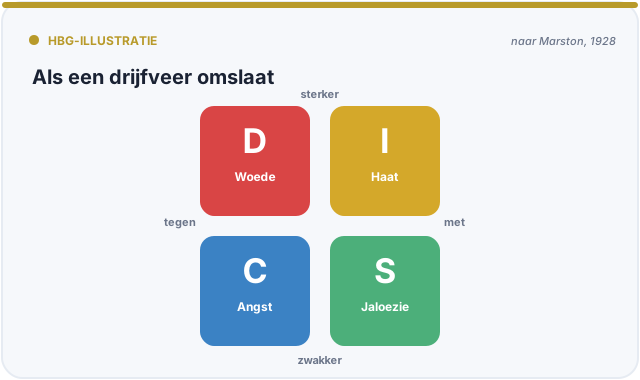
Woede is dominantie die zich vastbijt in iets onoverwinnelijks. Angst is daadkracht die zich onderwerpt aan de dreiging in plaats van andersom. Jaloezie is te veel overgave. Haat is invloed die weigert te buigen.

Een doelmatig samenspel van dominantie en conformiteit vraagt een vaste verhouding tussen die twee. Conformiteit is de voorbereidende reactie, de eerste helper van dominantie. Ze kiest het beste deel van het bewegingszelf uit om te versterken, en werkt als een overloopklep voor te heftige tegenwerkende prikkels. Om die rol te vervullen moet conformiteit voorafgaan aan een compenserende dominantie, en moet ze aan die dominantie zijn aangepast, die het organisme naar zijn natuurlijke evenwicht terugbrengt.

Sherrington vond onlangs geen tonische versterking in de buigspieren van ledematen waarvan de natuurlijke houding tegen de zwaartekracht door de strekspieren wordt bewaard. Conformiteit moet dus eerst de gewone ontlading naar de strekspier remmen en dan de buigspier samentrekken. Die buiging brengt het lidmaat in een onnatuurlijke stand, ongeschikt om rechtop te blijven. Wordt die conformiteit niet gecompenseerd en beeindigd door een gelijke, tegengestelde dominantie, dan kan het dier niet meer staan. Conformiteit mag dus alleen optreden in een lidmaat waarvan de reactie tijdelijk door de andere ledematen in evenwicht wordt gehouden, en mag alleen zover gaan als het meest doelmatig is voor de dominantie die erop volgt. Kortom, dominantie mag nooit worden aangepast aan een conformiteit die erop volgt en die haar stuurt, zonder verlies van evenwicht voor het hele organisme. Conformiteit moet altijd aan dominantie worden aangepast, nooit andersom.

De normale, doelmatige verhouding tussen deze twee appetijt-reacties toont dat het leven zelf afhangt van het blijvende overwicht van het bewegingszelf. De omgeving moet aan het organisme worden aangepast, niet het organisme aan de omgeving. Voorlopige aanpassingen aan de omgeving dienen alleen om die omgeving beter te dwingen het organisme te dienen. Het dier trekt zijn poot terug, maar alleen om die daarna een beetje verder te kunnen strekken en zo de omgeving vollediger te domineren. Het idee van aanpassing aan de omgeving is in de biologie zo benadrukt dat het lastig is in te zien dat aanpassing altijd een middel is, nooit een doel. Zodra aanpassing het hoofddoel van het bestaan wordt, begint de vernietiging van het organisme. Het enige dier dat geheel is aangepast aan zijn omgeving, is een dood dier, waarvan het lichaam is ontbonden tot chemische vormen die geheel bij de omgeving passen. In termen van primaire emoties moet het organisme zijn conformiteit altijd aan zijn dominantie aanpassen.

In dit hoofdstuk · 8 delen
  1. Wat een omkering is
  2. Woede
  3. Angst
  4. De leugendetector
  5. Jaloezie
  6. Haat
  7. Samengevat
  8. Als liefde en begeerte omdraaien
Deel 1 van 8

Wat een omkering is

HBG-beeld bij Wat een omkering is
HBG-toevoeging · samenvatting en beeld in onze stijl. Geen onderdeel van Marstons origineel.

In het kort, in onze taalMarstons sleutelidee: nare emoties zijn een gezonde drijfveer die op de verkeerde plek staat. De volgorde is omgedraaid.

Wat een omkering is

Wordt dominantie aan conformiteit aangepast, dan spreken we van een omkering. Omkeringen ontstaan door te veel dominantie of door te veel conformiteit. Dominantie kan opflakkeren tegen een afgedwongen conformiteit om die weg te werken, en zo voorkomen dat het organisme een nieuwe, aan dominantie aangepaste conformiteit aanneemt die het naar zijn evenwicht kon terugbrengen. Dat is overdominante omkering: een ram die met razende vastberadenheid tegen een onwrikbare muur beukt, juist omdat die muur hem tot conformiteit dwong. Een conflict is onvermijdelijk, waarin dominantie de conformiteit aanvalt. De tegengestelde omkering ontstaat door te veel conformiteit. Conformiteit kan zo woekeren dat het organisme geen nieuwe dominantie durft aan te nemen die de opgeblazen conformiteit inperkt. Dat is overconforme omkering: een kind dat in doodsangst voor zijn eigen schaduw wegrent. Een reeks conflicten volgt waarin conformiteit de dominantie aanvalt.

Deel 2 van 8

Woede

HBG-beeld bij Woede
HBG-toevoeging · samenvatting en beeld in onze stijl. Geen onderdeel van Marstons origineel.

In het kort, in onze taalWoede is dominantie die zich vastbijt in iets onoverwinnelijks. Ze is altijd vergeefs.

Overdominante omkering is woede

De grens tussen enkel koppigheid en woede ligt precies hier. Houd je de armen van een baby vast, dan reageert het kind met pure dominantie zolang zijn bewegingszelf alleen elke versterking oproept om de belemmering af te werpen. Het kind is overdominant, of koppig. Maar zodra het gaat huilen of machteloos wraakzuchtig krijst, is dat het teken dat de afgedwongen conformiteit in zijn bewustzijn is doorgedrongen, en dat zijn dominantie voortaan de tegenstander wil kwetsen in plaats van zijn vrijheid te herstellen. Het kind past nu heel zijn dominantie aan om deze ene conformiteit aan te vallen. Het kind ervaart woede.

Woede is een afwijkende emotie die veel te vaak voorkomt bij volwassenen. Omdat ze meestal uit overdominantie voortkomt, houden velen haar ten onrechte voor normaal en zelfs nuttig. Maar los van de ontwrichting die ze veroorzaakt en de lichamelijke schade die ze vaak oplevert, de ram met de verbrijzelde schedel, is woede niet doelmatig in het uitschakelen van de tegenstander. Domineert de woedende uiteindelijk toch, dan is het de niet-gedwarsboomde dominantie die dat doet, niet de woede. Moet de sterkere tegenstander worden uitgeschakeld, dan gebeurt dat door een nieuwe reeks conformiteiten die de zwakke plekken van de tegenstander uitkiest en domineert. Dat kan een dominantie vragen die zo hevig is dat de persoon zelf het woede noemt, maar zulk geslaagd aanvallen is opgebouwd uit conformiteit netjes aangepast aan opeenvolgende dominantie. Er zit geen woede in, al kan die er wel bijkomen, met bijbehorend verlies aan doelmatigheid. Het woede-deel is altijd vergeefs, en dus afwijkend.

Verwarring ontstaat ook doordat mensen en dieren met buitengewone dominantie hun kracht vaak in woede laten overslaan. Een man die sterker is dan zijn tegenstander kan zich woede veroorloven zonder te verliezen, en de argeloze gevolgtrekking is dan dat de woede de overwinning bracht. Verschijnt er ooit een tegenstander die de woede als zwakte doorziet en uitbuit, dan verliest de sterkere. Zo verging het in de bokswedstrijden tussen Dempsey en Tunney. Dempsey sloeg harder en viel agressiever aan, verreweg de dominantere vechter. Maar hij verviel vaak in woede, wilde blindelings van alle conformiteit af. Tunney, een ongewoon meegaande en intelligente bokser, sneed Dempsey's gezicht haast aan flarden met stoten juist tijdens diens razende momenten. Al gaat grote dominantie vaak met woede gepaard en wint ze vaak ondanks die woede van zwakkere tegenstanders, als onfeilbare regel geldt: overwicht bereik je alleen door conformiteit aan dominantie aan te passen, nooit door overconformiteit zoals in woede. Een hele reeks afwijkende emoties komt uit deze overdominante omkering voort: gedwarsboomde dominantie, prikkelbaarheid, humeurigheid, wraak en neerslachtigheid, tot en met de manisch-depressieve stoornis. Maar dit boek gaat over normale emoties, dus die reeks laten we verder rusten.

Deel 3 van 8

Angst

HBG-beeld bij Angst
HBG-toevoeging · samenvatting en beeld in onze stijl. Geen onderdeel van Marstons origineel.

In het kort, in onze taalAngst is daadkracht die zich onderwerpt aan de dreiging in plaats van andersom. Herstel de volgorde en ze verdwijnt.

Overconforme omkering is angst

De grens tussen schrikken en angst. Sla je met een stok op een pan vlak achter het oor van een baby, dan volgt een schrik: een te plotse, te brede remming van het bewegingszelf, waarbij de tonische energie abrupt wordt afgesneden. De conforme tegenprikkel uit zich in een snelle, oncontroleerbare ruk. Heeft het kind de juiste verhouding tussen conformiteit en dominantie geleerd, dan kan het daarna wegkruipen van de bron. Dan is er geen omkering en dus geen angst, hooguit wat overconformiteit: het kind beweegt verder en sneller dan nodig. Maar die te brede bewegingen zijn wel goed aangepast om het kind in een positie te brengen waar zijn dominantie de conformiteit weer kan vervangen. Zolang blijft conformiteit aan dominantie aangepast.

Maar huilt het kind, sluit het de ogen of valt het neer, zoals Watson in zijn angstproeven beschrijft, dan zijn dat reacties die op geen enkele dominantie gericht zijn. Er is niet alleen overconformiteit, maar ook een falen om die conformiteiten te kiezen die tot dominantie leiden. In plaats daarvan komen ogen sluiten en huilen, dominante gedragingen die alleen gekozen zijn omdat ze naast de overconformiteit kunnen bestaan. De ene dominantie die het overwicht kon herstellen, weglopen, wordt door de conformiteit geremd, en het kind valt neer. Een beetje dominantie wordt aangepast aan heel veel conformiteit, en zelfs die rest wordt door de conformiteit aangevallen. Het kind ervaart angst. Jaren geleden wees ik erop dat James' beroemde stelling, dat we bang zijn voor de beer omdat we wegrennen, moet worden bijgesteld tot: we zijn bang voor de beer omdat we niet snel genoeg wegrennen. En nu nog verder: we rennen niet snel genoeg weg omdat we het de beer naar de zin willen maken en niet onszelf. Zou de rennende psycholoog zich niets aantrekken van de bewegingen van de beer en alleen dominant vastbesloten zijn die beer koste wat kost te verslaan, dan ontkwam hij zeker aan alle angst voor de beer. Want angst komt alleen wanneer dominantie zich probeert aan te passen aan haar doodsvijand, overconformiteit.

Er is veel onzin over angst geschreven. Men zocht de bron in seksualiteit, in de libido, in verdrongen jeugd en in duizend andere onwaarschijnlijke hoeken. Angst is in werkelijkheid een eenvoudige omkering, de kar voor het paard, meer niet. Het is die omgekeerde verhouding die in de kindertijd wordt geleerd, niet losse angsten voor dit of dat. Mevrouw Jones toonde het uitwaaieren van kinderangsten, van harde geluiden naar harige dieren, en men nam vrijwel algemeen aan dat elke angst zich aan een nieuw voorwerp koppelt. Ik zou eerder zeggen: de eerste angst leert een omgekeerde aanpassing van dominantie aan conformiteit tegenover voorwerpen die tegenwerkend en sterker zijn. Daarna leert het kind dat ook andere voorwerpen in die klasse vallen. Elke nieuwe angst schaart niet alleen een nieuw voorwerp in de klasse tegenwerkend-en-sterker, maar versterkt ook telkens de omkering zelf. Zo waaiert angst uit, zowel in het aantal prikkels dat haar oproept als, belangrijker, in de neiging tot die omgekeerde verhouding zodra een van beide reacties het hele leven door optreedt.

Dit kan betekenen dat iemand voor het einde van de puberteit haast voortdurend in angst leeft zodra hij de wereld zonder beschermer tegemoet treedt, met een chronische omkering, angst bij alles wat nieuw is, en compenserende woede zodra hij alleen is. Er is geen ingewikkelde reeks verdringingen en complexen nodig, hooguit als propaganda bij de behandeling. Het maakt niets uit of iemand de omkering leerde van een blaffende bulhond of van alleen in het donker gelaten worden op zijn derde. Hoe hij de omgekeerde verhouding ook leerde, hij heeft nu twee taken: eerst de omkering afleren, dan de juiste verhouding leren, conformiteit aangepast aan dominantie. Het woord angst hoeft nooit te vallen. Angst verdwijnt vanzelf zodra iemand heeft geleerd zijn conformiteit aan zijn dominantie aan te passen, bij alle voorwerpen.

In enkele gevallen lukte die herscholing mij in tien minuten. In andere werkte ik jaren zonder haar bijna af te ronden. Het is een kwestie van de persoon bestuderen, een voldoende overgevende band met de trainer opbouwen, en dan de symboliek en prikkels gebruiken die voor die persoon het meest betekenen. Een algemeenheid mag ik wel wagen: het mysterie uit angst halen is negen tiende van het werk. Zolang iemand angst ziet als een grote, verborgen kosmische kracht die hem elk moment uit het niets, uit de libido, uit de evolutie of uit zijn jeugdcomplexen naar de keel kan vliegen, heeft de klinisch psycholoog geen kans op een miljoen om haar weg te nemen. Die begrippen zijn juist de doeltreffendste leermeesters van overconforme omkering en angst die er bestaan. Zorg, verlegenheid, terugtrekken uit de werkelijkheid, teruggetrokkenheid en een ontoereikende persoonlijkheid, tot en met regelrechte fobieen, wortelen allemaal in overconforme omkering. Maar het zijn afwijkende emoties, en horen dus niet in dit boek thuis.

Deel 4 van 8

De leugendetector

HBG-beeld bij De leugendetector
HBG-toevoeging · samenvatting en beeld in onze stijl. Geen onderdeel van Marstons origineel.

In het kort, in onze taalHier beschrijft Marston zijn bloeddruk-leugentest, de voorloper van de polygraaf. Dezelfde man bedacht later Wonder Woman.

Dominantie en angst in de leugentest

In 1917 meldde ik de ontdekking van de zogenoemde bloeddruk-leugentest. Mijn resultaten toonden dat de bovendruk in een kenmerkende curve stijgt zodra iemand die de proefleider wil misleiden over een vermeend misdrijf, een cruciale vraag krijgt. Een stijging van de bovendruk hoort bij een toename van het bewegingszelf, dus bij meer tonische ontlading via sympathische banen. Er is dus een duidelijke opflakkering van kracht om de dreiging van de cruciale vraag te weerstaan. In de toen gangbare taal noemde ik die emotie angst. In werkelijkheid moet ze dominantie heten.

De aard van die dominantie bleek verder uit reactietijdproeven, waarbij we de extra tijd voor het bedenken van de leugen eruit rekenden. Er bleek een type te bestaan dat sneller reageert bij liegen dan bij de waarheid spreken. Goldstein toonde later dat nog meer mensen dit vertoonden wanneer liegen niet meer denkwerk vroeg dan de waarheid. In een latere proef maten E.H. Marston en ik associatie-reactietijden, waarbij we mensen na het prikkelwoord de tijd gaven zelf een woord te kiezen, terwijl we de bloeddruk registreerden. De vergelijking tussen reageren met het ware woord en met een verzonnen woord overtuigde mij uiteindelijk dat het actieve element van misleiding geen angst is, maar dominantie.

Al is het de dominantie die de misleider verraadt, er zit waarschijnlijk ook veel echte angst in het bewustzijn van bijna iedereen die op misleiding wordt onderzocht, in het lab of in de rechtszaal. Het is de angst die de misleiding op veel manieren minder doelmatig maakt, terwijl juist de meest geslaagde leugenaar zich verraadt door de ademhaling en bloeddruk die op dominantie wijzen. De zwakke leugenaar verraadt zich vaker door langere reactietijden, door schuldige associaties en door zichzelf tegen te spreken bij het kruisverhoor. De zwakkere misleider reageert ook dominant op cruciale vragen, en verraadt zich ook door stijging van de bovendruk, maar die dominantie is kleiner, wordt makkelijker overweldigd, en verraadt zich in een grilliger, minder gladde reeks stijgingen. Waar angst optreedt, uit ze zich in tekenen van conflict tussen het vergeefse verbergen en de afgedwongen overconformiteit met het kruisverhoor. Angst tijdens misleiding levert zo het bewijs van haar ware aard: verzwakte dominantie die zich probeert aan te passen aan overconformiteit met een sterkere tegenstander, en die daarbij voortdurend deels wordt verslagen.

Hieruit volgt dat er twee soorten leugentest zijn. Ten eerste testen van de dominantie waarmee de leugenaar zijn geheime kennis vasthoudt. Ten tweede testen van de nederlaag van die dominantie, dus van de angst, door overconformiteit die de kruisverhoorder afdwingt. De dominantietest werkt bij iedereen, de angsttest alleen bij wie gewoonlijk in de overconforme omkering vervalt of daartoe te dwingen is. De dominantietest verraadt de leugen door elke toename van inspanning om de waarheid te verbergen. De angsttest verraadt de leugen alleen wanneer de persoon onder de druk even zijn greep laat verslappen. De dominantietest moet de persoon aanmoedigen zo hard te liegen als hij wil, de angsttest moet zijn misleiding bij elke stap dwarsbomen.

De dominantietesten zijn: stijging van de bovendruk, verandering in de verhouding tussen uit- en inademing, en verkorting van reactietijden. De angsttesten zijn: verlenging van reactietijden, schuldige associaties, en zelfverraad door tegenstrijdige antwoorden of bekentenis onder druk. Burtt en andere betrouwbare onderzoekers melden de beste en gelijkmatigste resultaten met de bloeddruktest en de ademhalingstest, beide dominantietesten. Langfeld, Jung en anderen melden goede resultaten met de reactietijdtest, een angsttest. Burtt, Troland en ikzelf vonden bij het beproeven voor oorlogsdoeleinden, in rechtszaal en lab, de bloeddruktest het bruikbaarst en de reactietijdtest het minst waardevol, vooral in echte rechtszaken. Larsen, die alle soorten test bij meer dan duizend verdachten gebruikte, liet de associatie- en reactietijdtest later vallen en steunde vooral op de bloeddruktest, met de ademhalingscurve als controle. Hij paste zijn techniek met succes toe bij de politie van Los Angeles, Oakland, Duluth en Evanston. In de praktijk blijkt de dominantietest dus verreweg het betrouwbaarst.

Deel 5 van 8

Jaloezie

HBG-beeld bij Jaloezie
HBG-toevoeging · samenvatting en beeld in onze stijl. Geen onderdeel van Marstons origineel.

In het kort, in onze taalIn de wereld van de verbinding ontstaat jaloezie: te veel overgave, die de ander niet opnieuw weet te winnen.

Omkeringen tussen overgave en invloed

Omkeringen tussen overgave en invloed veroorzaken botsende, gedwarsboomde liefde-emoties, net zoals omkeringen tussen dominantie en conformiteit botsende appetijt-emoties veroorzaken. De doelmatige verhouding is invloed aangepast aan overgave. In bewuste termen: bij alle liefde beinvloed je een ander alleen om je aan hem te kunnen overgeven. Het rustpunt hangt af van een slotovergave die gelijk is aan en sturend over de voorafgaande invloed.

Liefde is precies het tegendeel van appetijt in de verhouding tot de prikkel. Bij appetijt is conformiteit alleen een middel om de prikkel voor eigen voordeel te domineren. Appetijt is zelfvergrotend, en tenzij het organisme aan het eind volledig dominant staat tegenover de omgeving, heeft appetijt haar doel gemist. Bij liefde is het omgekeerd: je stelt jezelf onder de sturing van een ander om jezelf, of een deel van jezelf, aan die ander te geven. Invloed moet altijd voorafgaan aan dat geven, want het hoort niet bij liefde iemand iets op te dringen wat hij niet wil. De ontvanger moet eerst worden bewogen het gewillig en blij te aanvaarden. Kan de overgave niet prettig worden gemaakt voor de ander, dan is het geen echte overgave meer. Invloed moet dus altijd voorafgaan aan en geheel aangepast zijn aan overgave, wil het echte liefde zijn.

Omkeringen ontstaan door te veel overgave of te veel invloed. Overheerst overgave zo sterk dat de persoon, wanneer invloed nodig is om de overgave te kunnen voortzetten, toch blijft proberen zich over te geven, dan lijkt dat op de overdominantie die wraakzuchtig op de conformiteit blijft beuken. Overgave duwt dan hulpeloos en onprettig tegen de prikkel die tot invloed dwong. Dat is overgevende omkering: een minnaar die zwijgend op zijn snor kauwt terwijl zijn geliefde een aantrekkelijker man captiveert. Een pijnlijk conflict tussen de onwillige wens haar aandacht terug te winnen en een overgave aan haar charme die niet wil wijken. Hier valt overgave de invloed aan. De tegengestelde omkering ontstaat door te veel invloed. Ontdekt iemand die anderen altijd wil beheersen dat de overgave die hij als lokaas gebruikte niet volstaat, dan kan zijn invloed bij die weerstand razend opflakkeren. Dat is invloed-omkering: een vrouw die zich aan de voeten van haar vroegere minnaar werpt om hem terug te winnen, slechts een spottende lach oogst, en zich dan met haar nagels op zijn gezicht stort. Hier valt overmatige invloed de overgave aan.

Overgevende omkering is jaloezie

De grens tussen onevenwichtige opgeslorptheid in de geliefde en jaloezie. Watson lukte het niet jaloezie op te wekken door een jonger kind te liefkozen in het bijzijn van een ouder kind dat minder aandacht kreeg. Waarschijnlijk was de liefde nog niet zo ontwikkeld dat overgave omsloeg, en was er op dat moment te weinig liefde-prikkeling gaande. Ik riep wel jaloezie op bij een meisje van drie: terwijl de moeder haar dochtertje op schoot liefkoosde, bracht ik een oudere jongen binnen tot wie de moeder zich wendde en sprak, al hield ze de dochter in haar arm. Het meisje reageerde eerst normaal, met invloed, door aan de jurk van de moeder te trekken en dichter tegen haar aan te kruipen. Toen dat alleen een vermanend Rustig, Bee opleverde, maakte het kind een gebaar alsof het de jongen wilde wegduwen, verborg toen haar hoofd tegen de borst van de moeder en begon zacht te huilen, blijkbaar om aan het bevel rustig te blijven te voldoen. Noch moeder noch kind wist dat er iets werd waargenomen.

De actieve overgave van het meisje was op haar hoogtepunt toen ze werd onderbroken. Dat had normaal invloed moeten oproepen om de overgave te hervatten, en een lichte invloed kwam ook. Maar toen die eerst mislukte, sneed de bestaande overgave die invloed af. Het kind keerde de verhouding om en paste haar overgave aan de mislukte invloed aan, door zich zo goed mogelijk over te geven terwijl de invloed nog ongecontroleerd doorwerkte. Er was een conflict waarin beide elkaar deels dwarsboomden. Overgave moest zich aanpassen aan invloed omdat ze die niet kon wegnemen en er niet voor wilde wijken. Het gevolg was de afwijkende emotie jaloezie, waarschijnlijk voor het eerst in het bewustzijn van dit kind.

Hoe zou een ouder iemand met een gezonde verhouding dit hebben opgelost, zonder omkering en jaloezie? Invloed moet aan overgave aangepast blijven. Dus: de volledige overgave aan de moeder moet doorlopen, wat er ook gebeurt. De enige vraag is hoe die overgave te behouden. En de enige reactie die de moeder tot verdere overgave kan bewegen, is invloed. Geeft de bezoekende jongen de moeder plezier, dan moet de zoeker een manier vinden de moeder nog meer plezier van dat bezoek te geven: de jongen iets vragen wat de moeder bevalt, of hem een koekje geven. Zo'n daad beweegt de moeder om deze nieuwe overgave, het extra plezier, van de hand van haar dochter te aanvaarden. Invloed aangepast aan overgave laat de dochter zich blijvend en actief overgeven. Lichamelijk aankruipen was door de komst van de jongen geen overgave meer, dus moest een nieuwe reeks echte invloed worden gevonden. Dan is invloed steeds aan overgave aangepast, en is er geen omkering, geen conflict en geen jaloezie. Verwante overgevende omkeringen zijn verdriet, rouw, eenzaamheid te midden van gezelschap, schuchterheid en zwaarmoedigheid. Maar het zijn afwijkende emoties, dus laten we die rusten.

Deel 6 van 8

Haat

HBG-beeld bij Haat
HBG-toevoeging · samenvatting en beeld in onze stijl. Geen onderdeel van Marstons origineel.

In het kort, in onze taalHaat is invloed die weigert te buigen: je wilt de ander tot dat ene ding dwingen en ziet niet dat het ook anders kan.

Invloed-omkering is haat

De grens tussen onevenwichtige vastberadenheid andermans daden te sturen en haat. Er zijn geen goed onderbouwde gevallen van echte haat bij kinderen. De duidelijkste voorbeelden op grote schaal zijn de rassenhaat en de haat tussen volken, vooral in oorlog. De gewone burgers van een land raken, vooral door propaganda in de kranten, aangewakkerd door soms politici maar vaker private belangen, ervan overtuigd dat burgers van een ander land de vlag hebben beledigd of de rechten van onze burgers hebben geschonden. Toen de Amerikaanse kranten de oorlog met Spanje begonnen, waren het de rechten van de lijdende Cubanen die de haat opriepen. Om de liefde voor de gekwetste Cubanen uit te voeren, moest Amerika de Spanjaarden bewegen hun behandeling te veranderen. Amerika wilde zich op geen andere voorwaarde schikken dan die het Spanje wilde opleggen. Maar zolang Spanje de Cubanen hard bleef behandelen, wat het even in zijn macht had, werd Amerika gedwongen zich te schikken, ondanks alle pogingen tot invloed. Er ontstond een conflict tussen afgedwongen overgave aan Spanje en overmatige invloed die die overgave aan zichzelf wilde aanpassen. Zolang Spanje niet toegaf, wekte het haat bij elke Amerikaan die aan die omkering leed. Tot de burgers van een volk bereid zijn een ander volk alleen te beinvloeden om zich beter aan diens belang te kunnen overgeven, ontstaat er onvermijdelijk haat zodra het ene volk zich moet schikken naar het andere.

In zulke rampzalige internationale haat, waar miljoenen bewust de meest afwijkende emotie wordt aangeleerd, is de omkering dezelfde als bij de vluchtigste haat tussen twee mensen. En de oorzaak is dezelfde. Wie haat, is zo vastbesloten de ander tot dat ene ding te bewegen, dat hij niet ziet dat hij de ander makkelijk tot iets anders kon bewegen waaraan hij zich wel had kunnen overgeven. Verwoestende dominantie treedt binnen zodra de ander weerstand biedt, die dan een tegenstander wordt, niet meer te beinvloeden maar uit te schakelen en tot conformiteit te dwingen. Zo bereikt de overwinnaar, hoe geslaagd ook, nooit zijn oorspronkelijke doel de ander tot overgave te bewegen. Hij kan hooguit een vijand domineren en conformiteit afdwingen. Wil hij het eerste doel bereiken, dan moet invloed aan overgave worden aangepast: er moet een handelwijze van de ander worden gevonden waaraan de beinvloeder zich uiteindelijk wil overgeven, en waartoe hij de ander nu kan bewegen. Beiden moeten zich uiteindelijk overgeven, en beiden moeten een invloed kiezen die de overgave van de ander doet aanvaarden. Dat is compromis, volkerengemeenschap en vrede. Invloed moet aan overgave aangepast blijven, anders worden mensen dingen en vernietigen ze elkaar. Haat is de afwijkende emotie die de vernietiging van mensen door mensen begeleidt.

Al wijkt invloed in oorlog grotendeels voor dominantie, er blijft genoeg omgekeerde overgave en invloed over om de motiverende haat gaande te houden, zonder welke die vergeefse dominantie snel zou uitdoven. En haat is goed van dominantie te onderscheiden. De achterliggende wens is niet de vijand tot conformiteit maar tot overgave te dwingen, en wel tot een bepaalde, willekeurig gekozen invloed. Daarom is er de drang de invloed, nu verworden tot vernietigende dominantie, steeds heviger te maken zodat het slachtoffer haar genoeg voelt om zich over te geven. De omgekeerde beinvloeder ziet volstrekt niet in dat de kracht van invloed niet in tegenwerkende hevigheid ligt, maar in bondgenote hevigheid. Zit er ook maar iets kwetsends in de overmaat, dan verliest de invloed alle macht om overgave op te roepen. Maar de aanvaller beseft dat niet, zijn overgave en invloed staan omgekeerd. Om zijn invloed krachtiger te maken zoekt hij de gehate zoveel mogelijk persoonlijk te kwetsen. Dat geeft haat een heel ander bewust karakter dan dominantie, die de prikkel alleen tot alliantie wil dwingen of als hindernis wil wegnemen. Dominantie is hevig, meedogenloos, maar onpersoonlijk. Haat is bewust wreed, nog heviger dan dominantie, en juist persoonlijk. Wrok, zogenoemde gedwarsboomde seksualiteit, bepaalde vormen van kwaadaardigheid en paranoia horen bij haat in deze reeks. Maar het zijn afwijkende emoties, dus daarover niet verder.

Deel 7 van 8

Samengevat

HBG-beeld bij Samengevat
HBG-toevoeging · samenvatting en beeld in onze stijl. Geen onderdeel van Marstons origineel.

In het kort, in onze taalVier nare emoties, een oorzaak: herstel de volgorde en je zet ze terug.

Samenvatting

Conformiteit moet aan dominantie worden aangepast, en invloed aan overgave, wil de mens normaal blijven. Omkeringen leiden altijd tot conflict. Het gaat het organisme boven de macht om bepaalde conformiteit aan te passen aan enige dominantie die het kan opbrengen. Toch kan de overdominante het onmogelijke blijven proberen, ook al zijn er andere conformiteiten die makkelijk in dominantie konden overgaan. Hij blijft op de onoverwinnelijke conformiteit hameren, met een dominantie die deels wordt gedwarsboomd door het besef van de vergeefsheid. Dat is overdominante omkering, met woede als typische emotie. Er kan conformiteit gaande zijn die het organisme wel in dominantie kon omzetten, maar de overconforme durft het mogelijke niet. Zijn dominantie wordt vernietigend aangepast aan zijn conformiteit, terwijl hij beseft dat de dominantie steeds wordt verslagen. Dat is overconforme omkering, met angst als typische emotie. Er kan overgave gaande zijn die het organisme kon voortzetten met de juiste invloed, maar de overgevende kan die invloed niet kiezen. Zijn overgave past zich aan de vergeefse invloed aan, terwijl hij beseft dat ze wordt verslagen. Dat is overgevende omkering, met jaloezie als typische emotie. En het gaat boven de macht van het organisme bepaalde invloed aan te passen aan zijn overgave. Toch kan de overmatige beinvloeder het onmogelijke blijven proberen, met een steeds hevigere vergeefse invloed. Dat is invloed-omkering, met haat als typische emotie.

Deel 8 van 8

Als liefde en begeerte omdraaien

HBG-beeld bij Als liefde en begeerte omdraaien
HBG-toevoeging · samenvatting en beeld in onze stijl. Geen onderdeel van Marstons origineel.

In het kort, in onze taalOok tussen liefde en appetijt kan de volgorde omslaan. Daaruit komen nog meer ongezonde patronen voort.

Omkeringen tussen liefde en appetijt

De normale verhouding is appetijt geheel aangepast aan liefde. Een leven dat zowel geslaagd als gelukkig is, past zijn successen aan zijn geluk aan. Wie geluk aan succes aanpast, faalt uiteindelijk in beide. Waarschijnlijk lijdt bijna ieder mens min of meer aan deze omkering tussen liefde en appetijt. Het stelsel van Freud lijkt gebouwd op de meest fundamentele van alle ontdekkingen: dat appetijt aan liefde moet worden aangepast, terwijl de moderne zeden liefde aan appetijt aanpassen. Maar de waarde van die ontdekking is tenietgedaan door liefde zelf in appetijt-termen te beschrijven. De aanstaande minnaar krijgt te horen dat hij appetijt of begeerte heeft naar het lichaam van zijn geliefde. Liefde wordt seksuele emotie genoemd, en haar zogenoemde normale uiting beperkt tot seksuele appetijt tussen de geslachten. Zo wordt juist de omkering, liefde beheerst door appetijt, die sommige analytici als bron van alle conflict erkennen, in stand gehouden door liefde als eten en verteren van de geliefde af te schilderen.

Wil men de normale verhouding begrijpen, dan moet men eerst de ware aard van liefde begrijpen, want liefde moet de sturende reactie zijn waaraan appetijt zich aanpast. Liefde is geven, geen nemen; voeden, geen eten; een onbaatzuchtige alliantie, geen zelfzuchtig conflict met een lustobject. Wat het organisme tijdens appetijt verwierf, moet het in liefde weer weggeven, en dat alles omvat het organisme zelf. Weggeven betekent echter geen vernietiging van de gever, alleen een overgave van alles wat hij heeft, ook zijn lichaam, aan de dienst van de geliefde. De normale verhouding, appetijt aangepast aan liefde, wordt aan het vrouwelijk organisme opgelegd tijdens de voortplanting. De vrouw raakt daarbij niet uitgeput, want ze moet sterk en doelmatig blijven om juist haar kind te dienen. Wie zich geheel aan de omgeving aanpast, moet sterven en ontbinden. Wie zich aan de geliefde overgeeft, moet gezonder en levendiger worden dan tevoren. Elk verval van de voortbrengende vrouw schaadt haar schepping evenredig. Volledige aanpassing van appetijt aan liefde is dus maximaal doelmatig, zelfs voor de gever, en wordt nooit zelfopoffering zolang liefde werkelijk stuurt. Pas als de omkering binnensluipt, ontstaat conflict tussen liefde en behoefte.

Omkeringen tussen liefde en appetijt in het gedrag

Actieve liefde beheerst door actieve appetijt levert het gedrag op dat in Amerika bekendstaat als gold digging. Revuemeisjes, jongere zonen die om geld trouwen en gigolo's die op oudere vrouwen jagen, zijn beroepsjagers op geld. Maar amateurs zijn er overal, en in bepaalde society- en collegekringen is een meisje zonder enige trek van de golddigger haast niet te vinden. Het aantrekkelijke is dat er niets tegenover het verkregen voordeel hoeft te staan. Actieve liefde captiveert de uitgekozen bron. Zodra die genoeg onder liefde-controle staat, wordt actieve appetijt aangezet om de buit weg te halen. Noch overgave noch conformiteit, de twee moeilijkste emoties om te leren, zijn nodig. Actieve liefde en actieve appetijt staan voortdurend op gespannen voet zodra liefde voor appetijt wordt gebruikt. Elke keer dat de golddigger begint te graven, stopt de liefde. Kan dat handig en snel, dan kan captivatie weer worden aangezet voor een volgende buit. Maar er is een grens aan die reeks, afhankelijk van de verhouding liefde tot appetijt bij het slachtoffer. Oudere mannen, met verzadigde appetijt en losgeraakte liefde die overcompenseert voor een liefdeloos leven, zijn de meest vatbare slachtoffers. En de golddigger zelf, hoe sterk haar actieve liefde ook begon, ziet die onvermijdelijk slinken en verwringen onder de appetijt-controle, tot haar captiverende kracht op is en haar loopbaan vanzelf eindigt.

Actieve liefde beheerst door passieve appetijt heet verleiding. Het doel is niet verrijking, maar de geliefde gevangene te dwingen de verleider zinnelijk genot te geven, zoals fijn eten bevrediging geeft. Passieve liefde beheerst door passieve appetijt heet zinnelijkheid: men wil gecaptiveerd worden om passie te beleven, die op zijn beurt als intens prettige appetijt-bevrediging wordt genoten. Passieve liefde beheerst door actieve appetijt heet in de wet prostitutie: een echte passie wordt aangepast aan het verkrijgen van geld van degene aan wie men zich overgeeft. Ook huwelijken waarin de een, hoewel hij passie voelt, die passie ondergeschikt maakt aan geld of positie, vallen hieronder. Ik zag ook jongemannen met een echte passie voor een oudere man die ze bewonderen, waarbij ze die passie gebruikten om zoveel mogelijk positie en salaris van hem te verkrijgen.

Actieve liefde beheerst door actieve dominantie heet in haar afwijkende uiterste sadisme. De wens iemand te captiveren wordt beheerst door het dominante doel de gevangene te vernietigen, of, zoals bij de Markies de Sade zelf, om het slachtoffer volledig te onderwerpen. De dominantie legt martelingen op, en behandelt het slachtoffer als een levenloos, tegenwerkend voorwerp dat tot alliantie moet worden gedwongen. Het prettige dat de sadist eraan ontleent, is de captivatie die voortkomt uit de spontane liefde-gevoelens die hij bij het slachtoffer meent op te wekken. Zo dwong een berucht Amerikaans sadist een jongen die hij meedogenloos geselde een gedicteerde overgave op te schrijven, terwijl hij de gevoelens van liefdesgevangenschap opsomde die hij zich bij de jongen verbeeldde. Licht slaan of onderwerpen hoeft geen sadisme te zijn, mits de ander niet wordt geschaad en de captiveerster hem alleen zo onderwerpt dat het hem maximaal genoegen geeft. Zodra dominantie de actieve liefde beheerst, neemt het genot bij de gevangene af, en daarmee ook bij de captiveerster. Geen man is lichamelijk gebouwd als captiveerster, dus zodra een man dominantie gebruikt om te captiveren, beheerst zijn dominantie bijna zeker de captivatie, en wordt hij tijdelijk een sadist. Passieve liefde beheerst door actieve dominantie heet verraad: wie zich actief overgeeft en de ander zo tot vertrouwen beweegt, en de zo verkregen kennis dan gebruikt om de ander te domineren, is verraderlijk.

Omkeringen tussen invloed, overgave en appetijt

Actieve overgave beheerst door dominantie of appetijt heet huichelarij. Enige echte zorg voor de ander wordt gebruikt om de onderliggende dominantie te verhullen. Ook invloed kan meespelen. Sommige huichelarij toont alle elementen van voortbrenging, netjes geordend maar in dienst van appetijt. Hervormers die grote salarissen en wereldfaam oogsten met hun beroepsmatige hervormen, zijn hiervan het uiterste. Soms is hun einddoel haast pure dominantie, soms is het geld het sturende, waaraan invloed, overgave en zelfs voortbrenging worden aangepast.

Invloed beheerst door dominantie of appetijt levert misleiding op. Actieve invloed roept overgave op bij de misleide, om diens overgevende gedrag voor eigen belang te gebruiken. De emoties bij de eerste daad van misleiding moeten niet worden verward met die van de misleider die later wordt ondervraagd; dat kruisverhoor is vooral een verhouding van aanvaller en aangevallene. Waarschijnlijk zit er ook enige invloed in de ondervraagde die liegt, want in de rechtszaal moet de getuige de rechter of jury tot geloof bewegen terwijl hij zich verweert tegen de aanklager. Maar in de kern verdedigt hij zich, misschien voor zijn vrijheid of leven, tegen de dominante poging van de ondervrager zijn geheim af te nemen. Die emoties hebben weinig te maken met de omkering die de oorspronkelijke misleiding voedt.

Actieve invloed kan dienen om andermans bezit te verkrijgen: de eigenaar wordt bewogen zich zo te gedragen dat de misleider zijn bezit zonder vergoeding kan domineren. Dat is het verkrijgen van goederen onder valse voorwendselen. Actieve invloed kan ook aan passieve appetijt worden aangepast: wie een misstap beging, gebruikt invloed om overgave van de aanklager op te roepen, die het verhaal als waar aanvaardt en elders naar de dader zoekt. In een samenleving die alle overtreders met wrede overdaad straft, geldt dit vaak als vergeeflijk. Zo worden volwassenen tot misleiding aangezet door wetten die zelf mannelijk sadisme en huichelarij belichamen, zoals kinderen tot misleiding worden aangezet door ouders die liefde aan appetijt aanpassen. Ten slotte de eenvoudigste misleiding, invloed aangepast aan enkele actieve dominantie: de misleider domineert zijn tegenstander in een spel door hem tot overgave te bewegen op een manier die hem in het nadeel zet. Vallen, gezet voor mens of dier, zijn hiervan voorbeelden. In allerlei sport geldt dit gebruik van invloed voor dominantie als knap en prijzenswaardig. Waar de regels bepaalde misleiding toestaan, zijn beide spelers gewaarschuwd, en wordt dat deel van het spel een misleidingswedstrijd die juist in deze afwijkende aanpassing traint.

Waar wij afwijken van Marston: de structuur van dit hoofdstuk, emoties als omkeringen, vinden wij het waardevolst van het boek. Maar Marston koppelt zijn model aan sterk gedateerde voorbeelden en aannames: de Spaans-Amerikaanse oorlog als vanzelfsprekend kader, stellige uitspraken over rassen en volken, en het beeld dat vrouwen van nature captiveren en mannen van nature domineren. Ook zijn vertrouwen in de leugendetector als betrouwbaar instrument is achterhaald; de wetenschappelijke consensus is inmiddels dat de polygraaf geen betrouwbare leugendetector is. Wij nemen het emotiemodel over, niet de politieke, raciale of forensische conclusies van zijn tijd.

Bron en verantwoording

Controleer dit hoofdstuk aan de bron

Deze hertaling volgt hoofdstuk XVII van Emotions of Normal People (William Marston, 1928, publiek domein). Hieronder lees je de volledige originele Engelse tekst van dit hoofdstuk, met de oorspronkelijke paginanummers, zodat je alles kunt nalezen en verifieren. Je kunt ook de volledige woordgetrouwe Nederlandse vertaling en het Engelse origineel downloaden.

De woordgetrouwe NL-vertaling, het Engelse origineel, de HBG-versie en Marston 2.0 zijn gratis te downloaden zodra je een HBG-account aanmaakt en je e-mailadres bevestigt. Zo blijft dit gedachtegoed beschikbaar voor iedereen die er echt mee aan de slag wil.

Lees de originele Engelse tekst van hoofdstuk XVII · Marston, 1928
Dit is de oorspronkelijke Engelse tekst zoals Marston die in 1928 schreef, inclusief de originele paginanummers. Onze Nederlandse hertaling hierboven volgt deze tekst getrouw. Zo is elke passage terug te leiden naar de bron.

WE have noted that efficient functioning of dominance and compliance, either in simultaneous or successive combination, requires a certain definite relationship between those two types of primary emotional reactions. Compliance is the preliminary, preparatory response. Its value in, the general behaviour pattern is to act as a sort of first assistant to dominance. Compliance response is used to select the most efficient portion of the motor self to be reinforced, and also as a sort of escape valve to permit the discharge of over-intense antagonistic motor stimuli which might otherwise destroy some part of the motor self. To serve these functions, compliance must precede a compensating dominance response, and it must be adapted to the dominance reaction which brings the organism back to its natural reflex equilibrium.

Sherrington 1 has recently stated that he finds no tonic reinforcement mechanisms in the flexor muscles of limbs whose natural anti-gravitational posture is maintained by

pagina 567

tonic discharge to the extensor muscles. We have then a situation where compliance response must first inhibit the normal tonic (motor self) discharge to the extensors, and must then contract the flexor muscle. This flexor contraction, then, draws the limb into an unnatural condition of balance, not suited for holding the animal erect against the influence of gravity. Unless this compliance response is compensated for, and terminated by an equal and opposite dominance response, the animal can no longer stand erect, or maintain a balanced posture. The compliance response, then, must be allowed to occur only in a limb the reaction of which can be balanced temporarily, by the tonic positions of the other limbs; and the compliant flexing of the limb moved must be allowed to proceed only to the point of maximal efficiency for the

1 C. S. Sherrington, Lecture given before the New York Academy of Medicine, October 25th, 1927.

application of the dominance response to follow. If the dominant extensor movement of the limb be interrupted by flexor, or compliant inhibition before the dominance response is completed, then this secondary, or intervening flexor response must again be terminated, and compensated for by a dominant extensor reaction especially paired with it. In short, we may lay down the rule that a dominance response can never be paired with a compliance reaction which follows it, and controls it, without loss of equilibrium to the entire

pagina 568

organism. Compliance must always be adapted to dominance; dominance may never be adapted to compliance without injury to the subject.

The normal, efficient relationship, then, between these two fundamental appetitive responses, indicates that the very life of the organism itself depends upon the continuous supremacy of the motor self, and the selection of such compliant responses that these acts of compliance will enable the motor self again to rule supreme over the motor stimuli temporarily complied with. The environment must be adapted to the organism, not the organism to the environment. Preliminary adaptations of the organism to environment are only for the purpose of better compelling the environment to serve the needs of the organism by nourishing it and complying with it in a multitude of other ways. In terms of tonic and anti-tonic innervations, the animal complies with environment by drawing back its foot, but only for the purpose of being able to extend its foot a Ji+ f le further than before, and thus to dominate its environment more completely. The idea of adaptation to environment has been so strongly emphasized, in theories of biology and evolution, that it is difficult, at first, to realize that adaptation to environment is a means only, and never an end of human or animal action.

It is when adaptation to environment becomes the chief end of existence, to which the vital activities of the organism itself are adjusted, that destruction of the organism really begins. The only animal completely adapted to its environment is a dead animal, the tissues of whose body have substantially decomposed, thus returning once more to chemical forms of

pagina 569

energy completely adapted to the chemical energy forms of its environment. Adaptation, in short, is efficacious and constructive for just so long as it is used to enable the animal to compel the environment to adapt itself to the uses which

the animal organism seeks to make of the environment. *It is the old question of mechanistic-type cause versus vitalistictype cause. The environment represents a mechanistictype cause, and the human or animal a vitalistic-type cause. The mechanistic-type cause must be allowed to alter the behaviour of the organism sufficiently to generate in the organism, as it were, sufficiently potent forms of energy to act as vitalistic-type causes exerting greater influence upon the environment than the environment is exercising upon the organism. In terms of primary emotions, the organism must adapt its compliance to its dominance at all times.

When dominance is adapted to compliance, the resulting relationship of primary emotional responses may justly be termed a reversal. Reversals of the normal relationship between successive dominance and compliance responses may be brought about either by too much dominance or by too much compliance. That is to say, dominance may flare up against a compulsory compliance reaction for the purpose of removing it, and so may prevent the organism from adopting a new type of compliance response which is adapted to dominant control and, therefore, could be used to bring the organism back to its normal, dominant balance, once more. This type of situation may be termed over-dominant reversal. It is a

pagina 570

ram butting his head against an immovable wall with furious determination to destroy this particular obstacle for the very re^gon that the wall has already compelled him to compliance by stopping him in his course. A conflict is inevitable, as a result. It is a conflict wherein dominance attacks

The opposite type of reversal relationship between dominance and compliance may be brought about by too much compliance. Compliance may run riot in the central nervous system, preventing the organism from adopting a new dominance response which tends to limit, in any way, the magnified compliance responses already evoked. During this integrative condition, only those dominance responses are made which are completely adapted to the controlling compliance reactions. This type of situation may be termed over-compliant reversal. It is a child running away from his shadow, with terrified abandon of every desire save that to run toward a place where his invincible opponent is not. A continuous series of conflicts between compliance and dominance emotions results,

with compliance always holding the whip hand. These are conflicts wherein compliance attacks dominance.

Over-Dominant Reversals Rage

The line of demarcation between mere over-dominance and over-dominant reversal falls just between mere stubbornness and rage. When one holds the arms of an infant, the

pagina 571

baby responds with sheer dominance so long as his motor self merely calls upon every available reinforcement to throw off the restraint imposed upon the child's normal, spontaneous movements. The baby is over-dominant, or stubborn. But when the baby begins to cry, or to howl with an impotent but revengeful note in his voice, or otherwise manifests a baffled behaviour element, it is the signal that his compulsory compliance with a superior opponent has been forced into his emotional consciousness, and that his dominance, thenceforth, seeks partially at least, to injure his opponent rather than to restore his normal freedom of movement. The baby has been compelled partially to comply. He no longer strives solely to adapt his compliance to his dominance. He adapts, rather, the whole dominance of his being to attacking and destroying this one, particular compliance response. The baby is experiencing rage.

Rage is an abnormal emotion, which occurs all too frequently in adult life. Since rage customarily springs from overdominance, as in the behaviour of a new-born infant, "*st considered, it is an emotion that is mistakenly thought by many people to be normal and even advantageous. Aside from the destructive disorganization of the subject's emotions which rage produces, however, and aside from the physical injury to the subject's body which frequently results from physical expression of rage (the ram's skull broken against the offending wall), rage is not efficient nor beneficial in eliminating the opponent and restoring the normal, successful, dominance of the subject over his environment. If the enraged subject does, eventually, dominate his environment, it is the unbaffled dominance which accomplishes this result successfully, and not the baffled dominance which has given

pagina 572

itself up solely to the attack upon an opponent which has already beaten the subject. If this superior opponent is to be destroyed, as a measure of restoring the subject's supremacy over his environment, the destruction will actually be

accomplished by a new series of compliance reactions, designed to select the vulnerable places in the antagonist and to dominate those places. This proceeding may require dominance raised to such a pitch of intensity and violence that the subject himself thinks of it as rage. But any such series of successful attacking reactions can be shown to be composed of a series of compliance responses properly adapted to succeeding dominance reactions. There is no rage at all in such behaviour, though, of course, rage may be superadded, with corresponding loss of efficiency. The rage part of the response is always futile, and is, therefore, abnormal.

Another source of confusion, in the popular mind, between rage and the successful dominance with which it may be mixed, springs from the fact that men and animals who possess extraordinary dominance also tend to permit this dominance to break over, frequently into rage. That is to say, a man more powerful than his opponent can indulge in rage without suffering defeat. The unanalytical conclusion tends to follow, in the average mind, that it was rage that produced the victory. The superior, intense, dominance power is obvious to all, and

pagina 573

this may be identified, unthinkingly, with the baffled determination to rid himself of all compliance immediately, at whatever cost to himself. When an opponent ultimately appears who is intelligent enough to perceive this rage as a weakness, and to take advantage of it accordingly, the person o^uperior dominance is defeated. Such cases may be found in the heavyweight boxing contests between Dempsey and Tunney. The former champion, Dempsey, could hit harder, and attack more aggressively. He was by far the more dominant fighter. But he indulged frequently in rage; he liked to fume and flail about, trying to get rid arbitrarily of all enforced compliance with his opponent. Tunney, an unusually compliant and intelligent boxer, almost literally cut Dempsey's face to ribbons with punches delivered during Dempsey's raging moments of anti-compliant attack. Though tremendous dominance power is frequently found associated with rage, and though such powerful dominance frequently succeeds over weaker opponents despite its handicap of lapses into rage behaviour, it may be stated as an infallible rule that supremacy over antagonists is only attained by adapting compliance to dominance, and is never attained by adapting overcompliance, as in rage.

There is a considerable series of abnormal emotions which take their origin from over-dominarlt reversals of this same general type. Thwarted dominance, irritability, " bad temper ", revenge, and depression may be mentioned as members of this series. Manic depressive insanity may also be

pagina 574

traced to over-dominant reversal, whatever physiological or other physical cause may be shown to be responsible for the reversal of response relationships in these extreme cases of obvious abnormality. But the present volume, as its title implies, is devoted primarily to normal emotions, and further consideration of this abnormal series must be reserved, therefore, for discussion elsewhere.

Over-Compliant Reversals Fear

The line of demarcation between over-compliance and over-compliance reversal may be found between the experiences of startle and fear. When one clashes a dishpan with a stick close behind an infant's ear, a visible start, jump, or startle may be evoked. This response consists, it would seem, of an over-sudden and over-extensive inhibition of the motor self, with its outflowing tonic energy being cut off abruptly. The compliant, anti-tonic motor discharge which thus conquers the motor self, finds expression in the quick, uncontrollable jerk of appropriate anti-tonic muscles. This initial startle response may be followed immediately, after the infant has learned the proper C + D relationship of primary reactions, by crawling or walking away from the source of the startle stimulus. In this case there need be no reversal, and consequently no fear. There is, perhaps, a certain amount of over-compliance. The child moves farther and more quickly than he need do in order eventually to dominate the startling stimulus. But the compliant movements, though overextensive, are well adapted to place the child in a position where his dominant reactions can supersede, once more, the compulsory compliance, and so restore the normal, dominant supremacy of the child over his environment. So far, compliance remains adapted to dominance.

pagina 575

If, however, the child cries, closes its eyes, or falls down, as reported by Watson 1 in his fear experiments with children, we find responses occurring which are in no way adapted to ulti-

1 J. B. Watson, Behaviourism, p. 121,

mate dominance. In these reactions, there not only appears to be over-compliance with the superior antagonist, but there is also a failure to select those compliance responses which will lead to dominance behaviour capable of replacing them. Instead, reactions like closing the eyes and crying are indulged in, which represent types of dominant behaviour selected only because they are capable of co-existing with the over-compliance responses. The one dominance response which might serve to re-establish the subject's supremacy over environment, that is, walking or running away, is inhibited by compliance with the superior antagonist, and the child falls down. A small amount of dominance, in short, is adapted to a very large amount of compliance, ancj. even such dominance as may be left is attacked and partially defeated by compliance. Dominance no longer seeks to terminate and replace compliance; it seeks only to adapt itself in such a way as to avoid conflict with the overcompliance response completely controlling the organism's behaviour. In this process, necessarily, dominance is attacked and largely destroyed (weakened)

pagina 576

by over-compliance. The baby is experiencing fear.

Some years ago, I called attention to the fact that James* famous suggestion that we are afraid of the bear because we run from it must be amended so as to read : " We are afraid of the bear because we do not run away from it fast enough ".* We must now amend James' statement about the bear still furtiier. We do not run away from the bear fast enough because we are trying to suit the bear and not ourselves. If the running psychologist cared not a whit about whether he was conforming sufficiently to the bear's movements but was conscious only of strongly dominant determination to beat that bear by hook or by crook, he would undoubtedly escape if not from the bear, at least from all fear of the bear. For fear comes only when dominance tries to adapt itself to its mortal enemy, over-compliance.

A great deal of foolishness has been written about fear. The source of fear has been sought in " sex ", in the " libido ", in childhood " suppressions ", and in a thousand other obscure and unlikely places. Fear is really a very simple reversal of primary emotional responses, with the cart put before the horse, and that is all there is to it. It is this reversal relation-

1 W. M. Marston, " A Theory of Emotions and Affection based upon Systolic Blood Pressure Studies," American Journal of Psychology, 1924, vol, XXXV, pp. 469-506,

pagina 577

ship of responses that is learned in childhood, and not specific fears of this and that. t

Mrs. Jones has shown the " spread " of child fears, from loud noises to furry annimals, etc. 1; and the assumption has been almost universally adopted that each fear became " conditioned " as a response to some new object, by means of some hypothetical associative connection between the first stimulus to fear and the new object evoking fear. I would rather say that the first fear response teaches, to some extent, a reversed adaptation of dominance to compliance during reactions to objects bearing a certain relationship to the child's organism; that is, objects antagonistic and of superior strength. Then the child is further taught (by associations in time or sensory qualities) that other kinds of objects fall into this class. Each new fear response, then, not only tends to classify another object or group of objects in the antagonistic-superior class, but also enhances more and more the reversal of primary response relationship in reactions to this class of stimuli in general. Thus fear, each time it is evoked, " spreads " both in respect to the number of stimuli able to evoke it, and also, more importantly, in respect to the tendency for the reversed relationship of dominance adapted to compliance to be evoked whenever either one of these responses occurs throughout life.

This may mean, before adolescence has passed, that the

pagina 578

subject lives in an almost perpetual condition of fear, whenever he or she tries to contact " the world " without some protecting guardian to dictate the subject's actions. It does mean, oftentimes, that the reversal between dominance and compliance becomes a chronic one, with fear initially evoked, nearly always, by new and unknown situations and people; and with compensatory rage likely to follow hard upon the heels of fear, whenever the subject gets away by himself, free from the compulsion of the person or thing felt as superior and antagonistic.

No elaborate and mysterious series of " suppressions " and " complexes " need be worked out, (except, possibly for propaganda purposes, in treating the subject). It doesn't make the least difference, in any of the cases I have studied, whether the person first learned the over-compliance type of reversal giving rise to fear from a barking bull-dog or from

1 Mary C. Jones, " The Elimination of Children's Fears," Journal of Experimental Psychology, 1924, p. 328,

being left alone in a dark room at the age of three. However he learned the reversed relationship between dominance ajid compliance! he has two* tasks now before him : First, to unlearn the reversal; second, to learn the correct relationship, (C + D). One need never mention the word " fear ", unless for convenience in restraining the subject. * Fear vanishes, automatically, when the subject has learned to adapt his compliance to his dominance in all responses, to all objects.

pagina 579

I have accomplished this retraining, in a few cases, in ten minutes. In other cases, I have worked for years without nearly completing the retraining apparently necessary. It is all a question of studying the individual subject, establishing a sufficiently submissive relationship of subject to trainer, and then using the symbology and terminology, and primary emotional stimulations which mean most to the particular subject being treated. One generality may be indulged in, however. Removing the mystery from fear is nine-tenths of the battle. So long as any person thinks of fear as some great, hidden, cosmic force that is ready to jump down his throat anytime, from the great beyond, from the " libido ", from the evolutionary history of the race, or even from his own childhood " complexes " and " repressions," the clinical psychologist hasn't one chance in a million to get rid of it for him. Those concepts, in my experience, constitute precisely the most effective teachers of over-compliance reversal and fear, that it is possible to

Worry, timidity, retreat from reality, seclusiveness, and " inadequate personality ", as well as outright terrors and phobias, all find their roots in over-compliance reversal. This book, however, is not the place for their further discussion, since all fears are abnormal emotions.

Dominance and Fear in Deception Tests

In 1917, I reported to the literature discovery of the socalled systolic blood pressure deception test. 1 My results indicated that the systolic blood pressure tends to rise in a

pagina 580

characteristic curve whenever a subject who was to deceive the experimenter concerning some alleged " crime " of which he was accused, was asked a crucial question by the crossexaminer. Increase of systolic blood pressure evidently

1 W. M. Mars ton, " Systolic Blood Pressure Symptoms of Deception/' Journal of Experimental Psychology, 1917, pp. 117-163,

accompanies increase of the motor self, that is, increased tonic motor discharge through sympathetic autonomic channels. There appears to be, therefore, a maf ked access of power put forth by the organism to meet the challenge of a crucial question which threatens to defeat the subject's self-assumed task of deception. Following the terminology current among physiologists and psychologists, I termed the emotion thus revealed " fear ". It should actually be called dominance.

The nature of this dominance response during deception was further revealed in a subsequent series of experiments during which we measured the reaction time during deception, with the extra time required for additional mental work of deception eliminated from each series of reaction time measurements. This research revealed a distinct type of deception subject who reacts more quickly when lying than when telling the truth. 1 Goldstein later published results showing that a still greater proportion of subjects were of negative reaction-time type during deception when no more

pagina 581

mental work was required during deception than duiing truth telling.* In a subsequent unpublished experiment, E. H. Marston and I measured association reaction times of subjects of both sexes, allowing the subjects time to think up any association word they chose, after hearing the stimulus word, and before being called upon to respond with the word they had selected. (Blood pressure was simultaneously recorded with Tycos sphygmomanometer). Comparisons ot reaction times when the subject was given the true word (printed on a list given to the subject) and reaction times when he was attempting to deceive the experimenter by substituting a word of his own, were then made. The results of this experiment finally convinced me that the active emotional response element characterizing deception is not "fear", but rather dominance.

Though it is dominance which betrays the deceiver in the two tests mentioned, however, theie is probably a good deal of fear actually present in the consciousness of nearly all subjects under examination for alleged deception, whether in the laboratory situation or in the court room. Fear it is

1 W. M. Marston, " Reaction-Time Symptoms of Deception," Journal of Experimental Psychology, 1920, pp. 72-87.

1 E. R. Goldstein, " Reaction-Times and the Consciousness of Deception," 1923, American Journal of Psychology, pp. 562-581.

pagina 582

that renders the attempted deception less efficient in many ways; while it is the most successful type of liar who betrays himself most readily in breathing and blood pressure changes symptomatic of dominance (as previously pointed out by Benussi 1 and myself). The inactive, weak liar may frequently reveal himself by lengthened reaction times, disclosure of guilty knowledge in association responses, and self-betrayals under cross examination.

Of course, the weaker type of deceiver, although more subject to fear, still responds dominantly to crucial questions and so may be betrayed by rises in systolic blood pressure. But this dominance is of lesser extent, is more easily overwhelmed, and betrays itself by a more erratic, less smoothly progressive series of rises in systolic blood pressure. Wherever fear exists in the responses of a would-be deceiver, it is found to express itself in symptoms of conflict between ineffective attempts on the subject's part to conceal what he knows and compulsory over-compliance with the demands of the cross examiner. Fear, during deception, gives experimental proof of its true nature. It consists of enfeebled dominance trying to adapt itself to over-compliance with a stimulus (the cross examiner) which is antagonistic and of superior strength to the subject; with the subject's dominance, thus reversed, in constant conflict with his compulsory and constantly being partially defeated by it.

JThis conclusion concerning the nature of the subject's emotional responses while he is being tested for deception leads to the discovery that there are two distinct types of so-called " Deception Test ". First, there are tests of the

pagina 583

dominance used by the liar to tighten his grip on the secret knowledge in his possession, which the examiner is trying to pull away from him. Second, there are tests of defeats of this dominant reaction (fear), by over-compliance evoked by over-intensity of stimulation applied by the cross-examiner. The dominance test is applicable to all subjects without exception; the fear test is applicable only to those subjects who are habitually addicted to the over-compliance reversal of relationship between D and C, or who can be forced into this reversal by the conditions of the test. The dominance test reveals the subject's deceptions by detecting each increase

1 V, Benussi, "Die Atmungsymptome der Luge," Archiv. fur die Gesampte Psychologic, 1914, pp. 244-271.

of effort that he makes to withold the truth; the fear test reveals deception only at those times when the subject yields to torture by relaxing his grip, slightly, on the concealed facts. The test situation must encourage the subject to lie just as strenuously as he wants to; the fear test situation must seek to defeat the subject's deception at every turn.

The dominance tests for deception are : rise in systolic blood pressure (Mars ton); change in ratio of expiration to inspiration (Benussi, Burtt); and shortening of reaction times (Marston ). Fear tests are : lengthening of reaction times, guilty associations (Wertheimer, Jung); self-betrayal by incon-

pagina 584

sistencies of verbal responses, or by confusion of statements or confession under torture. H. E. Burtt 1 and other reliable investigators, report most successful and consistent results with the systolic blood pressure tests, and the breathing ratio test, under laboratory conditions. These are both tests of dominance. H. S. Langfeld 2, Jung 8, and others, report good results with lengthening of reaction time test, under similar conditions. This is distinctly a fear test. Burtt, Troland, and n^self,* in testing various types of deception test for war purposes, in court and laboratory, found the blood pressure test most useful, and the lengthening of reaction time tests least valuable, especially in actual court cases. J. A. Larsen, who has used deception tests of all types, in court cases, upon more than a thousand suspects, has omitted the association-word and reaction-time tests from his later technique, depending chiefly upon the systolic blood-pressure test, " while retaining the breathing curve as a check ". 6 Larson is quoted by C. T. McCormick* who has recently made a most careful and painstaking study of the present status of deception tests in America, as stating that his technique has been used successfully in the Police

1 H. E. Burtt, " The Inspiration-Expiration Ratio During Truth and Falsehood," Journal of Experimental Psychology, 1921, vol. IV, p. 18.

1 H. S. Langfield, "Psychological Symptoms of Deception," 1920, Journal of Abnormal Psychology, vol. XV, pp. 319-247.

8 C. G. Jung, " The Association Method," American Journal of Psychology, 1910, vol. XXI, pp. 219-269. See also Brain, 1907, vol.

pagina 585

XXX, p 153.

* W. M. Marston, " Psychological Possibilities in the Deception Tests," Journal of Criminal Law and Criminology, vol. XI, no. 4, pp. 112-131.

5 C. T. McCormick, " Deception Tests and the Law of Evidence," California Law Review, September, 1927, p. 491,

Ibid, p. 491-492.

Department of Los Angeles, Oakland, Duluth, and Evanston. Which means, apparently, that the dominance type of deception test, in actual practice, turns out to be by far the most reliable.

Reversed Relationships Between Submission and

Reversals of the normal relationship between submission and inducement are responsible for conflicting and thwarted love emotions in exactly the same way that reversals of relationship between dominance and compliance are responsible for conflicting and thwarted appetitive emotions. We have already noted, in chapters XIII and XIV, that the efficient, normal relationship between submission and inducement response consists of adaptation of* inducement response to submission emotion. That is to say, in terms of

pagina 586

conscious organization of emotional responses, the normal and efficient attitude in all love responses consists of inducing another individual only for the purpose of submitting to him. The final state of resting equilibrium between inducement and submission responses depends upon a final submission response equal to and controlling whatever inducement reaction may have preceded it.

Love is an emotion which is precisely opposite to appetite in the relationship which it establishes between subject and stimulus. In appetitive responses, no matter whether active or passive, compliance with the stimulus must only be a means used to dominate that stimulus for the advantage of the subject organism. Appetite is essentially ego-seeking or self-enlarging, and unless the subject's own organism, at the end of the response, is in a completely dominant relationship to its environment, then appetite has not accomplished its purpose. In the case of love responses, however, quite the opposite relationship is sought. Here, the subject endeavours to place himself under the control of another individual for the purpose of giving himself or some part of himself to the other person.

Inducement must always be the preliminary to this process of giving one's self to another, since it is no part of love to thrust upon another individual something that he does not want. The prospective recipient of a submissive service or gift, therefore, must first be induced to accept it willingly and gladly. For unless submission of one's self to another

pagina 587

can be made pleasant and acceptable to the other individual, the ultimate giving ceases to be a (true submission. Thus it is easy to see that inducement must always precede and be wholly adapted to submission response if the total response is to be true love behaviour.

Reversals of the normal relationship between successive inducement and submission responses may be brought about either by too much submission, or by too much inducement. Submission may be present so predominantly in the subject's existing behaviour, that when the necessity for inducement arises, in order to make continuance of submission possible, the subject tries to go on submitting even though he is compelled by the situation to want to induce. This integrative mix-up closely resembles the attempt which over-dominance may make to go on dominating, even after it has suffered defeat by compulsory compliance, by turning vengefully upon the compliance stimulus. So, in the present instance over-submission pushes, helplessly and unpleasantly, at the stimulus which has compelled unwilling inducement response. This type of situation may be called over-submission reversal. It is a male lover, gnawing silently and painfully at his moustache, while his inamorata captivates a more attractive man. A most unpleasant conflict is taking place between involuntary inducement wish to win back the girl's attention, and an oversubmission to the girl's charms which is determined, as it were, not to give way to the inducement interruption already tacitly recognized. This is a conflict wherein submission attacks inducement.

The opposite type of reversal relationship between submission and inducement may be brought about by too much inducement. When a person whose ultimate aim in all relationships with people is to establish an inducement con-

pagina 588

trol over them discovers that the submission which he has preliminarily employed as bait on the inducing hook is, after all, insufficient to make the other person submit, his inducement may flare up at this sudden resistance with consummate virulence. Over inducement is attacking the stimulus person toward whom further submission is required if the ultimate inducement is still to be accomplished. In other words, over-inducement is attacking compulsory submission. This variety of abnormal integration may be called over-inducement reversal. It is a woman who, having

thrown herself at her former lover's feet to induce him* to come back to her, wijining but a contemptuous laugh as response, hurls herself upon the man, tearing at his face with her hands in a paroxysm of destruction. A conflict is taking place in the woman's central nervous system, between overintense inducement and enforced submission. This is a conflict wherein over-inducement attacks submission.

Over-Submission Reversals Jealousy

The line of demarcation between over-submission and oversubmission reversal falls between unbalanced absorption in the loved one's companionship and jealousy. Watson failed to evoke jealousy, experimentally, by presenting various situations wherein a younger child was loved by the mother in the presence of the older brother, while the older child received less attention than before. 1 It seems probable, perhaps, that love had not reached a height of development, in the child subject, which could result in over-submission

pagina 589

to the mother. Also, it seems likely that there was not sufficient love stimulation of the child actually in progress* at the time the younger child was introduced. I have evoked jealousy from a three-year-old girl, however, while the mother was ' cuddling " and caressing the little daughter in her arms, by bringing in an older boy to whom the mother turned and talked, though she still kept her daughter in her arm tneantime. The little girl at first responded normally, with inducement, by pulling at her mother's dress to attract attention again to herself, and by " snuggling " closer against the mother's body. When this produced only an admonitory " Keep quiet, Bee ! " from the mother, the child made a gesture as though to push the boy away from her mother and then buried her head against the mother's breast and began to cry quit;e softly, evidently in order to obey the mother's injunction to remain quiet. Neither mother nor child knew that any experiment or behaviour observation was being made.

In this case, the little girl's active submission to her mother was at its height when interrupted. The interruption created a stimulus situation which should normally evoke inducement response from the little girl in order to resume her interrupted submission to her mother. A slight inducement reaction

1 J. B. Watson, Behaviorism, pp. 149-154.

was, in fact, evoked. But when it proved initially unsuccessful, the child's existing over-submission cut short her inducement behaviour. In that process, ihe child reversed the

pagina 590

normal relationship between submission and inducement, and actually adapted her over-submission to the abortive inducement response, by submitting to the mother as well as she could while the inducement response was still uncontrollably activating her organism. In short, there was a conflict between submission and inducement, each partially thwarting the other. Submission was compelled to adapt to inducement because it couldn't wholly eliminate it, and wouldn't give way to it. The result was the abnormal emotion of jealousy, probably making its earliest appearance in this child's consciousness.

Consider how an older person possessing normal emotional relationship between submission and inducement, might have solved this emotional problem without suffering reversal, conflict and jealousy. Inducement must be kept in adaptation to submission. That would mean, in a situation similar to the one under discussion, that complete submission to the mother must be maintained continuously, whatever other reactions might be going forward. How to keep this submissive relationship, then, becomes the only issue. There is only one type of emotional response that is capable of influencing the mother to accept further submission, and that is inducement. An inducement programme which will accomplish this end most successfully, then, must be selected. Inducement must be adapted to submission. If the boy visitor is giving the mother pleasure, then the would-be inducer must find some way of giving the mother more pleasure from the boy's visit. A question might evoke some response from the boy pleasing to the mother, or the boy might be given a cookie or an apple. Such an action toward the boy would constitute an inducement of the mother to accept this new submission, the added pleasure she derives from the boy's presence, at the hands of her daughter. Inducement, on

pagina 591

the daughter's part, adapted to submission, has enabled her to submit continuously and actively to her mother. Under the situation produced by the advent of the boy visitor, physical caresses were no longer a submission to the mother. Therefore, a wholly new series of true inducement reactions must be discovered capable of influencing the mother to

accept the new submissions. Inducement would then be adapted to submission^ throughout, and there could be no reversal, no conflict, and no jealousy.

A considerable series of over-submission reversal conflicts might be described, each producing its characteristic, abnormal emotion. Among these might be mentioned sorrow, grief, loneliness (when living in midst of social group), shyness, and melancholy (including psychopathic states of this type). Since this book is devoted to a study of normal emotions, we shall not discuss this abnormal group further here.

Over Inducement Reversals Hale

The line of demarcation between over-inducement and over-inducement reversal falls between unbakwceH determination to control another person's actions, and hatred. There seem to be at hand no well authenticated instances of true hatred responses evoked from children. Clearest examples of hatred on a vast scale are to be found in hatreds between races, especially, of course, during war. The " men in the street " of one nation are convinced, largely

pagina 592

by newspaper propaganda, inspired sometimes by politicians but oftener by private appetitive interests of one sort or another 1, that citizens of another country have "insulted the flag " or " violated the rights of our citizens ". When the Spanish war was begun by American newspapers, it was tiie rights of suffering Cubans that furnished the magic touchstone capable of evoking American hatred. To carry out the love response apparently felt by Americans toward the injured Cubans, America must induce the Spaniards to alter their treatment of their oppressed subjects. Americans did not intend to submit to the Spanish, on any other basis whatever than that which America proposed to induce Spain to accept. Yet as long as the Spanish continued to treat the Cubans harshly, which it was within their power, for the moment, to do, America was compelled to submit, despite the utmost intensity of attempted inducement to the contrary. There resulted a conflict, then, in the American consciousness, between enforced submission to Spain, and over-inducement which was trying to adapt this submission to itself by controlling the actions of the Spanish, and making them adopt the paiticular course of action to which Americans were willing to submit. So long as the Spaniards refused to

yield to America's inducement, therefore, they evoked hatred from every American who suffered from the over-inducement reversal taught by misunderstood patriotism. Until the citizens of one nation are willing to induce another nation only for the purpose of being able better to submit to the interests of that other nation, national hatreds must inevitably spring up upon any occasion when one nation is

pagina 593

compelled to submit to the actions of another, despite its utmost efforts to induce the other nation to adopt some other action which the first nation prefers, for its own reasons, to submit to.

In such horribly disastrous international hatreds, where millions of individuals arc deliberately taught to experience the most abnormal of all emotions, the primary emotional reversal is identical with that which is responsible for the most transitory private hatred, between two individuals only. And this reversal springs, in both cases, from the same cause. The individual who hates, or the national group of individuals who hate another group, are so determined upon inducing other people to do one particular thing, that they fail to perceive that they can easily induce the other individual or national group to do some other thing that can be submitted to by the inducers. Devastating dominance quickly enters the picture, once the offending nation resists being induced, and the offender then becomes an antagonist, not to be induced any longer, but to be knocked out, ana thus compelled, not to submit, but to comply. Thus in the end, no matter how successful the war victor may be, he never attains his original purpose of inducing the other person to submit; at best, he can only dominate an enemy and compel compliance. If the original end of inducing submission is to be gained, then inducement must be adapted to submission. Which means, specifically, that some course of action on the offending nation's part must be found to which the inducer is willing ultimately to submit, and which the inducer has the present power to induce the offender to submit to. In short, each must ultimately submit, and each must select an inducement which will bring about acceptance of the submission which each is prepared to make. This is " com-

pagina 594

promise ", " fellowship of nations ", and peace. Inducement must be kept adapted to submission, or people become things and destroy one another. Hatred is the abnormal emotion

that accompanies destruction of human things by human things. t

Though inducement gives way largely to dominance, during war, enough of the reversed S and I remain to keep active the background of motivating hatred, without which such futilly unproductive dominance would* soon die down. And hatred is easily distinguishable from dominance throughout. The background wish is not to make the enemy comply but to make him submit; and he is to be made to submit to one specific inducement, selected arbitrarily by the overinducer. Therefore, there is the constant, motivating drive to make the inducement (now metamorphosed into destructive dominance) more and more and more intense, so that the victim will feel it sufficiently to submit. The reversed over-inducer fails utterly to realize that the power of inducement lies not at all in antagonistic intensity, but allied intensity. If there is the slightest injurious element felt in the over-intensity of the would-be inducer, all power of such hoped-for inducement to evoke submission is taken, from it. But, of course, the attacker does not realize this; his S and I are in reversal. Therefore, to make his motivating inducement more powerful he seeks to hurt the object of hatred personally to the greatest extent possible. This gives hatred quite a different conscious quality from dominance, which seeks only to compel the stimulus object into

pagina 595

alliance with the self, or to remove it altogether as an obstacle from the subject's path. Dominance is intense, ruthless, but impersonal. Hatred is deliberately cruel, even more intense than dominance, and concentratedly personal.

Resentment, so called "thwarted sex' 1 or sex anger, 1 certain types of personal malice, certain paranoid states, and many other peculiarly dangerous reversal emotions undoubtedly belong with hatred in the series of over-inducement reversal emotions. But they are abnormal emotions, and therefoie cannot be discussed further in the present volume.

1 1 formerly attempted to devote the term " anger " exclusively to this variety of emotion calling it " true anger ", contrasting it to thwarted over-intense dominance, which I termed rage or fury. Criticisms upon this article showed, however, that the term " anger " could not be divorced in the public mind from dominance and its reversals. Therefore, it seems best to emphasize the word hatred in connection with reversal emotion containing submission and inducement in mutually conflicting and ultimately baffled condition.

Summary

Compliance must be adapted to. dominance, and in-

pagina 596

ducement to submission, if human beings wish to remain normal. Reversals of these relationships invariably result in conflicts between primary emotions.

It is beyond the powers of the organism to adapt certain compliance reactions to any superceding dominance responses which the organism is equipped to make. If the subject is over-dominant, he may nevertheless insist upon attempting the impossible, even though there are many other compliance responses available which might easily be adapted to and replaced by ultimate dominance. Such over-dominant subjects merely succeed in adapting their dominance to the unconquerable compliance response by continuing to hammer at it, yet all the while with a dominance partially baffled by recognition of the futility of the attack. This situation is called over-dominance reversal, and its typical abnormal emotion is rage.

, There may be compliance reactions going on which the organism is fully capable of adapting to appropriate superceding, dominance responses. But if the subject is overcompliant he may not attempt "the possible. Such overcompliant subjects permit their dominance to be forced into destructive adaptation to their compliance emotion, with the awareness, all the time, that dominance is being progressively defeated. This situation is called overcompliance reversal, and its typical abnormal emotion is fear.

There may be submission responses going on which the organism is fully capable of continuing, if appropriate inducement responses are selected, and are adapted to the

pagina 597

which the organism seeks to attain. But if the subject is over-submissive, his submission may prevent him from choosing and expressing such properly-adapted inducement reactions. The result is that the submission must adapt itself to whatever futile inducement reaction the subject is capable of making, with the constant awareness that his submission is being progressively defeated by its inability to use adequate inducement tools. This situation is called over-submission reversal, and its typical abnormal emotion is jealousy.

It is beyond the power of the organism to adapt certain inducement responses to the organism's ultimate submission. Nevertheless, an over-inductive individual may continue to

attempt the impossible by refusing to give up this futile -inducement and to select another inducement reaction capable of being adapted to, aAd superceded by submission response. Such over-inductive subjects merely succeed in adapting their submission to their futile inducement by continuing the ineffective inducement response more and more intensely, though all the while with the awareness of having their submission hopelessly baffled by its adaptation to unsuccessful This situation is termed over-inducement reversal and its typical abnormal emotion is hatred.

Love-Appetite Reversal Emotions

pagina 598

In the course of previous discussion we have noted both the normal and the reversed relationships between love and appetite. The normal relationship consists of complete adaptation of appetite to love. Any life which is both successful and happy must adapt its successes to its happiness. Certain types of individuals who habitually attempt to adapt happiness to success ultimately fail in both. There seems even to exist a predisposing emotional trend, in certain racial types of human beings, toward what might be termed a chronic reversal between love and appetite. Probably nearly all human beings on the planet, however, suffer more or less from this form of reversal and conflict between love and appetite. The Freudian system of psycho-analysis seems to be based, for the most part, on the most fundamental of all discoveries, to wit, that appetite should be adapted to love, whereas in modern life social laws and conventions compel the adaptation of love to appetite. The value of this discovery in the hands of the psycho-analysts, however, has been negated by the defining of love itself in appetitive terms. The prospective lover is told that he has an " appetite " or a " desire " for the body or companionship of his loved one. Love itself is described as "sex emotion", and its so-called "normal" expression, therefore, is limited to " sexual appetite " between members of opposite sexes. The reversal relationship between love and appetite, with love adapted to and controlled by appetite, which is recognized by some psycho-analysts as the theoretical source of all emotional conflicts, is perpetuated and enhanced by such depictions of love emotion in terms of eating and digesting the alleged loved one.

If the normal and efficient emotional relationship between

pagina 599

love and appetite is to be understood, it is first of all necessary to understand the true nature of love itself, since love, in its normal relationship with appetite, itfust be the controlling response to which appetite is completely adapted. Love is a giving, and not a taking; a feeding, and not an eating; an altruistic alliance with the loved one, and not a selfish conflict with a " sex object ". Whatever the organism has acquired during the expression of its appetitive emotion must be given away again in the expression of love t and " everything " includes the organism itself. " Giving away ", however, does not mean destruction or depreciation of the giver. It means only a submission of everything that the giver possesses, including his own body, to the service and needs of the loved one. Such an understanding of love presents an extreme contrast to the description of mixed and conflicting emotional states suggested by the term " sex appetite ".

The normal relationship consisting of appetite adapted to and controlled by love emotion, is made compulsory upon the female organism, at least, during the process of procreation. *The emotion of creation which this process teaches necessitates, as we have already seen, the use of appetite solely for love purposes. The female organism is not individually depleted during this process, since the woman herself must remain strong, and physically and mentally efficient for the very accomplishment of the love purpose of serving her child. A human being or animal in order to adapt completely to^ environment must die and undergo chemical decomposition. But a human being or animal in order to submit to and serve the need of the loved one must become more healthily alive

pagina 600

than before. Any deterioration or dimunition of the active creatress injures or diminishes her creation by a corresponding amount. Thus it is that complete adaptation of appetite to love is maximally efficacious, even from the point of view of enlargement of the lover. Adaptation of appetite to love cannot become self sacrificial so long as love is actually in control. Only when the reversed relationship of adaptation of love to appetite creeps in, does any emotional conflict appear between love purposes and appetitive needs.

Preliminary study of all the multitudinous reversal emotions to which control of love by appetite gives rise in human behaviour would require a volume or more devoted to such analysis. But in so far as these reversal emotions exist in

human or animal behaviour, they represent real abnormalities of emotion, and therefore fall, for the most part, outside the scope of the present bjpok. A number of these reversal emotions, however, may be somewhat sketchily suggested here, for the sake of the light which they shed upon normal emotional attitudes and relationships.

Reversal Emotions Between Active and Passive Love and Active and Passive Appetite

Active love, when adapted to and controlled by active appetite, gives rise to a type of complex emotional behaviour

pagina 601

made famous in America under the term " gold digging ". Chorus girls, night club entertainers, younger sons who marry for money, and " gigolos " whose haunt is the tea-house, whose victims are usually middle-aged women with no longer ardent husbands, and whose method of approach is a position as dancer, all are professional gold diggers. Amateur gold diggers, however, abound on every side. In certain " society " and college circles it is difficult, in fact, to find a girl or young woman who has not, in her emotional make-up, some attributes of the gold digger.

Gold digging is particularly attractive, apparently, because nothing need be given in exchange for appetitive benefits received. Active love consists of captivating the person selected as a prospective source of appetitive supply. When this individual is certain to be under sufficient love control, active appetite is turned on, as it were, to take the supply away from the love-captured individual, and to appropriate it conclusively to the possession of the captiva tress. Neither active submission nor compliance, which appear to be the two most difficult emotions for human beings to learn and to express, are required in this process of gold digging. As we have noted, active love and active appetite are held in continuous conflict when the love is controlled by and used for appetite emotion. Active love is definitely terminated altogether, each time the gold digger begins a definite digging, or active appetitive response. If this dominant extraction of money or property from the captivated person can be done very deftly, or very quickly, captivation may again be turned on, and another appetitive reward thereby gained. There is always a definite limit, however, to the series of successive captivations and acquisitions, the length of the series depending upon the

pagina 602

proportion of love to appetite in the emotional organization of the victim. Older men, whose appetite emotion is pretty much satiated, and whose love rerctions, thus freed from inhibitory restraint, assert an unbalanced emotional control of behaviour in an effort to compensate for total absence of love in the man's previous life, seem to constitute the most susceptible victims foi this type of reversed emotional stimulation. Though a woman gold digger may start her reversal activities with an unusually strong equipment of active love emotion, this emotion inevitably dwindles, and becomes thwarted and perverted under the conflicting influence of appetitive control, until, eventually, her power of love captivation is completely gone, and her career as a gold digger automatically peases.

Active love when adapted to and controlled by passive appetite is popularly termed " seduction ". The ultimate object of seduction is not to obtain enrichment from the persons captivated, but rather to compel the love captive to give sensual enjoyment to the seducer, in the same way that delicate food or enjoyable entertainment might evoke satisfaction emotion from the subject.

Passive love, when adapted to and controlled by passive appetite, is frequently referred to as " sensuality ". In this case the individual, male or female, wishes to be captivated for the purpose of experiencing passion; which in turn, is enjoyed as an intensely pleasurable form of appetitive sati$- faction.

pagina 603

When passive love is adapted to active appetite the resulting behaviour is legally termed "prostitution". In this case, a love response which, at the beginning, is genuine passion, is adapted to and controlled by desire for obtaining money, and other forms of payment, from the physical captivator to whom the subject submits. All marriages wherein one or the other individual, though experiencing passion for the other person, nevertheless adapts this passion to the acquisition ot money or position, and allows this passion to be controlled by this active appetite purpose, may properly be classified under this heading. I have observed, also, a number of instances where boys and young men appear to manifest a real passion response for an older male, whom they admire and " hero worship ". In every case, these young men used their passive love response toward the older and more powerful

man, for the purpose of obtaining from him the maximum possible appetitive benefits in the way of position, salary, and professional preferment;

Reversal Emotions Between Active and Passive Love and

When active love is adapted to and controlled by active dominance, the resulting emotional expression in its abnormal extreme is termed " sadism ". The wish to captivate another person is controlled by the actively dominant purpose of destroying the love captive. In other forms of sadism with which we have been made familiar by the Marquis de Sade,

pagina 604

himself, active dominance is used as in war, with the intent to compel the victim to become utterly submissive to the will of the over-inducer-dominator. In this form of sadism, the dominance response imposes various tortures upon the body of the person subjected, revealing the fact that the subjected person is regarded, for the time, as an inanimate antagonistic object, which must be compelled to ally itself with the dominator. The pleasant emotional experiences derived from the exercise of sadism are active love captivation responses springing from whatever spontaneous, voluntary feelings of love captivity and passion may be evoked from the person subjected. Thus a notorious American sadist, a few years ago, compelled a boy whom he whipped mercilessly to write a dictated " submission ", meanwhile, reciting the feelings of abject love captivity which it gave the sadist delight to imagine the boy to be experiencing. Mild whipping, spanking, or other forms of subjecting force applied to the body of the person captivated may not, necessarily, constitute sadism provided that the individual subjected is not injured physically or emotionally, and provided that the captivatress seeks to subject the other individual only in those ways which will evoke maximum pleasantness in the other individual. Wherever dominance gains control of active love, a dimunition of pleasure and passion in the love captive immediately results, ard the captivation excitement and pleasantness in the captivatress is correspondingly diminished. Thus the attempt to adapt love to dominance only results, with sadism as with other forms of reversal emotion, in mutual conflict and dimunition, or complete inhibition of love emotion. No male is physically equipped to act as a captivatress, Whenever a man attempts

pagina 605

to -use dominance to captivate either a woman or another male, his dominance almost certainly controls his captivation, making him temporarily a sadist. Whenever a man " mauls " a girl, or his wife, or mistress, he may begin as a captivatress, but he almost invariably breaks over into sadism at the climax of his excitement.

Passive love when adapted to and controlled by active dominance, is popularly termed " treachery ". The individual who submits actively to another person, passively inducing the other to form an intimate personal relationship of confidence and trust, and then uses the information or power thus obtained to dominate his victim, is said to be " treacherous ". In treachery, the passive love attitude is wholly adapted to and controlled by a dominant determination to destroy the betrayed individual, as an obstacle to the other's purposes, or to compel the betrayed person to ally himself with the other for the purpose of furthering the latter's interests.

Reversal Emotions Between Inducement and Submission and Appetitive Primaries

When active submission is adapted to and controlled by active dominance, or, in fact, by any of the normal appetitive combinations of dominance and compliance, the resulting response is properly termed " hypocrisy ". A certain amount of genuine regard for the needs and interests of another individual is used in this series of reversal emotions, to cloak or disguise the underlying, controlling dominance of the person who would use another individual for his own ends. Inducement, also, may enter the composite integrative picture

pagina 606

of hypocrisy. Certain types of hypocrisy behaviour manifest all the elements of creation emotion, in fairly well ordered form, the creative elements being used severally and collectively for the furtherance of appetitive purposes. " Reformers " who receive large salaries and international publicity as a result of their professional " reform " activities seem frequently to typify the extreme of this reversed adaptation of creation emotion to their own appetitive desires. Sometimes such a person's ultimate purpose represents an almost pure dominance response, while upon other occasions the pecuniary reward sought would indicate that active appetite in its entirety is the ultimate controlling response, to which

inducement, submission and perhaps active creation emotion is adapted.

When inducement is Adapted to and controlled by dominance or appetite, some form of " deception " results. Active inducement is employed to evoke submission from the person deceived, for the puipose of utilizing the deceived one's submissive behaviour for a dominant or appetitive interest of the deceiver. The combination 01 primary emotions which results in the initial act of deception is not to be confused with the situation in which the deceiver is being cross-examined by a lawyer or psychologist intent upon revealing the deception which has already been perpetrated. The latter condition, which constitutes the deception test situation, consists, chiefly, of a relationship of attacker and attacked between the cross-examiner and the individual accused of the deception.

pagina 607

Probably some admixture of inducement ultimately may be found in the total emotional responses of the subject under examination, if he is lying. But, for the most part, the examinee is merely attempting to defend himself, to the extent perhaps, of his liberty or his life, against what he feels to be the dominant attempt of the examiner to take away from him the secret information which he is with-holding. In actual court room procedure, the situation is somewhat altered by the fact that the witness must induce the judge or jury to belLve his story, at the same time that he defends himself against the attack of his enemy or antagonist, the prosecutor, or cross-examining attorney. However this situation ma> ultimately be analyzed, the emotional responses of the subject under such conditions have very little to do with the fundamental reversal emotions which supply the motivation for initial deception.

Active inducement may be used to accomplish an ultimate end of active appetite over the property of another person. In other words, the property owner may be induced to behave in a manner enabling the deceiver to dominate his possessions without giving compensation therefor. This may be called deception to obtain property under false pretences.

Active inducement, again, may be adapted to and controlled by passive appetite emotion. This is the situation in which a person who has committed a crime or indiscretion uses active inducement to evoke submission to himself from the prosecutor, or other person having authority to visit punishment upon

pagina 608

the culprit. The submission obtained takes the form of accepting the deceiver's story as an accurate compliance with fact, and a consequent searching elsf where for the culprit. This type of deception, in a society which punishes all offenders against its arbitrary rules with a savage severity all out of proportion to the offence committed, is generally considered to be a more or less excusable type of reversal behaviour. Thus adults are stimulated to deception reversal by laws which themselves embody male sadism and hypocrisy, just as children are stimulated to deception reversal by parents who similarly adapt love to appetite in their treatment of their children.

Finally, the more simple type of deception, wherein active inducement is adapted to and controlled by simple active dominance, may be mentioned. In this type of behaviour, the deceiver succeeds in dominating the opponent in games, or in a contest involving personal prestige of some sort, by inducing his rival to submit by acting in a manner which will enable the deceiver to dominate him. Traps of all kinds, when set for human beings or for animals, are examples of this type of reversal between active inducement and active dominance. In various sorts of so-called sporting contests, this reversed use of inducement to gain the ends of dominance is considered extremely clever and highly commendable. This type of reversal behaviour is sometimes termed " deceptive trickery ". In games, however, where certain types of deception behaviour are permissible under the rules, it is true that both contestants are fairly warned to be on their guard. That part of the game, therefore, becomes a deception-contest furnishing effective training in the abnormal adaptation of

pagina 609

inducement to dominance.

Veelgestelde vragen

Wat is een omkering volgens Marston?
Een omkering is een gezonde drijfveer die op de verkeerde plek komt te staan. Draait de natuurlijke volgorde om, dan ontstaat een van de nare emoties: woede, angst, jaloezie of haat.
Hoe ontstaan woede, angst, jaloezie en haat?
Woede is dominantie die zich vastbijt in iets onoverwinnelijks. Angst is daadkracht die zich onderwerpt aan de dreiging. Jaloezie is te veel overgave. Haat is invloed die weigert te buigen. Vier varianten van hetzelfde probleem.
Wat heeft dit hoofdstuk met de leugendetector te maken?
Marston beschrijft hier zijn bloeddruk-leugentest, de directe voorloper van de polygraaf. Dezelfde man bedacht later Wonder Woman met haar Lasso der Waarheid.