Ik ben een…Trainer · CoachHR · Team · LeiderDistributeur
Emotions of Normal People · hoofdstuk XVI van XVIII ← Overzicht van alle hoofdstukken
Deel 4 · Liefde en creatie
XVI
Creation

Creatie

Liefde en verlangen samen. Alles wat je voortbrengt en grootbrengt.

Je leest op deze pagina hoofdstuk XVI van het boek Emotions of Normal People van William Marston, de oerbron van DISC.

HBG-toevoeging · leeswijzer in onze taal
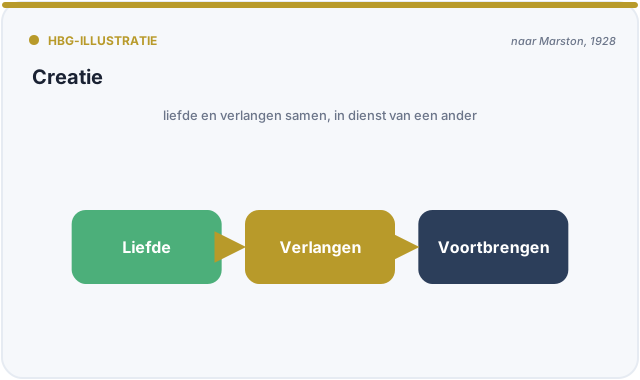
HBG-illustratie bij hoofdstuk XVI, Creatie
HBG-illustratie · door HBG toegevoegd om dit hoofdstuk toegankelijk te maken. Geen onderdeel van Marstons origineel.

In het kort

Creatie ontstaat als liefde en verlangen samenkomen in dienst van een ander. Het duidelijkste voorbeeld is een ouder die al zijn kracht inzet om een kind te laten groeien.

Presteren en verbinden vallen dan even samen. Je regelt en zorgt, maar niet voor jezelf, wel voor de ander.

Bij sommige mensen staan appetijt en liefde tamelijk los van elkaar. Maar bij de meesten hangen ze in het gedrag ingewikkeld en vaak onontwarbaar samen. De mens is nu eenmaal een zeer complex wezen. In een eerste verkenning als dit boek heeft het geen zin de hele reeks van appetijt-liefde-verhoudingen uit de klinische gevallen stelselmatig te behandelen. Beter is het het normale, doelmatige patroon van voortbrenging te belichten, dat liefde en appetijt combineert en dat mens en dier bij de voortplanting wordt opgelegd.

Zoals de hongermechanismen vanzelf begeerte en bevrediging tot appetijt verenigen, en de menstruatie vanzelf passie en captivatie tot liefde, zo roepen de voortplantingsmechanismen vanzelf een natuurlijke combinatie van liefde en appetijt op, die we voortbrenging kunnen noemen.

In dit hoofdstuk · 8 delen
  1. Moeder en kind
  2. Actief en passief voortbrengen
  3. Zorgen na de geboorte
  4. Verschillen tussen de seksen
  5. Bij het kind wint de begeerte
  6. Als zorg te lang duurt
  7. Kunst als voortbrenging
  8. Zorgberoepen en samenvatting
Deel 1 van 8

Moeder en kind

HBG-beeld bij Moeder en kind
HBG-toevoeging · samenvatting en beeld in onze stijl. Geen onderdeel van Marstons origineel.

In het kort, in onze taalVoortbrenging begint bij de band tussen moeder en kind tijdens de zwangerschap: kracht in dienst van een ander.

De band tussen moeder en kind tijdens de zwangerschap

Aan het slot van de lichamelijke liefde voltooit de man zijn reeks met een korte actieve liefde, terwijl de vrouw tegelijk een nieuwe reeks begint met een passieve liefde. Die passieve liefde, de periode na een inwendig orgasme, lijkt biologisch bedoeld om de zaadcellen te ontvangen. Ontmoet een zaadcel de eicel, dan treedt iets op wat je een lichamelijke captivatie van de mannelijke cel door de eicel zou kunnen noemen: een wederzijdse aantrekking waarbij de eicel de zaadcel in zich opneemt en omsluit. In de blijvende alliantie overheerst het volume van de eicel, al zet de energie van de mannelijke cel de geordende reeks celdelingen in gang die kort daarna tot het embryo leidt. Ons gaat het echter om de reacties van de moeder, niet om de genetische afkomst van het kind.

Zodra de bevruchte eicel zich in de baarmoeder ontwikkelt, ontstaan er voedingsverbindingen met de bloedbaan van de moeder, en een bepaalde verhouding tussen moeder en embryo. Gedurende de negen maanden geeft het embryo zich over aan de moeder door de voedingsstoffen die haar lichaam levert te domineren. Die voeding wordt aangeboden aan de opnemende weefsels van de vrucht, die de stoffen moet verwerven zolang ze door het lichaam van de moeder wordt gestuurd. De moeder schikt zich actief naar het voedsel uit de omgeving om de vrucht te bewegen tot groei. Ze moet zich niet alleen zoals gewoonlijk naar voedsel schikken voor haar eigen lichaam, maar ook op nieuwe manieren, geschikt voor het maken van de stoffen die het nieuwe organisme nodig heeft. Dit is de eerste lichamelijke verhouding: de moeder schikt zich actief naar voedsel om de vrucht tot groei te bewegen, en de vrucht domineert de geleverde stoffen door ze in zich op te nemen, om zich zo aan de invloed van de moeder over te geven.

Er is een tweede verhouding. De moeder geeft zich passief over aan het andere organisme in haar door alle invloeden die het ongeboren kind zouden kunnen schaden passief te domineren. Die passieve dominantie, het beschermen van de vrucht tegen tegenstanders, is een manier om de passieve overgave uit te voeren waartoe haar lichaam gedwongen is zolang het kleinere organisme in haar is. De vrucht moet, om die bescherming passief uit te lokken, zich passief schikken naar de beperkingen van de beschermende weefsels om haar heen. Zou de vrucht laat in de groei zo bewegen dat de navelstreng verstrikt raakte, dan kon voeding of bescherming wegvallen, met de dood tot gevolg. De ongeboren vrucht schikt zich dus passief naar de omhullende weefsels om de moeder passief te bewegen haar aanwezigheid te blijven toestaan, en de moeder beschermt de vrucht door haar vijanden passief te domineren om zich passief aan haar behoeften te blijven overgeven.

Deel 2 van 8

Actief en passief voortbrengen

HBG-beeld bij Actief en passief voortbrengen
HBG-toevoeging · samenvatting en beeld in onze stijl. Geen onderdeel van Marstons origineel.

In het kort, in onze taalMarston onderscheidt actieve voortbrenging, de gever, en passieve voortbrenging, de ontvanger.

Actieve voortbrenging

Voegen we deze twee verhoudingen samen, dan krijgen we dit patroon. De moeder geeft zich tegelijk passief over en beinvloedt actief. Die samenstelling is actieve liefde of captivatie. Tegelijk schikt ze zich actief en domineert ze passief. Die samenstelling is passieve appetijt of bevrediging. Maar omdat die bevrediging niet voor haar eigen begeerte is, maar voor die van het kind, ontstaat een nieuwe emotie. Deze nieuwe reactie, passieve appetijt samengesteld met en aangepast aan actieve liefde, kunnen we actieve voortbrenging noemen.

Passieve voortbrenging

De vrucht reageert tegelijk met passieve conformiteit en actieve dominantie, dus met actieve appetijt of begeerte. Tegelijk reageert ze met passieve invloed en actieve overgave, dus met passieve liefde of passie. Maar omdat de begeerte hier alleen wordt gevoeld om de passieve liefde te voltooien, is er weer een nieuwe emotie: actieve appetijt samengesteld met en aangepast aan passieve liefde, die we passieve voortbrenging kunnen noemen. Deze reacties zijn lichamelijk, grotendeels via het bloed en de hormonen. Toch moet er flink wat prikkeling in de baarmoeder zijn die weer ontlading naar de inwendige geslachtsdelen oproept. Het geheel benadert waarschijnlijk actieve voortbrenging, al gebeurt het meest onder de schors, met weinig waarneembaar gevoel.

Deel 3 van 8

Zorgen na de geboorte

HBG-beeld bij Zorgen na de geboorte
HBG-toevoeging · samenvatting en beeld in onze stijl. Geen onderdeel van Marstons origineel.

In het kort, in onze taalNa de geboorte uit de moeder actieve voortbrenging in het voeden en verzorgen. Marston beschrijft hoe dat voelt.

Actieve voortbrenging van de moeder na de geboorte

Na de geboorte verandert de situatie. Het kind wordt aan de borst gevoed. De moeder krijgt zo prikkeling van de tepels door de mond van het kind, en enige aanraking van de borst door zijn handen. Watson en anderen namen waar dat dit voor de moeder een erotische ervaring is: in onze termen een captivatie, opgeroepen door de borstprikkeling, plus het tegen het lichaam houden van het kind en het waarnemen van zijn behoefte en de vervulling ervan met melk. Er zijn aanwijzingen dat de borsten nauw verbonden zijn met de inwendige geslachtsdelen, want ze zijn vlak voor en tijdens de menstruatie bijzonder gevoelig. Waarschijnlijk vindt de ontlading na prikkeling van de borst haar weg naar de inwendige delen, wat betekent dat de opgewekte prikkels bondgenoot zijn van het bewegingszelf, en dus een actieve invloed vormen. Het kind wordt zo in alliantie met de moeder gehouden. Het waarnemen van zijn behoefte roept bij de moeder een passieve overgave op: het opgeven van alles wat het voeden in de weg staat. De samenstelling van deze twee is bij de moeder een echte captivatie, die zij, blijkens haar uitdrukking en verslag, vaak als uiterst prettig en eigen beleeft.

Tegelijk reageert de moeder op twee andere groepen prikkels. Ten eerste het gewicht en de omvang van het kind, die ze moet ondersteunen om het in een prettige houding te brengen. Later, als het kind zelf aan tafel kan eten, richt haar conformiteit zich op het voedsel in plaats van op het vasthouden. In beide gevallen is de kern gelijk: de moeder schikt zich naar iets wat, mits gebruikt, de behoefte van het kind kan stillen. Of ze de baby nu aan de borst houdt of later voedsel bereidt, ze verricht een actieve conformiteit om de innerlijke behoefte van het kind te stillen. Die behoefte, honger, blijkt uit huilen, onrust en grimassen. Zo weet de moeder van de hongerpijn die het kind domineert. Door haar conformiteit met het gewicht, of met het bereiden van voedsel dat het kind makkelijk domineert, domineert ze passief de hongerpijn van het kind. Ze beleeft dus tegelijk actieve conformiteit met het middel tot stilling en passieve dominantie tegenover de hongerpijn zelf. Die samenstelling is passieve appetijt of bevrediging. Moeders melden bij het voeden vaak een intense voldoening in het goed kunnen voorzien in de behoefte van het kind en het zien verdwijnen van zijn onprettigheid.

Het bewuste karakter van actieve voortbrenging

De moeder, die het kind voor zijn eigen bestwil laat eten en zorgt dat de honger verdwijnt, beleeft dus tegelijk actieve liefde en passieve appetijt: actieve voortbrenging. Die heeft een eigen, herkenbaar bewustzijn, waarover vrijuit wordt verteld omdat het maatschappelijk geprezen is. Het wordt beschreven als plaatsvervangend genoegen in iets doen voor een ander, of als voldoening iemand te hebben laten doen wat goed voor hem was. In het eerste ligt de nadruk op de bevrediging, in het tweede op de captivatie. Alle beschrijvingen bevatten beide, en zijn ruwweg in te delen naar de nadruk op het liefde-element of op het appetijt-element.

Deel 4 van 8

Verschillen tussen de seksen

HBG-beeld bij Verschillen tussen de seksen
HBG-toevoeging · samenvatting en beeld in onze stijl. Geen onderdeel van Marstons origineel.

In het kort, in onze taalMarston ziet verschillen tussen hoe mannen en vrouwen voortbrengen. Deze aannames zijn sterk van hun tijd.

Sekseverschillen in voortbrenging

Actieve voortbrenging beleven ook gulle mannen vaak, bij het meebrengen van speelgoed voor hun kinderen of cadeaus voor hun geliefde. Toch is er een verschil tussen de voortbrenging van moeders van jonge kinderen en die van volwassen mannen. Bij de man zit er meestal een passiever liefde-element in dan echte captivatie. Moeders lijken evenveel plezier te putten uit captivatie tegenover hun dochters als uit de bevrediging die ze hun kinderen geven. Mannen nemen de wens van een vrouw of kind vaak op de klank af, en brengen precies het gevraagde. Bij het geven ligt de vreugde dan vooral in de kosten of bijzondere kwaliteit van het geschenk, vaak beschreven als trots mijn meisje het beste te kunnen geven. Het liefde-element is meer overgevend dan beinvloedend. Het zou het plezier van de gulle man bederven als hij dacht dat hij de ander iets anders had aangepraat dan gewenst, ook al paste dat veel beter. De bevrediging is bij de man vaak zo sterk dat het liefde-deel geen duidelijke passie wordt.

Een moeder verliest daarentegen vaak plezier in het kopen van een jurk voor haar dochter als de dochter die spontaan zelf kiest. Heeft het meisje haar zinnen op een blauwe jurk gezet, maar overtuigt de moeder, zeker van haar smaak, haar een groene te nemen, dan beleeft de moeder groot genoegen omdat ze de dochter zover heeft gekregen de groene jurk te nemen, als uiting van actieve overgave aan de moeder. Soms gebruikt een man met een fijne feeling voor vrouwen dit vermogen om de smaak van een meisje in kleding of literatuur bij te scholen, en beleeft hij daarbij een levendige actieve voortbrenging. Omdat hij man is, bevat zijn reactie meestal meer actieve overgave dan die van de gemiddelde moeder. Juist daardoor kiest zo'n zeldzaam begaafde man vaak de meest passende richtingen voor de ontwikkeling van het meisje, vrij van eigen vooroordelen, terwijl de moeder, met weinig passieve overgave, vaak haar eigen dominantie in de plaats stelt van echte invloed en zichzelf behaagt in plaats van het belang van de dochter te dienen. Meestal zijn mannen die de vorming van dochters of geliefden op zich nemen echter overdreven overgevend of zelfzuchtig dominant. In een geval dwong een jongeman het meisje met wie hij verloofd was viool te leren, alleen omdat hijzelf op muziek was gericht. De muziekleraar weigerde na enkele hectische pogingen verder les te geven; het meisje kon geen noot van de andere onderscheiden. Toch bleef haar verloofde volhouden dat haar redding in het meesterschap op de viool lag.

Deel 5 van 8

Bij het kind wint de begeerte

HBG-beeld bij Bij het kind wint de begeerte
HBG-toevoeging · samenvatting en beeld in onze stijl. Geen onderdeel van Marstons origineel.

In het kort, in onze taalBij het kind zelf overheerst de appetijt: het wil vooral het voedsel, met wat liefde voor de moeder erbij.

Passieve voortbrenging bij het kind

Nu de reacties van het kind bij het ontvangen van voeding. Psychoanalytici hebben veel gemaakt van de zogenoemde erotische emotie die de baby zou ontlenen aan prikkeling van zijn lippen door de tepel. Ook schrijvers buiten die school zijn het erover eens dat de zogenoemde gevoelige zone niet tot de geslachtsdelen beperkt is, maar ook de lippen omvat. Uit volwassen gedrag blijkt dat de lippen inderdaad receptoren bevatten voor prikkels die alle vier de primaire emoties kunnen oproepen. Bepaald voedsel, vooral vloeistof, wordt deels met de lippen gedomineerd. Warmte en aanraking van de lippen kunnen reflexen tot speekselvloed opwekken, dus actieve conformiteit met voedsel. Kietelen of kussen van de lippen kan bij beide geslachten erectie geven, wat wij als actieve overgave lezen. En het gebruik van de lippen door een vrouw om passie bij een geliefde te wekken, kan ontlading naar haar inwendige delen geven, wat wij als actieve invloed lezen.

Welke van deze vier bij een zuigeling aan de borst optreedt, is op zijn minst onzeker. Ik heb gehoord van beweerde waarnemingen van erectie bij jongetjes tijdens het zuigen, maar men moet iets aftrekken van het buitengewone enthousiasme van psychoanalytisch ingestelde waarnemers om verborgen liefde-reacties aan het licht te brengen. Ik heb die verslagen nooit kunnen bevestigen. Zonder zo'n bevinding is niet met vertrouwen aan te nemen dat lipprikkeling deze actieve overgave bij het kind opwekt. Er zijn wel andere tekenen van overgave, zoals aankruipen en klanken, die op een overgevende houding kunnen wijzen. Ook wordt het kind geleerd te zuigen zonder dat er honger is, wat op een mechanische overgave in het zenuwstelsel wijst. We mogen dus gissen dat er enige overgave in het zuigen zit.

Dominantie is bij het zuigen duidelijker waarneembaar. Als de lippen van het kind eerst moeten worden aangeleerd door er een vinger tegenaan te drukken, is de tonische versterking van lip en kaak goed te merken. Het kind reageert op een tegenwerkende prikkel door zijn bewegingszelf te versterken om die met de mond te domineren. Is de melk zo binnengehaald, dan volgen slikbewegingen die duidelijk dominant zijn. Waarschijnlijk beleeft de zuigeling dus een tamelijk nadrukkelijke dominantie bij het nemen van voedsel, tegelijk met een eenvoudiger, minder uitgesproken overgave aan de moeder. De passieve conformiteit met de hongerpijn behoeft geen uitleg. De passieve invloed op de moeder, door de lippen op te heffen en door hulpeloos te vragen, is bij de zuigeling wat onzeker; de manier waarop een gezond kind de aandacht van de moeder trekt, is huilen en schreeuwen.

Bij het kind overheersen de appetijt-elementen

Dat huilen en schreeuwen zijn dominantie. De beide liefde-elementen die passie zouden vormen, komen bij de zuigeling zo weinig voor dat ze weinig gewicht in de schaal leggen tegenover de appetijt. Ook passieve appetijt beheerst het bewustzijn van het kind zodra het slikken de honger begint te stillen. Als gezicht en ontspanning iets zeggen, voelt het kind veel bevrediging zodra de honger verdwijnt, en die heeft weinig te maken met de moeder. Een nuchtere blik zegt dus dat het kind bij het voeden vooral met appetijt bezig is, met misschien een lichte bijmenging van passie voor de moeder. Wordt het kind ouder en actiever in zijn dominantie, dan ontstaat vaker een situatie waarin het iets begeert wat het zonder toestemming van de moeder niet kan krijgen. Bovendien domineert het kind het verkregen voorwerp actief, en blijft het zo begeerte uiten in plaats van in kalme bevrediging te vervallen.

Al meent de gemiddelde volwassene dat begeerte de eerste behoefte is en liefde slechts een middel, het blijft voor mij de vraag of het kind overgave aan de moeder leert via begeerte naar voorwerpen die alleen zij kan geven, of dat het normale kind overgave als een op zichzelf prettige gedragswijze ontwikkelt, sterk genoeg om dominante begeerte te bedwingen. Zoveel moeders leren gehoorzaamheid aan door appetijt-beloningen te geven, dat het gebruik van overgave in dienst van begeerte waarschijnlijk in de opvoeding ontstaat, niet in de natuurlijke ontplooiing van het kind. Zeker is dat overgave, eenmaal als appetijt-techniek geleerd, weinig waard is voor de moeder, zelfs niet om het kind even rustig te houden. Het kind dat overgave om haarzelf leert, komt niet telkens vragen of de tijd al lang genoeg was voor de beloofde beloning. En vanuit het kind gezien geniet het kind dat overgave om haarzelf leert dubbel wanneer de moeder het iets geeft. Ik zag veel gevallen waarin een passie bij het kind door de moeder werd opgeroepen, met begeerte duidelijk ondergeschikt daaraan. Het veelvoorkomende gedrag waarbij het kind smeekt te mogen helpen in het huishouden, of in de tuin de lievelingsvruchten van de moeder te mogen plukken en brengen, is het normale samengaan van passie en begeerte, met passie voor de moeder duidelijk aan de leiding. Overheerste de begeerte, dan zou het kind vragen zelf zijn eigen lievelingsvrucht te plukken. Dit laatste zie je bij pubers wier appetijt de liefde begint te overheersen. Maar bij normale kinderen voor de puberteit is begeerte naar een voorwerp als uiting van passie voor de moeder de normale houding. Deze samenstelling van begeerte aangepast aan passie is passieve voortbrenging.

Deel 6 van 8

Als zorg te lang duurt

HBG-beeld bij Als zorg te lang duurt
HBG-toevoeging · samenvatting en beeld in onze stijl. Geen onderdeel van Marstons origineel.

In het kort, in onze taalMoeders roepen sterke voortbrenging op bij dochters. Maar duurt die te lang, dan kantelt zorg in bezit.

Moeders roepen passieve voortbrenging op bij dochters

Meisjes ontwikkelen in de puberteit vaak een overdreven passieve voortbrenging voor hun moeder. Voor een moeder die niet met andere dingen bezig is, geeft dit de meest geconcentreerd prettige ervaring van haar leven. Haar overheersende captivatie krijgt vrij spel, en bij voldoende middelen ontleent ze ook grote bevrediging aan het mooi aankleden en het inwijden van het meisje in de omgangsvormen. De actieve voortbrenging die de moeder in deze periode uit, geeft haar vaak zoveel genot dat ze de verhouding niet wil loslaten wanneer het meisje haar eigen leven moet gaan leiden. De gewoonten van emotionele afhankelijkheid die het meisje vormde, blijven dan vaak een groot deel van haar leven bestaan, tenzij ze die na de puberteit zelf resoluut verbreekt.

Ik had twee klinische gevallen van studentes die nog onder deze moederlijke dwang stonden, zeer tot hun nadeel. In het ene besefte de moeder dat haar tijd van doelmatige voortbrenging voorbij was, maar hield ze de dochter vast als openlijk zelfzuchtig genoegen. In het andere besefte de moeder niet dat ze de grens van haar vermogen tot verdere ontwikkeling van het kind had bereikt. Recht voor dat feit gesteld, sloeg haar houding niet om in appetijt, maar dwong die haar de dochter los te laten uit een sturing die haar rijping niet meer diende. Deze moeder toonde echte liefde, en vernieuwde juist daarmee haar band, waarbij zij een passiever en de dochter een actiever rol nam. Het personeelshoofd van een van de grootste bedrijven van Amerika, dat vijfentwintig jaar de behoeften van medewerkers bestudeerde, van goedbetaalde verkoopdirecteuren tot piepjonge typistes, vertelde mij dat een van zijn dringendste problemen bij vrouwelijke medewerkers juist deze volledige emotionele beheersing door moeders over dochters was. In meerdere gevallen zaten vrouwen boven de vijftig nog strak gebonden aan de bevelen van een klagerige, misschien volstrekt onbekwame moeder, die de dochter ooit in haar puberteit via die intense voortbrenging aan zich bond. Zulke gevallen tonen de enorme kracht van de emotie, en het gevaar de verhouding voort te zetten nadat de moeder de ontwikkeling van de dochter niet meer kan dienen. Vanaf dat punt ontaardt de band, in stand gehouden door gewoonte en zeden, onvermijdelijk in appetijt-dominantie bij de moeder en onverschillige of onprettige conformiteit bij de dochter.

Deel 7 van 8

Kunst als voortbrenging

HBG-beeld bij Kunst als voortbrenging
HBG-toevoeging · samenvatting en beeld in onze stijl. Geen onderdeel van Marstons origineel.

In het kort, in onze taalKunst is voor Marston de rijkste vorm van passieve voortbrenging: scheppen uit passie.

Kunst als passieve voortbrenging

Misschien is kunst de belangrijkste uiting van passieve voortbrenging bij volwassenen. Waarneming van veel kunstenaars bracht mij tot de gevolgtrekking dat de volkse uitdrukking passie voor de kunst een treffende beschrijving is van wat echte kunstenaars drijft. Te veel actieve voortbrenging leidt bij mannelijke kunstenaars meestal tot vervanging van invloed door dominantie, en zo tot verwrongen, destructieve kunst. Het is misschien te ver om te zeggen dat alle grote kunst een uiting van passie voor een vrouw is, echt of verbeeld, die de kunstenaar sterk captiveerde. Maar in alle gevallen die ik zelf kon waarnemen, stond buiten redelijke twijfel dat passie voor een vrouw, soms een verbeelde, de onmisbare voorwaarde voor kunst was.

In de begeerte die de kunstenaar drijft zijn materiaal te verzamelen en te vormen, kan wisselende dominantie en conformiteit zitten. Sommige onbetwist grote kunstenaars zijn sterk dominant en verwerpen veel voorbereiding; hun werk is stoutmoedig en dwingend. Sarah Bernhardt, Cyril Scott, Leo Ornstein en anderen, die steeds een nieuwe mode in hun kunst wilden scheppen in plaats van zich naar de conventie te schikken, zijn van dit sterk dominante type. Aan het andere uiterste staan kunstenaars met veel conformiteit in hun appetijt, wat grote fijnheid en subtiliteit oplevert, en die zich naar de gangbare techniek schikken. Maar welk overwicht er ook heerst, bij alle echte kunstenaars stuurt sterke passie voor de, misschien onbewust, als ideaal geziene captiveerster het hele werk. In landschap of lyriek is dat minder zichtbaar dan bij naaktsculptuur of aan een vrouw opgedragen poezie. Toch is de uitbeelding van de natuur volgens mij een overdracht van passie, van een vrouw naar de mooie of harmonieuze kanten van levenloze dingen. Kunstenaars van dit type tonen vaak een bezielende houding tegenover moeder natuur, die eerder actieve overgave is dan esthetische conformiteit. Bij Edgar Allan Poe verraadt het sturende element dat hem een lyrisch gedicht van weergaloze schoonheid als De klokken liet schrijven, zich in zijn andere gedichten die openlijk passie voor mooie vrouwen tonen. In zijn Filosofie van de compositie stelt Poe dat de schoonheid van de vrouw onvergelijkbaar is en de dood van een geliefde, mooie vrouw het meest poetische onderwerp ter wereld. Voor mij, zegt Poe, is poezie geen doel geweest, maar een passie.

Opvallend is ook dat verreweg de meeste scheppende kunstenaars tot nu toe mannen waren. Echte passie is immers de liefde waarvoor het mannenlichaam bij uitstek is gebouwd, en passieve voortbrenging is dus de vorm die je bij mannelijke kunstenaars zou verwachten. Maar het vrouwenlichaam heeft een dubbele liefde-uitrusting, voor zowel actieve als passieve liefde. Al zouden de meesten zich aan captivatie wijden, de vrouwelijke passie, gewijd aan kunst, blijkt ongewoon krachtig en fijn van vorm. Zo lijkt het bij bekende kunstenaressen wier werk rechtstreeks met dat van mannen te vergelijken is: Sappho, Le Brun, Laurence Hope, George Sand, Elizabeth Barrett Browning en Christina Rossetti. De passie van de vrouw in kunst bevat vaak een veel groter aandeel zuivere passie dan bij de meeste mannen. In het algemeen worden scheppende kunstenaars van beide geslachten gedreven door begeerte aangepast aan passie, dus door passieve voortbrenging.

Deel 8 van 8

Zorgberoepen en samenvatting

HBG-beeld bij Zorgberoepen en samenvatting
HBG-toevoeging · samenvatting en beeld in onze stijl. Geen onderdeel van Marstons origineel.

In het kort, in onze taalArtsen, leraren en geestelijken leven van actieve voortbrenging. Een samenvatting sluit het hoofdstuk af.

Actieve voortbrenging drijft artsen, leraren en geestelijken

De belangrijkste uitingen van actieve voortbrenging bij volwassenen liggen in de beroepen van leraar, arts en geestelijke. De laatste is verreweg de openlijkste poging captivatie en passieve appetijt te verenigen. Het priesterschap bestaat in bijna alle godsdiensten uit actief toezicht op het gedrag van de mensen, met de plicht geestelijke of lichamelijke steun te geven aan wie zich aan de priester overgeeft. Dat is de kern van actieve voortbrenging. In de vroege middeleeuwen oefende het hoofd van het priesterschap ook appetijt-macht over de mensen uit. Al is die macht in theorie afgeschaft, er blijft veel appetijt-macht bij de veronderstelde liefde-leiders, nu uitgeoefend via zeden en gewoonten. Het is niet vruchtbaar te onderzoeken in hoeverre zo'n leider echte captivatie over anderen kan uitoefenen.

Bij mannelijke leiders in politiek en industrie is de echte actieve liefde tegenover ondergeschikten, zoals gezegd, tamelijk gering. Dominantie en appetijt sluipen erin en beheersen de bedoelde liefde, ondanks de beste bedoelingen, want dominante appetijt zit het dier in het bloed. Bij kerkleiders is dat misschien anders, maar dat heb ik niet onderzocht. Bij mannelijke leraren en artsen komt de meest heilzame voortbrenging het vaakst tot stand wanneer de leerling of patient toevallig ook de appetijt-belangen van de man dient. De meeste aandacht gaat naar wie kan worden onderwezen of genezen zonder dat een ongewoon onbaatzuchtige houding nodig is. Toch heb ik veel gevallen ontleed waarin een mannelijke leraar of arts op de behoefte van een ander reageerde met een voortbrenging die duidelijk door liefde werd gestuurd, al kon die liefde nauwelijks captivatie heten. Zoals bij de gevende geliefden en ouders, vervangt bij de liefdevolle arts of leraar actieve overgave aan de bestaande behoeften van de ander grotendeels de actieve invloed om die behoeften te veranderen, die zo kenmerkend is voor de liefde van een moeder voor haar dochter. Al met al ben ik niets tegengekomen dat mij doet geloven dat een ander dan de zeldzaam begaafde man in staat is een houding van echte captivatie langere tijd vol te houden.

Samenvatting

Liefde en appetijt worden tegelijk gecombineerd in een samengestelde emotie, voortbrenging. Bij de moeder is dit actieve voortbrenging: captivatie voor het kind, samengesteld met bevrediging in het stillen van zijn behoeften. Bij het kind is het passieve voortbrenging: passie voor de moeder, samengesteld met actieve appetijt naar het voedsel dat zij bezit. Bij actieve voortbrenging is elk appetijt-element aangepast aan en dienstbaar aan een liefde-element: de moeder schikt zich actief naar voedsel om het kind te bewegen dat te domineren, en domineert passief de invloeden die het kind schaden om zich passief aan zijn behoeften over te geven. Bij passieve voortbrenging schikt het kind zich passief naar zijn honger door alles op te geven om de moeder te bewegen tot aandacht, en gehoorzaamt het de moeder door te domineren wat zij aanwijst. De natuurlijke band tussen moeder en kind levert een leermechanisme voor voortbrenging, zoals honger en menstruatie dat voor appetijt en liefde doen. Actieve voortbrenging bereikt een hoogtepunt in de liefde van een moeder voor haar puberende dochter, en passieve voortbrenging in de band van de dochter met de moeder in die tijd. Kunst is een van de belangrijkste uitingen van passieve voortbrenging. Beroepen als geestelijke, leraar en arts zijn belangrijke uitingen van actieve voortbrenging, al kunnen mannen in die rol zelden zuivere captivatie volhouden en wisselen ze invloed vaak in voor dominantie of voor overgave. Leraressen en vrouwelijke artsen kunnen, net als moeders, wel echte actieve voortbrenging uiten, althans tegenover vrouwen en kinderen.

Waar wij afwijken van Marston: dit hoofdstuk leunt zwaar op speculatieve fysiologie van zwangerschap en borstvoeding, en op de aanname dat vrijwel alle kunst voortkomt uit mannelijke passie voor een vrouw. Ook zijn stellige uitspraken over wat mannen en vrouwen van nature wel of niet kunnen, delen wij niet. Wij nemen het bruikbare idee over, namelijk dat gezonde zorg en leiderschap de ander laten groeien en op tijd loslaten. Zijn biologie, zijn kunsttheorie en zijn seksegeneralisaties lezen wij als tijdsbeeld.

Bron en verantwoording

Controleer dit hoofdstuk aan de bron

Deze hertaling volgt hoofdstuk XVI van Emotions of Normal People (William Marston, 1928, publiek domein). Hieronder lees je de volledige originele Engelse tekst van dit hoofdstuk, met de oorspronkelijke paginanummers, zodat je alles kunt nalezen en verifieren. Je kunt ook de volledige woordgetrouwe Nederlandse vertaling en het Engelse origineel downloaden.

De woordgetrouwe NL-vertaling, het Engelse origineel, de HBG-versie en Marston 2.0 zijn gratis te downloaden zodra je een HBG-account aanmaakt en je e-mailadres bevestigt. Zo blijft dit gedachtegoed beschikbaar voor iedereen die er echt mee aan de slag wil.

Lees de originele Engelse tekst van hoofdstuk XVI · Marston, 1928
Dit is de oorspronkelijke Engelse tekst zoals Marston die in 1928 schreef, inclusief de originele paginanummers. Onze Nederlandse hertaling hierboven volgt deze tekst getrouw. Zo is elke passage terug te leiden naar de bron.

APPETITE and love emotions are relatively independent in the emotional organization of some subjects. But, with a majority of individuals, appetite and love appear to manifest an intricate, and often inextricably confused relationship, in the total behaviour pattern. Human beings are, of course, extremely Complex organisms. It is useless to attempt, in a preliminary analysis such as this book represents, anything like a systematic presentation of the extended series of appetite-love relationships which appear in the clinical cases studied. It seems best, therefore, to emphasize the normal and efficient pattern of creation responses, combining love and appetite, which appear to be enforced upon human beings and animals in the course of reproduction. For just as the hunger mechanisms automatically evoke the natural integrative combination of desire and satisfaction into appetite emotion, and as the menstrual function automatically evokes the maximally efficient integrative combinations of passion and captivation responses into love emotion, so, in thr same

pagina 539

way, do the reproductive mechanisms automatically evoke a natural integrative combination of love and appetite into an emotional behaviour pattern which may aptly be termed

Types of Physiological Relationships Between Mother and Child During Pregnancy

We have noted that at the termination of physical love relationship between woman and man, the male completes his series of love responses with a brief expression of active love, while the woman simultaneously begins a new series of love responses on her own part, by a corresponding passive love reaction. It would seem that this passive love reaction on the woman's part, consisting, it will be remembered, of the period immediately following an internal type of orgasm, is biologically designed to accompany reception of spermatazoa

within the vagina, the uterus eventually receiving the male germ cells without resistance. When a spermatazoon encounters the ovum, however, a process that might be described as physiological captivation of the male cell by the ovum immediately occurs. In other words, there is a mutual physiological attraction between these two cells, the ovum eventually drawing the spermatazoon into itself, and com-

pagina 540

pletely surrounding it. Thereafter, in the continued alliance between the two cells, the volume of the ovum predominates throughout, though it might be held that the energy of the male element precipitates the ordered series of cell divisions, shortly resulting in the appearance of the embryo.

It is the mother's responses, however, that we are primarily concerned with, rather than with the genetic origirf and history of the infant.

As soon as the fertilized ovum, with its protective tissues and membranes begins its process of further development within the uterus, nutritional connections are made with the blood stream of the mother, and a definite type of relationship is set up between mother and the embryo. In this relationship, throughout the nine month period preceding birth, the embryo and fetus may be regarded as submitting to the mother, by dominating the nutritional substances furnished by the maternal organism for embryonic growth and development. This nutritional supply is placed in contact with appropriate absorptive tissues of the fetus, which must acquire or dominate these substances so long as it remains responsive to control by the mother's body. The mother organism, on the other hand, complies actively with the food materials taken into it through the stomach, for the purpose of inducing the fetus to grow and mature. The mother's body must comply with food from the environment and not only is the usual measure of compliance necessary to furnish materials for her own organism, but also she must comply in new ways, appropriate to the manufacture of materials necessary to the development of the new organism within her own.

This, then, is the first physiological set of relationships established between mother and child. The mother complies

pagina 541

actively with food from the environment in order to induce the fetus to grow. The infant organism dominates the materials furnished by drawing these materials into its own body in order to submit to the mother's inducement.

A second set of physiological relationships seems also to be present. The mother submits passively to the presence of the other organism within her own, by passively dominating all environmental influences which might tend to injure or attack the unborn child. Passive dominance, in short, on the part of the mo'ther, consists in protecting the infant organism from environmental opponents. This passive dominance is simply a means or method of carrying out the response of passive submission to which her body is impelled by its inability to function in a way divergent from the need of the smaller organism, so long as the latter is held incorporated within the mother's body. Similarly, the infant, in order passively to induce this protection from the mother, must passively comply with the physical limitations of the protective tissues and other materials placed around it. If the fetus, for instance, at a late stage in its growth, should move in such a way that the umbilical cord became twisted or a rupture in any tissue occurred, sustenance might fail the fetus, or protection might no longer be obtained from various inimical influences, probably resulting in ultimate destruction of the fetus. In simplest terms, then, the unborn infant passively complies with the restrictive tissues with which it is surrounded, for the purpose

pagina 542

of passively inducing the maternal organism to permit continued presence of the infant within the mother. The mother protects the unborn babe by passively dominating its antagonists for the purpose of continuing passively to submit to the needs ^rf the infant.

Active Creation (pAaL) Defined in Terms of Physiological Relationships

When we put these two sets of physiological relationships together, we find the following completed behaviour pattern. The mother is passively submitting and actively inducing, simultaneously. We have already seen that this particular compounding of responses constitutes active love or captivation response. Furthermore, the mother simultaneously is actively complying and passively dominating. This combination of responses as we have seen, constitutes passive appetite, or satisfaction response. Since the appetitive satisfaction attained, however, is not for the mother's own desire but for the desires of the infant, a new character of emotion is produced. This new type of response, then, consists of passive

appetite compounded with and adapted to active love (pAdL). This new response compound may be termed active creation.

Passive Creation (aApL) Similarly Defined

pagina 543

The infant organism reacts simultaneously with passive compliance and active dominance responses. This constitutes active appetite or desire. At the same time, however, the unborn infant is reacting with passive inducement and active submission simultaneously. This compound response has been shown to constitute passive love or passion. Yet in this case, where appetitive desire is felt only for the sake of consummating passive love, we must again postulate a new type of compound emotion. This compound response, which consists of active appetite compounded with and adapted to passive love may be termed passive creation (aApL).

As previously emphasized, the reactions analysed in the preceding paragraphs are physiological, a major portion of the adjustments of the maternal body, and practically all adaptations of embryonic and fetal growth to maternal stimuli, being mediated through the blood, which carries appropriate hormones. Nevertheless, there must be a considerable volume of inter-uterine stimulation adequate to motor discharge back again to the internal genitals, with changes, also, in appetitive stimulations. Tbe resulting integrative picture possibly approximates pAaL, though the integrations evidently occur, for the most part, at sub-cortical levels, giving little introspectively discernable love emotion, and certainly no new creation emotion consciousness which the subject herself is able to observe and report upon.

Active Creation of Mother After Birth of Child

Immediately after birth, however, the situation is changed. The infant, normally, is now nourished at the mother's breast. The mother, therefore, receives stimulation of the nipples from the child's mouth, and some manipulation of the breast

pagina 544

itself by the child's hands. Watson, and others, have observed that the resulting experience to the mother is of an erotic variety. That is, in our own terms, a captivation reaction seems to appear, evoked by breast stimulation, plus the other stimulations of holding the child against the body, and perception of the child's behaviour indicating need of nourishment with subsequent satisfaction of the need by means of

milk supplied by the mother. There is considerable evidence that the breasts of the mother are intimately connected with the internal genital organs, since the breasts are particularly sensitive, and occasionally painful just before and during menstrual periods. It seems a good guess, therefore, that the motor discharge, following stimulation of the breasts by the child's lips, finds its way to the internal genitals. It will be remembered that this type of motor discharge is to be regarded as evidence that the motor stimuli evoked are in submission to the motor self, and constitutes, therefore, an active inducement reaction. The child, in other words, is being controlled and held in alliance with the mother through stimulation of its lips with her breast. Perception of the child's need of nourishment evokes from the mother a passive submission response which consists of giving up all other activity which might conflict with feeding the child. The simultaneous compounding of these two responses evokes in the mother's central nervous system an integrative pattern of true captivation response. Observations of the general emotional expression of mothers during the nursing of their infants, as well as their verbal reports of introspection indicate that an extremely pleasant type of captivation emotion,

pagina 545

qualitatively distinct, can frequently be introspected by the mother herself.

At the same time there are two other groups of stimuli which the mother is reacting to by obvious motor responses. First, there are the stimuli arising from the child's weight, size, etc., which must be supported and placed in position by the mother in order to bring the child to a comfortable posture for feeding. Later in life, when the dominance of the child has developed to the point where it can sit at table and feed itself, the compliance response of the mother will be directed toward the food materials, instead of toward holding the child himself in position to eat. In both cases, however, the essential nature of the reaction seems to be the same. The mother is complying with certain objects or materials which, when complied with t are capable of satisfying the child's need (pD). Whether the mother holds the baby up to her breast, therefore, or whether she later cooks and prepares food materials for the child, she is performing an act of active compliance for the purpose of satisfying the inner need of the infant organism. This need, Hunger, is evidenced in the child's behaviour in various ways

such as crying, making restless movements or making facial grimaces indicating th$ unpleasantness it is experiencing. These stimuli inform the mother of the child's need. That is, they inform her of the hunger stimuli which are dominating the infant organism and causing unpleasantness in the baby's consciousness. By means of the compliance wftich the mother expresses toward the child's weight in holding it against her

pagina 546

breast, or preparing nourishment in a form which the child can easily dominate, the mother passively dominates the infant hunger pangs.

Thus she simultaneously experiences active compliance with the means of satisfying the pangs and passive dominance toward the hunger pangs themselves in the process of removing them. This combination of active compliance 9 and active dominance constitutes the compound emotion which we have designated as passive appetite or satisfaction. Mothers, while nursing or feeding their children frequently report a feeling of " intense gratification ", or great satisfaction in being able to provide satisfactorily for the child's need, and in observing in the child's behaviour, the cessation of unpleasantness which it previously had manifested.

Conscious Characteristics of Active Creation Emotion

The mother, therefore, while compelling the child to eat for its own good, and preparing both child and food in such a w^ff that the child's hunger is removed, experiences simultaneously active love and passive appetite. This complex emotion we have already designated active creation. Active creation emotion appears to possess a distinct type of consciousness, which can easily be distinguished, and is freely reported upon because it is considered socially admirable in every way. It is sometimes described as " taking vicarious pleasure in doing something for another person ", or as " gratification in having made him do what was good for him ". In the first of these characterizations of active creation, the emphasis appears to be in the satisfaction, or passive appetite emotion. In the last instance, the emphasis seems just as clearly to be placed upon captivation emotion. A considerable

pagina 547

list of popular terms and introspections in the subject's own words might be given, describing active creation emotion. All these terms and introspections will be found to include, to some degree, both captivation and satisfaction; and all

might be divided, roughly, into one of two classes according to the emphasis placed upon the active love element, or upon the passive appetite element.

Sex Differences in Active Creation Response

Active creati&n is an emotion, apparently, which " generous " men experience rather frequently, in bringing toys to their children, buying clothes for their wives and daughters, or bringing presents to their sweethearts. Active creation seems to be the preponderant emotional response. There appears to be, however, a more or less marked difference between active creation reported by mothers of comparatively young children, and active creation as experienced by adult males. The male experience of active creation contains, as a rule, a somewhat more passive love element than true captivation. Mothers whose behaviour I have observed, appeared to derive fully as much pleasure from expression of captivation emotion toward their daughters, especially, as from the satisfaction which they were enabled to give their children.

Males are apt to accept the wish, or demand of a woman or child at its face value, bringing to the loved one the particular thing demanded. Thus when the gift is presented, the chief joy of the giver lies, perhaps, in very extensive satisfac-

pagina 548

tion in the cost, or special virtue of the article presented. This emotion is frequently described as a feeling of " pride " in being able to " give my girl the best there is ". Thelove emotion element is more markedly submissive than inductive. It would frequently spoil the pleasure of the generous male altogether, if he felt he had persuaded the recipient of the gift to accept a different sort of thing from that which she originally desired, even though the change in choice might obviously suit her much more effectively. Thus the male reaction which comes nearest to being active creation is likely to exhibit a submissive element which is much more active than passive. The satisfaction increment, however, is apt to be so strong in this male emotion, that the love response portion does not clearly assume the aspect of passion emotion.

A mother, on the other hand, very frequently loses a considerable degree of her own pleasure in buying her daughter a dress if the daughter succeeds in selecting the frock spontaneously, without the mother's direction. If the youngster has heart set on a blue frock, however, and the mother, fully

confident that she is best able to judge what colours are becoming to the child, persuades the girl to accept a green costume, the mother appears to experience keen delight in having induced the daughter to take (dominate) the green dress as an expression of active submission to the mother.

Occasionally a male of peculiarly acute perceptions in matters feminine uses this ability to re-educate a girl's taste

pagina 549

in clothes, literature, and other esthetic matters. During this process, such a male may actually experience a very vivid and clear-cut type of active creation emotion. Since the subject is a male, his total response is still apt to contain more active submission than does the creation emotion of the average mother. For this very reason, such a rarely gifted male is likely to select the most appropriate ave'nues of expression for the girl's development, free from his own personal prejudices; whereas the mother, with a minimum of passive submission, may frequently substitute her own dominance for true love inducement, actually pleasing herself rather than looking out for the daughter's interests. In the main, however, males who undertake the development or education of daughters or sweethearts are either over-submissive, or selfishly dominant. In an instance of the latter sort, a young man attempted to compel the girl to whom he was engaged to learn to play the violin, simply because the boy himself was absorbed in musical interests. The music teacher to whom the girl was sent, after a few hectic attempts, refused to give her further instruction. The girl " couldn't tell one note from another ". Yet her fiance continued to insist that the girl's one means of salvation lay in learning to become an accomplished musician.

Passive Creation (aApL) Evoked From Child

The emotional responses of the child, on receiving nourishment and other appetitive benefits from the mother, have still to be considered. As previously mentioned, psychoanalysts have made much of the erotic emotion supposedly derived by the infant from stimulation of its lips with the nipple of the mother's breast. A number of writers who do not espouse psycho-analytical theories agree that the so-called

pagina 550

" sensitive ", or " erogenous " zone is by no means limited to the infant's genital organs, but also includes its lips and other portions of the body.

judging by adult behaviour and experiences, the lips do actually contain receptor organs for stimuli ultimately evoking all four types of primary emotional response. Certain types of nourishment, notably liquids, are partially dominated with the lips. Temperature, touch, and possibly taste stimulations of the lips may initiate reflexes tending toward increased salivary secretions, and abolishing of hunger pangs; that is, active compliance response to food. Tickling or kissing the lips may give rise, in both male and female, to erection of the external genital organs, which we have interpreted as an active submission response. Finally, use of the lips by a woman to arouse passion in a lover, may very possibly result in motor discharge to the woman's internal genital organs, which has Been construed as an active inducement response.

Which of these four types of primary emotional responses occur in an infant while nursing at the mother's breast is problematical, to say the least. I have heard of alleged observations of erection, in male children, which occurred, it was said, during stimulation of the child's lips by the nipple of the mother's breast. But it seems to me that some allowance must be made for the extraordinary enthusiasm of persons psycho-analytically inclined, regarding the matter of bringing to light love (" sex ") responses hidden to other eyes. I can only say that I have never succeeded in verifying the reports cited. In the absence of such finding, it seems im-

pagina 551

possible to assume with any confidence, that active submlosion response of this particular variety is elicited from the child by lip stimulation at the breast.

There are some other evidences of active submission, however, such as cuddling responses, and various vocal sounds, which may very possibly indicate some sort of submissive attitude toward the mother It is also true that the child is taught to respond by suckling at the breast with its lips, even though no hunger pangs may be motivating him at that particular moment. This probably represents a certain more or less mechanical type of submission integration in the child's nervous system. We may guess, as a result of these secondary behaviour symptoms, that there is some submission response concerned with the act of suckling at the mother's breast.

Dominance response would seem more definite and easily observable, however, during this infant reaction. When the infant's lips are first taught to react, as is frequently necessary,

by pressing a finger against them until they begin to contract, the tonic reinforcement Q lips and jaw musculature can easily be detected. It would seem evident that the child is reacting to an opposition stimulus, pressed antagonistically, though with comparative gentleness, into its mouth, by increasing its motor self to dominate the stimulus in a mamler appropriate to the portion of the body stimulated, that is to say, the mouth. When milk has actually been drawn into the mouth

pagina 552

by this dominance reaction, there ensue certain gulping and voluntary swallowing reactions which are clearly of a dominant nature. It would seem probable, therefore, that the infant organism experiences a rather emphatic variety of dominance reaction in taking the food from the proffered breast, simultaneously with a simpler and less marked degree of' submission response toward the mother.

The passive compliance with hunger pangs, occurring prior to and during the act of nursing, needs no especial comment, since presumably this passive compliance response closely resembles that of an adult who is forced to give up all other business during his quest for food. Passive inducement expressed toward the mother by the infant's holding up its lips to be stimulated with food, and by its various behaviour expressions of helpless solicitation of whatever the mother may choose to give it, like the active submission element involved in taking the breast between the lips, seems somewhat problematical so far as the infant is concerned. The variety of inducement by which a healthy child does actually attract the mother's attention is crying and screaming.

Appetitive Elements Predominate in Child's Responses to Mother

These types of behaviour, no doubt, represent dominance responses on the child's part. It would seem, therefore, that both the love elements requisite to distinct passion emotion are of such minimal occurrence in the infant consciousness, as to merit little weight in comparison to the appetitive elements composing active desire for food. Moreover, passive appetite

pagina 553

also gives every evidence of controlling the infant's total consciousness, after the swallowing of milk begins to abolish his hunger pangs. If facial expressions and general relaxation of body tension give any indication of what is going on within the infant organism, a great deal of satisfaction emotion

is felt by the infant as his hunger pangs are quelled. It would seem that this appetitive satisfaction has little, if any, connection with emotional responses toward the mother. A common sense view of the matter, therefore, based upon the infant's behaviour without, of course, any available infantile introspection, would suppose that the infant while feeding is chiefly concerned with appetite emotion, experiencing, perhaps, a slight admixture of passion response toward the mother.

As the child grows older, and its dominance behaviour becomes more varied as well as more active, a type of situation begins to arise, much more frequently, in which the child experiences desire for some plaything or sweetmeat which it is impossible to obtain without the mother's consent and cooperation. Moreover, when the toy or other object is attained, the child begins to dominate it actively, thus continuing to express desire response rather than relaxing into such placid satisfaction emotion as that manifested by the feeding infant.

Although it is the average adult's chronic point of view that appetitive desire is the primary need of human behaviour, with love and submission used largely as a means to obtain

pagina 554

the object of desire, it seems to me still an open question as to whether the child learns submission to the mother through desire for objects which the mother alone can give, or whether the normal child develops submission response as an intrinsically pleasant method of behaviour scuffiiently powerful to cutk and control dominant desire. So many mothers employ the method of teaching the child obedience by bestowing appetitive rewards for obedient conduct that it seems to me quite likely this use of obedience or submission to serve desire has its origin in the method of training rather than in the natural unfoldment of the child's own responses. Certain it is that submission, once learned as an appetitive technique, is not worth very much to the mother, even as a method for temporarily keeping the child quiet and out of the parent's way. The child who learns submission for its own sake does not continually return to the parent to inquire whether or not the submission period has been long enough to merit the promised reward.

Moreover, from the child's own point of view, the child who learns to enjoy submission for its own sake attains a double pleasantness in receiving an object of desire given it by ife

mother. I have observed a number of cases of the relationship between child and motlier which give considerable evidence that a passion response is evoked from the child by the mother, with desire emotion very clearly subsidiary to and frequently

pagina 555

compounded with the passion response. The very common type ef child response which consists of begging the mother to be allowed to help her in household tasks, or to go out into the garden and pick her favourite fruit or berries, and bring them in to her, appears to represent the normal blending of passion response and desire emotion, with passion for the mother distinctly in control of the reaction. Were desire the predominating element, the child might beg to paint the house, or to pick his own favourite kind of fruit, permitting the mother to share these objects of desire as a mere incident to the total response. This type of reaction is frequently seen in the behaviour of adolescent boys whose appetite development has begun definitely to predominate over their love response. But in normal children of both sexes prior to adolescence, it would appear that desire to obtain an appetitive object as an expression of passion emotion for the mother comprises the normal attitude on the child's part toward the parent. This simultaneous compounding of desire emotion and passion response, with desire adapted to passion may be termed passive creation emotion. (aApL).

+?.f others Evoke Passive Creation From Daughters

Girls, during the adolescent period, frequently develop an exaggerated passive creation emotion for their mothers. This attitude on the part of the girl appears to give a mother whose attention is not predominantly occupied with other pursuits, the most concentratedly pleasant experience of her entire life. Full play is given to the older woman's preponderant captivation response, and if the family means are sufficient,

pagina 556

the mother also obtains enormous satisfaction in dressing the child prettily, and training her in the technique of social conduct (the female's appetitive battle ground). In fact, the active creation which the mother is able to express toward her exaggeratedly passionate daughter, during this period, frequently yields such consummate pleasure to the mother that she is unwilling to relinquish this relationship with the girl at a subsequent period, when it is necessary for the girl to begin to live her own life free from the mother's control.

The habits of emotional bondage which the girl may have formed during her phase of concentrated passive creation emotion are likely to persist throughout a major portion of the daughter's life if they are not boldly broken by the girl herself upon the completion of adolescence.

I have had two cases, in clinic, of college girls who were still under this type of maternal constraint, with very great detriment to the girls in question. In one instance, the mother undoubtedly realized that her period of maximally efficient active creation emotion toward the girl was over, yet clung to her control over the daughter as a frankly selfish pleasure to herself.

In the other case, the mother seemed not to realize that she had passed the limit of her own ability to actively create further development in her child. When induced squarely to face this fact, the mother's creative attitude did not pass

pagina 557

over into appetite, but compelled her to release the daughter from the emotional control no longer helpful to the girl's mature development. This mother showed true love, and by this very action renewed her love relationship with the girl, the mother now assuming a more passive role, and the girl a more active one.

The personnel officer of one of the largest corporations in America, who has spent twenty-five years or more in making a sympathetic, yet eminently clear-headed study of the needs and personalities of employees ranging from $40,000 a year sales managers to unskilled girl clerks barely of legal age, informed me, in personal conversation, that one of his most pressing problems with respect to women employees is this very relationship of complete emotional control exercised by mothers over their daughters. In several instances, women over fifty years of age are still heH rigidly confined to the needs and commands of a querulous, and perhaps thoroughly incompetent mother, who originally gained control over her daughter through the extraordinarily intense creation relationship consummated during the daughter's adolescence. Such cases seem to present evidence of the tremendous emotional strength of active creation response on the mother's part, and of the strength of the original passive creation emotion experienced by the daughter. These cases serve, also, to point the danger of continuing this creation emotion relationship, after the mother has ceased to

be able to further her Daughter's development or well being in any way. From this point on, the relationship maintained

pagina 558

by habit and force of social custom and law inevitably develops into appetitive dominance on the mother's part, and indifferent or unpleasant compliance on the part of the daughter.

Artistic Creation Expresses Passive Creation Emotion

Perhaps the most important expression of passive creation in adult life is that of artistic production. Observation of a considerable number of artists, together with analysis of their introspection and other verbal responses, has led me to conclude that the popular term " passion for art " is an apt description of the complex emotional response which motivates artists who are capable of producing true art. Too great an admixture of active creation emotion in male artists, at least, seems usually to result in substitution of dominance for inducement. " Freak " art, or perverted, destructive art, of any sort, is inevitably produced in consequence of this controlling dominance emotion. Perhaps it is too sweeping a statement to say that all great works of art have been produced as an expression of passion response to some woman, real or imagined who has strongly captivated the artist. But I can say that in all the cases where I have had opportunity personally to observe and to anajjjse male artists' emotional responses, I have been able to establish beyond reasonable doubt that passion for a woman or women (sometimes imaginary women) is the sine qua non of artistic creation.

Varying degrees of dominance and compliance may appear in the active appetite or desire which impels the artist to gather his materials, and to dominate them successfully in the form desired. Some indubitably great artists are extremely dominant, scorning any considerable amount of compliance preparation for the work to be produced. The

pagina 559

results of such artists appear to be bold and strongly compelling. Sarah Bernhardt, Cyril Scott, Leo Ornstein, and other artists who have always insisted upon creating a new vogue in their particular field of art rather than complying with the concept of character portrayal or harmonics conventionally espoused by their predecessors, probably exemplify this strongly dominant type. At the other extreme we find artists who possess an enormous amount of

in the appetitive portion of their artistic response, producing as a result very great delicacy and Subtlety of artistic creation. Such artists, also, are apt to comply with the current technique and conventions in their own particular field of art.

But whichever type of dominance-compliance emphasis may obtain in the appetitive portion of the artist's emotion, strong passion expressed toward the model or imagined captivatress who is regarded, perhaps " subconsciously ", as dictating an ideal pattern, would seem to control the entire creation responses of all true artists from first to last. In landscape painting, or lyric poetry, this passion for captivating women, real or imagined, is less obvious than in sculptures made from nude models, and poetry directly dedicated to the feminine object of adoration. It is my suggestion, however, that artistic portrayals of " nature " represent a certain type of transfer of the passion response, from a human or idealized woman to the beautiful or harmoniously powerful aspects of inanimate objects and forces. The verbal responses

pagina 560

of artists of this type give considerable evidence of a sort of animistic attitude toward " mother nature ", or " nature the beautiful " which lead one to believe that the artists' response toward nature is one of active submission rather than an attitude of aesthetic compliance. In the case of artists like Edgar Allen Poe, the controlling element of the creative emotional pattern which enabled him to wnfe a lyric poem of unsurpassed beauty such as " Bells ", seems clearly revealed by this man's other poems, directly revealing passion for beautiful women. In his " Philosophy of Composition ", Poe maintains that the beauty of women is incomparable, the death of a beloved and beautiful woman the supreme loss, " and the most poetical topic in the world ". And this from a lyric poet 1 " With me ", says Poe, " poetry has been not a purpose, but a passion "- 1

It seems a notable fact, also, that a large majority of creative artists prior to the present age have been men. True passion, as we have already noted, is the type of love response for which the male organism is pre-eminently fitted. Any passive creation is, therefore, the type of emotional creation response which might be expected to predominate in the spontaneous behaviour of male artists. We have also observed, however,

I Preface tq the Poe Collection of 1845, signed " E.A.P."

that the human female organism possesses a double physiological love endowment, capable of building up both active and passive love emotion patterns. While a majority of women

pagina 561

might be expected, therefore, to devote themselves to captivation emotion, for which woman alone possesses an adequate mechanism, the female passion response when^ and if devoted to artistic creation might be expected to prove itself unusually potent, and delicate in its form of expression. Such seems to have been the result in the cases of those well known women artists whose work is directly comparable with that of male artists. One might mention, in this connection, the works of Sappho, Le Brune, Laurence Hope, George Sand, Elizabeth Barrett Browning, and Christina Rossetti. Woman's passion, when expressed in artistic creation, frequently, appears to contain a much larger proportion of pure passion element than is the case with the majority of male artists. The writings of Sappho and Laurence Hope serve to illustrate this point. In general, creative artists of both sexes seem motivated by desire adapted to passion, or passive creation emotion.

Active Creation Motivates Physicians, Teachers, Clergymen

The most important expressions of active creation in adult life would appear to be of the type represented by the professions of the teacher, physician, and clergyman. The latter is by far the most frank and thorough-going attempt to express CQiajDined captivation emotion and passive appetite response. The theorv of priesthood, in nearly all religions and civilizations, has consisted of active supervision by the priest over the behaviour of the people with resultant duty on the priest's part to supply spiritual or physical sustenance, or both, to meet the needs of the persons submitting to him. This appears to be the essence of active creation response. Under the political theories of church and state which obtained in Europe

pagina 562

throughout the early middle ages, the head of the priesthood exercised appetitive as well as love control over the conduct of human kind. Though the appetitive control of the priesthood over the lay citizenry has been theoretically abolished, there still remains a considerable amount of appetitive power residuent in the supposed male love leaders of the people, though this power must now be exercised through control of social customs and conventions. It is not profitable to attempt to discover to what degree it is possible for a male in

a position of leadership of this priestly type, to exercise a true love captivation response over other males, and over women who place themselves under his power and control.

In the case of male leaders in politics, and industry, as we have already noted, the amount of true active love response likely to be exorcised, spontaneously, toward employees or underlings, is comparatively slight. Dominance and appetite creep in and control the intended love response, despite the best intentions of the male leader, for dominant appetitive emotion "is the nature of the animal". Perhaps this is otherwise in the case of male church leaders. I have not ventured to make any personal investigation of their emotional patterns of behaviour. In the case of male teachers and physicians, bowever, the active creation results most helpful to their students and patients are most often obtained when the person submitting to instruction or medical treatment chances to satisly the appetitive interests of the male teacher, or doctor to a considerable degree. A maximum amount of attention is apt to be paid to persons who can be taught or

pagina 563

healed without any unusually altruistic alteration of attitude becoming necessary on the part of the male who is attempting to play the r6le of active creation. I have personally analysed many cases, however, in which a male teacher or physician reacted to another's need with a creative response undoubtedly controlled, in the main, by its love element, though this love element could scarcely be called captivation emotion. Ajj,in the cases before mentioned, where male lovers or parents gave gifts to their loved ones, so in the love controlled behaviour of men physicians and teachers, active submission to the existing needs and desires of the stimulus person appear largely to replace the active inducement to change the stimulus person's desires or conduct, which is so characteristic of the love behaviour of a mother toward her daughter, or of a woman captivatress toward her lover. In the main, I have encountered no evidence which leads me to believe that any but the most peculiarly gifted male is psycho-physiologically capable of sustaining an attitude of true love captivation for any length of time, toward persons of either sex.

Summary

Love and appetite are found combined, simultaneously, in a complex emotional response, termed creation emotion.

This emotion expresses itself in a mother's responses toward

pagina 564

the child to whom she gives birth, and for whose nourishment and protection she later provides. The mother's response is active creation, consisting of captivation emotion toward the child, simultaneously compounded with satisfaction emotion expressed toward the satisfaction of the child's needs. In the child's responses toward the mother, during this same relationship, the child's response is passive creation consisting of passion response toward the mother simultaneously compounded with active appetite toward the food, or other appetitive benefit in the mother's possession.

During active creation each of the appetitive primary emotional elements is adapted to and used for the consummation of a corresponding primary element of the love emotion. In the mother's response of active creation she complies actively with the food materials, in order to actively induce the child to dominate the materials. The mother passively dominates influences inimical to the child's welfare, in order to passively submit to the child's needs rather than her own.

In the child's response of passive creation, the individual reaction elements are arranged in the same way, each separate appetitive element being adapted to and used for the consummation of a corresponding love element. The child passively complies with its hunger pangs or other need by giving up all other pleasurable occupations, in order passively traduce the mother to give her attention to the child. The child then obeys or actively submits to the mother, by dominating whatever food she directs.

The natural physical relationship between mother and child seems to furnish a training mechanism and pattern for the type of integration compbsing creative emotion just as the

pagina 565

bodily mechanisms of hunger and menstruation furnish training mechanisms and patterns for appetite and love respectively.

Active creation emotion appears to reach a height of extreme intensity and pleasantness in the normal love behaviour of a mother toward her adolescent daughter, while passive creation may reach a similar degree of pleasantness and extensity in the relationship of the daughter to the mother at this period.

True artistic creation seems to represent one of the most important expressions of passive creation during adult life. The artist, whether male or female, being motivated by desire

to dominate his materials in such a way as to produce a work of art consummating most perfectly his passion response to a captivating woman, real or imagined.

Professions like that of the clergyman, the teacher, or the physician, seem to represent important adult expressions of active creative, emotion. Males who essay the career of teacher or physician are seldom able because of their bodily limitations and training, to maintain pure active love response, with true captivation emotion toward their students or patients. They are apt, on the one hand, to exchange inducement for dominance, and to use those who submit to them for their own purposes, or, on the other hand, to substitute active submission for inducement in the love portion of their creative responses, apd thus approximate the type of passive love

pagina 566

response which male parents and lovers frequently manifest in giving gifts to children or loved ones. Women teachers, whose pupils are of appropriate age, may, like mothers, express true active creation toward their pupils; and it would seem possible that women physicians also might express true active creation in their professional relationships at least, toward other women and children.

Veelgestelde vragen

Wat is creatie of voortbrenging volgens Marston?
Creatie is liefde en verlangen samen, in dienst van een ander. Het duidelijkste voorbeeld is een ouder die al zijn kracht inzet om een kind te laten groeien. Presteren en verbinden vallen dan samen.
Wanneer wordt zorg ongezond?
Op het moment dat de ander niet meer groeit en jij toch blijft sturen, kantelt zorg in bezit. Gezonde zorg maakt de ander groter en laat op tijd los.
Wat heeft creatie met leiderschap te maken?
Een goede leider, leraar of ouder herkent het kantelpunt en laat los. Dat loslaten is niet het einde van de band, maar de vernieuwing ervan. Het is de kern van dienend leiderschap.