
Ik ben een…Trainer · CoachHR · Team · LeiderDistributeur
Emotions of Normal People · hoofdstuk II van XVIII ← Overzicht van alle hoofdstukken
Deel 1 · De vraag en het fundament
II
Materialism, Vitalism, and Psychology

Materialisme, vitalisme en psychologie

Wetenschappers kijken gekleurd. Goede psychologie beschrijft beide soorten oorzaken.

Je leest op deze pagina hoofdstuk II van het boek Emotions of Normal People van William Marston, de oerbron van DISC.

HBG-toevoeging · leeswijzer in onze taal
HBG-illustratie bij hoofdstuk II, Materialisme, vitalisme en psychologie
HBG-illustratie · door HBG toegevoegd om dit hoofdstuk toegankelijk te maken. Geen onderdeel van Marstons origineel.

In het kort

Voor Marston zijn emoties geen toeval en geen magie. Ze horen bij een levend wezen dat op zijn omgeving reageert en die omgeving tegelijk vormt. De mens is geen machine, maar ook geen raadsel.

Hij plaatst de psychologie onderaan een ladder van wetenschappen. Niet omdat ze minder waard is, maar omdat ze het meest complexe bestudeert: menselijk gedrag. Natuurkunde staat bovenaan met de eenvoudigste bouwstenen, psychologie onderaan met de rijkste.

Ons vraagstuk is dit: welke onderliggende verlangens of wensen brengen sommige wetenschappers ertoe vast te houden aan mechanistische opvattingen, en andere, even vooraanstaande wetenschappers, om een vorm van wetenschappelijk vitalisme aan te hangen? Want in de psychologie, net als in andere wetenschappen, ligt aan de wortel van bijna elke schoolstrijd een materialistische of een vitalistische voorkeur.

Soms heeft dat onderliggende verlangen alleen te maken met het persoonlijke gewin van de betrokken onderzoekers, en zulke egoistische motieven spelen waarschijnlijk een aanzienlijke rol in de ontwikkeling van elke wetenschappelijke leer. Maar daarnaast hebben de grondleggers en verspreiders van denksystemen bijna altijd verborgen verlangens om de wetenschap deze of gene kant op te duwen, omwille van de wetenschap zelf. Het gekozen doel is steeds dat wat het dichtst aansluit bij de emotionele grondinstelling van de wetenschappelijke voorvechter. En die grondinstellingen laten zich grofweg indelen in twee groepen: de materialistische en de vitalistische.

In dit hoofdstuk · 6 delen
  1. Mechanisch of levend
  2. Beide oorzaken bestaan naast elkaar
  3. De mens vormt zijn omgeving
  4. Psychologie bestudeert het meest complexe

  5. Wat elke stroming benadrukt
  6. Emotie, voorlopig omschreven
Deel 1 van 6

Mechanisch of levend

HBG-beeld bij Mechanisch of levend
HBG-toevoeging · samenvatting en beeld in onze stijl. Geen onderdeel van Marstons origineel.

In het kort, in onze taalTwee manieren om gedrag te verklaren. De mechanistische kijkt naar oorzaken van buitenaf, de vitalistische ziet de mens als een eigen, levende oorzaak.

De mechanistische instelling

Mechanisten zijn nuchter en hardvochtig. Het zijn chronische sceptici die het bewijs willen zien. Ze beweren al hun conclusies op materieel bewijs te baseren, en merken zelden dat hun eigen felle ongeloof in het bestaan van dit of dat juist berust op een gevoelsmatige afwijzing van precies het soort bewijs dat hun geloof heilig verklaart. Hun rechtvaardiging van die eigen emotionele voorkeur klinkt ongeveer zo: wetenschap is de studie en uiteenzetting van materiele oorzaken. Materieel betekent altijd grovere, minder complexe vormen van energie. Dus is echte wetenschap de studie van de invloed van eenvoudiger energie-eenheden op complexere. En aangezien we alles wat we ervaren op die manier kunnen verklaren, waarom zouden we tijd verspillen aan de gedachte dat er nog een ander soort oorzaak bestaat?

De mechanistische leer is kernachtig, bondig en gemakkelijk te begrijpen. Net als de emotionele instelling van haar aanhangers is ze stellig, zelfverzekerd en aanzettend tot snel en doortastend handelen. Wetenschappelijke resultaten worden, net als andere beloningen, door handelen bereikt. Het materialisme heeft zich dan ook bewezen als een zeer nuttig middel om het menselijk verstand van leunstoel-bespiegeling naar laboratoriumonderzoek te brengen.

De vitalistische instelling

Het vitalisme verbindt zich nauw met religie, en religie zou je kunnen omschrijven als een emotionele politiemacht voor de moraal. De grondinstelling van de vitalist is subtieler, complexer en moeilijker te omschrijven dan die van de materialist. Ze zoekt een hoger goed voor het zelf en wil tegelijk de gelegenheid hebben om anderen een verhevener troost te bieden. Zodra een louter fysiek feit ergens botst met de heilige doelen van het vitalisme, vlucht het de hoogten van de verbeelding in, waar geen fysieke feiten bestaan. En die uitstapjes blijken niet altijd vruchteloos. Vaak keert de vluchteling uit de werkelijkheid terug met nieuwe, bruikbare inspiratie. Fysieke feiten blijken namelijk dikwijls kameleons, die onder feller licht rijkere en gevarieerdere kleuren aannemen.

Bij het rechtvaardigen van zijn diepere verlangens naar wetenschap blijft de vitalist zichzelf trouw: hij begint met aannames vooraf en daalt pas daarna af naar de feiten. Hij gaat er om te beginnen van uit dat fysieke verschijnselen niet afdoende te verklaren zijn als louter gevolg van fysieke oorzaken. Daarom moeten we, zo lijkt het, ook het bestaan aannemen van een eerste oorzaak, een bovenfysieke invloed met onbekende eigenschappen. Zodra je het bestaan van zo'n bovenstoffelijke kracht toegeeft, is het gemakkelijk te beweren dat Hij het fysieke bewustzijn voortbrengt, uitstraalt, of zelf is. Vanaf dat punt daalt de vitalist af naar dezelfde wereld als de materialist. Alleen verloopt de vitalistische oorzakelijkheid in tegengestelde richting. Bewustzijn is een complexere, meer uiteindelijke vorm van zijn dan organische materie, die op haar beurt complexer en machtiger is dan anorganische energie-eenheden.

Complexe energievormen gelden voor de vitalist als dwingender dan de grovere eenheden. Dus, zo houdt hij vol, zijn de hogere energie-eenheden de oorzaken en de eenvoudiger eenheden de gevolgen. God schiep de mens naar Zijn evenbeeld en stelde hem aan over de dieren des velds. De dieren heersen op hun beurt over de planten, en zo verder de keten af. Wetenschap is voor de vitalist de studie en beschrijving van de oorzakelijke invloed van het hogere op het lagere, het complexere op het eenvoudigere, het bewustere op het minder bezielde. Deze leer stuit veel wetenschappers tegen de borst, omdat ze begint met een pure, onbewezen aanname, en omdat ze even naief talloze alledaagse gevallen negeert waarin grovere vormen van materie wel degelijk bepalende invloed uitoefenen op het menselijk bewustzijn zelf, dat de vitalist juist als de hoogste bekende vorm van energie beschouwt.

Deel 2 van 6

Beide oorzaken bestaan naast elkaar

HBG-beeld bij Beide oorzaken bestaan naast elkaar
HBG-toevoeging · samenvatting en beeld in onze stijl. Geen onderdeel van Marstons origineel.

In het kort, in onze taalJe kunt gedrag niet met een van beide alleen verklaren. Goede wetenschap beschrijft de mechanische en de levende kant samen.

Het bestaan van beide soorten oorzaken

Aan de andere kant verdragen natuurwetenschappers die hun medemens willen verheffen maar moeilijk de gedachte dat het lot van de mensheid willoos in de macht van het ongebonden elektron ligt. Het mechanistisch determinisme wordt even hartgrondig verafschuwd door menig literator die er geen logische ontsnapping aan ziet, als door fundamentalistische predikers die in de zegetocht van het materialisme een bedreiging voor hun eigen boterham zien. Het meest gevreesde van alle mechanistische leerstukken is kennelijk de Darwinistische evolutie. Dat de aap de mens naar zijn evenbeeld zou hebben gemaakt, voelt als een vernederende gedachte. Waarom? Omdat zo'n conclusie zou betekenen dat de mens, eenmaal ontstaan, beheerst blijft door dezelfde elementaire krachten die hem voortbrachten.

Maar de biologische evolutie, ook al klopt ze, houdt zo'n gevolgtrekking niet in. De aap, of de gemeenschappelijke voorouder, heeft de mens misschien tot zijn huidige vorm laten evolueren. Maar de mens kan nu naar believen nieuwe soorten apen scheppen, door beheersende invloed uit te oefenen op hun voortplanting. En dat is precies het soort oorzakelijkheid dat de vitalisten verheerlijken. De mens, het complexe wezen, zet oorzaken in gang die de aard van de aap, het eenvoudiger dier, bepalen. Bovendien: terwijl de materialistische veronderstelling dat de aap ooit de mens voortbracht ons verificatievermogen te boven gaat, kun je de invloed van mens op aap elke dag in het laboratorium waarnemen. In dit ene argument moeten we dus toegeven dat de vitalistische oorzakelijkheid steviger door de feiten wordt gedragen dan de mechanistische, die de materialisten in de saga van de evolutie tot epische hoogte verhieven. We moeten erkennen dat de vitalisten hun theorie weliswaar beginnen met verzonnen vluchten, maar dat de materialisten hun leer afsluiten met een bijna even speculatieve verheffing van hun eigen emotionele grondinstelling.

En, eerlijk tegenover beide, kun je stellen dat de vitalistische beschrijving van oorzaken net zo goed een nauwkeurige waarneming van fysieke feiten is als de mechanistische. Eenvoudiger energie-eenheden beinvloeden voortdurend complexere, en kunnen onder gunstige omstandigheden hun gedrag sturen. Tegelijk dwingen ingewikkelder krachtenbundels, dankzij nieuwe eigenschappen die uit hun complexiteit voortkomen, even voortdurend gehoorzaamheid af van grovere materie, en regelen die voor onze ogen volledig. De natuurwetenschap moet en zal beide soorten oorzakelijkheid omvatten.

De wetenschap moet beide soorten oorzaken beschrijven

We weten niet uit eigen waarneming hoe organische energievormen ontstaan. Wel weten we dat zulke eenheden bestaan, en dat elke eenheid die leven bezit gedurende haar hele levensduur spontaan invloed uitoefent op de anorganische materie. Die invloeden zijn in alle opzichten vitalistische oorzaken. Zelfs anorganische materie kan spontaan oorzaken van dit type voortbrengen. Radioactieve metalen bijvoorbeeld stralen energiedeeltjes uit, ongeacht de omgeving waarin dat gebeurt. De natuurwetenschap is ongetwijfeld gehouden om die verschijnselen volledig te beschrijven.

Tegelijk ondergaan levende eenheden van materie, zoals planten en dieren, voortdurend veranderingen als gevolg van prikkels die vanuit de minder complexe materie van hun omgeving op hun organisme inwerken. Eenvoudige maar krachtig geladen krachten als wind of golven kunnen plant of dier volledig vernietigen, of op beslissende wijze hun groei of beweging beinvloeden. Bij anorganische materie kunnen zuren of enkelvoudige scheikundige elementen, op zichzelf veel minder complex dan de radioactieve metalen, die metalen aantasten en afbreken, of hun radioactiviteit versnellen of vertragen. Dat zijn mechanistische oorzaken die bepalend inwerken op energie-eenheden die complexer zijn dan zijzelf.

Deel 3 van 6

De mens vormt zijn omgeving

HBG-beeld bij De mens vormt zijn omgeving
HBG-toevoeging · samenvatting en beeld in onze stijl. Geen onderdeel van Marstons origineel.

In het kort, in onze taalMens en omgeving beinvloeden elkaar voortdurend. En hoe complexer iets is, hoe meer oorzakelijke macht het heeft.

De wisselwerking tussen beide soorten oorzaken

Naast zulke geheel te scheiden soorten oorzakelijkheid heeft de wetenschap ook nog de wisselwerking tussen vitalistische en mechanistische oorzaken te behandelen. Juist bij die wisselwerking tussen complexe en eenvoudige energie-eenheden ontstaan de grootste verwarringen en conflicten in de wetenschappelijke analyse. Stel dat de wetenschap gevraagd wordt een plant in een veld te beschrijven. Aantoonbaar levert de bodem een doorlopende reeks scheikundige prikkels aan de plant. Even goed vast te stellen is dat de plant op die prikkels reageert met reacties die eigen zijn aan haar eigen aard. Sommige van die reacties leveren tegenprikkels terug aan de bodem, andere niet. De invloeden die de plant op de bodem uitoefent, veranderen de bodem grotendeels op manieren die door de scheikundige kracht van de plant worden bepaald. In zoverre bodem en plant invloeden uitwisselen, mag je zeggen dat de complexere eenheden van de plant het samenspel van oorzaken beheersen.

Maar zoals gezegd zullen veel veranderingen in de plant, het gevolg van haar reacties op de bodemprikkels, geen enkele invloed terugsturen naar de aarde. Stel dat die veranderingen in de plant door de bodem werden gestuurd, tot eigen voordeel van de bodem, dan zouden we mogen aannemen dat de eenvoudiger energievorm de complexere beheerste. Met andere woorden: als de bodem de complexere energie van de plant kon gebruiken om zichzelf te vergroten, simpelweg door de plant aan te zetten volgens haar eigen wetten te handelen, dan zou de macht uiteindelijk bij de eenvoudiger eenheid liggen. Dat zou een filosofische erkenning zijn dat de mechanistische oorzakelijkheid de overhand heeft. Maar zo blijkt het niet te zijn. Al wordt de plant door de bodem tot handelen aangezet, ze reageert met haar eigen energie, volgens haar eigen aangeboren wetten, met reactieneigingen gericht op haar eigen voordeel. Met het aangeboren vermogen om zich gedurende haar hele levenscyclus spontaan te ontwikkelen, met een wisselwerking die de bodem ingrijpender verandert dan andersom, en met een bouw die haar altijd in haar eigen voordeel laat reageren, moeten we concluderen dat de plant een krachtiger voortbrenger van werkzame oorzaken is dan de bodem.

Kortom, een nauwkeurige logische analyse van de wisselwerking tussen complexe en eenvoudige energie-eenheden lijkt te laten zien dat de reacties van de eenvoudiger eenheid sterker afhangen van de sturing door de complexere materie dan andersom. Als we op grond van waarneming de balans zouden moeten opmaken tussen vitalistische en mechanistische oorzaken, zouden we de doorslag aan de vitalistische moeten geven. Maar de wetenschap hoeft die balans helemaal niet op te maken. Ze hoeft alleen beide soorten oorzakelijkheid te beschrijven, en geen van beide te verwaarlozen.

Complexe eenheden hebben de grootste oorzakelijke macht

In grote lijnen kunnen we het zo stellen. De wetenschap treft in deze wereld energie-eenheden van uiteenlopende complexiteit aan. Ze stelt vast dat complexe eenheden spontane invloed kunnen uitoefenen op eenvoudiger eenheden, en omgekeerd. Ze stelt vast dat eenvoudige en complexe eenheden gewoonlijk op elkaar inwerken en elkaar veranderen. De doorslag in die uitwisseling ligt over het geheel genomen bij de complexere energie-ophopingen. Stel bijvoorbeeld dat lood ooit verantwoordelijk was voor de evolutie van uranium, dan lijkt het nu zo dat het radioactieve metaal voor onze ogen lood kan voortbrengen, terwijl lood, als het al evolutionaire kracht bezit, die in zo'n geringe mate toont dat geen instrument haar kan waarnemen. Misschien brachten anorganische verbindingen miljoenen jaren geleden plantenstructuren voort. Maar nu veranderen planten in enkele seizoenen de hele samenstelling van de bodem die hen voedt, terwijl het zeer onzeker is of de bodem de fundamentele kenmerken van het plantenleven kan veranderen. Aapachtige primaten brachten lang geleden misschien het mensengeslacht voort, maar er is nu weinig vergelijking tussen de invloed die de mens op het gedrag van apen kan uitoefenen en die welke apen op de mens kunnen uitoefenen. Het lijkt een natuurwet dat zodra een complexere energievorm verschijnt, die meteen meer oorzakelijke macht over eenvoudiger vormen bezit dan zij over hem.

Maar het loutere feit dat het merendeel van de oorzaken van vitalistisch type is, betekent allerminst dat de wetenschap de enorme, gelijktijdig bestaande massa mechanistische oorzaken mag negeren. Beide kanten van de beschrijving zijn in elke wetenschap nodig. In de natuurkunde bijvoorbeeld, die de meest elementaire reactieneigingen van materie wil beschrijven, probeert men nu alle complexe massa's te herleiden tot uiterst eenvoudige proton- en elektronsystemen. De invloed van elk proton-elektron-microkosmos moet dan worden gevolgd tot in haar verste effecten op het gedrag van de grote massa waarvan ze deel uitmaakt. Omgekeerd moet ook de invloed van de hele massa op haar samenstellende proton-elektronsystemen worden beschreven.

De scheikunde, die al begint met complexe materie-eenheden, het atoom en het molecuul, wil het oorzakelijk effect beschrijven van atomen op moleculen, en van moleculen op hun atomen en op andere atomen. Ook complex georganiseerde groepen moleculen bestudeert de scheikunde, en ze probeert de invloeden te volgen die enkele moleculen uitoefenen op organische en anorganische verbindingen, en omgekeerd.

Van de scheikunde stappen we over de grens tussen anorganische en organische materie, het terrein van de wetenschappen die levende organismen bestuderen. In de plantkunde probeert men plantenstructuren te ontleden in cellen, en bekijkt men het effect van die cellen en van nog eenvoudiger anorganische eenheden op complexe planten. Belangrijker nog is de beschrijving van de manier waarop planten hun omgeving gebruiken en erop inwerken. In de biologie, die als inleiding op de gespecialiseerde fysiologische wetenschappen dient, is het opvallend dat dieren worden ingedeeld in stammen, geslachten en soorten op grond van het soort gedrag dat elk dier op zijn omgeving uitoefent, eerder dan op grond van het effect dat de omgeving op het dier heeft. Beide kanten van de beschrijving zijn ook in de biologie van belang.

Met de komst van de gespecialiseerde fysiologische wetenschappen vinden we een groep studies wier bijzondere doel de analyse en beschrijving van de mens zelf is. Dieren onder de complexiteit van de mens worden in het fysiologisch laboratorium voortdurend gebruikt, maar dan om de zo verkregen kennis toe te passen op een beter begrip van de mens. Het doel van de fysiologische wetenschappen is daarmee onomwonden vitalistisch geworden wat betreft het soort oorzaak dat wordt benadrukt. Men wil weten hoe de mens inwerkt op en gebruikmaakt van dieren die minder complex zijn dan hijzelf, en welke invloed hij over zijn plantaardige en anorganische omgeving kan uitoefenen. Dit onderliggende doel verstoort de mechanistisch ingestelde onderzoekers zichtbaar, en steeds opnieuw wordt geprobeerd het belang van dierlijke en plantaardige resultaten gelijk te stellen, los van hun uiteindelijke betekenis voor het begrip van de scheppende neigingen van de mens.

De waarheid van die mechanistische bewering laat zich toetsen aan de aard van de zenuwprikkels, waarvan men algemeen aanneemt dat ze het lichamelijk gedrag van de mens in gang zetten en sturen. Vroeger dacht men dat zenuwprikkels elektrische verstoringen waren: de energie die door een zenuw reist, zou een van buiten opgelegde kracht zijn, opgewekt door een prikkel die eenvoudiger van bouw is dan de zenuw zelf. Maar neurologen hebben sindsdien ontdekt dat de aard van een zenuwprikkel volledig afhangt van de energie die al in de zenuwvezel zelf besloten ligt. Een zenuwprikkel wordt nu beschreven als een reeks ontploffingen, waarvan de intensiteit en omvang niet afhangen van de sterkte van de fysieke prikkel, maar van de eigen bouw van de geprikkelde zenuwvezel. Men heeft het vergeleken met het ontbranden van een spoor buskruit, in tegenstelling tot een geluidsgolf die haar energie geheel aan haar bron ontleent.

De functie van de fysieke prikkel beperkt zich dus tot het op gang brengen van een opslag aan zenuwenergie die complexer is dan de prikkel zelf. In geen enkel opzicht wordt de zenuwprikkel bepaald door, of oorzakelijk afhankelijk van, de eenvoudiger fysieke prikkel waarop hij reageert, behalve in dat ene punt dat de prikkel verantwoordelijk is voor het ontstaan ervan. Zodra de zenuwprikkel er is, werkt hij op zijn eigen energie en volgens zijn eigen regels, zoals alle complexe energievormen. De mechanistische denker neemt aan dat oorzakelijke verantwoordelijkheid voor het ontstaan van de complexere vorm ook latere beheersing ervan inhoudt. Alleen als de eenvoudiger vorm de complexere voortdurend zou beheersen, zou deze wereld zuiver mechanistisch te noemen zijn. In werkelijkheid neemt een complexere energie-eenheid, zoals de zenuwprikkel, zodra ze ontstaat, meteen de controle over haar eigen gedrag, en in aanzienlijke mate ook over het gedrag van de prikkel die haar opwekte.

De analyse van de menselijke emoties die hierna volgt, zal hopelijk duidelijk laten zien dat de mens, het meest complexe organisme, op dezelfde manier onafhankelijk is van, en invloed uitoefent op, de prikkels uit de omgeving die zijn reacties aanvankelijk oproepen.

Deel 4 van 6

Psychologie bestudeert het meest complexe

HBG-beeld bij Psychologie bestudeert het meest complexe
HBG-toevoeging · samenvatting en beeld in onze stijl. Geen onderdeel van Marstons origineel.

In het kort, in onze taalMarston rangschikt de wetenschappen naar complexiteit. De psychologie staat onderaan, niet omdat ze minder waard is, maar omdat menselijk gedrag het rijkst is.

De toewijzing van de wetenschappen

De psychologie is de jongste en minst ontwikkelde van de gespecialiseerde, de mens beschrijvende wetenschappen. Wat is haar bijzondere opdracht? Welke energie-eenheden moet juist zij onderzoeken, zowel naar de invloed die eenvoudiger materie op die eenheden uitoefent als naar de manier waarop die eenheden de eenvoudiger vormen bewerken? De fysiologen onderzoeken, zoals we zagen, de effecten van de omgeving op weefsels en organen, en omgekeerd het effect van de organen op de krachten van de materie waarmee ze in aanraking komen. De neurologie, ook een betrekkelijk jong vak, is vooral geinteresseerd in het effect van organen en weefsels op het netwerk van neuronen, het zenuwstelsel, en nog meer in de invloed van zenuwprikkels op de organen en weefsels van het lichaam.
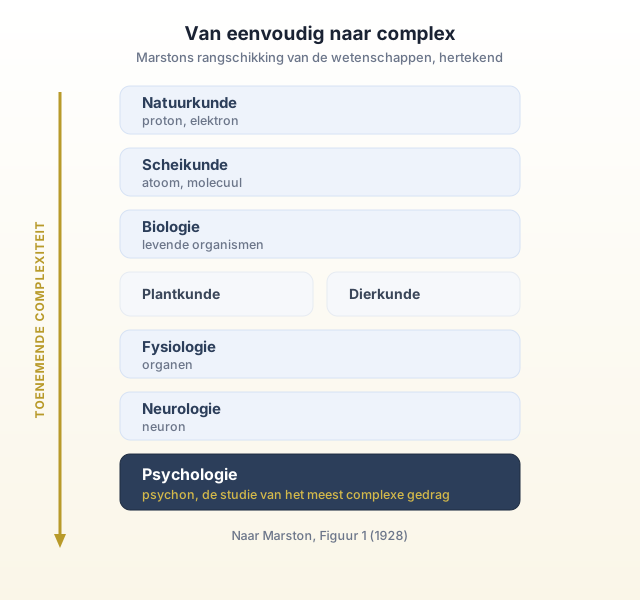
Marstons rangschikking van de wetenschappen, van natuurkunde tot psychologie, hertekend in HBG-stijl
Figuur 1, hertekend. Marston rangschikt de wetenschappen naar oplopende complexiteit. De psychologie staat onderaan, als studie van het meest complexe gedrag.
Download de originele tekening (1928)
Bestaat er een stabiele energievorm die complexer is dan de zenuwprikkel? Het antwoord van het gezond verstand luidt: ja, het bewustzijn.

De toewijzing van de psychologie

Fysiologen, neurologen, psycho-fysiologen en wellicht ook psychoanalytici zijn het in grote lijnen met dat antwoord eens. Al deze onderzoekers nemen, stilzwijgend of uitgesproken, aan dat het bewustzijn een uiting van energie is die bestaat en reageert als een eenheid, los van een loutere verstoring binnen de zenuwcel. Als je dat aparte bestaan van het bewustzijn toegeeft, dan moet de bijzondere taak van de psychologie de beschrijving van die meest complexe energievorm zijn. En de psychologie moet, net als elke andere wetenschap, beide oorzakelijke kanten van haar onderwerp beschrijven. Het effect van zenuwprikkels op het bewustzijn moet worden ontdekt en geanalyseerd. Niet minder belangrijk is de invloed van het bewustzijn op de zenuwprikkels. Via die invloed op de zenuwenergie werkt het bewustzijn op de weefsels, en via de weefsels uiteindelijk op de fysieke omgeving van het organisme.

Een van die schakels tussen bewustzijn en omgeving weglaten, betekent een gat in de wetenschappelijke beschrijving, en zulke gaten leiden meestal tot onnauwkeurigheid. Daarom is het verstandig dat de psychologie zich allereerst op de neurologie baseert en steunt op de beschrijving van het zenuwgedrag die dat vak levert. Zo vindt de psychologie haar vertrek- en aanknopingspunten min of meer kant-en-klaar.

Als de opdracht van de psychologie het bewustzijn is, en als het bewustzijn rechtstreeks in contact staat met de zenuwenergie, dan kunnen de waarneembare lichamelijke veranderingen en bewegingen op twee manieren van nut zijn. Ten eerste kan een lichamelijke beweging een symptoom zijn van een voorafgaande psycho-neurale oorzaak. Het bewijs voor het bestaan van die bewuste oorzaak hoort, zoals later wordt uitgewerkt, niet op introspectie te berusten, maar op objectieve maatstaven. Ten tweede, als een verandering of beweging niet het gevolg van bewustzijn is, kan ze toch interessant zijn als oorzaak die bewustzijn voortbrengt of wijzigt. Meetbare lichaamsveranderingen kunnen dus de eenvoudiger oorzaken zijn van het ontstaan of de verandering van bewustzijn. Steeds geldt: of het bewustzijn werkelijk is veranderd, moet zoveel mogelijk op objectieve in plaats van introspectieve gegevens worden beslist.

Samengevat zijn meetbare lichaamsveranderingen op twee manieren waardevol voor de onderzoeker. In het eerste geval gebruikt hij de verandering als aanwijzing van vooraf bestaand bewustzijn, en behandelt hij het bewustzijn als vitalistische oorzaak waarvan de beweging het gevolg is. In het tweede geval gebruikt hij de verandering als aanwijzing van het bewustzijn dat zal volgen, en is de lichaamsverandering een mechanistische oorzaak waarvan de verandering van bewustzijn een voorspelbaar gevolg is.

Deel 5 van 6

Wat elke stroming benadrukt

HBG-beeld bij Wat elke stroming benadrukt
HBG-toevoeging · samenvatting en beeld in onze stijl. Geen onderdeel van Marstons origineel.

In het kort, in onze taalElke school in de psychologie legt de nadruk ergens anders. Marston wil ze samenbrengen in plaats van er een te kiezen.

Welke oorzaken de verschillende scholen benadrukken

Met dit voorlopige beeld van de psychologie kunnen we kijken naar de verschillende kanten van haar taak waarin de uiteenlopende onderzoekers zich specialiseren.

De psycho-fysiologen

De psycho-fysiologen zijn onderzoekers die zorgvuldige laboratoriummetingen proberen te doen van veranderingen binnen het lichaam. Vooral zij benadrukken de mechanistische kant van hun gegevens: ze willen graag het bewustzijn beschrijven dat uit de gemeten lichamelijke veranderingen voortkomt. Vanuit die voorkeur hebben psycho-fysiologen lang tevergeefs geprobeerd te bewijzen dat lichamelijke veranderingen de mechanistische oorzaken zijn van de daaruit volgende gewaarwordingen, en dat die gewaarwordingen de emotie zijn. Dat is de James-Lange-theorie.

Aan de andere kant heeft een beperkt aantal psycho-fysiologen geprobeerd lichamelijke metingen te gebruiken als symptomen van reeds bestaande emotionele oorzaken. Associatie-reactietijdtesten, systolische bloeddruk-leugentests en galvanometrische emotietests zijn van dat type. Lichaamsveranderingen worden dan stilzwijgend behandeld als gevolg van emotie-impulsen die als vitalistische oorzaak werken. Hoewel de fysiologische psychologen zwaar gehinderd zijn door de onzinnige aanname dat alle bewustzijn uiteindelijk uit gewaarwording bestaat, hebben ze zich over het geheel genomen niet laten verleiden om hun resultaten eenzijdig als mechanistisch of vitalistisch te bestempelen. Kortom, ze hebben hun metingen en introspecties zorgvuldig vastgelegd en zich onthouden van stellige uitspraken over het soort oorzaak tussen beide.

De testers en statistici

De tester-statisticus is lastiger in de psychologie te plaatsen. Soms ben je geneigd te denken dat dit type helemaal niet in de psychologie werkzaam is. Toch werpen statistische testresultaten waardevol zijlicht op veel strikt psychologische vraagstukken. Het is moeilijk om intrinsieke psychologische betekenis te vinden in de mededeling dat Thomas Brown een legertestscore van 200 haalde. Er bestaat, voor zover ik weet, geen sleutel tot de verschillende bewustzijnselementen die nodig zijn voor die 200, en geen overzicht van de psycho-neurale mechanismen die hij gebruikte om zo'n hoge score te halen. De gangbare betekenis van de score is enkel dat Brown een willekeurig vastgestelde reeks taken aanzienlijk effectiever heeft gehoorzaamd en overheerst dan miljoenen anderen.

Wil je dit resultaat psychologisch gebruiken, dan moet je raden welke psycho-neurale mechanismen bij deze persoon door de taken werden aangesproken. Dat is minder moeilijk dan het klinkt. Met wat praktische ervaring merk je dat bepaalde bewustzijnskenmerken, zoals reactiesnelheid en de fijnheid van de conformiteitsemotie, nodig zijn voor een hoge score. Dit ruwe ontleden van testresultaten in allerlei genoemde mentale eigenschappen is waar testspecialisten uiterst bedreven in raken. Voor een genie als Thorndike, die jaren testresultaten analyseerde, zijn de psychologisch suggestieve waarden enorm, te oordelen naar zijn bijdragen aan de psychologie van het leren. Als we die suggestieve waarde, in plaats van de statistische formulering, als de voornaamste psychologische opbrengst nemen, dan specialiseren de testers zich in de vitalistische oorzakelijkheid: de prestaties worden behandeld als symptoom van bewustzijns- en zenuwenergie die als vitalistische oorzaak van het gemeten gedrag werken.

De behavioristen

John B. Watson stelt dat de behavioristen in 1912 besloten om de psychologie ofwel op te geven, ofwel er een natuurwetenschap van te maken. Velen menen nu dat de Watsoniaanse behavioristen niet een, maar beide dreigementen hebben uitgevoerd. Zeker, Watsons mechanistische voorkeur, gesteund door zijn buitengewoon scherpe waarneming, heeft wonderen verricht in het omvormen van de psychologie tot een objectieve wetenschap. Maar er zijn ook flinke aanwijzingen dat Watson de psychologie helemaal heeft opgegeven. In zijn jongste boek omschrijft hij het onderwerp van de menselijke psychologie als het gedrag of de activiteiten van de mens, maar hij sluit het bewustzijn daar uitdrukkelijk van uit. Als Watson erin zou slagen de psychologie zo te kortwieken, zou hij zichzelf overbodig praten. Want de neuronactiviteit is toegewezen aan de neuroloog, de weefselactiviteit aan de fysioloog, en de indeling van het grove gedrag van alle dieren, de mens inbegrepen, aan de biologie.

Maar de behavioristen hebben zich niet gedragen alsof ze hun taak zo beperkt zien. Watson heeft veel zorgvuldig opgezette proeven beschreven waarin hij juist de mechanismen binnen het lichaam probeerde te ontleden die het uiteindelijke gedrag voortbrachten. Dat hij zich nu op zaken richt en zegt minder belang te hechten aan de ingewikkelder mechanismen, vooral die van het centrale zenuwstelsel, komt waarschijnlijk door tijdgebrek voor laboratoriumwerk, niet door een echte ommezwaai. Over het geheel kunnen we het Watsoniaanse behaviorisme zien als een mechanistisch gedreven poging om de psychologie objectief te maken door simpelweg datgene weg te laten wat de behavioristen niet menen te kunnen beschrijven. Dat het weggelaten verschijnsel toevallig het bewustzijn is, is jammer voor het behaviorisme, niet voor de psychologie.

Durven we, tegen de behavioristische storm in, aan te nemen dat het bewustzijn een zeer complexe maar stabiele energievorm is die tot de activiteiten van de mens hoort, dan zou Watson juist geinteresseerd zijn in de macht die omgeving en weefsels over het bewustzijn uitoefenen. Watson houdt vol dat alleen mechanistische oorzaken bestaan. Hij ziet het centrale zenuwstelsel als een loot van de overige weefsels die het volledig beheersen, en stelt dat de reacties van weefsels en zenuwstelsel geheel zijn overgeleverd aan de fysieke omgeving, zoals Atalanta volledig was overgeleverd aan de gouden appels.

Maar bijna in de volgende alinea probeert Watson te laten zien hoe de mensheid haar slavernij aan religieuze en sociale conventie van zich af kan werpen. Hij heeft onlangs betoogd dat er geen kinderen meer ter wereld zouden moeten komen tot ouders genoeg over hen weten om elk kind op te voeden volgens de eigen aard van dat kind, fysiek, mentaal en emotioneel. Een treffender geloof in de macht van de vitalistische oorzakelijkheid is nauwelijks denkbaar. Als het menselijk bewustzijn werkelijk werd beheerst door de eenvoudiger krachten van de omgeving, zou zo'n droom van zelfregulatie pure waanzin zijn. De werkzame kracht in Watsons programma is juist het complexe bewustzijn van de ouders, dat, nog complexer gemaakt door kennis, het eenvoudiger bewustzijn van het kind kan sturen. Het waren niet echt de appels die Atalanta overwonnen, maar het complexere bewustzijn van Milanion die de appels liet vallen. Het is dan ook waarschijnlijk dat we van de meester-behaviorist uiteindelijk evenveel nadruk op vitalistische als op mechanistische oorzaken mogen verwachten. Beide kanten van een wetenschap zijn onafscheidelijk. En het is niet roekeloos te voorspellen dat de behavioristen van vandaag volledig in de psycho-fysiologen van morgen kunnen veranderen, zodra methoden om het bewustzijn objectief te beschrijven zijn vervolmaakt.

De psychoanalytici

Tot slot de psychoanalyse. De psychoanalytici hebben bijzondere belangstelling voor de macht die uiteenlopende, botsende en vervormde bewustzijnselementen over het gedrag uitoefenen. Dat is duidelijk een vitalistische oorzakelijkheid. Maar als we een stap dieper in hun leer doordringen, blijkt dat die storende bewuste elementen zelf worden gezien als product van weer een andere grootheid: de libido. Als de libido een massa onbewuste, fysieke energie blijkt, dan is het hele fundament van het psychoanalytische systeem volstrekt mechanistisch. Blijkt de libido daarentegen deel te hebben aan de aard van het bewustzijn zelf, dan loopt er een vitalistisch thema tot in het hart van de leer.

De effecten die fysieke voorwerpen en situaties op het emotionele bewustzijn van kinderen zouden hebben, zijn voorbeelden van zuiver mechanistische oorzakelijkheid. De psychoanalytici leren namelijk dat het emotionele bewustzijn van jonge kinderen bijzonder vatbaar is om beheerst, verwrongen en misleid te worden door onweerstaanbare effecten van eenvoudiger materie in de omgeving. Naarmate de mens ouder wordt, acht men zijn bewustzijn minder vatbaar voor zulke schade, al kunnen omgevingsvijanden, wanneer de libido ze tegenkomt, meer macht over het bewustzijn krijgen dan de libido zelf. Over het geheel kunnen we de psychoanalyse kenmerken als een denksysteem dat uitgaat van een voortdurend lichamelijk conflict tussen de vitalistische oorzaken, die hun oorsprong vinden in de libido of in het bewustzijn, en de mechanistische oorzaken uit de omgeving. De verklaarde bedoeling van de psychoanalyticus is zich te verbinden met de zelfsturende, bewuste oorzaken in een mens, om de mechanistische omgevingsoorzaken te verslaan en die invloeden zo mogelijk in harmonie te brengen met de eigen aard van de mens. We mogen concluderen dat de psychoanalyticus de psychologie ziet als de studie van het conflict tussen vitalistische en mechanistische oorzaken, voor zover die het bewustzijn betreffen.

Samenvatting

De nadruk van de belangrijkste onderzoekers laat zich zo samenvatten. Psychologen die tegelijk het introspectief gerapporteerde bewustzijn en de met precisie-instrumenten gemeten lichaamsveranderingen onderzoeken, zijn meestal even geinteresseerd in mechanistische als in vitalistische oorzaken. Zij hoeven zich, en doen dat vaak ook niet, niet stellig uit te spreken over de vraag of het bewustzijn de lichaamsverandering heeft veroorzaakt of andersom. Daar is niets op tegen, al mag je hopen dat de psycho-fysiologen wat meer durf tonen in de oorzakelijke duiding van hun resultaten, zodra het bewustzijn als een vorm van fysieke energie wordt erkend.

De testers en statistici, die psychologisch suggestieve resultaten van aanzienlijke waarde opleveren, zoeken oorzaken van het vitalistische type, voor zover testresultaten als onthullend voor bestaand bewustzijn worden opgevat. De Watsoniaanse behavioristen, ogenschijnlijk fel mechanistisch in hun huidige propaganda, blijken niettemin de meest praktische belangstelling van allemaal te hebben voor de vitalistische oorzakelijkheid. Want zij houden vol dat de mens, de meest complexe energie-eenheid, het vermogen bezit om zijn eigen gedrag geheel van de omgeving te bevrijden. De psychoanalyticus ten slotte heeft bijzondere belangstelling voor de verhouding tussen beide soorten oorzaken, een verhouding die hij als conflict opvat en in het voordeel van de vitalistische oorzaken wil beslechten. Van alle denkers die aan de emotietheorie bijdragen, lijkt hij de enige die het gelijktijdig bestaan van beide soorten oorzaken uitdrukkelijk erkent, en de noodzaak voor de psychologie om met beide te werken.

Deel 6 van 6

Emotie, voorlopig omschreven

HBG-beeld bij Emotie, voorlopig omschreven
HBG-toevoeging · samenvatting en beeld in onze stijl. Geen onderdeel van Marstons origineel.

In het kort, in onze taalEen eerste werkdefinitie van de psychologie van de emotie, als opstap naar de rest van het boek.

De psychologie van de emotie, voorlopig omschreven

Als we onze conclusies over mechanisme, vitalisme en psychologie op de emotie toepassen, kunnen we ons vakgebied voorlopig zo omschrijven. De psychologie van de emotie is de wetenschappelijke beschrijving van het affectieve bewustzijn. En wetenschappelijke beschrijving moet, zoals gezegd, de ontdekking en uiteenzetting van beide soorten oorzaken en hun wisselwerking omvatten.

Concreet mogen we verwachten dat we de oorsprong van de emotie kunnen terugvoeren op mechanistische oorzaken: op zenuwprikkels, vandaar op lichaamsveranderingen en uiteindelijk op prikkels uit de omgeving. Die drie soorten oorzaken zijn eenvoudiger energievormen dan het bewustzijn zelf. We mogen ook verwachten dat veel elementen van het emotionele bewustzijn door diezelfde mechanistische oorzaken worden beeindigd. En, jammer genoeg, dat de koppeling van het emotionele bewustzijn aan omgevingsprikkels grotendeels onder mechanistische invloed staat. Vaak is namelijk de kwaliteit van de emotie die op een bepaalde prikkel reageert, bepaald door toevallige herhaling van die prikkel, of door de omstandigheden waarin de prikkel voor het eerst werd aangeboden. In dat geval oefent het levenloze voorwerp volledige controle uit over de aard van de emotionele reactie, en zo'n oorzakelijkheid blijft door en door mechanistisch.

Aan de andere kant moeten we de lichamelijke uitingen van het emotionele bewustzijn zien als vitalistisch veroorzaakt door de bewuste energie zelf. Het lichamelijk gedrag dat wij als symptoom van emotie opvatten, is werkelijk een gevolg van de fysieke oorzaak die de emotie-energie in gang zet. Het emotionele bewustzijn werkt als vitalistische oorzaak telkens wanneer het zich uit door wijziging van eenvoudiger energievormen, zoals zenuwprikkels, weefsels of levenloze voorwerpen. Sterker nog, het emotionele bewustzijn werkt ook als vitalistische oorzaak op zijn eigen, minder complexe eenheden. Grotere eenheden van emotioneel bewustzijn kunnen kleinere sturen langs de omweg van het dwingen van zenuwprikkels en, via die, van omgevingsprikkels, om als het ware nieuwe eenheden emotioneel bewustzijn op maat te laten maken. Zo blijkt de volledige beheersing van de eigen emotionele conditionering, die Watson bepleit, tot stand te komen doordat een vitalistische oorzaak de mechanistische oorzaken stuurt en voor haar eigen doel gebruikt. Die weg, eerder dan een onderling conflict tussen twee bestaande eenheden van bewustzijn, lijkt de natuurlijke vorm van emotionele zelfbeheersing.

Kortom, het emotionele bewustzijn, werkend als vitalistische oorzaak, kan niet alleen zenuwprikkels, lichaamstoestanden en omgevingskrachten beinvloeden, maar het kan die eenvoudiger eenheden ook zo sturen dat hun mechanistische werking wordt ingezet om het bestaande emotionele bewustzijn te verlengen of te beeindigen.

Deze uitvoerige analyse van de wetenschappelijke oorzakelijkheid in de psychologie van de emotie is bedoeld als een eerste bepaling van de eisen waaraan elke zinvolle emotietheorie moet voldoen, wil ze als geraamte voor onderzoek dienen. Ik kan hier wel zeggen dat ik het niet eenvoudig vond aan die eisen te voldoen. Maar als ze uiteindelijk vervuld zijn, geloof ik dat het resulterende bouwwerk aanvaardbaar zal blijken voor alle uiteenlopende onderzoeksrichtingen. De winst van zo'n wapenstilstand in de huidige psychologische burgeroorlog zou groot zijn, want alleen door een gemeenschappelijke werkhypothese kan een wezenlijk deel van al die uiteenlopende bijdragen betekenis krijgen voor iedereen.

Waar wij afwijken van Marston: zijn indeling van de wetenschappen in eenvoudige tegenover complexe energie-eenheden, en zijn idee van bewustzijn als hoogste energievorm, zijn achterhaald. De moderne wetenschap denkt hier anders over. Wij nemen van dit hoofdstuk vooral de gedachte mee dat een onderzoeker nooit neutraal kijkt, niet zijn natuurfilosofie.

Bron en verantwoording

Controleer dit hoofdstuk aan de bron

Deze hertaling volgt hoofdstuk II van Emotions of Normal People (William Marston, 1928, publiek domein). Hieronder lees je de volledige originele Engelse tekst van dit hoofdstuk, met de oorspronkelijke paginanummers, zodat je alles kunt nalezen en verifieren. Je kunt ook de volledige woordgetrouwe Nederlandse vertaling en het Engelse origineel downloaden.

De woordgetrouwe NL-vertaling, het Engelse origineel, de HBG-versie en Marston 2.0 zijn gratis te downloaden zodra je een HBG-account aanmaakt en je e-mailadres bevestigt. Zo blijft dit gedachtegoed beschikbaar voor iedereen die er echt mee aan de slag wil.

Lees de originele Engelse tekst van hoofdstuk II · Marston, 1928
Dit is de oorspronkelijke Engelse tekst zoals Marston die in 1928 schreef, inclusief de originele paginanummers. Onze Nederlandse hertaling hierboven volgt deze tekst getrouw. Zo is elke passage terug te leiden naar de bron.

OUR problem is : What are the underlying desires, or wishes, that lead some scientists to insist upon mechanistic conceptions, and others equally eminent, to espouse some form of scientific vitalism ? For in psychology, as in other sciences, a materialistic or vitalistic bias may be found at the root of nearly all factional schools, or contentious groups. Sometimes, of course, the underlying desire relates solely to the advaffcement of the personal fortunes of the workers concerned; and such purely egoistic motives probably play a considerable part in the evolution of every scientific doctrine. In addition to this, however, originators and promulgators of conceptual

pagina 22

systems of thought, nearly always possess hidden desires to push science in this direction or that, " for science's own sake ". The goal selected is the one that accords most closely with the basic emotional set of the scientific agitator. And the emotional sets of scientists may be classified, broadly, into two elementary groups, materialistic and vitalistic.

The Mechanistic Set

Mechanists are " hard-boiled ". They are chronic sceptics* and must be shown. They pretend to base all their conclusions upon material evidence, and seldom observe that their own aggressive disbeliefs in the existence of this or that are based upon temperamental rejection of the very proffered evidence which their creed holds sacred. Their rationalization of their own emotional bias runs something like this : Science is the study and exposition of material causation. " Material " means always " cruder, less complex forms of energy ". Therefore, true science is the study of the influence of simpler energy units upon more complex energy units. And, since we can account for everything we have experienced in tfcis way, why waste time imagining that there exists any other.type of

cause or causation ? The mechanistic doctrine is pithy, succinct, and easily understood. Like the emotional set of its adherents, the mechanistic doctrine is aggressive, selfassured, and makes for rapid and decisive action. Scientific results, like other types of reward, are attained by action. Materialism, therefore, has proved itself a very useful agent in turning man's intellect from arm-chair speculation, to

pagina 23

laboratory research.

The Vitalistic Set

Vitalism seems to associate itself very intimately with religion, and religion might be defined as an emotional police force for morals. The vitalises basic emotional set is subtler, more complex, and harder to define than is that of the materialist. It seeks a more ultimate good for the self, and, at the sa*e time, desires opportunity to dispense loftier cheer to others. If mere physical fact interferes, at any point, with vitalism's sacred purposes, then escape is taken to the heights of imagination, where no physical facts exist. Nor do these occasional excursions prove wholly futile. Often the fugitive from reality returns to earth with new and usable inspiration. Physical facts frequently turn out to be chameleons, changing to richer and more varied colours under more vivid illumination.

In rationalizing his underlying desires for science, the vitalist remains true to form, starts with a priori assumptions, and ultimately descends to facts. He assumes, to begpn with, that physical phenomena cannot adequately be accounted for as mere results of physical causes. Therefore, it seems, we must further assume the existence of a first cause, or superphysical influence of unknown attributes. Granting the existence ol such an ultra-material agent, it is easy to assert that " He " produces, emanates, or is physical consciousness. From this point on, the vitalist descends into the same world with the materialist. Only, vitalistic causation proceeds in an opposite direction. Consciousness is a more complex, more ultimate form of being than is organic matter; which, in turn, is more complex and potent than are inorganic energy units.

pagina 24

Complex energy forms are regarded by the vitalist as more compelling than the cruder units. It is held, therefore, that higher fenergy units are the causes, and that simpler energy units aVe effects. " God made man in His own image ", and

set him to rule over the beasts of the field. The beasts, in turn, rule the vegetables, and so on down the line. Science is conceived of by the vitalist as a study and description of the causal influences of the higher upon the lower, the more complex upon the simpler, the more conscious upon the less animate. This doctrine is utterly repellant to many scientists, because it bases itself, initially, upon sheer, unproved assumption, and because, with equal naivetd, it ignores countless instances, appearing in every day life, wheie determinative influences are exercised by cruder forms of matter upoji human consciousness itself, which the vitalist regards as the highest known form of energy.

Existence of Mechanistic-Type Causes and Vitalistic-Type

Causes

On the other hand, physical scientists who desire, IUF- selfconsciously, to uplift their fellow humans, endure with difficulty the thought that the destiny of mankind rests supinely in the power of the unbound electron. Mechanistic determinism is abhored just as whole-heartedly by many a man

pagina 25

of letters who sees no logical escape from its tentacles, as it is by " fundamentalist " preachers who see in the triumph ot materialism a prospective loss of their own bread and butter. Most dreaded of all mechanistic tenets, apparently, is Darwinian evolution. That monkey has made man in his own image is % felt to be a degrading thought. Why? Because such a conclusion is taken to mean that man, once made, continues to be controlled by the same elementary forces which originally produced him. But biological evolution, even if true, entails no such implications. Monkey (or the common ancestor), may have caused man to evolve into his present form; but man, on the other hand, can now create new types of monkeys at will, by exercising a controlling influence over their breeding habits. And this is the very type of causation idealized by the vitalists. Man, the complex, sets causes in motion which influence the nature of monkey, the simpler animal. Moreover, while the materialistic supposition that monkey originally created man is beyond our present powers of verification, the influence exercised by man over monkey can be observed, any day, in the laboratory. In this argument, at least, we must concede that the vitalists' variety of causation is more solidly upheld by facts than is the median-

io EMOTIONS OF NORMAL PEOPLE

istic type of cause raised by materialists to epic grandeur in the saga of biological evolution. We must admit that while the vitalists begin their theorizing with fictional flights, the materialists conclude their doctrines with an almost equally speculative sublimation of their underlying emotional set.

pagina 26

Also, in justice to both, it may be said that the vitalistic account of causation is just as much an accurate observation of physical fact, as is the mechanistic account. Simpler energy units constantly influence more complex units, and may, under favourable conditions, control their behaviour, while more intricate assemblages of force, by virtue of new attributes derived from their complexity, as constantly compel comliance from cruder types of matter, and do, under our very eyes, completely regulate the simpler energy forms.

-""Physical science must and does include both mechanistic and vitalistic types of causation.

Science Musi Describe Both Types of Causes

We do not know as a matter of actual observation how organic forms of energy originate. We do know, however, that such energy units exist, and that any life-possessing unit exercises spontaneous influences over inorganic matter throughout its life span. These influences are in every sense vitalistic-type causes. Even inorganic matter may spontaneously generate causes of this same type. Radio-active metals, for instance, emanate energy particles regardfess of the nature of the environment in which these emanations take place. Physical science, without doubt, is held accountable for a full description of these phenomena.

At the same time, life-possessing units of matter, such as plants and animals, are constantly undergoing modification as a resu^: of stimuli which impinge upon their organisms from the less complex material units of their environment. Simple, but intensely energized forces like wind or waves may destroy

pagina 27

plant or animal organisms altogether; or such forces may influence in conclusive manner the growth or movements of the more complex animal and plant organisms. In the case of inorganic matter, acids or single chemical elements vastly less complex in themselves than the radio active metals, may t attach and destroy the latter, or may hasten or retard the radio* activity. These are mechanistic-type causes acting

MATERIALISM, VITALISM, AND PSYCHOLOGY n

determinatively upon energy units more complex than

themselves.

Interaction of Mechanistic Type and Vitalistic-Type Causes

In addition to such wholly separable types of causation, science has still to deal with the interaction of vitalistic and mechanistic causes. It is in the discussion of influences interacting between complex and simple energy units that the greatest confusions and conflicts of scientific analysis arise. For instance, let Us suppose that science is called upon to describe the plant growing in a field. It can be shown definitely that the soil is delivering a continuous series of chemical stimuli to the plant. It is equally ascertainable that the plant reacts to these stimuli with a series of reactions peculiar to its own inherent nature. Some of these plant responses will result in the delivery of counter stimuli to the soil and some will not. Those influences which are exercised by the pl~%t over the soil will, for the most part, alter the soil in ways determined by the chemical power of the plant. In so far, therefore, as soil and plant interchange influences, it may fairly

pagina 28

be said that the more complex units of energy composing the plant will dominate the interplay of causal forces.

But, as we have noted, there will be many changes in the plant, as a result of reactions to soil stimuli, which will not direct any influence back toward the earth. Were these plant changes directed by the soil to its own ultimate benefit, then we might clearly assume that the simpler form of energy was in causal control of the more complex energy unit. That is to say, if the soil were able to use the more complex energy of the plant to effect its own enlargement, simply by stimulating the plant to act according to the plant's own principles of action, we might conclude that, after all, the balance of control lay with the simpler unit of energy. This would amount to philosophical admission that mechanistic causation holds the balance of power. But such does not appear*to be the case. Though stimulated to action by the soil, the plant reacts with its own energy according to its own innate principles of action, and with reaction tendencies designed for its own ultimate benefit. With innate power to develop spontaneously throughout its own life cycle, with a balance of power of interaction capable of changing the soil more radically than the soil can change it, and, finally, with a structure designed in such a way as always to react for its own benefit

when stimulated to action by the soil, we are forced to conclude that the plant is a more potent generator of effective causes than is the soil. In short, a close logical analysis of influences interacting between complex and simple energy units would

pagina 29

seem to show that the responses of the simpler unit are dependent to a greater extent upon the causal control of the more complex form of matter, than are the reactions of the latter upon the former. If a balance is to be struck, then, upon the basis of empirical observation^ between vitalistic and mechanistic types of causation, we should be obliged to concede to the vitalistic causes the final balance of power. But science is not called upon to strike any such balance; it is merely required to describe both types of causation, neglecting neither the one nor the other.

Complex Matter-Units Possess Greatest Causal Power

In the large, we may put the matter somewhat as follows. Science finds, in this world, units of energy of varying complexity. It finds that the complex units are capable ol exerting spontaneous influences upon the simpler units, and vice versa. It finds that simple and complex units customarily interact, each causing changes in the other. The balance of power, on the whole, in this interchange of causal influences, lies with the more complex energy accretions. Even supposing, by way of illustration, that lead was once responsible for the evolution of uranium, it seems now the fact that radio-active metal can create lead under our own observation; while lead, if it still possesses evolutionary power, manifests it in too small a degree to be detected with available instruments. Perhaps inorganic compounds, millions of years ago, evolved plant structures. But now, at least, vegetable growths alter the entire composition of their nurturing soils, in the course of a few seasons; while the ability of the chemical influence of the soil to change the fundamental characteristics of plant life is extremely uncertain. Monkey-like primates may have given rise, in the long ago, to genus homo; but there is now little comparison between the influence that man is capable of

pagina 30

exerting over ape behaviour, and that which monkeys may bring to bear upon man. It seems to be a principle of nature that once a more complex form of energy appears, it forthwith possesses greater causal power over simpler forms of energy than the simpler forms possess over it.

But the mere fact that a quantitative majority of causations are of vitalistic type, does not in the least mean that science can neglect the huge, co-existing volume of mechanistic-type causations. Both aspects of causal description are required in all sciences. In physics, for example, which seeks to describe the most ultimate, or elementary reaction tendencies of matter, the attempt is now being made to resolve all complex masses into ultra-simple proton and electron systems. The influence of each proton-electron microcosm, then, must be traced in its most far-reaching effects upon the physical behaviour of the macrocosmic mass of which it forms a single unit. The causal influences of the total mass, on the other hand, upon its constituent proton-electron systems, and upon other free-lance proton-electron systems, must be described.

Chemistry, starting with already complex units of matter, the atom and the molecule, seeks to describe the causal effect of atoms upon molecules, and of molecules upon their constituent atoms, and upon other atoms, free 01 in other molecular systems of combination. Complexly organized groups of molecules, also, are studied by chemistry, which attempts to trace the influences which single molecules exercise upon

pagina 31

organic and inorganic compounds, and the causal effects of such compounds upon the simpler, molecular units.

From chemistry we step over the border line between inorganic and organic matter into the field of the sciences which deal with living organisms. In botany an attempt is made to analyze plant structures into cellular units. The effects of these units, together with the influences of still simpler inorganic units upon complex plant structures is then considered. Slightly more important, perhaps, is the description of the manner in which plants utilize and react upon their environment. In the general science of biology, which serves as an introduction to the more highly specialized physiological sciences, it is interesting to note that animal organisms are classified into phyla, genera, and species, upon the basis of the type of action which each animal exerts upon its environment, rather than according to the effect which inorganic or vegetable environment exerts upon the animal. Both aspects of scientific description are important in biology, however, as we have seen them to be in the other sciences.

With the advent of the highly specialized physiological sciences, we find a group of studies whose special objfect is

I 4 EMOTIONS OF NORMAL PEOPLE

analysis and description of man himself. Animal organisms below the complexity level of man are, of course, constantly utilized in the physiological laboratory; but such animal subjects are studied in order to apply the knowledge thus gained to further understanding of man. In other words,

pagina 32

the purpose of the physiological sciences has become frankly vitalistic as to type of causation emphasized. It is desired to know how man reacts upon and utilizes animals less complex than himself, as well as to learn the influences which he is able to wield over his vegetable and inorganic environments. This underlying purpose of the human scientist appears greatly to disturb mechanistic -minded writers and investigators, and the repeated attempt is made to assert the equal scientific importance of animal and botanical results regardless of their ultimate bearing upon analyses of man's own creative tentLncies. Similarly, attempts are frankly made by materialistically biased persons to assert that man's behaviour is determined in its entirety by the influences exerted upon it by units of energy simpler than man himself.

The truth of this assertion may be tested by examination of the nature of the nervous impulses by which, it is generally conceded, man's bodily conduct is initiated and controlled. Nerve impulses were formerly thought of as electrical disturbances. The energy travelling along a given nerve was conceived of as an outside force imposed upon the nerve by an environmental or physiological stimulus; that v is, by a stimulus less complex in energy organization than the nerve itself. Neurologists have subsequently discovered, however, that the nature of a nervous impulse is wholly dependent upon the potential energy already contained within the nerve fibre. A nervous impulse is now described as a series of explosions, 1 2 dependent for their intensity and volume, not upon the intensity of the physical stimulus, but rather upon the intrinsic structure of the particular nerve fibre stimulated. The

1 K Lucas, The Conduction of the Nerve Impulse, London, 1917, p 23.

pagina 33

1 A Forbes, " The Interpretation of Spinal Reflexes in Terms of Present Knowledge of Nerve Conduction, " Physiological Reviews, vol ii, July, 1922, p 367 : "It has been likened to the burning of a train of gunpowder, in contrast with the transmission of a sound wave whose energy comes entirely from its initiating source This fact, now well established, should put an end to all efforts to explain the nerve impulse simply as a transient current of electricity conducted along the fibre on thesame principle as in an insulated wire; the dynamics of the two modes of conduction are fundamentally different,"

function of the physical stimulus is limited to an initial release of nervous energy accumulations more complex than itself. In no sense is the nervous impulse determined by, or causally dependent upon the less complex physical stimulus to which it responds, except in the single particular that the physical stimulus is responsible for the origin of the nervous impulse. Once the nervous impulse appears, it proceeds to operate on its owil energy and according to its own rules of behaviour, like all other complex forms of energy. The mechanistic thinker assumes that causal responsibility for the origin of the more complex form of energy implies subsequent' control of the more complex unit throughout its life span. Only if

pagina 34

such continuous control were exercised by the simpler over the more complex could this world be regarded as uniformly mechanistic. As a matter of fact, however, the moment a more complex energy unit, such as the nervous impulse, iscalled into being, it forthwith assumes control of its own behaviour, and, to a considerable extent also, it exercises control over the behaviour of the stimulus energy unit.

The analysis of human emotions hereinafter set forth will, I trust, clearly show that man, the most complex of unit organisms, is similarly independent of, and influential over, the environmental stimuli which initially call into being his

responses.

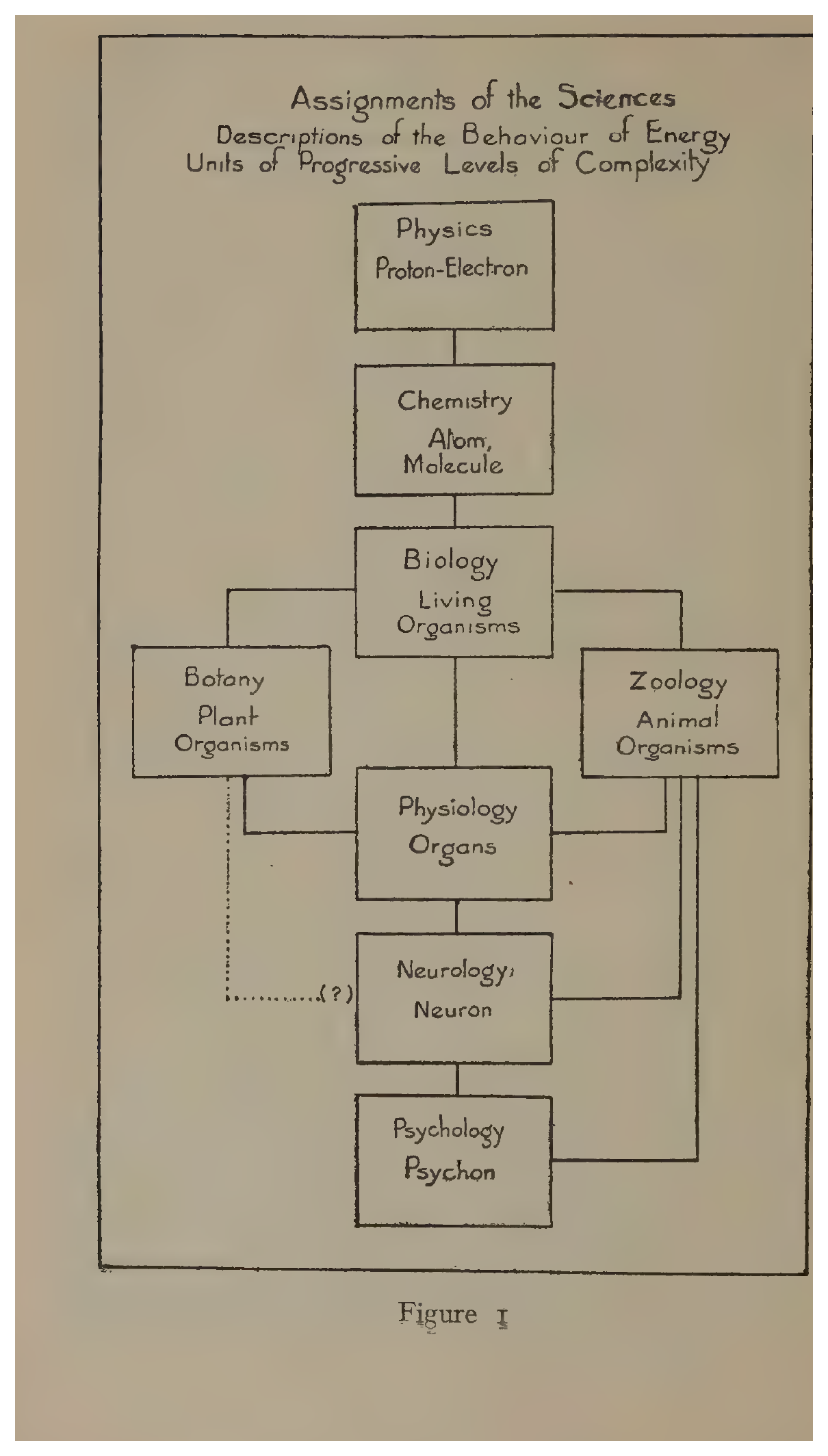
Assignments of the Sciences

Psychology is the youngest and most undeveloped of the specialized, man-describing sciences. What is psychology's peculiar assignment ? What especial group of energy units must psychology examine, both with respect to the influences exerted upon these units by simpler forms of matter, and with respect to manipulations of simpler forms by the units described by psychology ? Physiologists, as we have seen, undertake to examine the effects of environment upon bodily tissues and organs. They also seek to discover the actions of the organs themselves upon the various vegetable and mechanical forces of matter which they contact. Neurology, which is also a comparatively new branch of science, is particularly interested in the effects of bodily organs and tissues upon the net-work of neurons constituting the so-called nervous system.

pagina 35

More particularly is neurology interested in the influences exerted by nervous impulses over the various organs and tissues

of the body. Is there any stabilized form of energy more complex than the nervous impulse ? The common sense answer to this question is " Yes, Consciousness ".

Psychology's A ssignment

Physiologists, neurologists, psycho-physiologists and possibly psycho-analysts, substantially agree with this answer. All these types of investigators assume, either tacitly or explicitly, that consciousness is a manifestation of energy which exists and reacts as a unit separate from mere intra-neuronic disturbance. If this separate existence of the phenomenon consciousness be conceded, then psychology's especial task must be the description of this most complex form of energy. And psychology, like all other sciences, must proceed to the analysis and description of both causal aspects of its subject.natter. The effects of nerve impulses upon consciousness must be discovered and analyzed. None-the-less importantly must the influences of consciousness upon nervous impulses be studied Through the mediumship of its influence upon nervous energy consciousness will, of course, act upon bodily tissues, and through the mediumship of bodily tissues, consciousness will be found ultimately to influence the organism's physical environment. To leave out any of these essential causal

pagina 36

media which are interposed between consciousness and physical environment must be to leave a gap in the totality of scientific description. Such gaps usually make for inaccuracy. Therefore, it would seem sensible for psychology to base itself first of all upon neurology, relying upon the description of nerve impulse behaviour furnished by workers in that field. Thus may psychology find more or less ready-made its points of departure and application.

If psychology's assignment be consciousness, and if consciousness lies in immediate contact with nervous energy, then the physiological changes which can be discovered in bodily organs and the observable physical movements of the body itself may be utilized for psychology's purposes in two ways. In the first place, bodily movements may be regarded as possibly symptomatic of a preceding psycho-neural cause. The proof of the existence of this primary, conscious-cause should not, as will later be set forth in detail, depend upon introspective observations. Definitive, objective criteria,ba?ed upon known structures and functions of the particular median-

isms of consciousness, should be used always in deciding whether observed body changes or movements are the result of consciousness or not. In the second place, if such a change or movement is not the result of consciousness, it might still prove of interest to psychology as a causal originator of consciousness. That is to say, measurable bodily changes and movements may represent the simpler energy unit causes of

pagina 37

the generation of consciousness, or they may represent causes of its modification. **Again we must emphasize the fact that bodily changes may or may not influence consciousness, and that the issue of whether consciousness has, in faCt, been changed is to be decided as far as possible upon objective, rather than upon introspective data.

In summary, then, measurable bodily changes and observable bodily movements may be of value to the psychological investigator in one of two ways. First, it is possible that th psychologist may use the bodily change as an indicator of pre-existing consciousness. In that case consciousness is treated as a vitalistic-type cause, the effect of which is the bodily movement. Or, secondly, measured modifications may prove of value to the investigating psychologist as indicators of the consciousness which is to follow. In this case the bodily changes represent a mechanistic type cause of which

the alteration of consciousness is a predictable result.

Tyfies of Causes Emphasized by Different Schools of Emotion Investigators

With such a preliminary view of psychology as that just outlined, we find ourselves in a position to consider the various aspects of psychology's task in which different types of workers specialize.

Psycho-Physiologists

pagina 38

The psycho-physiologists may be regarded as investigators who are trying to make careful laboratory measures of intrabodily changes. More especially do we find this type of researcher emphasizing the mechanictically causal aspect of his data. That is, the psycho-physiologist seems especially concerned with trying to describe the consciousness resulting from the physiological changes measured. Following this "bias, perhaps, psycho-physiological workers have long striven in vain to prove that bodily changes constitute mechanistic-

i8 EMOTIONS OF NORMAL PEOPLE

type causes of resulting sensations, and that these sensations are emotion (James-Lange theory).

On the other hand, a limited number of psycho-physiological researchers have tried to utilize physiological measures as symptoms, or indicators of previously existing emotional causes. Association reaction-time tests, systolic blood-pressure deception tests, and galvanometric emotion-detecting tests may be listed as investigations of this type. Bodily changes, thus regarded, are tacitly treated as resultS'of emotion impulses acting as vitalistic-type causes. Though physiological psychologists have been severely handicapped by the senseless assumption that all consciousness is, in its final essence, composed of sensation, they have, on the whole, shown no prejudicial bias toward limiting the use of their results by regarding them either as exclusive!}' mechanistic-type causes or as ex-

pagina 39

Thisively vitalistic-type causes. In short, the psycho-physiologists, for the most part, have made their bodily measurements, or they have recorded their subjects 1 introspections as carefully, and they have icf rained from dogmatic assertion as to the type of causal conception, if any, existing between their two sets of data.

Mental-T ester-Statisticians

It is more difficult to place the mental-tester-statistician within the field of psychology as we have attempted to outline it. One is tempted to believe, at times, that this type of person is not working in the field of psychology at all. Yet even if this conclusion were justified, it would still remain true that the statistical-testing type of result is throwing invaluable side lights upon many strictly psychological problems. It is difficult to find intrinsic psychological meaning in the statement that Thomas Brown has made an army alpha score of 200. There exists, so far as I know, no available key to the different elements of consciousness involved in securing 200 on that particular test, nor is there an extant compendium detailing the psycho-neural mechanisms of causation employed by the subject in obtaining this unusually high score. The prevailing mental test meaning of the score is merely that Thomas Brown has complied with and dominated an arbitrarily fixed set of tasks considerably more effectively than several million other persons have been able to do. If one would utilize this result in a truly psychological analysis of

pagina 40

Brown, one must guess 'what psycho-neural mechanisms were called into play in this particular individual by the tasks imposed. Such an application of a test score to psychology is not as difficult as it sounds. After a little practical experience with tests, one comes to realize that certain characteristics of consciousness such as speed of reaction and finesse of compliance emotion are necessary to the making of a high test score. This is the sort of rough and ready analysis of test results into heterog^neously named " mental traits " at which mental test specialists become extremely expert. To a genius like Thorndike, for example, who has spent many years in analyzing mental test results, the psychologically suggestive values of test tabulations are tremendous, if one may judge from his theoretical contributions to the psychology of learning. Accepting, then, this suggestive value of mental tests, rather than the statistical formulation of their results, as the chief psychological value of this method of investigation, we may regard mental test procedures as specializing in the vitalistictype of psychological causation. The bodily performances of the persons tested are treated as symptomatic of consciousness energy and nervous energy acting as vitalistic-type causes of the behaviour measured.

Behaviourists

John B. Watson states 1 that in 1912 the behaviourists decided either to give up psychology or else to make it a natural Lcience. Many people are now inclined to believe that Watsonian behaviourists have carried out not one but both of these threats. Certainly Watson's mechanistic bias, backed by his extraordinarily keen scientific observation, has accom-

pagina 41

plished wonders in converting psychology into an objective science. But, at the same time, there is considerable evidence that Watson himself has given up psychology altogether. In his latest text, he defines the subject matter of hianan psychology as " the behaviour or activities of the human being " but he explicitly excludes consciousness from human behaviour and activity. If Watson should succeed in this bob-tailing of psychology, he would have talked himself out of a job. For neuronic activity has been assigned to the neurologist, body tissue activity to the physiologist, and classification

1 J B Watson, Behaviorism, New York and London, 1925, p 16. 1 J. B. Watson, ibid., p. 3.

of gross bodily behaviour of all anirtials, including man, to the general biologist. It might be possible, of course, for psychology to appropriate to itself the last-named function of biology in so far as it relates to the genus homo. In such case psychology would act as a sort ol clearing house for the facts of neurology and physiology, with a department for the release of composite motion pictures of whole human beings in action. But behaviourists, as a matter of fact, have not behaved as though acting upon such a concept of their scientific task. Watson, for instance, has reported to the literature many carefully controlled experiments in which he sought to analyze and explain the intra-bodily mechanisms by which the final gross actions were brought about. Watson himself,

pagina 42

of course, is now devoting himself to business, and his recent expressions of lack of interest in attempting to describe the more intricate bodily mechanisms of response (particularly those of the central nervous system) are probably attributable to his personal lack of time for laboratory experimentation, rather than to any radical shift in scientific attitude. On the whole, then, we may conclude that the Watsonian type of behaviourism is merely a mechanistically motivated attempt to turn psychology into objectively scientific channels by the simple expedient of eliminating whatever type of subject matter the behaviourists feel themselves incapable of describing. That the phenomenon eliminated chanced to be con-,, sciousness is unfortunate for " behaviourism ", not for psychology. *

If, then, we dare to assume, in the very teeth of the behaviouristic tempest, that consciousness is a very complex but stabilized form of energy which must be included in the " activities of the human being ", we may conclude that Watson and his allies would be especially interested in the control which physical environment and bodily tissues exercise over consciousness. Watson insists that only mechanistictype causes exist He regards the central nervous system as a mere off-shoot of the other bodily tissues which control it completely; and he furthermore states that the responses of both bodily tissues and nervous system are wholly at the mercy of the physical environment, just as Atalanta found herself wholly at the mercy of the golden apples. 1 Almost

1 J. B. Watson, Psychology from the Standpoint of a Behaviorist, 1919, ' Philadelphia and London, p. 3.

pagina 43

in the next paragraph, however, Watson attempts to show how the human race can throw off its thraldom to religious and social convention and other environmentally determined influences. He has recently maintained that no more children should be brought into the world until parents have learned enough about them to regulate each child's life according to the principles of the child's own nature, physical, mental, and emotional. Surely no more striking faith in the potencies of vitalistic-type causation can be found than this statement ! If human consciousness were truly controlled by less complex energy forms of the environment, such dreams for human self-regulation would be sheer madness. The actively potent cause in the programme which Watson advocates is the complex human consciousness of parents, which, when it has been made still more complex by added knowledge, \\ atson hopes can control and modify the simpler consciousness of the child. It was not really the apples which over-powered Atalanta, but the more complex consciousness of Milanion who dropped the apple?. It seems to me probable, therefore, in light of this unintentional self-revelation on Watson's part, that we may, after all, expect the master " behaviourist " to lay fully as much emphasis upon analysis of vitalistic-type causes as upon purely mechanistic descriptions. These two aspects of any science are, of course, inseparable. And it is not reckless to predict that the behaviourists of to-day may be transfer ned completely into the psycho-physiologists ol to-morrow if procedures for objective examination and description of consciousness can be perfected.

Psycho- A nalysts

pagina 44

Lastly, we may consider, briefly, the causal emphasis to be found in the doctrine of psycho-analysis. The psychoanalysts seem to take an especial interest in the control which various conflicting and distorted elements of consciousness exercise over human conduct. This clearly is a vitalistictype of causation. Yet when we penetrate one step further into the psycho-analytical teachings, we discover that the offending conscious elements themselves are regarded as being the product of still another type of entity, the libido. If, then, the libido turns out to be a mass of unconscious, physical, or physiological energy, the whole foundation of the psychoanalytical system must be regarded as thoroughly mechanistic.

If, on the other hand, the libido is discovered to partake of the nature of consciousness itself, we might conclude that a vitalistic theme of causation runs back into the very heart of the psycho-analytical doctrine.

The effects which physical objects and environmental situations are supposed to have upon the emotional consciousness of children constitute instances of purely mechanistictype causation. That is to say, the psycho-analysts teach that the emotional consciousness of young children is peculiarly susceptible to being controlled, perverted, and mis-directed by irresistible effects produced upon it by less complex forms of matter in the physical environment. As the individual

pagina 45

grows older his consciousness is thought to be less susceptible to damage or perversion from such causes, although when the libido meets with environmental enemies, these outside antagonists may exercise more control over the subject's consciousness than does the libido itself. On the whole, we may characterize psycho-analysis as a system of thought which assumes a continuous state of bodily conflict between the vitalistic-type causes, having their origin in the libido or in consciousness itself, and the mechanistic-type causes springing from environmental stimuli. The psycho-analyst's avowed intention is to ally himself with the self-controlling conscious causes existing in a subject, for the purpose of defeating the, mechanistic, environmental causes. These material influences are to be brought, if possible, into harmony with the human being's own nature. We may, perhaps, draw a general conclusion that the psycho-analyst believes psychology to be a s+udy of the conflict between vitalistic-type causes and mechanistic-type causes, in so far as such causes relate to consciousness.

Summary

It may be well to summarize the causal emphasis of investigators making the most important contributions to psychology of emotions as follows : Psychologists who seek to make simultaneous laboratory examination of consciousness as reported introspectively, and of physiological changes in the subjects' body as measured by instruments of precision, are usually interested equally in mechanistic-type causes and vitalistic-type causes. These workers need not, and often

pagina 46

do not, commit themselves very definitely as to whether

consciousness has caused bodily change, or bodily change has controlled consciousness. No fault can be found with this position, though a hope may be expressed that psychophysiologists may manifest a little more boldness in the causal interpretation of their results, once consciousness has come to be definitely recognized as a form of physical energy.

Mental-tester-statisticians, working by a method which produces psychologically suggestive results of considerable value, may be saidto seek causes of vitalistic-type in so far as test results are regarded as revelatory of existing consciousness or conscious tendencies.

Watsonian behaviourists, though ostensibly and aggressively mechanistic in their present propaganda, are found, nevertheless, to possess the most practical interest of all in vitalistic-type causation. For these behaviourists maintain that human beings, who are the most complex of physical energy units, possess the ability wholly to free their own behaviour from environmental control.

The psycho-analyst takes especial interest in the relations existing between mechanistic-type causation and vitalistictype causation. The existing relationship between these antithetical types of causal influence is conceived by the psycho-analyst to be one of conflict, and this conflict he would

pagina 47

resolve in favour of the vitalistic-type causes. Of all classes V)f thinkers contributing to the problem of emotional theory, the psycho-analyst seems to be alone in his explicit recognition of the simultaneous existence of both types of causation, and of the scientific necessity for psychology to deal with both,

Psychology of Emotion Tentatively Defined

Applying our conclusions with regard to mechanism, vitalism, and psychology to the psychology of emotions, we may suggest a tentative definition of our prospective field of research. Psychology of emotion is the scientific description of affective consciousness. " Scientific description ", as hereinbefore set forth, must include discovery and exposition of both mechanistic-type and vitalistic-type causes and their interactions within the field defined.

Concretely, we may expect to trace the origin of emotion to mechanistic-type causes; that is, to nerve impulses, thence to bodily changes and, ultimately, to environmental stimuli. These three types of cause constitute simpler forms of energy

than does consciousness itself. We may also expect to find that many elements of emotional consciousness are terminated by these same mechanistic-type causes. Unfortunately, also, we may feel rather sure that the conditioning of emotional consciousness upon environmental stimuli will be found under the control, for the most part, of mechanistic-type influences. That is to say, we shall find that the quality of emotional

pagina 48

consciousness which responds to and reacts upon a given environmental stimulus frequently has been determined by chance repetition of that stimulus, or by the conditions under which the stimulus first happened to be presented to the subject, by his inanimate environment. If such be the case, the inanimate object, or simpler form of energy, is exercising complete control over the nature of the emotional response, and indirectly over the subsequent type of influence exerted back again upon environment by the emotional consciousness evoked. This type of causation remains predominantly mechanistic throughout.

On the other hand, we must be prepared to regard bodily expressions of emotional consciousness as vitalistically caused by the conscious energy itself. In other words, we must not forget that physical or physiological behaviour which we regard as symptomatic of emotional consciousness, is truly a result of the physical causation set up by the emotion energy. Emotional consciousness is to be regarded as a vitalistic-type cause whenever it expresses itself by modification of simpler forms of energy such as nerve impulses, bodily tissues, or unconscious objects of environment. We may expect, furthermore, to find emotional consciousness acting as a vitalistic-type cause over its own less complex units. Larger and more complex units of emotional consciousness may causally control simpler units of consciousness by the round-about method of compelling nerve impulses, and, through their mediation, compelling environmental stimuli to manufacture new units of emotional consciousness made to order, as it were. Thus we find that

pagina 49

the complete control of one's own emotional conditioning advocated by Watson may be brought about by vitalistictype causation controlling and using to its own purposes mechanistic-type causes. This method, rather than the method of mutual conflict between two existing units of emotional consciousness each acting as a vitalistic-type cause, seems to constitute the natural means of emotional self-control.

In short, emotional consciousness, acting as a vitalistic-type cause, may not only definitely influence nerve impulses, bodily states, and environmental forces, but it may also influence these simpler energy units in such a way that their powers of mechanistic-type causation shall be utilized to prolong or terminate the existing vitalistic-type cause emotional consciousness.

This detailed analysis of scientific causation as it appears in the psychology of emotion is intended as a preliminary determination of the requirements which any sensible theory of emotions must meet if it is to serve as a skeleton for research I may say, at this point, that I have not found the task of meeting these requirements an easy one. But when the re-.quirements are eventually met I believe that the resulting psychological structure should prove acceptable to all the divers cults of research contributors to the psychology of emotions. The benefit of such a truce in the present psychological civil war would be great, for it is only by the establishing

pagina 50

of a common working hypothesis that any substantial portion of these divers research contributions can be given meaning for all.

Veelgestelde vragen

Wat bedoelt Marston met materialisme en vitalisme?
Materialisme verklaart gedrag puur uit mechanische oorzaken, vitalisme ziet de mens als een eigen, levende oorzaak die de omgeving beinvloedt. Marston vindt dat goede psychologie beide serieus neemt.
Waarom staat psychologie onderaan in Marstons rangschikking van de wetenschappen?
Niet omdat ze minder waard is, maar omdat ze het meest complexe bestudeert: menselijk gedrag. Natuurkunde staat bovenaan met de eenvoudigste bouwstenen, psychologie onderaan met de rijkste.
Waarom is dit hoofdstuk relevant voor gedrag begrijpen?
Het laat zien dat je mensen niet volledig kunt verklaren als machines. Ze reageren op hun omgeving en vormen die tegelijk. Dat idee loopt door heel Marstons werk en door DISC heen.