Ik ben een…Trainer · CoachHR · Team · LeiderDistributeur
Emotions of Normal People · hoofdstuk XIV van XVIII ← Overzicht van alle hoofdstukken
Deel 4 · Liefde en creatie
XIV
Love

Liefde

Liefde is invloed en stabiliteit samen. Wederzijds, beide partijen winnen.

Je leest op deze pagina hoofdstuk XIV van het boek Emotions of Normal People van William Marston, de oerbron van DISC.

HBG-toevoeging · leeswijzer in onze taal
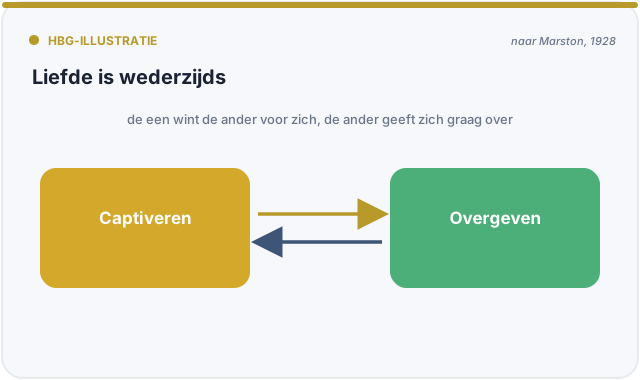
HBG-illustratie bij hoofdstuk XIV, Liefde
HBG-illustratie · door HBG toegevoegd om dit hoofdstuk toegankelijk te maken. Geen onderdeel van Marstons origineel.

In het kort

Liefde is voor Marston iets heel anders dan begeerte. Begeerte wil hebben en bezitten. Liefde wil geven en zich verbinden. Ze zitten aan tegenovergestelde kanten van de cirkel.

Liefde bestaat uit invloed en stabiliteit samen, wederzijds, waarbij beide partijen winnen. De een captiveert, wint de ander voor zich door aantrekkingskracht. De ander geeft zich graag over.

Liefde moet je onderscheiden van sekse. Sekse betekent volgens het woordenboek het lichamelijke verschil tussen man en vrouw. Neem je die betekenis, dan zou een sekse-emotie de emotie zijn die je hebt doordat je man of vrouw bent. Maar niemand heeft ooit serieus beweerd dat liefde een emotie van maar een van beide geslachten is. Zowel mannen als vrouwen hebben lief, en vrouwen hebben elkaar lief op precies dezelfde manier als ze mannen liefhebben. Liefde kan dus geen lichamelijk verschil tussen man en vrouw zijn, en hangt ook niet af van het bestaan van sekseverschillen.

De gelijkstelling van liefde met sekse is voor een groot deel de oorzaak van de sociale taboes die westerse beschavingen op liefde leggen. Liefde zien als een emotie die door de lichamelijke sekseverschillen wordt vergemakkelijkt, is gezond. Maar liefde vereenzelvigen met de seksekenmerken in het algemeen, vooral die van de man, leidt tot een uiterst ongelukkig onbegrip van liefde, want het mannelijke geslacht wordt vooral gekenmerkt door een overwicht van appetijt. Het leidt ook tot verwarring tussen sekseverschillen in liefde en sekseverschillen in appetijt. Elk geslacht heeft bepaalde secundaire appetijt-kenmerken, net zoals elk geslacht secundaire liefde-kenmerken heeft. De sekseverschillen in de liefde-structuren van het lichaam zitten aan de buitenkant, terwijl die in de appetijt-structuren minder opvallen en zich tonen in een andere klierbalans, een ander hongermechanisme en een andere lichaamsvorm en bespiering. Er is niet meer reden om liefde met sekse gelijk te stellen dan om appetijt met sekse gelijk te stellen.

In dit hoofdstuk · 8 delen
  1. Liefde in twee vormen
  2. Captivatie
  3. Captivatie buiten de liefde
  4. Passie
  5. Bij meisjes overheerst captivatie
  6. Onderzoek onder studentes
  7. Passie bij mannen
  8. Onderzoek onder mannelijke studenten
Deel 1 van 8

Liefde in twee vormen

HBG-beeld bij Liefde in twee vormen
HBG-toevoeging · samenvatting en beeld in onze stijl. Geen onderdeel van Marstons origineel.

In het kort, in onze taalAl bij baby's zie je twee soorten liefde: de actieve, die captiveert, en de passieve, die zich overgeeft. Samen zijn ze invloed en stabiliteit.

Baby's tonen actieve en passieve liefde

Babygedrag toont blijkbaar gelijktijdige combinaties van bepaalde kanten van invloed en overgave, net zoals het samenstellingen van dominantie en conformiteit toont. De baby's die Watson, Jones en anderen bestudeerden, tonen twee soorten liefdegedrag. Bij de eerste soort stopte de baby met alle andere bezigheden en gaf hij zich volledig over aan de sturing van de prikkel. Daar bleek actieve overgave aan de prikkelende persoon de duidelijke reactie. Dit kunnen we voorlopig passieve liefde noemen, en het tweede bestanddeel ervan behandelen we zo. De tweede soort liefdegedrag, waarbij het kind zich tegen de ouder drukt, moeder of verzorgster omhelst en op allerlei manieren de daden van de geliefde persoon probeert te sturen, heeft actieve invloed als het duidelijkste emotionele bestanddeel. Dit kunnen we actieve liefde noemen, en ook het tweede bestanddeel ervan moeten we ontleden.

Passieve liefde is passieve invloed plus actieve overgave

Bij passieve liefde is het duidelijk sturende bestanddeel actieve overgave. De baby reageerde geheel volgens de aanwijzingen van de persoon die zijn gevoelige zones prikkelde. Na een eerste vermindering van het bewegingszelf, genoeg om de bondgenote prikkel de leiding te geven, versterkte het bewegingszelf juist die delen van de ontlading die de prikkel vroeg. De prikkelende persoon kietelde, streelde en aaide de baby, en koos zo bepaalde tonisch bezenuwde delen van het lichaam uit, zowel skeletspieren als organen, die met tonische versterking actief reageerden. Die reacties waren niet tegenwerkend, maar toonden dat de banen vrij werden opengezet voor de opgewekte impulsen. Erectie van de penis, bijvoorbeeld, is een tonisch eindeffect dat normaal door remming van de schors wordt tegengehouden. Treedt die reactie toch op, dan is duidelijk dat het bewegingszelf niet verder is geremd, maar juist positief en overgevend heeft gereageerd op de bondgenote impulsen. Dat is actieve overgave.

Passieve liefde bevat een tweede bestanddeel, dat door die actieve overgave wordt opgewekt. Het bestaat uit het uitsteken van handen en voeten om gekieteld te worden, in het vorige hoofdstuk al genoemd als uiting van invloed. Je zou kunnen denken dat het kind de actieve overgave zo intens geniet dat het zichzelf handig aanbiedt om die voort te zetten. Dit gedrag, hoewel het terecht invloed heet, is toch wat passiever dan het spontane omhelzen dat later komt. De geprikkelde delen worden suggestief aangeboden, maar het kind neemt geen initiatief om die prikkeling zelf op te wekken. Het versterkt zichzelf net genoeg om aandacht op die delen te vestigen, maar niet zo sterk dat het ze tegen het lichaam van de prikkelaar drukt. Deze gedeeltelijke versterking, bedoeld om uit te nodigen tot wat de ander maar wil geven, kunnen we passieve invloed noemen.

Passieve invloed kan blijkbaar goed samengaan met actieve overgave, zoals in dit babygedrag. Beide reacties zijn bondgenoot van het bewegingszelf en van elkaar, en worden opgeroepen door en gericht op dezelfde persoon. Zo'n gelijktijdige samenstelling van passieve invloed en actieve overgave noemen we passieve liefde.

Actieve liefde is actieve invloed plus passieve overgave

Ook actieve liefde blijkt uit twee gelijktijdige bestanddelen te bestaan. Er moet een voorbereidende reactie in het kind zelf zijn, voordat het zich plotseling tegen de moeder aan drukt. De moeder houdt het kind immers vaak vast zonder dat er actieve liefde verschijnt, terwijl het op andere momenten spontaan het initiatief neemt. Wat is die voorbereidende reactie?

Een aanwijzing komt uit het feit dat actieve liefde vaak onmiddellijk volgt op het ophouden van het aaien en strelen dat de moeder gaf. Bijna elke keer dat ik zulk gedrag bij jongetjes zag, verscheen het meteen nadat de moeder was gestopt. Een moeder had een jongetje van drie maanden gebaad. De warmte van het water en het strelen hadden passieve liefde opgewekt. Toen het bad voorbij was en het strelen stopte, strekte de baby spontaan zijn armen uit, zonder te huilen. Bracht de moeder haar hand binnen bereik, dan drukte hij die tussen zijn handjes en tegen zijn lichaam.

Bij oudere meisjes zag ik soortgelijk gedrag dat niet zo direct op strelen volgde. Maar dan was het altijd gericht op iemand die het kind eerder vaak had geliefkoosd, of het kwam na een ongewoon lange tussenpoos waarin de moeder het kind niet had geaaid. Bij de jongetjes wijst dit erop dat actieve liefde optreedt terwijl de prikkel tot actieve overgave nog werkt, maar net niet meer sterk genoeg is om het bewegingszelf actief te sturen. Bij de meisjes rijst het vermoeden dat er een liefdehormoon bestaat dat zich na een tussenpoos genoeg ophoopt om op dezelfde manier te werken, dus als een bondgenote prikkel tot overgave die net niet sterk genoeg is voor actieve overgave.

Werkt zo'n te zwakke overgave-prikkel op het organisme, dan kan hij toch sterk genoeg zijn om passieve overgave af te dwingen. In deze gevallen kwam de prikkel van binnenuit, hetzij als na-ontlading uit recent geprikkelde centra bij de jongen, hetzij mogelijk als liefdehormoon bij het meisje. Passieve overgave bestaat dan uit het passief opgeven van elke bezigheid die niet verenigbaar is met die inwendige overgave-prikkels.

Dit is de voorbereidende oorzaak van de actieve invloed, die wordt opgeroepen door de moeder of geliefde in de omgeving. Net als bij passieve conformiteit met hongerpijn, waar voedsel de enige prikkel sterker dan de honger was, is hier de liefde-persoon de enige prikkel die zwakker is dan het kind, want het kind heeft geleerd dat die persoon toegeeft aan zijn invloed, en toch sterker dan de inwendige overgave-prikkels die het bewegingszelf op dat moment beheersen. Deze situatie maakt de baby geneigd tot invloed op de moeder, net zoals hongerpijn geneigd maakt tot voedsel. Was de moeder er niet, dan zou het kind zolang de inwendige overgave duurt tot geen enkele samenhangende emotie in staat zijn. Bij kinderen die zo openlijk actieve invloed tonen terwijl ze innerlijk met passieve overgave reageren op een inwendige prikkel, vinden we een nieuwe samenstelling, van gelijktijdige actieve invloed en passieve overgave, en die noemen we actieve liefde.

Deel 2 van 8

Captivatie

HBG-beeld bij Captivatie
HBG-toevoeging · samenvatting en beeld in onze stijl. Geen onderdeel van Marstons origineel.

In het kort, in onze taalCaptivatie is iemand voor je winnen door aantrekkingskracht. Tussen de geslachten roepen mensen die wederzijds bij elkaar op.

Captivatie

Bij baby's zijn de bewuste kanten van actieve en passieve liefde niet duidelijk genoeg om de samengestelde emoties te benoemen. Maar bij oudere kinderen komen ze wel helder naar voren. Bij de bespreking van invloed ontleedden we een reeks mannelijke reacties, bestaande uit wreedheid tegenover zwakkere jongens. De onderliggende liefde-reactie, aangepast aan en beheerst door dominantie, bleek een mengsel van invloed en overgave dat erop gericht was de zwakkere jongen te betoveren. Deze captivatie is wat haar primaire bestanddelen betreft gelijk aan de actieve liefde van baby's. Halen we dominantie en appetijt er helemaal uit, dan blijft een actieve reactie die overgave van de gepeste jongen wil oproepen, plus een passieve overgave-reactie, opgewekt door een van meerdere mogelijke prikkels.

Bij een groep jongens die zich verenigt om een zwakkere te pesten, geeft elk lid zich passief over aan de groep als geheel. Een groep heeft natuurlijk geen gemeenschappelijke wil of geest die een lid actief kan sturen. Maar de aanwezigheid van acht, tien of twintig jongens die met hetzelfde bezig zijn, kan elk lid er heel doeltreffend toe brengen alle eigen verlangens op te geven. Deze reactie van de enkeling op de groep is een duidelijke passieve overgave.

Het is vaak gemeld dat enkele leden van zo'n groep in stilte terugdeinzen en niet zouden doorgaan als ze de sterke invloed van de groep niet voelden. Die invloed dwingt hen door te gaan. Ze kan deels dominant zijn, maar overwegend is ze invloed, want elk lid wordt veel sterker gedreven door de wens de goodwill van zijn kameraden te behouden en niet als lafaard te gelden, dan door angst voor geweld als hij zich afscheidt. Kort gezegd: het aanzien bij de anderen brengt elke jongen ertoe zich aan de groep over te geven door mee te doen aan het pesten van een ander. Voeg je aan die passieve overgave een actieve invloed op de gepeste toe, dan heb je actieve liefde. In het bewustzijn van de pestende jongens krijgt dit bestanddeel het karakter van plezier in het tot slaaf maken van de ander.

De mannelijke emotie bevat hier een beheersend mengsel van dominantie. Het geweld en de tegenwerking in dat plezier moet je er dus aftrekken voordat de ware aard van actieve liefde zichtbaar wordt. Blijft na aftrek van dominantie zuivere actieve liefde over, dan vinden we nog steeds het plezier in het veroveren van de zwakkere persoon. Maar zuivere actieve liefde vereist voor haar plezier het plezier van de veroverde. De veroverde moet een gewillige, geheel toegewijde gevangene zijn. Dat lukt alleen als de veroveraar zich zo aantrekkelijk maakt dat de ander zich vrijwillig aan de aantrekkingskracht overgeeft. Actieve liefde is dus: een geliefde veroveren door de kracht van persoonlijke aantrekking. Het woord dat dit het best weergeeft is captivatie, wat betekent gevangen nemen door charme.

Wederzijdse captivatie tussen de geslachten

Captivatie komt in het dagelijks leven het vaakst voor tussen mensen van verschillend geslacht. Bijna elke normale jongen of elk meisje beleeft flink wat captivatie tijdens een speelse worsteling met een aantrekkelijke ander. Nog vaker gebeurt het in emotionele of zelfs verstandelijke wedstrijden van dezelfde soort. Zulke wedstrijden zijn er niet op gericht de ander te domineren zoals je een levenloos voorwerp wilt domineren. Ze moeten alleen uitmaken wie invloed uitoefent en wie zich overgeeft.

Hier is geen groep die de overgave oproept. De passieve overgave roepen beiden bij elkaar op. Er bestaat een aangeleerde alliantie tussen de lichamen en emoties van man en vrouw. Tijdens de worsteling probeert elk zijn bewegingszelf te vergroten om de ander tot overgave te bewegen. Elk van die pogingen slaagt gedeeltelijk en roept enige overgave op, maar net genoeg om de ander te beletten op iets anders dan de beinvloeder te reageren. Dat is de passieve overgave bij beiden. Tegelijk blijft elk proberen zijn kracht boven die van de ander te stellen. Dat is de actieve invloed. We vinden dus dezelfde combinatie van innerlijke passieve overgave en uiterlijke actieve invloed. Alleen neemt de prikkeling van beide bestanddelen hier steeds toe naarmate de worsteling toeneemt, wat een maximaal prettige captivatie bij beiden oproept. Aan het strand, waar de lichamen veel meer ontbloot zijn, grijpen mannen vaak hun vriendinnen om ze de branding in te dragen, en gooien meisjes kiezels naar hun mannelijke metgezellen. Beide zijn erop uit zo'n wederzijdse captivatie op te roepen.

Juffrouw Z en de jongeman X

Bij een gewone kennismaking is het meisje vaker de uitlokker van captivatie-wedstrijden dan de man. Een geval uit mijn spreekuur laat dit zien. Een meisje van twintig klaagde, blijkbaar oprecht, dat ze mannen simpelweg niet kon beletten haar te betasten. Ze vroeg mij om hulp tegen wat ze mannelijke beestachtigheid noemde, opgewekt buiten haar wil, zo geloofde ze, door haar seksuele charme. Dit meisje, Z, vertelde een voorval dat ik later deels heb geverifieerd.

Een jongen, X, had Z op een dansavond uitgenodigd voor de gebruikelijke autorit. Wat er in de auto gebeurde blijft onzeker, want de verhalen van Z en X liepen sterk uiteen. Maar haar uiterlijk bij terugkeer werd beschreven door enkele vriendinnen die ik ondervroeg. Ze was een puinhoop, zoals er een zei. Haar bovenarmen zaten vol blauwe plekken, haar mond was gescheurd en flink gezwollen. Haar kleren waren gescheurd en haar lange haar hing verward om haar schouders. Er waren aanwijzingen dat de lichamelijke omgang niet door X was afgedwongen. Toen haar vriendinnen haar zagen, huilde Z hysterisch.

De eerste indruk zou zijn dat X op zijn zachtst gezegd een holbewoner was in de omgang met vrouwen. Maar zorgvuldig navragen bracht niets aan het licht: X had nooit enig meisje ruw of gewelddadig behandeld. Meerdere meisjes waren met hem gaan rijden onder vrijwel gelijke omstandigheden. In een geval kon ik verifieren dat X een meisje het hof had gemaakt zonder nare gevolgen. Ja, vertelde zij, X was volkomen in orde. Ik had geen moeite hem duidelijk te maken dat ik niet in hem geinteresseerd was. Het staat vast dat dit meisje X op die manier afwees.

De verklaring lag ongetwijfeld in de techniek van juffrouw Z. Z benaderde alle mannen, mij inbegrepen, op een manier die berekend was om haar lichamelijke charmes te tonen en op te dringen. Haar benadering was uitdagend prikkelend. Ze wierp een man als het ware haar onberispelijke deugd voor de voeten, haar onthouding van elke liefdesintimiteit, maar bood tegelijk een onmiskenbare uitdaging om zijn grotere emotionele kracht te bewijzen door haar die houding te doen opgeven. Kort gezegd: Z bood haar persoon vrij aan een mans blik aan, en riep zo overgave op tot het punt dat zijn aandacht onontkoombaar op haar charmes was gericht. Tegelijk beweerde ze bot haar meerdere kracht op dat terrein, en riep zo actieve invloed plus dominantie op. De gelijktijdige passieve overgave en actieve invloed vormden captivatie bij de man, uiteraard vermengd met de gebruikelijke mannelijke dominantie.

Z daagde alle mannen uit tot een wedstrijd, zonder te beseffen dat captivatie bij de gemiddelde man onlosmakelijk met dominantie is vermengd. Zodra de sturende dominante macht van de samenleving, waarop Z aanvankelijk vertrouwde om X's dominantie te bedwingen, in de auto wegviel, leed Z onder de losgelaten dominantie van X. Dit is een eeuwenoude vorm van emotionele omgang tussen de geslachten, die vrouwen halsstarrig weigeren te begrijpen. Hun weerstand tegen dat begrip lijkt te liggen in hun onwil om te aanvaarden dat de kracht van de vrouw, in het huidige stelsel, geleende kracht is, verkregen van mannen die haar tegen andere mannen beschermen. Geeft ze die geleende kracht op, dan wordt haar eigen kracht snel overweldigd door de grotere lichamelijke en emotionele dominantie van de man. En het is moeilijk een man te vinden bij wie captivatie in enige mate kan worden opgewekt zonder een beheersend mengsel van dominantie.

Juffrouw Y als tegenvoorbeeld

De aard van Z's prikkel wordt nog duidelijker door het contrast met juffrouw Y, die bij X noch dominantie noch captivatie opriep toen ze zijn avances afwees, hoewel Y lichamelijk even aantrekkelijk was als Z. Y had een zeer ongewone combinatie van dominantie en liefde. Haar dominantie was ongeveer gelijk aan die van X, met een navenant sterk lichaam. Haar reactie op mensen van beide geslachten was overwegend overgevend, tenzij haar dominantie door zelfzuchtige tegenwerking werd gewekt. Y's omgang met X bevatte weinig of geen invloed. Ze schikte zich naar zijn smaak in gesprek en gezelschap, maar toen X neigde naar het typische dominant-captiverende gedrag van de man, reageerde Y op het tegenwerkende element met heldere, onbuigzame dominantie, en riep, geholpen door X's sociale opvoeding, eerder conformiteit dan verdere captivatie bij hem op. Haar rustige, besliste afwijzing drong tot X door als een prikkel die tegenwerkend en sterker was dan hijzelf. Tegelijk riep haar schikken naar zijn smaak een tamelijk zuivere invloed bij X op: een duidelijke wens vrienden te blijven en van haar gezelschap te genieten onder voor haar aangename voorwaarden. Het contrast tussen X's reactie op Z en op Y gaf haast een Jekyll-en-Hyde-effect in zijn persoonlijkheid. Maar dat contrast lag niet aan iets eigenaardigs in X, maar aan het uiterste verschil tussen de twee soorten prikkel, die elk hun eigen voorspelbare emotie opriepen.

Deel 3 van 8

Captivatie buiten de liefde

HBG-beeld bij Captivatie buiten de liefde
HBG-toevoeging · samenvatting en beeld in onze stijl. Geen onderdeel van Marstons origineel.

In het kort, in onze taalMarston beschrijft ontgroeningsrituelen om te laten zien dat captivatie ook buiten romantiek voorkomt. Deze voorbeelden zijn sterk gedateerd.

Mannen die mannen vangen ervaren dominantie-captivatie

Studies naar ontgroening op college en klassenstrijd tussen studenten deden F.S. Keller en ik in 1925 en 1926. Vrijwel alle ouderejaars gaven een hoge prettigheid aan dominantie-captivatie tegenover eerstejaars. Ging er een lichamelijke worsteling aan de vangst vooraf, dan nam de kracht en het plezier van die emotie in bijna alle gevallen sterk toe. De traditie schreef een reeks worstelingen voor tussen tweedejaars en eerstejaars, waarbij elke klas de ander probeerde te beletten een klassendiner te houden. Vermoedde de ene klas dat de rivalen een diner planden, dan vingen ze zoveel mogelijk tegenstanders, bonden hen vast en hielden hen zo tot vaststond dat er die dag geen banket kon zijn. Wilde een gevangene aan opsluiting ontkomen, dan kon hij zich vrijkopen door op zijn erewoord te beloven niet naar het diner te gaan.

Slechts een heel klein deel, waarschijnlijk een of twee, gaf zich voor langere tijd aan opsluiting over. Zij meldden geen enkel plezier zodra ze overwonnen en gebonden waren. Daarna werd het een kwestie van berusten in het ongemak van de boeien of in de vernedering van het vrijkopen. Maar een grote meerderheid van zowel winnaars als verliezers meldde intens prettige dominantie-captivatie tijdens de worsteling, tot het punt waarop de overwinning beslist was. De winnaars meldden dat hun plezier nog toenam tijdens het binden en opsluiten. Ze beleefden veel minder plezier als een tegenstander zich vrijkocht. Bij een paar jongens was dominantie of conformiteit zo sterk dat captivatie niet als zodanig kon worden waargenomen, al toonde hun gedrag wel een flink captivatie-element. In deze reeks riepen twee worstelende mannen passieve overgave en actieve invloed bij elkaar op, met als doel niet de ander te verwonden of weg te werken, maar zijn lichaam te vangen door het te binden. Dat captivatie bij een meerderheid niet door hun dominantie werd onderdrukt, is een aanwijzing dat de situatie juist captivatie opriep. En dat captivatie in tamelijk zuivere vorm bij de ene man door de andere werd opgeroepen, bewijst dat captivatie niet tot de omgang tussen de geslachten beperkt is.

Meisjes die meisjes straffen ervaren captivatie

Studies naar de emoties van tweedejaars en ouderejaars meisjes tijdens hun jaarlijkse straffen van de eerstejaars deden juffrouw Olive Byrne en ik in het studiejaar 1925 en 1926. Het was gebruik dat ouderejaars een reeks regels opstelden die de eerstejaars moesten volgen: de gebruikelijke beperkingen, het dragen van eerstejaarsspeldjes en algemene gehoorzaamheid. In het voorjaar hielden de tweedejaars het zogenoemde Babyfeest, dat alle eerstejaars moesten bijwonen. Daar werden ze ondervraagd over hun overtredingen en gestraft voor hun ongehoorzaamheid. Het feest heette zo omdat de eerstejaars zich als baby moesten kleden.

Op het feest moesten de meisjes allerlei kunstjes doen op bevel van de tweedejaars. Zo werden ze een voor een een donkere gang in geleid, geblinddoekt en met de armen op de rug gebonden, langs bewaaksters die op afstanden stonden opgesteld, om hen te doordringen van de onmogelijkheid te ontsnappen. Na een reeks onschuldige straffen werd elk meisje een grote zaal in geleid, vol met alle oudere studentes, waar ze werd veroordeeld tot vertoningen die geacht werden juist haar ongehoorzaamheid te straffen. De tweedejaars droegen lange stokken om de kunstjes zo nodig af te dwingen. Het programma kende geen vooraf geregelde worstelingen zoals bij de jongens, maar de veelvuldige opstand van de eerstejaars tegen de bevelen vormde volgens de meerderheid het spannendste deel.

Vrijwel alle tweedejaars meldden opgewonden, prettige captivatie tijdens het feest. Die nam toe wanneer ze opstandige eerstejaars lichamelijk moesten overwinnen of met herhaalde bevelen en extra straffen moesten bewegen tot de daden waaraan de gevangenen probeerden te ontkomen. Maar huilde een eerstejaars of toonde ze angst, dan meldde haar bewaakster steeds onprettigheid, met gevoelens van medelijden. Ze zeiden dan bijna altijd dat ze niet bang hoefde te zijn, en overreedden haar door te gaan in plaats van haar te dwingen. Dit staat scherp tegenover de mannelijke ontgroeners, die een jongen die verzwakte vaak met schadelijk geweld behandelden.

Uit deze studies bleek dat de sterkste en prettigste captivatie werd beleefd tijdens een worsteling met meisjes die probeerden aan hun gevangenschap te ontsnappen. Zodra de gevangene lijden of onprettigheid toonde, riep dat steevast een heel ander soort liefde-reactie op. In dat geval, of wanneer een meisje zich volgzaam overgaf, riep dat bij de oudere een haast zuivere invloed op, met een flinke bijmenging van actieve overgave aan de behoeften van de gestrafte. Waarschijnlijk versterkten de babykostuums zowel de passieve overgave als de actieve invloed van de ouderejaars, al verhinderde de conventionele terughoudendheid dat dit openlijk in de verslagen verscheen. Al met al beleefden de ouderejaars zuivere, zeer prettige captivatie, met weinig of geen bijmenging van dominantie. Misschien werkt er vanaf de vroege kindertijd een liefdehormoon in het vrouwelijk organisme, dat meisjes en vrouwen door inwendige prikkeling tot passieve overgave, en zo tot captivatie, geneigd maakt. Deze reactie verschijnt bij de bestudeerde meisjes in veel zuiverder en gelijkmatiger vorm dan bij mannen, en ook meer dan bij mannen blijkt dat captivatie niet tot de omgang tussen de geslachten beperkt is. Het meisje roept onder de juiste omstandigheden een even sterke captivatie op als de man.

Deel 4 van 8

Passie

HBG-beeld bij Passie
HBG-toevoeging · samenvatting en beeld in onze stijl. Geen onderdeel van Marstons origineel.

In het kort, in onze taalPassie is de overgevende kant van liefde. Ook jonge kinderen tonen haar tegenover hun moeder.

Passie

Bij het woord passie voor passieve liefde is voorzichtigheid nodig. In de volksmond wordt passie zonder onderscheid gebruikt voor captivatie, voor echte passieve liefde, of voor een mengsel. Na het verzamelen van zelfwaarneming bij honderden mensen ontdekte ik dat vlammende of vuurrode passie meestal captivatie beschrijft, niet passieve liefde. Toch zit er in die toestanden altijd een flinke bijmenging van actieve overgave aan de geliefde. En omdat juist die overgave het hoofdkenmerk van passieve liefde is, kunnen we besluiten dat actieve en passieve liefde in de omgang tussen de geslachten onlosmakelijk verweven zijn. In de volksmond betekent passie dus een lichamelijke liefde-emotie met zowel actieve als passieve elementen, waarbij het actieve overheerst. Op dit punt bleek het onmogelijk de literaire taal te volgen. Captivatie beschrijft actieve liefde veel nauwkeuriger dan het woord passie, terwijl passie, goed begrepen, wijst op actieve overgave van het zelf aan de geliefde. Met deze afbakening kunnen negen van de tien mensen hun eigen liefde-emoties veel helderder waarnemen. Onthoud wel: passie zoals hier gebruikt betekent geen liefdesagressie of initiatief, en is ook niet verbonden met de kleur rood.

Passie bij jonge kinderen

Passieve liefde combineert een duidelijke actieve overgave aan een beinvloeder met een innerlijke passieve invloed op diezelfde persoon. Omdat het eerder ontlede gedrag babygedrag was, ontbrak zelfwaarneming. We moeten dus naar oudere kinderen kijken. Kinderen van beide geslachten tussen twee en vijf tonen een milde passie als natuurlijke reactie op moeder of verzorgster. Ze kunnen met korte woorden en klanken de richting van hun bewustzijn aangeven. Bij liefkozing klampen ze zich vaak stevig aan de moeder vast, met kleine hijgende geluidjes, niet onvergelijkbaar met volwassen passie. Aanbidding van de moeder blijkt uit korte woordjes, glimlachen die duiden op sterke opgeslorptheid in de moeder, en zacht ritmische bewegingen van handen en armen. Wat ouder zegt het kind mama is mooi, of ik hou van mama, uitingen van een spontane, geheel overgevende liefde. Er is duidelijk actieve overgave aan de moeder, samengesteld met de eerder beschreven passieve invloed. Veel psychoanalytici herkennen in deze passieve liefde het kenmerk passie, en verbannen haar zo naar de sfeer van het afwijkende waarin overwegend perverse mannen normale liefde met appetijt-uitwerpselen besmeuren. Ik erken dit bijzondere bevinden, maar stel met nadruk dat passie die kinderen van beide geslachten voor de moeder voelen, een natuurlijke en volstrekt wenselijke liefde is. Wordt zij niet in enige mate door de moeder opgeroepen voor het vijfde of zesde jaar, dan begint het kind met een zware handicap. Onder de huidige omstandigheden is het uiterst onwaarschijnlijk dat een jongen ooit later in zijn leven nog gelegenheid tot zuivere passie krijgt.

Deel 5 van 8

Bij meisjes overheerst captivatie

HBG-beeld bij Bij meisjes overheerst captivatie
HBG-toevoeging · samenvatting en beeld in onze stijl. Geen onderdeel van Marstons origineel.

In het kort, in onze taalBij meisjes is captivatie eerder het spontane element dan passie, aldus Marston.

Bij meisjes is captivatie het spontane element, niet passie

Meisjes van vijf, zes jaar of ouder beleven vaak passieve liefde voor andere meisjes, met of zonder wederzijdse prikkeling van de geslachtsdelen. Dit lijkt niet zozeer voort te komen uit een inwendige prikkel bij een van beide, maar uit de spontane captivatie door het ene meisje, gevolgd door overgave van het andere. Ten minste twee voltooide liefdesverhoudingen van dit type tussen meisjes van vijf tot zeven zijn mij gemeld, in beide gevallen volkomen normale kinderen. Volgens verzorgers van kinderen die ik kon raadplegen, zijn zulke verhoudingen tussen meisjes eerder regel dan uitzondering, zolang er geen verbiedend onderwijs aan voorafging. De zo gewekte passie heeft de typische toon van passieve liefde, met vurige overgave aan het beinvloedende meisje en volledige opgeslorptheid in haar charme. Vaak raken groepjes van drie of meer meisjes spontaan zo liefdesverbonden. Twee kanten lijken schadelijk. Ten eerste de geheimhouding die door verbiedende houdingen van ouders of leraren wordt afgedwongen. Ten tweede de onwetendheid en grofheid van de prikkeling die het beinvloedende meisje geeft. Verder heb ik in dit spontane ontstaan niets dan normale vrouwelijke ontwikkeling gevonden.

Yvette

De verliefdheid van pubermeisjes en ouder op andere meisjes, leraressen of oudere vrouwen is een te bekend verschijnsel om te beschrijven. Het meisje met zo'n verliefdheid toont een opvallend intense, opslorpende passie voor haar aanbedene. In een geval waren meerdere meisjes tussen veertien en zeventien verliefd op een ander meisje op dezelfde school. Dat meisje, de prikkel tot passie, was achttien. Ze was bleek, mager, droeg haar haar op een eigenaardige manier en liep met de tenen naar binnen. Ze is niet bepaald mooi, zei een van de aanbidsters, maar gewoon charmant. Ze lijkt mensen te willen en iedereen naar zich toe te trekken, een treffende beschrijving van captivatie. De overgave van de aanbidsters was opvallend volledig. De meisjes die verliefd waren op Yvette gingen allemaal met de tenen naar binnen lopen. Ze deden hun haar zo veel mogelijk als het hare en gingen ijverig tekenen oefenen, want Yvette had onmiskenbaar tekentalent. Niet tevreden daarmee bleven haar aanbidsters 's nachts lang op om zich even bleek te maken als zij. Yvette beperkte haar veroveringen niet tot haar eigen sekse, maar sloop 's nachts weg om jongens te ontmoeten die ook verliefd op haar waren. Hoezeer de jongere meisjes ook streden om de aandacht van diezelfde jongens, ze toonden geen greintje jaloezie op Yvette's veroveringen. Ze hielpen haar op elke manier die jongens heimelijk te ontmoeten en vonden het zo dapper van haar. Hier riep een meisje ongewoon intense en duurzame passie op bij vele andere, iets jongere meisjes, zonder enig lichamelijk contact of prikkeling van de geslachtsdelen.

Deel 6 van 8

Onderzoek onder studentes

HBG-beeld bij Onderzoek onder studentes
HBG-toevoeging · samenvatting en beeld in onze stijl. Geen onderdeel van Marstons origineel.

In het kort, in onze taalMarston onderbouwt zijn ideeen met een studie onder studentes naar leiden en volgen.

Studie naar passie bij studentes

Om te onderzoeken of er passie in het Babyfeest zat, deed juffrouw L.F. Glidden van Jackson College onder mijn leiding een studie naar de houding van haar klasgenotes tegenover de behandeling door de oudere meisjes. Ten tijde van de studie waren de ondervraagde meisjes tweedejaars. Ze hadden hun eigen overgave op het Babyfeest het voorjaar ervoor achter de rug, en waren nu al zo'n twee maanden bezig de nieuwe eerstejaars te disciplineren. Ze hadden echter nog nooit een Babyfeest als veroveraarster meegemaakt, zodat er geen gevoel van het ene feest op het andere kon zijn overgedragen. Het doel was elk meisje haar houding te ontlokken tegenover de disciplinering van eerstejaars, en haar herinnerde houding tegenover de tweedejaars van het jaar ervoor. Juffrouw Glidden moest haar klasgenotes, met wie ze uiteraard vertrouwd was, benaderen zonder te laten merken dat ze een studie deed, wat behoorlijk lukte.

De meisjes werd gevraagd, ten eerste, of ze het Babyfeest als eerstejaars leuk vonden, met een cijfer voor prettigheid op een schaal waarbij tien de grootst mogelijke prettigheid was en nul onverschilligheid. Ten tweede, wat hun houding was geweest tegenover de tweedejaars die ze het jaar ervoor hadden moeten dienen. Ten derde, of ze de disciplinering van de eerstejaars die ze nu zelf uitvoerden goedkeurden en leuk vonden. Ten vierde, of ze zich vrijwillig aan mannen of aan vrouwen overgaven. Ten vijfde, of ze, als ze mochten kiezen, liever een ongelukkige meester of een gelukkige slaaf zouden zijn. De antwoorden en bijbehorende zelfwaarnemingen werden vastgelegd. De uitkomsten staan in Figuur 4.
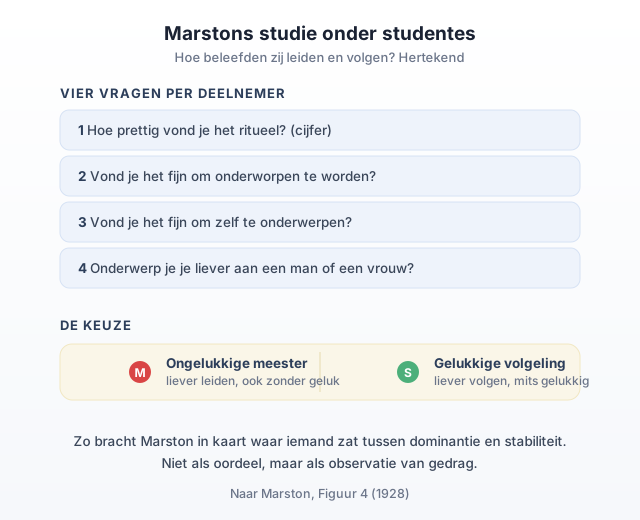
Marstons studie onder studentes naar leiden en volgen, hertekend in HBG-stijl
Figuur 4, hertekend. Marston onderbouwde zijn theorie met echt onderzoek. Deze studie bracht in kaart waar iemand zat tussen leiden en volgen, als observatie van gedrag, niet als oordeel.
Download de originele tekening (1928)
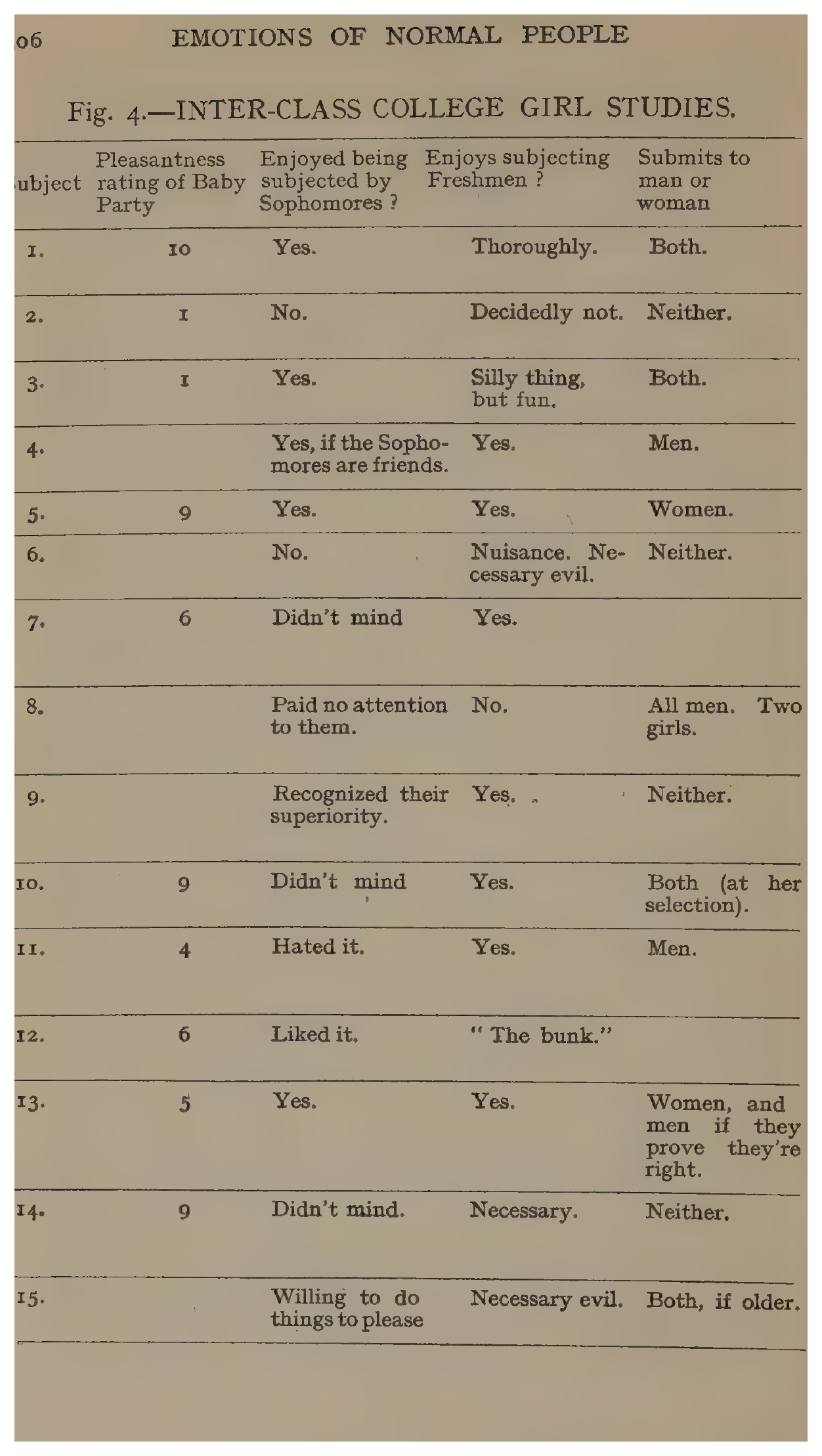
De betrouwbaarheid van deze studie berust meer op de vertrouwelijke band waarmee de zelfwaarnemingen zijn verkregen dan op statistiek. Juffrouw Glidden kon als vriendin vertrouwen winnen, en de meisjes wisten bovendien dat hun ondervraagster hun gedrag goed kende. Daardoor is er naar mijn mening minder misleiding gepleegd dan bij de gebruikelijke studie van dit soort.

De middelste waarde voor prettigheid tijdens de gevangenschap op het Babyfeest ligt rond de zeven. Enkele meisjes weigerden een cijfer te geven, wat op onderdrukking wijst. Opvallend is dat meer meisjes hun plezier op negen en tien zetten dan op enige andere waarde. Ook opvallend: terwijl slechts veertien meisjes ronduit toegaven het hele jaar plezier te hebben gehad in overgave aan de tweedejaars, beweerden twintig meisjes plezier te hebben in het onderwerpen van de eerstejaars. Al gaven zeventien meisjes een houding van overgave aan mannen op tegen twaalf aan vrouwen, waarschijnlijk is wat als overgave aan mannen geldt in veel gevallen helemaal geen overgave, maar invloed. Wel lijkt het waar, zoals gezegd, dat vrouwen onder het huidige stelsel stelselmatig worden geleerd zowel invloed als overgave te gebruiken om appetijt-voordelen van mannen te verkrijgen.

De betekenis van de keuze tussen gelukkige slaaf en ongelukkige meester is wat onzeker. De vraag moest een onderdrukte bereidheid tot slaaf-zijn boven water halen. Het plezier in gevangen worden werd al met al veel openlijker toegegeven dan verwacht. Merkwaardig is dat twee van de meisjes die hun plezier op tien zetten toch liever ongelukkige meester dan gelukkige slaaf waren. Wijst dit erop dat ze maximaal plezier in gevangenschap toegaven zolang die niet als zodanig werd benoemd, terwijl hun sociale remmingen meteen in werking traden bij het woord slaaf? Meisje nummer een, dat het feest een tien gaf en zei er emotioneel enorm van te genieten, verklaarde toch een sterke afkeer van het idee van onderwerping. Ook speelt het verschil in uitleg van meester en slaaf. Was mistress niet zo beladen, dan zou dat woord de voorkeur verdienen boven master, dat velen uitleggen als iemand die anderen tot zijn eigen zelfzuchtige appetijt dwingt. Slaaf op zichzelf wordt door meisjes eerder als liefdesslaaf uitgelegd, maar tegenover meester krijgt het een appetijt-kleur. Sommige meisjes stelden dan ook terecht dat er geen gelukkige slaaf van andermans zelfzuchtige dominantie kan bestaan. In het algemeen was er een scherp verschil tussen overgave aan iemand uit liefde en overgave aan iemand, zoals bepaalde huismoeders, die dat deed om haar eigen dominantie of appetijt. Dit onderscheid komt precies overeen met dat tussen echte overgave-passie en onprettige of onverschillige conformiteit.

Conclusies uit de studie

Onze conclusies waren, ten eerste, dat ongeveer driekwart van de meisjes die op het Babyfeest lichamelijk gevangen werden, zuivere, prettige passie beleefde, bestaande uit actieve overgave aan de oudere meisjes plus passieve invloed op diezelfde meisjes. Die passieve invloed bleek uit gedrag als het uitsteken van de handen om te tonen dat de boeien los waren geraakt. Dat het plezier afnam wanneer een meisje zich overgaf zonder de aandacht op haar losse boeien te vestigen, blijkt uit meisje nummer acht, dat zei geen plezier te hebben gehad omdat ze onder haar blinddoek door kon kijken, en dat ze geen aandacht aan de tweedejaars had geschonken. Ten tweede besloten we dat een veel verdunder soort passie, of geen, werd opgeroepen tijdens het jaar waarin de meisjes persoonlijke boodschappen deden voor hun tweedejaars superieuren. Toen werd minstens even vaak dominantie als overgave opgeroepen, en de dienst werd vaak met een besef van conformiteit verricht. Ten derde besloten we dat passie bij het ene meisje door het andere kon worden opgeroepen wanneer de onderwerpende haar bevelen als invloed liet voelen in plaats van als dominantie, en geen zweem van eigenbelang toonde. Het captiverende meisje moet zich dus geheel met haar gevangene verbinden en toch haar gevangenschap steeds vergroten. Een eerstejaars meldde prettige passie toen ze de voeten moest kussen van een meisje dat ze aardig vond, maar nam liever veel extra straf dan de schoenen te poetsen van een meisje dat ze zelfzuchtig vond.

Samenvatting

Passie of passieve liefde bestaat uit de gelijktijdige samenstelling van actieve overgave, opgeroepen door een beinvloeder, en passieve invloed op diezelfde persoon als gevolg van die overgave. Het bewuste kenmerk is een uiterst prettig gevoel onderworpen te worden en steeds hulpelozer te worden in de handen van een bondgenote persoon van grotere kracht. Het staat wel vast dat meisjes als beinvloeders intense, zeer prettige passie kunnen oproepen bij alle normale, evenwichtige meisjes die in de juiste krachtsverhouding tot hen staan, zonder enige prikkeling van de geslachtsdelen.

Deel 7 van 8

Passie bij mannen

HBG-beeld bij Passie bij mannen
HBG-toevoeging · samenvatting en beeld in onze stijl. Geen onderdeel van Marstons origineel.

In het kort, in onze taalBij mannen ligt passie anders, en soms is de kracht van een vrouw in Marstons ogen onvoldoende om haar op te roepen. Sterk van zijn tijd.

Passie bij mannen

Bij jongens en jonge mannen ligt het volgens mijn studies heel anders. Laten we de zogenoemde oedipuscomplexen en moederbindingen buiten beschouwing, dan is er weinig dat erop wijst dat bij de meeste normale mannen echte passie wordt opgeroepen tot het moment dat omgang met de andere sekse optreedt, met bijbehorende prikkeling van de uitwendige geslachtsdelen. Wel treedt captivatie vaak op bij jonge mannen, sterk vermengd met en beheerst door dominantie. Waarschijnlijk is het juist dat dominantie-element in de oudere, sterkere jongens dat de jongere pijn en onprettigheid bezorgt, in plaats van de zeer prettige passie die normale meisjes van vijf jaar of ouder beleven.

De moeder kan, zolang ze sterker is dan de jongen, deze passie oproepen zonder prikkeling van de geslachtsdelen. Waarschijnlijk komt de zogenoemde moederbinding zo vaak voor omdat er in het leven van de gemiddelde jongen geen vervangende prikkel tot passie verschijnt tussen het natuurlijke afnemen van de moederband en het normale begin van seksuele omgang. Het werkelijk schadelijke van zulke bindingen lijkt de scherpe scheiding tussen de passie die de moeder opriep en de passie die later door prikkeling van de uitwendige geslachtsdelen wordt opgeroepen door een vrouw aan wie de man zich na zijn seksuele rijping overgeeft. De echte weerstand lijkt te bestaan uit het niet verbinden van de vroege prettige passie met de latere erotische prikkeling. In het zenuwstelsel ontstaat vaak een remmende barriere tussen die twee.

Sociale erkenning van prikkeling door de moeder zou dit kunnen voorkomen. In de weinige gevallen die ik zag waarin vroege passie voor de moeder een barriere vormde voor latere overgave aan echtgenote of geliefde, had de jongeman nooit prikkeling van de geslachtsdelen gekregen van een kindermeisje of andere vrouw uit zijn jeugd. In een geval van een jongeman die de vroege passie voor zijn moeder niet via prikkeling kon herstellen, was de jongen met geweld geprikkeld door oudere jongens, en had hij pijn en schaamte geleden, in werkelijkheid een conflict tussen gedwarsboomde dominantie en overgave. Zulke intens onprettige ervaringen versterken de remmende barriere tussen passie en erotische gewaarwording.

Bij sommige mannen is de kracht van de vrouw onvoldoende voor passie

Een bepaald type jongeman ontwikkelt in de late puberteit spontaan een verlangen om gecaptiveerd te worden. Vaak vindt dit type geen vrouw met genoeg lichamelijke of emotionele kracht om hem toereikend te onderwerpen. Dan kan hij flink wat passie ontlenen aan onderwerping door mannen die sterker zijn dan hij, ondanks de dominantie die zij onvermijdelijk tonen. Een jongen van dit type die als eerstejaars zwaar werd gepest, meldde mij openhartig dat hij er enorm van genoot, met een haast zuivere passie voor zijn onderwerpers. Deze jongen was om een reden overgestapt naar het college waar ik toen lesgaf en moest opnieuw eerstejaars worden wegens te weinig studiepunten. Toen hij merkte dat de ontgroening daar lang niet zo streng was als eerder, uitte hij sterke teleurstelling en bekritiseerde het bestuur bitter om de regels die de discipline beperkten. Andere jongens van dit type kozen, meen ik, juist een militaire academie boven een college, in de verwachting plezier te beleven aan strenge onderwerping.

Deel 8 van 8

Onderzoek onder mannelijke studenten

HBG-beeld bij Onderzoek onder mannelijke studenten
HBG-toevoeging · samenvatting en beeld in onze stijl. Geen onderdeel van Marstons origineel.

In het kort, in onze taalEen vergelijkbare studie onder mannelijke studenten sluit het hoofdstuk af.

Studie naar passie bij mannelijke studenten

Emotionele studies tonen echter dat dit type, dat prettige passie voor sterkere mannen kan beleven ondanks het lijden, maar een klein deel van de mannelijke jeugd uitmaakt. F.S. Keller deed een studie naar de houding van eerstejaars jongens tegenover hun tweedejaars onderwerpers, precies in vorm gelijk aan die van juffrouw Glidden. De uitkomsten waren grotendeels negatief. Slechts een of twee jongens gaven betrouwbaar blijk van prettige passie, hetzij tijdens het handhaven van de tradities, hetzij op de feesten waar de eerstejaars met de plak en anderszins pijnlijk werden gestraft. Op een of twee na gaf iedereen de voorkeur aan ongelukkige meester boven gelukkige slaaf, en niemand uitte een spontane wens zich aan man of vrouw over te geven. Vrijwel allen geloofden juist in de noodzaak van conformiteit aan hun meerderen.

In een bijzondere situatie werd meer passie gevonden. De jongens werden gedwongen in pyjama voor een van de meisjesgebouwen te marcheren, waar ze kunstjes moesten doen tot grote opwinding van de meisjes die vanuit de ramen keken. Hier ontstond een duidelijk conflict tussen passie, opgeroepen door de toekijkende meisjes, en gedwarsboomde dominantie tegenover de tweedejaars. Die laatste won onmiskenbaar, en meerdere eerstejaars rukten zich met geweld los. Uit hun zelfwaarneming bleek dat ze een tamelijk zuivere passie zouden hebben genoten als hun overweldigers meisjes waren geweest in plaats van andere jongens. De normale jongen heeft blijkbaar geleerd andere jongens als vijandig te zien, terwijl meisjes, hoe misprijzend ook behandeld, in de grond als vriendelijk en liefhebbend gelden.

Conclusies uit de studie

Onze algemene conclusies waren, ten eerste, dat zuivere passie zelden of nooit bij de ene normale man door de andere kon worden opgewekt binnen de bestudeerde groep. Ten tweede, dat sterke passie bij een meerderheid van de jongens kon worden opgeroepen door meisjes die hen op dezelfde manier gevangen namen als de eerstejaars meisjes, mits die meisjes genoeg emotionele of lichamelijke kracht hadden om zich als meerdere op te dringen zonder hun dominantie te wekken. In het algemeen is de passie van de man niet door andere mannen op te roepen zonder prikkeling van de geslachtsdelen, behalve bij het genoemde type man wiens passie sterk genoeg is om onder militaire of andere onderwerping door sterkere mannen te blijven bestaan.

Waar wij afwijken van Marston: dit hoofdstuk bevat sterk verouderde en problematische aannames over sekse, over vaste rollen van man en vrouw, en beschrijft ontgroeningsrituelen en de seksualisering van kinderen op een manier die vandaag onaanvaardbaar is. Wij nemen alleen de emotionele structuur over, dus het onderscheid tussen liefde en begeerte en tussen invloed en overgave. Marstons uitspraken over geslachten, zijn observaties aan kinderen en zijn goedkeuring van bepaalde onderwerpingspraktijken staan wij nadrukkelijk niet achter. Wij lezen ze als tijdsbeeld, niet als richtlijn.

Bron en verantwoording

Controleer dit hoofdstuk aan de bron

Deze hertaling volgt hoofdstuk XIV van Emotions of Normal People (William Marston, 1928, publiek domein). Hieronder lees je de volledige originele Engelse tekst van dit hoofdstuk, met de oorspronkelijke paginanummers, zodat je alles kunt nalezen en verifieren. Je kunt ook de volledige woordgetrouwe Nederlandse vertaling en het Engelse origineel downloaden.

De woordgetrouwe NL-vertaling, het Engelse origineel, de HBG-versie en Marston 2.0 zijn gratis te downloaden zodra je een HBG-account aanmaakt en je e-mailadres bevestigt. Zo blijft dit gedachtegoed beschikbaar voor iedereen die er echt mee aan de slag wil.

Lees de originele Engelse tekst van hoofdstuk XIV · Marston, 1928
Dit is de oorspronkelijke Engelse tekst zoals Marston die in 1928 schreef, inclusief de originele paginanummers. Onze Nederlandse hertaling hierboven volgt deze tekst getrouw. Zo is elke passage terug te leiden naar de bron.

LOVE must be differentiated from " sex ". " Sex ", according to the dictionary, means " the physical difference between male and female; the character of being male or female ". Accepting this meaning for the word " sex ", " sex emotion " must mean that emotion which one has by virtue of being either male or female. The contention has never, seriously been advanced that love is an emotion experienced by one sex only. Undoubtedly, both men and women love, and women, at least, love one another in exactly the same way as they love males. Therefore, love emotion cannot be regarded as a " physical difference between male and female ", nor can it be supposed to depend for its existence upon the existence of sex differences. The identiiication of love emotion with sex is responsible, in a large degree, for the social taboos which occidental civilizations place on love. To regard love as an emotion the expression of which is facilitated by sex differences of body structure is wholesome. But to identify love emotion with sex characteristics in general, especially those of the male^ leads to a most unfortunate lack of understanding of love, since the male sex is characterized chiefly by a preponderance of appetite. It also leads to a confusion of sex differences in love, with sex differences in appetite. Each

pagina 448

sex possesses certain secondary appetitive characteristics, just as each sex possesses secondary love characteristics. The sex differences in bodily love structures are localized on the outside of the body; while the sex differences in appetitive bodily structures are less obvious, manifesting their presence by different glandular balance, differences in hunger mechanism, and differences in bodily shape and musculature. There is no more reason for identifying love with sex under the name " sex emotion " than there is for identifying appetite with sex under a similar title.

Infants Manifest Active and Passive Love Behaviour Infant behaviour reveals, apparently, simultaneous com-

binations of certain aspects of inducement and submission, just as we have seen that it reveals Integra tive compounds of dominance and compliance. As already noted, the infants observed by Watson, Jones, and others, are reported as manifesting two types of love behaviour. In the first type of love behaviour wherein the infant ceased other activities and gave himself up completely to the control and direction of the stimulus, we have already noted that active submission to the stimulating person constituted the explicit response. This might be termed, tentatively, passive love response, and its other constituent element besides submission will be considered presently. The other type of love behaviour mani-

pagina 449

fested by infants, wherein the child pressed itself against the parent, hugged its mother or nurse, and sought in various ways to control the actions of the loved person, contains active inducement as its most explicit emotional response element. This aspect of love behaviour may conveniently be termed active love, and its additional emotional constituent also must be analysed.

Passive Love Is a Compound of pi and aS

In passive love, the obviously controlling element is active submission. Infants, during the responses analysed, reacted both explicitely and implicitly according to the dictates of the person stimulating their sensitive zones. After an initial dimunition of the motor self sufficient to put the allied^stimulus completely in control, (as evidenced by giving up of dominance response, crying, etc.) the motor self increased those parts of its total motor discharge required by the motor stimulus. That is to say, the stimulus person tickled, stroked, and petted the infant, thus selecting certain tonically innervated parts of the child's body, both skeletal muscles and viscera, which responded actively, with tonic reinforcements, to the stimulation imposed. The active responses, moreover, were not of antagonistic nature, but indicated that the tonic discharge paths were being freely opened to the impulses evoked by the stimulation. Erection of the penis, for example, we know to be a tonic end effect ordinarily held in check by cortical inhibition. 1 When this response occurs, therefore, it is

*E. G. Martin and M. L. Tainter, " The Inhibition of Erection by Decerebration," American Journal of Physiology, 1923, vol. 65, pp, I39-I47-

pagina 450

apparent that the motor self has not been further inhibited by the motor stimuli evoked, but rather that it has responded positively and submissively to the allied impulses set up by sensitive zone stimulation. This is active submission.

Passive love, moreover, contains a second element, evidently conditioned, in the first place, by the active submission responses just referred to. This second element consists of the holding out of hands and feet to be tickled, already cited in Chapter XII, as expressions of inducement. The child, one might believe, enjoys the active submission experience so intensely that he offers himself conveniently to the stimulator for its continuance. This behaviour, though properly characterized as inducement, is yet of a somewhat more passive nature than the spontaneous hugging, and pressing against the mother's body which may come later. The stimulated parts are tendered suggestively for further stimulation but no attempt is made to take the initiative in bringing such further stimulation about. The motor self may be thought of as reinforcing itself in respect to the tonic innervations of hands, feet, and other parts presented for stimulation in order to invite attention to those parts. But the motor self does not reinforce itself with sufficient strength and positiveness to press the parts offered against the body of the stimulator, thereby actively evoking corresponding pressures of overwhelming strength, to which the child may submit. This Partial reinforcement of the motor self then, for the purpose of inviting whatever stimulation the stimulus person may choose to administer, may be termed passive inducement.

pagina 451

It seems quite apparent that passive inducement can coexist effectively with active submission, as actually occurs in the infant behaviour under discussion. Both responses, moreover, being mutually allied with the subject's motor self and with each other, are evoked by and expressed toward the same stimulus person. Such simultaneous compounding of passive inducement and active submission may be termed passive love. \^

Active Love is a Compound of al and pS

Analysis of active love as evidenced in child behaviour similarly reveals a pair of primary emotional response elements simultaneously occurring. There must be, of course, some predisposing or determining reaction within the child's own

organism, prior to his sudden hugging or pressing against the mother. That is to say, the mother or nurse may frequently hold the child, or remain within reach of it, without any appearance of active love behaviour. On other occasions, the child spontaneously manifests a love initiative. What is the nature of the preparatory response within the infant organism, upon those occasions when active love spontaneously appears toward the mother ?

A clue to the implicit predetermining reaction within the

pagina 452

child's organism may be obtained from the frequency with which active love responses follow immediately upon the cessation of previous petting and caressing which the mother has been bestowing upon the child. Upon practically every occasion when I have observed active love responses of the type described in the behaviour of male children, the active love response has appeared immediately alter a mother or nurse had ceased petting or stroking the infant. On one occasion the mother had been bathing a male infant three months old. The temperature stimulation from the water and the stroking of the child's skin by the mother had evoked what appeared to be passive love responses. When the bath was over and the stroking stopped the infant extended its arms spontaneously and without crying. When the mother's hand was brought within the child's reach he pressed it between his hands and hugged it against his body.

I have noted similar active love behaviour on the part of girl children of a somewhat older age which did not follow so closely a petting or caressing of the child. But in these cases the active love behaviour was always expressed toward a person who had frequently caressed the child upon previous occasions, or after an interval of unusual length, during which the mother had not petted the child.

These instances seem to indicate, in the case of the male children, that active love behaviour tends to occur while the stimulus to active submission is still acting upon the organism, but after it has ceased to possess sufficient strength actively to direct the child's motor self. In the case of girl children the suggestion arises that a love hormone may exist which accumulates

pagina 453

sufficiently after an interval to act in a similar manner upon the organism; that is, by administering an allied stimulus to submission not quite strong enough to produce active submission,

If a submission stigiulus which is not powerful enough actively to direct the motor self of the child, is acting upon the organism, such a stimulus may still prove sufficient in strength to enforce passive submission upon J,he motor self. This stimulus, in the cases cited, was applied from within the organism either in the form of after discharge from centres recently stimulated as in the case of the male child, or in the possible form of a love hormone in appropriate regions of the female organism. Passive submission response in either case would seem to consist of a simple passive giving up of every sort of activity of the motor self which was not compatible with the motor stimuli to passive submission evoked within the organism.

This situation seems to be the predisposing cause of the active inducement response, which is evoked by environmental stimuli consisting of mother of loved one. Just as in the case of passive compliance with hunger pangs, where food was the only environmental stimulus stronger than hunger pangs, so in the case of intra-organic passive submission stimulus, a love stimulating person would seem to be the only possible environmental stimulus weaker than the subject (because subject has learned that this person yields to her inducement), yet stronger than the passive submission stimuli at present controlling the motor self. This integrative

pagina 454

situation predisposes the infant organism to inducement response toward Ihe mother just as hunger pangs predispose both infant and adult organisms toward food. If the mother were not present to evoke the inducement response, the organism would be incapable of concerted emotional response toward other environmental stimuli for as long a time as the passive submission response to the intra-organic stimuli persisted. Only this one type of active inducement response would seem to be capable of controlling any considerable part of the child's behaviour at this time, just as food alone is capable of controlling behaviour during the persistence of hunger pangs. In children who thus overtly manifest active inducement response while implicitly reacting with passive submission to some intra-organic stimulus, we find in existence a new emotional compound, composed of simultaneously occurring active inducement and passive submission, and this compound emotion may be named active love,

Captivation r

The conscious emotional qualities of active and passive love do not appear with sufficient certainty in the case of infant responses such, as those analysed to characterize or name the compound emotions thus discovered. We have already mentioned instances, however, taken from the behaviour of oiucr children, where the characteristics of active and passive

pagina 455

love responses are clearly manifest. While discussing inducement, a series of male responses was analysed consisting of cruelty or torments imposed upon weaker males. We noted, at that time, that the underlying love responses which were adapted to and controlled by dominance consisted of a mixture of inducement and submission which cause a type of response designed to captivate the weaker male. This captivation emotion seems identical in respect to its primary emotional elements and their simultaneous compounding, with the active love response found in the behaviour of infants. When we abstract dominance and appetitive emotion completely from the compound, we find that there remains an active response designed to evoke submission from the boy tormented plus a passive submission reaction, which may be evoked by one of a number of environmental stimuli, depending upon the circumstances. In the case wheie a group of boys (known in social psychology as " the crowd ") unite to haze or torture a boy weaker than the rest, it would seem that each individual member of the crowd, is submitting passively to the crowd as a whole. A " crowd ", or group, does not possess, of course, a united " will "or " mind ", with which it can actively direct or compel an individual member of the group. But the situation wherein eight, or ten, or twenty other boys are engaged in the same play, may act very efficiently to induce each member of the group to give up all personal desires and activities other than those in which the group is engaged. This response of each individual boy to the group constitutes a clear-cut passive submission reaction.

It is an often reported fact that a few members of a crowd which is engaged in tormenting a single individual, privately demur, and would not continue with the project in hand, were

pagina 456

it not for the powerful influence which they feel from the group as a whole. It is this influence which compels them to go on with it. The crowd's influence, of course, to some extent, mav be a dominant one. with a corresnondincr admixture of

compliance in the behaviour of the over-influenced group member. Yet the influence of the crowd upon its individual members is predominantly one of inducement, for each individual is apt to be much more influenced by his wisjh to retain the good will of his fellows, and not to be thought of by them as a " quitter ", than by a likelihood of physical violence in case he separates himself from the crowd's activities. In short, regard for the esteem of his fellows causes each boy to submit to the whole group to the extent of staying with them and participating in the bullying of another boy, which they had jointly undertaken.

If to his passive submission response be added an active inducement reaction toward the boy hazed, then we have the compound emotion already designated as active love. In the emotional consciousness of males engaged in tormenting another, this active love element clearly assumes the characteristic of pleasure in enslaving (making captive) the stimulus person.

It must be remembered that the male emotion, just considered, contains a controlling admixture of dominance. The

pagina 457

violence, and antagonistic quality of its delight in forcing another person into captivity and subjection, therefore, must be discounted before the true quality of active love emotion can be disclosed. When the dominance is abstracted, and pure active love alone remains, we find still the delight in capturing the weaker, stimulus person. But pure active love requires, for its 1 pleasure, the p^asure of its captive. Active love requires that the person captured must be a willing, wholly submissive captive. The result can be accomplished only when the captor (or captress) makes himself or herself so utterly attractive to the stimulus person that the captured one submits voluntarily to the attraction exercised over him. Active love, according to this analysis, must be defined as capturing a loved person by the power of personal attraction.

The term which most nearly conveys this meaning seems to be " captivation ". Captivation means. " Making captive by charm ", which offers a very fair characterization of pure active love emotion. We may, therefore, adopt the term captivation as a verbal symbol for active love emotion.

Mutual Captivation Emotion is Evoked by Struggles Between

the Sexes

Captivation emotion most frequently occurs in every day

life between members of opposite sex^s. Nearly all normal girls or boys experience a considerable amount of captivation emotion during a playful physical struggle with an attractive

pagina 458

member of the qpposite sex. Still more frequently captivation emotion is experienced in emotional or even in intellectual struggles of the same sort. Such contests are not for the purpose of dominating the opponent as one desires to dominate an inanimate object. The issue of the struggle is intended to decide only who shall induce and who shall submit.^,

In this type of behaviour, there is no crowd or group to evoke passive submission from either individual. The passive submission, in these inter-sex struggles, consists of passive submission evoked by each individual from the other. That is to say, there exists a learned alliance between the bodies and emotions of males and females. During the struggle each attempts to increase the motor self to induce the other to be captured. Each of these attempts to induce is partially successful, evoking some submission from the person of opposite sex, but this submission response is only sufficient to prevent the other individual from responding to another stimulus than the inducer. This constitutes passive submission response on the part of both.

Each individual, at the same time, continues to attempt to prove his physical or emotional strength superior to that of the other person. This constitutes active inducement. We find, therefore, the same combination of implicit passive submission and explicit active inducement that occurred in the active love responses formerly analysed. In this case of struggles between the sexes, however, there is a cumulatively increasing stimulation of both primary emotional elements, pan passu with the increase of the struggle. This situation evokes, therefore, a maximally pleasant type of captivation emotion from botli parties to the struggle. Mutual captivation responses between the sexes are of very common

pagina 459

occurrence in everyday life. At the seashore, where the bodies are much more completely exposed than upon most other occasions, men frequently seize girl companions and attempt to carry them into the surf. Girls on the beach throw pebbles at their male companions. Both activities are calculated to evoke mutual captivation struggles of the type analysed. During social relationships which are initiated in a con-

ventional type of meeting between the sexes, the girl is more frequently the aggressor in provoking captivation contests than is the male. One case of this sort which came to my attention in clinic will serve to illustrate the type of behaviour suggested. A girl twenty years old complained,*with apparent sincerity, that she " simply could not prevent men from mauling her ". She came to me to ask for help in methods of preventing what she described as " male bestiality " which was roused beyond control, as she believed, by her " sex charm ". This young person, Z, related an incident which I afterwards verified in part.

A boy, X, meeting Z at a dance, had invited her for the usual motor ride. Just what happened in the jnachine is problematical, since the stories of Z and X differed substantially. Z's appearance, however, on her return from the ride, was described by several girl friends of Z whom I questioned concerning the affair. " She was a mess " as one girl described it. Her upper arms were badly bruised, her mouth was cut and considerably swollen. Her clothes were torn, and her hair, which was long, was hanging about her shoulders

pagina 460

in complete disorder. There was evidence that the bodily relationship had not been established by X. Z, when first seen by her friends after returning in X's motor, was crying hysterically.

The initial inference from these facts would be that X was, to say tiie least, a " cave man " in his treatment of the opposite sex. Careful inquiries failed to reveal, however, that X had ever treated any other girl with any rudeness or violence whatsoever. Several girls had gone for motor rides with X under circumstances almost identical with Z's case. In one instance, I was able to verify the fact that X had made love to a girl who was his guest at a dance, with no untoward results. " Yes ", this girl told me, " X was perfectly all right. I had no difficulty in showing him that I did not care for him ". The evidence is conclusive that this girl did reject X in the manner reported.

The explanation of X's response to Miss Z undoubtedly lay in Miss Z's ' ' techni que with men ". Z customarily approached all males, including myself, in a manner effectively calculated to display and impress upon their attention her own bodily charms. Her approach was boldly stimulating but challenging. She flaunted in a man's face, as it were, her irreproach-

able virtue in abstaining from the jntimacies of love, but offered an unmistakeable challenge to the male to prove his superior emotional strength by inducing her to change this attitude of self-restraint. In short, Miss Z submitted her person rather freely to a man's inspection, thus evoking from

pagina 461

him submission to the extent of fixing the man's attention inescapably upon her charms. At the same time, she bluntly and obviously asserted her superior strength in matters intersexual, thus evoking combined active inducement and dominance. The simultaneous occurrence of passive submission and active inducement constituted captivation emotion on the part of the male (mixed, of course, with the usual male

Z challenged all males to inter-sexual combat, not realizing that the captivation response of the average male is inextricably mixed with dominance. When the superior dominance power of society, upon which Z initially relied to quell X's dominance, was removed, in the motor ride situation, Z suffered accordingly from X's released dominance. This is a world-old variety of inter-sex emotional response, which women habitually refuse to understand. Their resistance to comprehending its true nature appears to lie in their reluctance to accept the fact already commented upon above, that women's under the inducement-for-appetite regime, is a borrowed power, attained from males who protect her from other males and from females stronger than herself. If she gives up this projection of second-hand strength attained by inducement, her own strength by itself is quickly overwhelmed by the male's superior dominance, physical and emotional. And it is difficult to find a male whose captivation emotion can be aroused to any considerable extent without an admixture of controlling dominance response.

Such was the situation, it seems, in the case of Z and X. The nature of the stimulus furnished by Miss Z's behaviour

pagina 462

is made even clearer by its contrast to the behaviour of Miss Y, who evoked neither dominance nor captivation response from X in the process of rejecting his advances, although Miss Y was fully as attractive, physically, as was Miss Z. Miss Y was a girl possessing a very unusual combination of and love development. Her dominance was probably approximately equal to that of X, with strong body development corresponding. Miss Y's response to persons of both sexes

was predominately submissive, unless her dominance was aroused by selfish antagonism. Miss Y's treatment of X contained, apparently, little or no inducement. She submitted to his tastes and interests in conversation and companionship, yet when X showed a tendency toward the typical dominant captivation behaviour of a male, Miss Y responded to the antagonistic element in his behaviour with clear-cut, unyielding dominance response, and, aided by X's social training, evoked compliance from X rather than further captivation. In other words, Miss Y's quiet, decisive rejection of X impressed itself upon X as an environmental stimulus both antagonistic and stronger than himself, when coupled with social conventions, at least. At the same time Miss Y's submission tq X's tastes and interests evoked a rather pure type of inducement behaviour on X's part consisting of an evident desire to remain friends and enjoy Miss Y's companionship under conditions most agreeable to her. The contrast, in fact, between X's emotional reaction to Miss Z and to Miss Y produced almost a Jekyll and Hyde effect in X's personality, whenever these two divergent types of emotional response could be observed in

pagina 463

sequence in X's behaviour. The contrast in emotional response, however, was not attributable to any peculiarity possessed by X, but rather to the extreme contrast between the two types of stimulus, each evoking its own predictable emotion. J

Males Capturing Males Experience Dominance-Captivation

Studies of college hazing and inter-class struggles between students were made by F. S. Keller 1 and myself in 1925-26. We found that nearly all the upper classmen gave a high rating of emotional pleasantness to dominance-captivation responses exercised toward freshmen. When a physical struggle between the upper class boy and a freshman preceded the capture of the latter, the strength and enjoyability of the dominance-captivation emotion experienced by the upper classman was greatly enhanced, in nearly all cases reported. The college traditions called for a series of physical struggles between sophomores and freshmen, during which each class attempted to keep their opponents from holding a class dinner. Upon any occasion when the boys of one class had reason

1 These studies were made at Tufts College, Mass., where Mr. Keller is an instructor in Psychology.

to suspect that their rivals planned tp hold their dinner, the method of procedure was to capture as many of the other class as possible, tie them up, and keep them thus bound or

pagina 464

otherwise confined until after it was determined that no banquet couldf be held that day. If a member of the rival class captured wished to escape confinement, he could " sign off " by pledging, on his word of honour, not to attend his class banquet if any was held that day.

A very small percentage, probably only one or two of the boys captured, submitted to confinement for any considerable period. They reported that they experienced no pleasure whatever once they were overcome and bound by their opponents. After that it become a question of complying, either with the discomfort of their bonds, or with the humiliation of surrender involved in signing off. A large majority of both the victors and vanquished, however, reported that they experienced intensely pleasant dominance-captivation emotion during the struggle, up to the point where the issue of superiority was finally decided.

The victors reported that their pleasure in captivation response increased even more during the process of binding and confining their opponents. They experienced much less pleasant captivation emotion on the whole, if an opponent signed off. There were a few boys whose dominance or compliance, depending upon the role played in the struggle, was so pronounced that no emotional element recognfrzed as captivation (or " subjection emotion ") could be introspectively observed. The behaviour of these boys, however, evidenced a considerable element of captivation response in the total emotional pattern. In this series of struggles it would seem that passive submission and active inducement were mutually evoked from one another by two males engaged in a

pagina 465

bodily struggle, the object of which was not to injure the other boy or to remove him as an obstacle to success t but rather to capture his body by binding and confining it.

This type of situation seems to present one of the strongest possible varieties of stimulus to captivation emotion. The fact that the dominance responses of male subjects failed wholly to suppress or inhibit captivation emotion in a majority of these subjects seems evidence that the stimulus situation was one operating selectively to evoke captivation emotion. The fact, also, that captivation response was evoked in rather

pure form from a male ^ubject by another male, who acted as stimulus person, is evidence that captivation emotion is by no means limited to inter-sex relationships.

Girls Punishing Girls Experience Captivation Emotion

Studies of the emotions reported by sophomores and upper class girls during their annual punishment of the freshmen girls were made by Miss Olive Byrne and myself, during the academic year 1 925-1926. * It was the college custom for upper class girls to draw up a set of rules which freshmen girls were required 1o follow. These rules called for the usual restrictions of behaviour, wearing freshman buttons, and general yielding to the direction of the older girle. In the spring of the freshmen year, the sophomore girls held what was called " The Bab> Party ", which all freshmen girls were

pagina 466

compelled to attend. At this affair, the freshmen girls were duly questioned as to their misdemeanors and punished for their disobediences and rebellions. The baby party was so named because the freshmen girls weie required to dress like babies.

At the party, the freshmen girls were put through various stunts under command of the sophomores. Upon one occasion, for instance, the freshmen girls were led into a dark corridor where their eyes were blindfolded, and their arms were bound behind them. Only one freshman at a time was taken through this coiridor along which sophomore guards were stationed at intervals. This arrangement was designed to impress the girls punished with the impossibility of escape from their captresses. After a series of harmless punishments, each girl was led into a large room where all the Junior and Senior girls were assembled. There she was sentenced to go through various exhibitions, supposed to be especially suitable to punish each particular girl's failures to submit to discipline imposed by the upper class girls. The sophomore girls carried long sticks with which to enforce, if necessary, the stunts which the freshmen were required to perform. While this programme did not call for a series of pre-arranged physical struggles between individual girls, as did the class banquet contest of the boys previously reported, frequent rebellion of the freshmen against the commands of their captresses and

1 These studies were made at Jackson College, Mass., when Miss Byrne was a student there.

pagina 467

guards furnished the most exciting,porti on of the entertainment according to the report of a majority of the upper class girls.

Nearly all the sophomores reported excited pleasantness of captivation emotion throughout the party. The pleasantness of their captivation responses appeared to increase when they were obliged to overcome rebellious freshmen physically, or to induce them by repeated commands and added punishments to perform the actions from which the captive girls strove to escape. On the other hand, when a freshman occasionally cried, or showed signs of fear, her sophomore guards, in every instance, reported a feeling of unpleasantness, with emotions of " sympathy " and " feeling sorry for her ". They nearly always told the freshmen thus affected " not to be afraid ", and persuaded her to go on rather than compelling her to do so. (This behaviour is in marked contrast to male college hazers, who frequently treated with injurious violence a boy who weakened or " turned yellow ").

From these studies of girls' reactions, it seemed evident that the strongest and most pleasant captivation emotion was experienced during a struggle with girls who were trying to escape from their captivity. A totally different type of love response was invariably evoked by indication of suffering or unpleasantness experienced by the captive.

In the latter case, or when a girl submitted with complete docility, an almost pure inducement response was*' evoked from the older girl, with considerable admixture of active

pagina 468

submission to the needs of the girl who was being punished. It seems probable that the costumes worn by the freshmen girls enhanced, considerably, both the passive submission and the active inducement emotions of the upper class girls although great reticence of introspective description, due to conventional suppressions, prevented this type of response from appearing with complete frankness in the reports received.

On the whole, it would seem that the upper class girls experienced pure captivation emotion of great pleasantness. Little, if any, admixture of dominance could be detected in the reports, or in the observed behaviour of the girls toward their younger charges. While the struggle of the girl punished to escape her punishment by physically overcoming her captress apparently gave the strongest and most pleasant captivation response to both girls, there were many indications

that captivation emotion was present at all times during the behaviour reported, ancf even before and after the Baby Party, in nearly as strong and pleasant a form as during the struggle situation. Perhaps a love hormone is operative in the female organism from early childhood, predisposing girls and women to captivation emotion by evoking passive submission by intra-organic stimulation. Certainly this response appears in the behaviour and in the naive introspection of the girls studied in very much purer and more consistent form than in male responses to corresponding environmental stimulus situations. Female behaviour also contains still more evidence than male behaviour that captivation emotion

pagina 469

is not limited to inter-sex relationships. The person of another girl seems to evoke from female subjects, under appropriate circumstances, fully as strong captivation response as does that of a male.

Passion

In using the term passion to characterize passive love emotion, a word of caution is necessary. The term " passion ", in popular literature, is used indiscriminately to indicate captivation emotion, true passive love emotion, or a mixture of both. After obtaining introspection from several hundred subjects, I have discovered that " flaming passion " or " red passion ", or " crimson passion " are identifiable, for the most part, as^descriptions of captivation rather than passive love. Despite the pre-determined active emotional tone in the emotional states thus designated, however, there is always a considerable admixture of active submission in yielding to the lover. Since this emotional element is the principal characteristic of passive love, it justifies the conclusion that active and passive aspects of love in inter-sex relationships of the sort described are inextricably interwoven.

Passion, then, in popular parlance, signifies a physical love emotion containing both active and passive elements but with the active element predominating. In this particular it seemed impossible to follow literary terminology. Captivation emotion far more accurately characterizes active love than does the word " passion "; whereas passion, when properly understood, suggests active submission of self to the lover.

With the terms thus defined, nine subjects out of ten find

pagina 470

their introspective ability to observe and analyse their own love emotions greatly clarified. The fact must be remembered, however, that the term passion as herein used does not indicate love aggression or initiative. Nor is the emotion herein characterized as -passion associated customarily with the colour red.

Passion in Behaviour of Young Children

In a preceding section we have noted that passive love emotion combines, simultaneously, an explicit response of active submission to an inducer with implicit reaction of passive inducement toward the same person. The behaviour previously analysed, however, was infant behaviour, consequently " no introspection was available to enable us to characterize the emotional consciousness containing these two compounded primary emotional elements. We must now consider, therefore, responses of both sexes at more mature ages, in order to determine the conscious aspect of passive

Children of both sexes, between the ages of two and five, give evidence of a mild degree of passion as a natural response to the mother or nurse. Children of this age are usually able to indicate, by short words and by inarticulate vocal expressions, the general trend of their consciousness. Upon being caressed physically by the mother, in the various ways

pagina 471

already mentioned, children frequently cling tightly to the mother, emitting slight gasps, or sometimes panting, gently, in a manner by no means dissimilar to adult passion in intersex relationships. Adoration of the mother is frequently expressed in monosyllabilic words, smiles, apparently indicative of marked absorption in the mother as a controlling stimulus, and in gently rhythmic movements of hands and forearms.

At a somewhat older age, when the vocabulary is increased, the child may say " Mama is pretty ", or " I love mama ", and other phrases seemingly expressive of spontaneous and wholly submissive type of love response for the mother. Clearly there exists active submission response to the mother as a determining emotional factor, compounded with the passive inducement attitude already described. These passive love responses are recognized by many psycho-analysts as possessing the conscious characteristic of passion, and are, accordingly, consigned to that limbo of abnormality in which dpminantly perverted males are wont to besmudge normal

love emotions with appetitive excreta. While acknowledging the accuracy of this particular psycho-analytical finding, I cannot too strongly state my own finding that passion felt by children of both sexes toward the mother is a natural and wholly desirable type of love response. In fact,, if passion in some degree is not evoked by the mother from her children, prior to the age of five or six years, the children's development is initiated under a very serious handicap. It is extremely unlikely under conditions prescribed by our present civilization,

pagina 472

that opportunity for development of pure passion in a male child will again be obtained during the entire subsequent life of the individual.

Captivation Is Spontaneous Element in Girls' Behaviour, Not

Passion

Girls of five or six years, or older, are quite likely to experience passive love for other girls of similar age, with or without mutual stimulation of the genital organs, as the case may be. This type of passion experience does not appear to be attributable so much to the existence of intra-organic stimulation to passion on the part of either child, as to the spontaneous expression of captivation behaviour by one or the other girl, with subsequent yielding on the part of the girl captivated. At least two completed love affairs of this type between girls five to seven years old have been brought to my Attention. In both cases the children were wholly normal so far as could be determined by medical and psychological examination.

Though I have not had the opportunity, thus far, to make an extensive compilation of cases on this point, it seems to be current opinion among workers having physical charge of children whom I have been able to consult, that relationships of this sort between girls, are the rule rather than the exception in the absence of prior teaching of prohibitive variety. Passion thus aroused in little girls by other little girls clearly possesses the typical emotional tone of passive love, with ardent submission to the inducer girl, and complete absorption in the charms of her companionship. Frequently groups of three or more girls, five to seven years old, become love associated, spontaneously, in such relationships. Two aspects

pagina 473

of such responses seem deleterious. First, the secrecy enforced upon this type of conduct by prohibitive attitudes on

the part of parents or teachers. Secondly, the ignorance and crudity of the inducement stirmllation (whether genital organs are stimulated or not) which the inducer girl is likely to administer. I have not discovered anything but normal female emotional development in this spontaneous arising of the captivation-passion relationship.

Passion Easily Evoked by One Girl From Other Girls

The " crush ", normally experienced by girls of adolescent age and older, for other girls, or for teachers and older women, is too well recognized a phenomenon to require especial description. The girl who " has a crush on another girl " exhibits a singularly intense and absorbing passion emotion toward her inamorata. In one instance a number of young girls between the ages of fourteen and seventeen " had crushes on " another girl in the same school.

The girl stimulus to passion was eighteen years old. She was pale, thin, wore her hair in a curiously distinctive fashion, and habitually " toed-in " while walking. " She isn't exactly pretty ", as one of the girl admirers told me, " but she is just charming ". " She seems to want people, and to draw everybody right to her ", an apt description of the older girl's captivation influence as felt by one of her " captives ". The active submission responses of the latter were interestingly

pagina 474

complete. The girls who had " crushes " on Yvette all began to " toe-in ". They arranged their hair as nearly like.XVette's as possible, and began to practice drawing assiduously, since Yvette had unmistakable artistic talent. Not satisfied with these submissions, Yvette 's admirers sat up late at night in order to make themselves as pale as the girl who captivated them.

Yvette did not limit her captivations by any means to members of her own sex, but was accustomed to slip out at night to meet boys who were also in love with her. Much as the younger girls vied with each other for the attentions of the very youths whom Yvette attached to herself, they did not show the slightest jealousy of Yvette's conquests. They helped her in every way to meet these boys illicitly, and " thought it was so brave of her " to carry on these clandestine affairs. In the case of Yvette and her girl lovers there seems little doubt that passion emotion of unusually intense and enduring type was evoked by one girl from many other girls

only slightly younger than herself, without any bodily contact or genital organ stimulation.

Study of Passion in Inter-Class Relationships of College Girls In order to examine t me possible existence of passion emotion in the Baby Party situation, Miss L. F. Glidden, of Jackson College, made a study under my direction of the attitudes of her class mates toward the treatment they had received from the older girls. At the time this study was made, the girls questioned were sophomores. They had completed their

pagina 475

own period of submission to the sophomores at the Baby Party the preceding spring, and had been actively engaged in disciplining girls of the incoming freshman class for about two months. The girls questioned, however, had -never been present at a Baby Party where they were captresses, so that there could have been no transfer of feeling, retrospectively, from one Baby Party to the other. The attempt was made to determine each girl's attitude toward the submission training of freshmen by sophomores when she herself was a sophomore, as well as her remembered attitude toward the sophomores while she was under their control the preceding year. Miss Glidden was instructed to approach her classmates with whom, of course, she was on intimate terms, without allowing them to discover that she was making a psychological study. This instruction was carried out rather successfully.

The girls were asked, (i) Whether they had enjoyed the Baby Party when they were freshmen. They were then asked to rate the degree of pleasantness which they experienced during their own captivity on a scale where ten represented the greatest possible pleasantness, and zero indicated indifference. (2) The girls were asked what their attitude had been toward the sophomores whom they had been required to serve and to obey in various ways during the preceding year. (3) The girls were asked whether they approved and enjoyed the submission training of freshmen which they as sophomores were then engaged in. (4) Each girl was asked whether she submitted voluntarily to men or to women. (5) Each girl was asked to state whether, if she had her choice, she would elect to be an unhappy master or a happy slave. The answers to these questions together with any pertinent introspections were duly recorded by Miss Glidden,

pagina 476

The tabulated results are presented in Figure 4, which follows.

Fig. 4. INTER-CLASS COLLEGE GIRL STUDIES.

Pleasantness Enjoyed being Enjoys subjecting Submits to Subject rating of Baby subjected by Freshmen ? man or

Party t Sophomores ? woman

1. 10 Yes. Thoroughly. Both.

2. i No. Decidedly not. Neither.

3. i Yes. Silly thing, Both.

but fun.

4. Yes,iftheSopho- Yes. Men.

mores are friends.

5. 9 Yes. Yes. Women.

pagina 477

6. No. Nuisance. Ne- Neither.

cessary evil.

Didn't mind Yes.

8. Paid no attention No. All men. Two

to them. girls.

9. Recognized their Yes. Neither,

superiority.

Didn't mind Yes. Both (at her

selection).

Hated it. Yes. Men.

pagina 478

12. 6 Liked it. " The bunk."

13. 5 Yes. Yes. Women, and

men if they prove they're right.

14. 9 Didn't mind. Necessary. Neither.

15- Willing to do Necessary evil. Both, if older,

things to please

Fig. 4.- INTER-CLASS COLLEGE GIRL STUDIES.'

Subject

Choice of unhappy master (M), or happy slave (S).

pagina 479

Introspection

i.

" Big kick " from b.p. 1 Dislikes intensely idea of subjection.

2.

M.

B p. was terrible. Dislikes Sophomores.

Likes power.

S. No fun at b p. because not subjected.

Likes to serve whom she loves.

pagina 480

4. Hated b.p. because made ridiculous.

5. " Big kick " out of obeying Sophomores.

6. M. Watched b.p. from side-lines. Got a

" thrill " out of seeing others subjected.

Prefers happiness at any cost. Had wonderful time at b.p., but not pleasantest thing imaginable since engaged at the time.

8. M. Took no notice cf Sophomores. No " kick "

out of b.p. because could see under blindfold. Big joke.

M. Liked to tell friends about her subjection.

Hated making speech at b.p. Can't stand subjection.

S.

pagina 481

S. B.p. too " tame ". Burnt her arm on

radiator pipe. Must have happiness, and can get it by serving others.

S. Likes to boss the freshmen. Likes being

bossed. Can conceive of being a slave.

13. S. No thrill out of doing stunts. Wanted to

appear indifferent.

S. As an upper classman, loves to subject

freshmen. Enjoyed showing off at b.p. Hates submission. Hates unhappiness.

15. S. There is happiness in service.

Baby Party.

pagina 482

Fig. 4. INTER-CLASS COLLEGE -GIRL STUDIES-conil.

Pleasantness Enjoyed being Enjoys subjecting Submits to Subject rating of Baby subjected by Frebhmen ? man or

Party

Sophomores ?

16.

No.

Yes.

Both.

17-

pagina 483

No.

Yes.

Neither.

18.

As a matter of course.

Yes, in moderation.

Neither.

19.

pagina 484

No.

Men.

20. 21.

Hated it.

Neither.

2 Willing.

Yes.

Both.

22.

" Bunk."

pagina 485

Neither.

Silly.

All men and a few girls.

24.

Indifferent.

Yes.

Neither.

25-

8 Yes, with reser-

pagina 486

vations.

Yes.

Both.

26.

Hated it.

Indifferent.

One man and One woman.

2 7.

Didn't like it.

Yes.

Men.

pagina 487

28.

Didn't like it.

Indifferent.

Men.

29.

8 Hated it.

Fine.

3<>.

Hated to be nagged.

Great.

Men.

pagina 488

Totals

Median.. 7 Yes.. 14 Modes... 91,0 No... 1 1

Yes.... 20 No.... 7

Men... 17 Women 12

Fig, 4. INTER-CLASS COLLEGE GIRL STUDIES-cow*.

Choice of unhappy

Subject master (M), or Introspection

happy slave (S).

16. M. Hates to submit to anybody.

pagina 489

17. S. Liked b.p. Enjoyed being ordered around.

As upper classman, wants freshmen to submit to her. Chooses between happy and unhappy.

iS, S, B.p. pretty good. Do not allow subjection

by anyone.

19. S. As upper classman, indifferent to freshmen

20. M. Will do things for friend as great favour.

Wants no favours done for her.

21. S. B.p. silly and childish.

22. M. Made to do reducing exercises at b.p. Felt

she was being ridiculed.

23. S. Will willingly do things for girls on whom

she has " crushes."

24. M. Doesn't require much of freshmen as upper-

pagina 490

classman.

S. B p. was great. Liked being ordered

around. Hates idea of subjection.

M. Would be unhappy as slave so why not

have power.

27. S. Likes own way.

28. S. As upper classman likes to " wield a high

hand " over freshmen.

29. S. Likes to subject others to her " will ".

Had good time at b.p. Put something over on sophs. Likes power but happiness more.

30. S. Enjoyed b.p. immensely. Likes to " boss "

freshmen. Conscience would trouble her if she were an unhappy master.

Totals 18.. S.

pagina 491

10.. M.

The reliability of this study depends rather upon the intimacy of contact by which the self-observations were obtained, than upon statistical analysis of the results. Not only was Miss Glidden able to win confidence, as a friend, in obtaining Her classmates' reports, but the girls questioned also knew that their questioner had considerable knowledge of their behaviour and general attitudes in the matters under discussion. It is my own opinion, in light of this factor, that less deception, conscious, or " subconscious ", was practised in reporting these self observations to Miss Glidden, than is to be found in the usual study of this type.

The central tendency in pleasantness rating or emotion experienced during captivity at the Baby Party appears to be about 7. Several girls refused to give a pleasantness rating, evidencing a good deal of supression in regard to their emotions while captives. It is interesting to note that more girls gave their enjoyment of captivity at 9 and 10, than any other value, indicating greatest pleasantness. It is also interesting to observe that whereas only fourteen girls frankly acknowledged their enjoyment of submission to the sophomores throughout the year, twenty girls assorted their pleasure in making the freshmen submissive to them. Though seventeen girls acknowledged a general attitude of submission to men as against twelve who willingly submitted to women, it seems rather probable that what is thought of as " submission to men ", in many cases at least, is not submission at all, but inducement. It seems to be true, however,

pagina 492

as we have already suggested, that women are trained systematically under the existing social regime, to use both inducement and submission responses as methods of obtaining appetitive benefits from males.

The significance of the " happy slave unhappy master " choice is somewhat doubtful. The query was intended to bring out suppressed willingness to be a slave, which might not be elicited in reported self-observations of actual experiences (at Baby Party, etc.). The enjoyment of being made captive seemed to be acknowledged much more frankly, on the whole, than was anticipated. It is a curious result that of the girls who rated their enjoyment of captivity at 10, two also elected to be an unhappy master rather than a happy slave. Does this indicate, perhaps, that these girls frankly admitted maximal enjoyment of being made captive,

when their captivity was not labelled, or characterized in such a way that they 'became conscious of its real nature, while their social inhibitions immediately became operative upon hearing the word " slave " ? Some verification of tnis suggestion may be obtained from the introspection of subject number i, who rated her enjoyment of the Baby Party at 10, and reported that she got a " big kick," emotionally, from the punishment she received from the sophomores, yet stated that she disliked intensely the idea of subjection.

Another distinction which appears in some of the detailed introspections which there is not room for in the table above,

pagina 493

is the possible difference of interpretation in the word " master " and " slave ". Were it not for the fact that the word " mistress " has acquired a definite tabooed social connotation, it would probably be preferable to the word " master " in studies of this sort, since " master " is interpreted by many subjects to mean a person who uses to compel others to serve his own selfish appetitive purposes. The word " slave " by itself would tend to be interpreted more frequently, by girls at least, as meaning " love slave " rather than appetitive slave. But when " slave " is used in contrast to " master ", it may assume a more appetitive interpretation. Some girls who thus understood the meaning of slave insisted, quite rightly, that there could be no such thing as a "happy slave " to another person's selfish dominance.* In general, a marked divergence of attitude was found as between a girl's submitting to a person because she loved her, and enjoyed doing it, and submitting to a person (like certain types of house matron and disciplinary official) who were felt to be subjecting the girl to further their own dominance or appetitive convenience. This distinction corresponds precisely to the difference between true submission-passion response, and unpleasant or indifferent compliance reaction.

Conclusions From Study

Our conclusions from the study reported above, were, first, that about three-fourths of the girls physically made captive to other girls at the Baby Party experienced pure, pleasant passion emotion, consisting of active submission to the older girls who were subjecting them compounded with passive inducement toward these same girls. The

pagina 494

passive inducement response appeared in such actions as a girl's holding out her hands to show that her bonds had become loose. The lessening of enjoyment when a girl submitted without calling her guard's attention to her lack of sufficient bonds may be noted in the introspection of subject 8, who said she " got no kick out of the Baby Party because I could see under my blindfold ". This girl's inhibition of passive inducement, essential to passion emotion, is further evidenced by her statement that she " took no notice of the sophomores ".

Secondly, we concluded that a much more dilute type of passion response, if any, was evoked, in a majority of the girls, throughout the freshmen year, when they were required to run personal errands, and otherwise appetitively serve their sophomore " superiors ". Dominance response, under these circumstances, was evoked from the freshmen at least as frequently as was submission; and the actual service was frequently performed with a consciousness of compliance.

Thirdly, we concluded that passion emotion could be evoked from one girl by another girl whom she was compelled to obey, when, and if, the subjecting girl made her commands felt as inducement rather than as dominance, and revealed no possibility of ultimate self-seeking in what she required the other girl to do. In other words, the captivating girl in order to be an adequate stimulus to passion emotion, must ally herself with her captive completely, yet at tho same time constantly increase the submissive one's captivity. A freshman girl reported herself as feeling pleasant passion

pagina 495

emotion when compelled to kiss the feet of a girl whom she liked. But this same girl took a large amount of extra punishment rather than shine the shoes of an older girl whom she thought selfish.

Summary.

In summary, we may say that passion or passive love emotion consists of simultaneous compounding of the primary emotional response of active submission, evoked by an inducer person, and passive inducement evoked by the same person as a corollary to active submission.

The conscious emotional characteristic of passion emotion appears to be an extremely pleasant feeling of being subjected

and being made more and more helpless in the hands of an allied stimulus person of superior strength.

It seems undoubtedly to be the fact that girls, acting as inducers, can evoke intense and very pleasant passion emotion from all normal and well-balanced girls who are.in appropriate strength relationship to themselves without administering genital organ stimulation directly or indirectly.

Development of Passion Emotion In Males

The situation with respect to the passion emotion of boys

pagina 496

and young men is quite different from that obtaining among girls, so far as my own studies indicate. If we waive discussion of the " Oedipus complex " and " mother^ fixations " there is little to indicate, so far as the literature or my own studies reveal, that true passion response is evoked from a majority of normal males up to the time when inter-sex relationships occur, with consequent stimulation of the external genitals (discussed in next chapter).

There is little doubt but that captivation response occurs frequently in the behaviour of young males, largely mixed with and controlled by dominance. It is probably this dominance element in the older and stronger boys which makes the younger boy suffer physical pain, and emotional unpleasantness, rather than evoking from him the extremely pleasant passion emotion experienced by normal girls five years ci age or older, in response to the captivation behaviour of other girls.

The boy's mother, of course, while she remains stronger than himself physically, is able to evoke this passion, as already noted, without stimulation of the genital organs. It is probably because no other substitute stimulus to passion is apt to appear in the average boy's life between the time for normal waning of this mother-child relationship, and the normal period for assuming genital organ relationships with the other sex, that the so-called mother fixation frequently occurs. The really detrimental aspect of such fixations, in the few instances I have been able to observe, seems to be the marked dissociation between the passion evoked by the mother, and the passion evoked by stimulation of the external genitals later in life, by a woman to whom the male normally submits after sexual maturity. The real " resistance " appears to me to consist of a failure to associate the pleasant

pagina 497

passion originally experienced with the so-called erotic stimulation later received. A positive inhibitory barrier between these two psychical elements seems frequently to develop in the central nervous system.

This might, of course, be prevented by social sanction of genital organ stimulation by the mother. In the few cases which have come to my attention wherein early passion for the mother appeared to act as a barrier to subsequent passionate surrender to wife or mistress, the youth concerned had never received genital organ stimulation from a nurse-maid, or other female with whom he had come into contact during his boyhood. In one case of a youth who suffered from inability to reinstate, by way of genital organ stimulation, the passion experienced in early life toward his mother, the boy had been stimulated forcibly by older boys, and had suffered physical pain and emotional shame (really a conflict between thwarted dominance and submission) in consequence. Intensely unpleasant emotional experiences of this type serve further to reinforce the inhibitory barrier already existing between passion emotion and " erotic " sensations.

Women's Strength Insufficient to Evoke Passion from Some

Males

There is a certain type of youth who, during later adolescence, appears spontaneously to develop emotional longing

pagina 498

to be captivated. This type of male frequently fails to find any female who possesses sufficient strength, physical or emotional, to subject him adequately. Under such circumstances, this type of male may gain considerable passion experience from subjections imposed upon him by maleo superior to himself, despite the dominance which these males inevitably express toward him, along with their captivation emotion.

One boy of this type who was severely bullied as a freshman, reported to me frankly that he enjoyed the experience very greatly. This youth was quite naive in his report, introspecting an almost pure passion response toward his sophomore subjectors. For some reason this boy had transferred to the college where I was teaching at that time, at the beginning of his second year, and was obliged to accept freshman standing again because of insufficient credits for studies previously completed. When he discovered that the hazing

to which he was subjected was not nearly as severe as that previously experienced, he expressed very strong disappointment, and criticized the college administration with evident bitterness for their regulations minimizing discipline of freshmen by sophomores. Other boys of this same type have been largely influenced, I believe, in choosing to attend military academy rather than college, by expectation of enjoyment in being subjected to rigid discipline throughout the entire four years' course.

Study of Passion In Inter-Class Relationships of College Men

pagina 499

Emotional studies indicate, however, that this type of male youth, who is able to experience pleasant passion emotion toward superior males despite injuries and suffering of various sorts which he must endure, incidently, at their hands, represents a comparatively small proportion of the male youth of this country. F. S. Keller made a study of the attitude of freshmen boys toward their sophomore subjectors, corresponding exactly in form and subject matter to the study made by Miss Glidden. The results, however, were largely negative. Only one or two boys gave reliable evidence of pleasant passion emotion evoked by sophomores either during enforcement of freshmen " traditions ", throughout the year, or at the special parties where the freshmen boys were " paddled " and otherwise painfully punished. All but one or two* expressed decided preference for being an "unhappy master " rather than a " happy slave ", and none of the boys questioned expressed a spontaneous wish to submit either to men or women. Nearly all, on the other hand, expressed their belief in the necessity of compliance with their superiors.

In one especial type of situation imposed by the sophomores upon the freshmen boys more evidence of passion emotion was found than in other situations. This occurred when the boys were compelled by the sophomores to march in their pyjamas before one of the girls' dormitories, where they were put through various exhibitions and stunts, to the great excitement of the girls, who watched the performance from dormitory windows. In this situation, marked conflicts seemed to appear in the consciousness of the boys hazed, between passion emotion seemingly evoked by the girl spectators, and thwarted dominance felt toward their male oppressors, the sophomores. The latter unmistakably prevailed,

pagina 500

3i6 EMOTIONS OF NORMAL PEOPLE

however, and several of the freshmen violently broke away from the sophomore guards. It seemed quite predictable, from the self observations of the freshmen boys, that they would have greatly enjoyed a fairly pure type of passion emotion had the actual captors who exerted the superior force over them been girls rather than other males. The normal boy seems to have learned to regard other males as fundamentally inimical to his interests, while girls, though they may be treated with pretended scorn and disfavour, are fundamentally regarded as friendly and loving.

Conclusions From Study

Our general conclusions in the study cited were :

(1) That pure passion emotion could seldom, if ever, be elicited from one normal male by another, within the group of college boys studied.

(2) That strong passion emotion could be evoked from a majority of the boys studied by girls who made the boys captive in the same way they treated the freshman girls, provided that girls could be found of sufficient strength, emotional or physical, to impress themselves upon the male subjects, by inducement as superior to the males, without evoking their dominance.

Summary

In general, it seems fair to summarize the passion emotion

pagina 501

of the male sex as not evokable by other males, in the absence of genital organ stimulation. This conclusion may be qualified by reference to the type of males previously alluded to, whose passion emotion development is sufficiently strong to permit passion to persist under military, or other subjections by superior males, despite the preponderance of dominance behaviour indulged in by such male sub jec tors.

Veelgestelde vragen

Wat is liefde volgens Marston?
Liefde is invloed en stabiliteit samen, wederzijds, waarbij beide partijen winnen. Ze zit op de bondgenoot-kant van de emotie-cirkel en is iets heel anders dan begeerte.
Wat is het verschil tussen liefde en begeerte?
Begeerte wil hebben en bezitten en zit op de tegenstander-kant. Liefde wil geven en zich verbinden. Wie ze verwart, wie liefde behandelt als iets om binnen te halen, verliest juist wat hij zocht.
Wat betekent captivatie?
Captivatie is iemand voor je winnen door aantrekkingskracht. Marston benadrukt dat het alleen slaagt als de ander zich vrijwillig en graag verbindt, niet onder dwang.