Dit is de oorspronkelijke Engelse tekst zoals Marston die in 1928 schreef, inclusief de originele paginanummers. Onze Nederlandse hertaling hierboven volgt deze tekst getrouw. Zo is elke passage terug te leiden naar de bron.
IN the last chapter it was suggested that all phasic motor impulses are compelled to combine with, or to conflict with, the tonic motor impulses continuously discharging in a pattern which may be called, for convenience, our natural reflex equilibrium. 1 In the manufacture of pleasantness and unpleasantness we had supposed a qualitatively simple relationship to exist between phasic and tonic impulses. That is, a simple one-to-one relationship. If this ultimately simple, one-to-one relationship existed in fact, we should have no variable in the equation except the degree of alliance or antagonism existing between tonic and phasic impulses. In such a theoretically simplified equation, we might expect to find sheer pleasantness or sheer unpleasantness without any further complicating factors due to the quantities of the two units brought together. But the moment we consider a 1 " combination of tonic and phasic impulses where one group or the other clearly predominates in quantity, a new set of integrative relationships appears.
Referring back to the same situation appearing in chemistry, we may note that a one-to-one comparison between various chemical atoms reveals merely a contrast or similarity between the internal constituents of the atoms examined, but the moment we vary the number of one or the other atoms brought together, a new set of phenomena appears which must also be described. That is, we must note the properties of two ajoms.
pagina 146
of hydrogen brought in contact with one atom of oxygen. This new set of phenomena are termed chemical compounds, and for each type of atom combined with another type of atom, a long series of compounds might be arranged according
1 " Reflex equilibrium," as a term descriptive of the condition to which the central nervous system returns after the tonic discharge has been disturbed by an intercurrent reflex, is used by Sherrington. C. S. Sherrington, Integrative Action of the Nervous System, p. 203.
to the number of atoms used in each compound. The entire series of all possible compounds between all types of atoms might be so arranged as to show at one end of the series the compound resulting from the smallest possible quantity of atoms possessing the greatest possible attraction for one another, while at the opposite extreme of the series might lie compounds containing a maximal quantity of atoms having the greatest repulsion one for the other.
The problem before us with respect to integrative combinations of quantitatively varying intensities of tonic and phasic impulses is first of all, to discover the general principle of the changes resulting from the intensity variant in each combination. That is, to put it more concretely, it is im-
pagina 147
portant to discover, if possible, what effect will be wrought in the total intensity of tonic discharge by greater or lesser intensities of allied and antagonistic phasic impulses. We have already noted the effect which the alliance or antagonism of a phasic group or impulses will have upon the tendency of the tonic impulses to ally themselves with, or antagonize the phasic group. We may look, in the second place, for the influences which the relative intensities of the phasic group may exercise over the intensity of the total tonic discharge. In order to discover these basic principles of integration, it will be necessary to examine the nature of the tonic reflexes and their mechanisms of reinforcement, and diminution.
The Tonic Mechanisms *
In the last chapter we noted that the tonic reflexes were designed to counteract environmental influences such as gravitation, atmospheric pressure, etc., which if not counteracted, would abolish the posture and attitude necessary^o the life and activity of the organism. Appro pi iate receptors, or sense organs, therefore, connect with tonic motor centres discharging into those muscles designed to react selectively to tfie forces which must be offset. The semi-circular canals, and probably other types of receptors of the type affected by gravitational influence, respond quickly to changes in the position of the head. Motor discharge evoked by sensations of equilibrium normally contracts the muscles necessary to hold the head and body in the required state of balance. This is the normal or reflex equilibrium of the tonic mechanism, and increases in the gravitational pull, or any similar influence
pagina 148
exerted upon the body by phasic reflexes moving the body off balance, would immediately increase the intensity of stimulation of the semi-circular canals. There would follow, through the tonic centres, compensatory increase in motor discharge which should continue until the body has been restored to its normal balance.
We may also consider another and different type of tonic mechanism which operates independently of the balancing reflexes just considered. Sherrington shows 1 that there exist certain proprioceptor sense organs in the skeletal muscles of the body stimulable by the tension within the muscle itself. These stimulations result in motor discharge back into the muscle itself with the result that the muscle is increasingly stimulated to contraction. Suppose, for example, that an experimental animal in a condition of decerebrate rigidity is placed in a holder so that the outstretched limbs and tail do not receive artificial support, but are held rigidly extended by the tonic reflexes under discussion. If, now, the experimenter moves one of the limbs forcibly in a direction opposed to that in which it is held by the extensor contractions due to tonic motor discharge, the extensor contraction can be shown to increase in intensity. When the pressure is removed, the limb returns to a more extieme position than that in which it was originally held.
This same result has been shown to occur if the limb is moved in a position opposed to that brought about by tonic discharge through the agency of an intervening reflex electrically stimulated, thus demonstrating that the phenomenon may be produced either by passive manipulation of the limb or by phasic reflex movement of the limb in an anti-tonic
pagina 149
direction. If the afferent nerves from the limb in question be severed, the efferent discharge is diminished or abolished altogether, indicating that the enhancement of tonic discharge is dependent upon sensory impulses rising from the muscles, of the limb as they are increasingly tensed by the pressure exerted against them. Probably when the movement is produced by phasic reflex stimulation there is some integrative equivalent of this mechanical effect also operative. Forbes, Campbell, and Williams" have measured, by means of the
1 C. S. Sherrington, Integrative Action of the Nervous System, pp. 300 ff.
A. Forbes, C. J. Campbell, and H. B. Williams, " Electrical Records of Afferent Nerve Impulses from Muscular Receptors," American Journal of Physiology, 1924, vol. LXIX, pp. 238-303.
galvanometer, the action currents resulting from increased tension of the muscles in reflex contraction, and have shown that one battery of proprioceptive afferent impulses is evoked as a result of reflex contraction of the muscle, and that a second battery of afferent impulses is evoked as the muscle contraction meets increased opposition from the load it is trying to move.
Importance of Tonic Mechanisms
We may consider briefly the extent to which the entire
pagina 150
operation of the central nervous system depends upon the interaction between tonic and phasic systems of reflex nerve excitation.
The psycho-neural concept which looked upon the brain and spinal cord as mere separately strung telephone wires with a switch key to be turned on at the synapses, is passing rapidly. Herrick says 1 " but the concept of the reflex is not a general master key competent to unlock all the secrets of brain and mind, as all seem to suppose, and it has of late been subjected to very searching physiological analysis ". And again, " all the parts of each such reflex system are so intimately and variously connected with one another and with parts of other systems by collateral branches of the nerve fibres and by correlation neurones that anatomical mechanisms are provided for innumerable modifications of any typical or primary reflex pattern. Which, if any, of these cross connections will be activated in any particular response will be determined by the aggregate of external and internal factors at the moment operating ".
By far the most important of the internal factors operating at any moment are the various units of tonic energy continuously exciting large tracts of the brain, spinal cord, and peripheral nerve trunks. It has long been known that the cere-.bellum is chiefly concerned with maintaining the constant tonic motor discharge necessary to keep the body in its natural state of equilibrium. The cerebellum has been called primarily the "balancing brain". " Its cortex", says Herrick, 1 " seems to be a great reservoir of latent nervous energy which
1 C. J. Herrick, Neurological Foundations of Animal Behavior,
pagina 151
pp. 234-6.
*C. J. Herrick, Neurological Foundations of Animal Behavior, p. -?42.
may be tapped for discharge into any neuromotor apparatus as needed. Its stabilizing influence may be compared with the action of a gyroscope on a large steamship, ensuring the steady progress of the vessel in its course by compensating the buffeting of wind and waves/*
Sherrington has proved that not only is the cerebellum to be regarded chiefly as an organ of tonic discharge, but also, that certain centres of the brain stem are concerned with maintaining tonic motor outflow. Sherrington found that decerebrate rigidity which seems to represent a state of natural reflex equilibrium with the normal inhibitory regulation removed cannot be abolished by ablation of the cerebellum. 1
Lashley has found 2 that the cerebral cortex itself, may be largely concerned with maintaining tonic discharge. He says, " A normal function of the stimulable cortex is to supply a sub-stratum of facilitating impulses which act in some way to render the final common paths excitable by the more finely graduated impulses ", (which emanate from phasic reflexes).
These few quotations from recent writings and research reports will serve to show that the concept long held by many psychologists with regard to the central nervous system as an inert mass of conducting material within which the environ-
pagina 152
ment could cause phasic reflex excitations to play about with po other control than that exercised by other phasic excitatidns which happen to be simultaneously aroused, is no longer tenable. j\ more apt metaphor would represent the central nervous system as a powerful dynamo generating energy at high and rather regular speed throughout the life of the organism. Phasic excitations aroused by the environment from time to time are to be thought of as passing hands upon the rheostat switches controlling this dynamo. One phasic influence increases the speed of the generator, others may slow it down. Some phasic impulses may reduce the response in conductors already energized by the dynamo while others saay increase such excitations. But unless the mechanical and chemical laws of the planet itself be abrogated, (that is, unless gravitation, temperature, air pressure, etc., cease to exert their natural influences upon the organism) the great dynamo
*C. S. Shenington, Integrative Action of the Nervous System, p. 302-
* K. S. Lashley, " The Relation between Cerebral Mass Learning and Retention," Journal of Comparative Neurology, August, 1926, vol. 4.
of the central nervous system may be expected to grind out its daily and hourly quota of tonic motor discharge, pretty
pagina 153
much regardless of minor changes and influences of the particular environment in which the organism is placed.
What the transient phasic reflexes do very largely determine is the particular outlet through which the energy generated by the dynamos shall be brought into contact with environment.
Herrick says 1 " What particular motor centres will receive the nervous impulses discharged from the cerebellum is apparently determined less by what is going on in the cerebellum than by what systems are in actual function in the rest of the nervous system... The circuits acting in the brain stem tend to capture and utilize the cerebellar discharge."
Lashley has reported evidence tending to show a result quite astounding to the older telephone connection theory of action. By eliminating the cerebral motor cortex in an animal trained to certain definite motor habits, Lashley found that impulses to particular muscles do not leave through the pjnramidal tracts from the so-called motor area of the cerebrum. He concluded in a later research that the phasic motor impulses descending from the cortex by extra pyramidal paths thus produce the " finer shades of adaptive movement". 8 Which may mean, as far as one is entitle^ to guess from incomplete results, that the motor area itsetf is chiefly concerned with routing tonic discharge rpntinuously to the so-called voluntary muscles all over the body, thus maintaining all these different muscles in a more or less stabilized condition of continuous excitation. Whenever this reflex equilibrium might be changed in such a way that one muscle receives a larger increment of tonic energy than other muscles, an adaptive bodily movement would result. The
pagina 154
phasic or transient environmental stimulus would then conctitate merely a hand on the lever shifting the tonic outflow slightly from one muscle to another. This effect might be accomplished within the nervous system either by increasing the tonic outflow itself at an appropriate synapse, or by
1 C. J. Herrick, Brains of Rats and Men, Chicago, 1926.
1 K. S. Lashley, " The Retention of Motor Habits after Destruction of the so-called Motor Area in Primates/' Archives of Neurology and Psychology, 1924, vol. XII, p. 249.
* K. S. Lashley, " The Relation between Cerebral Mass, Learning and Retention," Journal of Comparative Neurology, August, 1926, vol. 41.
facilitating the transmission of energy through a nerve path and synapse common to phasic and tonic motor impulses.
Recent researches, on the whole, appear to describe the constant tonic motor energy as a rather uniformly stabilized mass of motor discharge which may " capture ", or " be captured by " the transient motor energy units called phasic impulses.
This " capture " of tonic motor discharge by phasic impulses, or the " capture " of phasic excitations by tonic impulses,
pagina 155
takes place, necessarily, at motor synapses appropriate to the psycho-neural level of the response ultimately ipanifest. Psychons in all these centres must be in a continuous condition of excitation, prior to the reception of phasic impulses, as a result of the constant out-flow of tonic motor energy. According to the psychonic theory of consciousness, therefore, there exists a certain residuum of motor (affective) awareness, in all animals above the coelenterates (that is, animals possessing synaptic nerve mechanisms), from before birth until after death (at least as " death " is now defined by medical certification). Normally, this residual notation should be felt as mild, pervasive pleasantness, since motor impulses from different tonic mechanisms, and from different tonic centres must be supposed normally to be in closely ordered alliance, thus affording a certain constant increment of mutual facilitation at common psychons. The existence of such a continuous background of pleasantness in the normal individual is in close accord with results (experimental, clinical analysis, and introspective report) from a great majority of the subjects, friends, and students whom I have studied. It appears to be the basis of " joie de vivre". Experience of its existence seems to restrain from suicide most of the persons still alive, (at least, those who have not been restrained by dread of the suicidal instruments, as suggested by Watson 1 ).
Concepts of " Motor Self" and " Motor Stimuli " ^
The total of psychonic (synaptic) excitation, existing at any given moment in the subject organism as a result of reft ex tonic motor discharge, may be called, for convenience, the " motor self". Definition of this term does not include any phenomena not objectively described or indicated.
pagina 156
Phasic motor impulses forming psychonic (synaptic) con- 1 J. B. Watson, Behaviorism, New York, 1925, pp. 147-8.
junction with tonic motor excitations may conveniently be termed " motor stimuli ", and are to be regarded as being in exactly the same relation to the motor self as are afferent impulses to the organism's sensory mechanisms. Motor stimuli thus objectively defined, are not to be confused, under any circumstances, with environmental stimuli, which may be defined as objects or forces acting upon the organism's sensory recoptors.
Principles of Response of Motor Self to Motor Stimulus
Using the terminology just defined, then, we may summarize the possible relationships so far worked out between the motor self and the motor stimuli as follows : Motor stimuli may first of all either ally themselves with, or antagonize the motor self within motor psychons at any level in the central nervous system. Such motor stimuli will evoke, in return, corresponding alliance or antagonism from the motor self. The resulting situation, which is referred to by neurologists as mutual facilitation or conflict of impulses, will thereupon enter consciousness as pleasant or unpleasant motation. This motation, if pleasant, will be added to the normal, pre-existing pleasantness constituting the motor self; or if unpleasant, it will diminish or supersede the normal pleasantness of the motor self. t
pagina 157
But, as noted, it is exceedingly difficult to find a situation where this relationship of mutual facilitation or Antagonism exists all by itself without some superadded effect upon the existing intensity of the motor self. It would require a motor stimulus of exactly the same intensity as the motor self 1 to bring about an ultimately simple relationship of alliance with no other relationship existing between stimulus and reagent. Since intensity differences, then, between motor stimuli and motor self will be found in most cases to exist, our analysis *h:wed that this second general type of complicating relationship might usually be found added to the simple pleasantness or mutual facilitation.
1 It is necessary to emphasize the fact that this one to one relationship might not consist of absolute equalities of intensity, but rather of equal intensities relative to the reacting power of tonic and phasic impulses, the former being more easily interrupted than the latter, according to Sherrington. Comparisons between intensities of tonic and phasic excitations should always be understood as including this qualification with regard to the relativity of the measure.
Motor Self and Antagonistic Motor Stimuli (Inferior and
pagina 158
Superior)
Let us attempt to discover, then, in the first place, the general principle of reaction manifested by the motor self in changing its intensity or volume, in response to inferior or superior intensity or volume of an antagonistic stimulus. " Inferior " and " superior " as used in the discussion to follow must be taken to mean " intensity or volume of motor stimulus inferior to existing intensity or volume of the motor self/' and " intensity or volume of the motor stimulus superior to the existing intensity or volume of the motor self ". We have already noted, during our brief consideration of the regulative tonic mechanisms, that the tonic discharge may be increased or decreased as a reaction to opposition influences exerted upon the balance of the body or upon tension of the muscle tonically innervated. Such a change of body balance or muscular tension, no matter by what influence this change is brought about, tends to increase the intensity of tonic motor discharge. It is to be assumed in all instances of this increase of tonic discharge which we have so far considered, that the intensity of the motor stimulus was inferior to the intensity of whatever rival tonic motor impulses might have successfully retained possession of the disputed final common path to the muscle in dispute. For if such had not been the case, how could the increased tonic discharge have been measured by means of the increased contraction of the muscle in question ?
That is to say, if an opposed motor stimulus tries to reach the flexor muscle over a final common efferent path held at the moment of stimulation by tonic impulses which are using the final common path to reach antagonistic extensor muscles, and if we find as a result of intervention of the phasic motor stimulus that the contraction of the extensor is heightened,
pagina 159
we must assume that the tonic impulses or motor self were aVc to hold full control of the entrant psychon to the final common path. This would seem to mean tJmt the motor stimulus was less intense or powerful than the already existing tonic discharge. Had the motor stimulus been of superior intensity to the motor self, it would have dispossessed the tonic impulses of their control over the entrant psychon to the final common path and we should have observed a contraction of the flexor jnuscles instead of an enhanced contraction of the extensors.
We may assume, then, that a motor stimulus of inferior intensity results in an increase of the motor self.
In the experiment reported by Sherrington where an increased load placed upon the extensor muscles of the dog by physical pressure exerted by the experimenter upon the limb in a flexor direction, it is true that the physical superiority of an antagonistic stimulus failed to dispossess the motor self of its hold upon the efferent paths to the extensors. But a physically superior force could not, of course, possess any integrative power or significance whatever, unless it gave rise to intervening phasic reflexes which this particular brief movement of the limb did not do. When a phasic reflex of greater intensity than the tonic discharge was evoked by electric stimulation, the tonic discharge into the extensors was diminished, during the persistence of the intervening reflex, to the point where it exerted no observable power of
pagina 160
dimunition over its successful phasic rival. 1 The fact, then, appears to be that a successful intervening phasic reflex of superior intensity to the existing tonic discharge results in a dimunition of that same tonic discJiarge (and motor self) throughout the persistence of the superior motor stimulus.
We find, then, that the general rule of intensity relationship between motor self and motor stimulus seems to be as follows :
(1) An antagonistic motor stimulus of inferior intensity to the motor self evokes an increase of intensity from the nfotor self as reagent.
(2) An antagonistic motor stimulus of superior intensity to the motor self evokes a decrease of intensity from the motor self as reagent.
Motor Self and Allied Motor Stimuli (Inferior and Superior)
We still have to consider whether the same principle of change of strength by the motor self holds good for motor ~ f -ynuli allied to the motor self, since both types of motor
1 " Post-inhibitory rebound " was later found by Sherrington to have no correlation with the amount of tonic activity inhibited, and therefore is not attributed solely to a continued cumulative increase of tonic energy during the interim that the intervening stimulus is in control
pagina 161
of the final common path. It evidently represents however a secondary central reaction to the intervening motor stimulus which occurs as a result of primitive integration occuring in the absence of the animal's cerebral hemispheres. Post-inhibitory rebound is to be interpreted, perhaps, as a subsequent resurgence of tonic energy rather than an increase in the motor self while the superior motor stimulus is in control,
stimuli so far considered have been antagonistic in the effect upon the final common path. The experiments of Forbes, Campbell and Williams, already cited, indicate that an intervening reflex allied to the tonic discharge in its end effect upon the muscle jointly innervated, would tend to have the same effect of increasing the tonic discharge or motor self that occurred, as we have already seen, as a result of intervention by an antagonistic motor stimulus of inferior intensity. So far as one can tell, the motor stimulus evoked in experiments of the type mentioned would be of equal or inferior volume to the pre-existing motor self, if evoked from a normal animal in the natural way. When a greater load is placed upon any muscle already in a state of tonic contraction (as in the case where the dog's leg was passively moved by Shcrrington in an anti-tonic direction) the same effect is produced upon the increase of tonic discharge as would be produced ultimately by intervening allied phasic reflexes of inferior volume.
pagina 162
Shcrrington describes the reflex neuro-muscular situation, in the matter of tonic reinforcement, as follows 1 : -The extensor muscle of the knee, in the instance discussed, constituted the effector organ into which the tonic impulses were discharged. When this muscle was passively stretched by attaching appropriately calibrated weights, afferent impulses were evoked from receptor organs in the muscle fibres. These excitations entered the cord, and efferent, tonic reinforcement impulses emerged from the cord, and travelled back, over the efferent axone trunk, to the muscle which gave rise, originally, to the reflex. A greater number of individual muscle fibres were stimulated to contraction, as a consequence of this motor discharge, than were previously working. Thus the antagonistic weight imposed upon the muscle was compensated for, and the muscle as a whole resumed nearly the same position as before the weight was imposed.
The individual muscle fibres, it is held, cannot under^ partial contraction. Each fibre contracts to its maximum or not at all. Therefore, tonic reinforcement must always take the form of bringing more individual muscle fibres into play. It is supposed that individual axon fibres, in the efferent nerve, innervate individual muscle fibres. Therefore,
1 This data is reproduced from notes taken by the writer at a lecture delivered by Sir Charles S. Sherrington, before the New York Academy Ql Medicine, New York City, October 25, 1927,
pagina 163
the total muscle contraction depends upon the number of individual muscle fibres maximally contracted; this depends upon the number of individual axone fibres excited (maximally or not at all by the all-or-none law of nerve conduction); and this depends, in turn, according to Sherrington, upon the amount of nervous excitation which reaches the motor centre where the efferent fibres receive their stimulus to excitation.
Sherrington has evidence that each motor fibre has an individual, synaptic threshold of excitation, within the motor centre. The afferent reinforcement disturbance, when it arrives at this motor centre, " grips " its maximum number of motor fibres immediately, then loses its grip on those fibres having the highest synaptic thresholds, and continues to activate, for some time, the motor fibres with lower thresholds.
Suppose, then, that an allied motor impulse, of less strength than the existing tonic discharge, arrives at the same motor centre from some other source within the higher centres of the central nervous system. This allied molor stimulus, by definition, is not able to " grip " as many of the individual efferent nerve fibres as are already being activated by the total tonic excitation at the centre. Yet there is an unused margin of potential tonic excitation coming into the centre over the afferents from stretched muscle fibres. This potential increment is not able, by itself, to become kinetic, psychonic (inter-neuronic) excitation, because it is unable to pass the synaptic thresholds of the efferent fibres which remain to be activated. This potential, unused increment of tonic energy should be released, however, by the mutual facilitation between it and its new ally, the phasic, allied motor stimulus of inferior strength. As a result, the potential tonic increment will
pagina 164
become active, psychonic impulses, crossing to the hitherto dormant motor fibres of comparatively high threshold, thus increasing the motor self by an increment equal to the strength >&f the allied, inferior, motor stimulus.
Suppose, on the other hand, that the allied motor stimulus which arrives at the common motor centre is superior in strength to the existing motor self, or tonic excitation actually crossing the efferent reinforcement synapses. Exactly the same release of the potential tonic increment may initially occur. But as soon as the superior ally grips its full quota of efferent fibres, a new type of phenomenon must result. M0re individual axon fibres will be excited, and more individual
muscle fibres will be contracted than the total, compensatory tonic reinforcement calls for. That is, compensation for the weight constantly imposed upon the muscle will be carried beyond the point where compensation is complete. If 25 per cent, of all muscle fibres are needed for complete compensation, and 35 per cent, of the total number of fibres are actually shortened by the superior, allied motor stimulus, then the tension imposed by the load on the muscle will be distributed between a larger number of individual fibres, and each fibre will undergo correspondingly diminished tension.
Parallel with the diminution of tension in each muscle fibre activated, the intensity of stimulation of the proprioceptive sensory organ within each muscle fibre will be decreased, and total afferent reinforcement excitation sent to the motor centre, will diminish by a corresponding amount. Following
pagina 165
this diminution, a smaller number of efferent nerve fibres will be gripped by the tonic excitement, per se; and, pan passu, the total strength of psychonic excitation of tonic origin will suffer decrement. Since this psychonic excitation is synonymous with the motor self, we find that an allied motor stimulus of superior strength ultimately decreases the motor self by a decrement equal to the amount of the ally's superiority.
The clearest indication that such a theoretically predictable result does, in fact, occur is to be found in the apparent diminution of muscular tonicity and other bodily resultants of tonic discharge during " sexual " (love) passion. There are easily observable* signs of bodily lassitude and weakness, especially in women subjects, at the same time that the passion itself is felt as most intense and pervasive. This weakening of the self in order to surrender utterly to a loved one of superior strength is aptly described in Sappho's immortal lines :
" For when I see thee but a little, I have no utterance left, my tongue is broken down, and straightway a subtile fire has run under my skin, with my eyes I have no sight, t jpv ears ring, sweat pours down and a trembling seizes all my body; I am paler than grass, and seem in my madness little better than one dead." 1 Such a description would indicate that tonic-type motor discharge (" sweat ", etc.) is present, but that the motor self proper is progressively weakened (" little better than one dead ").
1 Second Sapphic fragment, H. T. Wharton, Sappho, London, Reprint of Fourth Edition, 1907, p. 65.
pagina 166
ioo EMOTIONS OF NORMAL PEOPLE
Moreover, systolic blood pressure records taken during love excitement sometimes show a progressive and extensive drop at a short interval prior to the sexual orgasm. Such drops in systolic blood pressure perhaps indicate that the strength of the heart beat, which is tonically maintained, has been diminished not by inhibition but by general diminution of the tonic outflow of motor self.
However such cardio-vascular phenomena may be interpreted, the decrease of muscular tonicity all over the body seems unmistakably symptomatic of lessening of tonic discharge. This decrease of the motor self does not occur immediately upon initiation of love excitement, nor does it occur very frequently with male subjects, or even with extremely passionate women subjects, except under maximally favourable conditions. The phenomenon seems to depend upon the passing of a certain threshold in the volume of phasic motor discharge produced by the entire love situation stimulus. When this volume of motor stimuli has become sufficiently great, the symptoms of decrease in the motor self interest themselves, sometimes rather suddenly. May it not be the case that this phenomenon occurs at the time that the total volume of sexual motor discharge exceeds the volume of allied tonic impulses ?
If our foregoing analysis is correct, then we find that the motor self follows a general principle of increasing its volume* of intensity in response to a motor stimulus of less strength than itself regardless of whether the motor stimulus be allied or antagon-
pagina 167
istic to the motor self, and that the motor self decreases its volume of intensity when reading to a motor stimulus of greater strength than itself, regardless of whether the motor stimulus be allied or antagonistic to the motor self.
Differences Between Psychonic Relationships of Motor Self to Allied and to Antagonistic Stimuli
It should be noted at this point, however, that the actual phenomena occuring upon the motor psychons where the increase or decrease of the motor self is integrated, must be thought of quite differently when the increase or decrease is accompanied by facilitation, than in the case where the change in volume or intensity is coupled with mutual antagonism between motor self and motor stimulus. When the motor stimulus is antagonistic to the motor self, the victor in the
conflict wins a right of way across the disputed psychon into the final common path, but there seems to be no neurological evidence that the victor in such a conflict possesses power to compel the vanquished impulse to change its rhythm or impulse rate in such a way as to conform to and facilitate the impulse rate of the victorious antagonist. In the conflict under discussion, however, the motor self attains almost precisely the same result because it reinforces itself in the process of winning its victory by an increment as great as the strength of the vanquished opponent. Thus, although the
pagina 168
weaker antagonist is not actually made over into the nature and pattern of its conqueror, the victor is increased, in strength or volume in its own nature or pattern by an increment identical in strength with the vanquished stimulus.
The result which occurs when the motor stimulus is the victor is not precisely the same as in the case just considered. When the motor stimulus wins through into the disputed common path, it has no mechanism for self reinforcement 1 and remains, therefore, of exactly the same strength it was in the first place. The diminution of the motor self in this case rather represents a readjustment of tonic discharge to permit the victorious phasic impulse to hold Us own, specific course, than a general defeat of the motor self proportionate to the victory of the stimulus. In short, there is a conceded victory for the motor stimulus without any enhancement of the latter. This is followed by a readjustment of the motor self which, if the integration is completed, restores harmony to the entire integrative picture. By means of this adjustment, all parts of the motor self save that interrupted, and also the motor stimulus may follow their own paths without mutual interference.
In the case of a real alliance between the motor self and the motor stimulus, however, each continues in union with^tjie other, no matter which ally is in quantitative supremacy. When the motor self decreases in reaction to an allied motor stimulus of superior volume, it does not step aside, as it were, and permit the victorious motor stimulus to continue on its way unimpeded. The decreased motor self, even though made smaller by the presence of the victorious motor stimulus,
1 According to a recent statement by Sherrington, during the lecture
pagina 169
referred to above, the flexor muscle of the knee, an anti-tonic muscle, possesses no mechanism for progressive self reinforcement.
must continue to facilitate the victor across the common psychons, and into the final common path. This relationship, therefore, seems to represent nearly the converse of the antagonistic integration wherein the motor self was reinforced in victory by the quantitative equivalent of its opponent. Yet, in victory, the enlarged motor self could maintain no further relationship with its vanquished opponent, while in allied defeat the diminished motor self must continue to maintain tributary union with its victorious ally..
In the case where the motor self was found to increase as a result of union with a weaker ally, this same continued contact between superior and inferior members of the alliance is found to exist. This integrative situation would be nearly, though not quite, the converse of that antagonistic integration wherein the motor self was diminished, and subsequently made a forced adjustment to the right of way won by its opponent. In the latter instance, the motor self, following its readjustment, might recover its internal harmonization of motor discharge, and the victorious impulses themselves, if of sufficient volume, might separately facilitate one another. But this would not affect any psychonic juncture between motor self and the victorious opponent. In the converse allied integration, however, the victoriously enlarged motor self would continue
pagina 170
to receive tributary facilitation from its increased ally through-* out the duration of the relationship.
The " Emotion Circle " of Integrative Relationships Between Motor Self and Motor Stimuli
If the above is a correct description of the basic integrative principles involved, we now have a complete analysis of the self -regulatory mechanisms by which the tonic motor discharge, or motor self, readjusts itself upon coming into contact with plj^sic reflexes, or motor stimuli at entrant psychons to final common paths leading to those muscles which are continuously used to keep the body in its normal posture. According to this analysis, we find that two separate integrative principles appear to operate regardless of how one of these principles may be combined with the other. The two principles may be stated as follows :
i. Alliance and antagonism of motor stimuli toward the motor self evoke corresponding alliance and antagonism from the motor self.
2. Inferior intensity of volume of the motor stimulus evokes increase of intensity or volume from the motor self; and superior volume or intensity of the motor stimulus evokes decrease of intensity or volume from the motor self.
Thus, an antagonistic motor stimulus may possess either
pagina 171
inferior or superior intensity, and the motor self may respond by an attitude of antagonism plus either increase or decrease of its own intensity. An allied motor stimulus, similarly, may possess either inferior or superior volume to that of the motor self, and the motor self should thereupon react by an attitude* of alliance plus either an increase or a decrease of its own strength*
It is convenient to think of the strength of the motor self, plus the strength of the motor stimulus, as representing a constant or balanced equation. Whatever intensity or volume value is thereafter removed from one side of this equation, must be added to the other side to keep the equation balanced; and whatever intensity or volume value is subtracted from one side must similarly be added to the other side to balance the equation again.
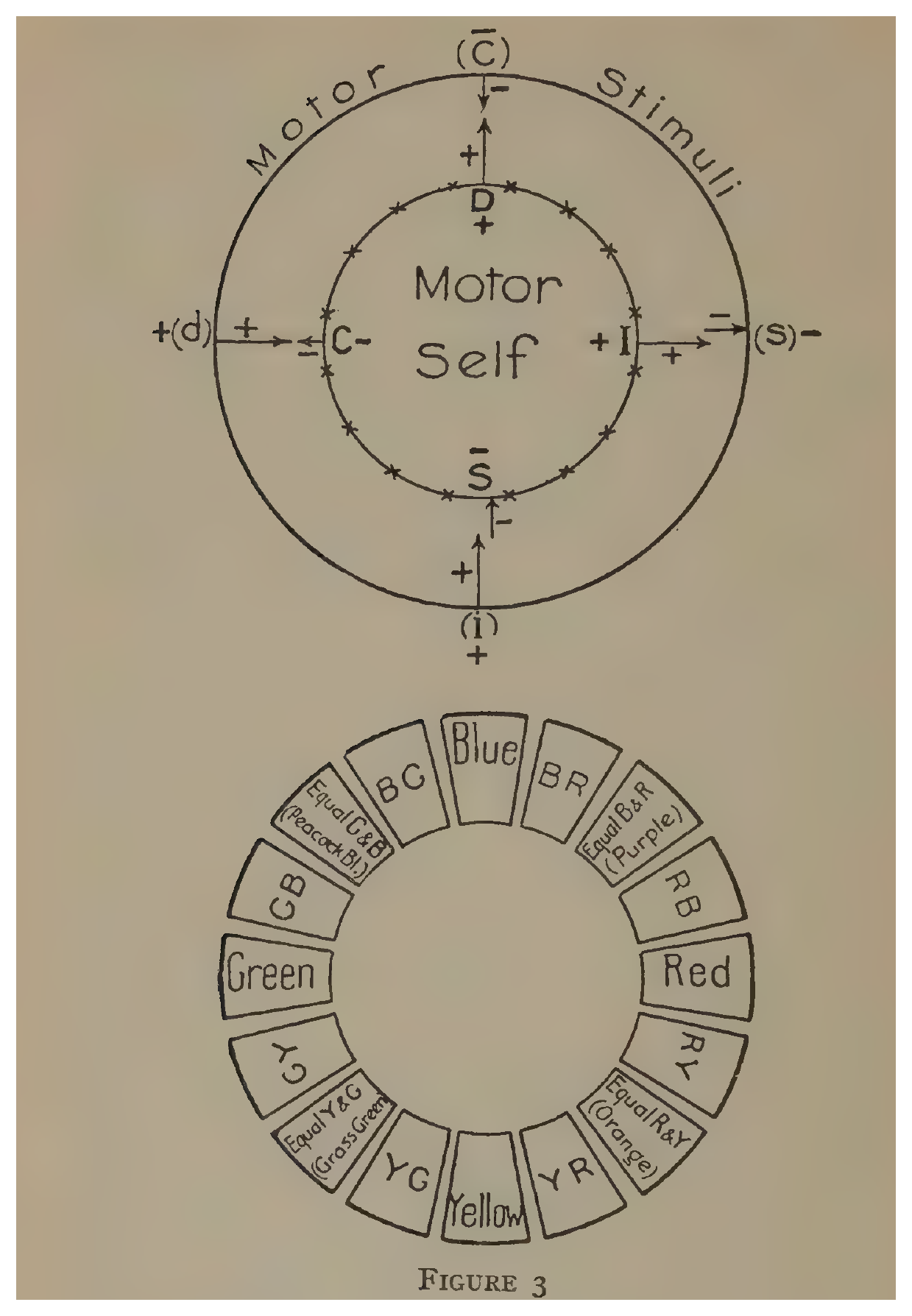
If, now, we combine in every way possible the two sets of integrative relationships above described, we shall have a continuous series of motor stimuli, and a corresponding series of motor self responses, each varying from its predecessor in the series by a just noticeable quantitative difference in degree oi harmony, and in degree of intensity or volume difference. Such a continuously graded series of motor stimuli and motor self responses are represented in an accompanying diagram.
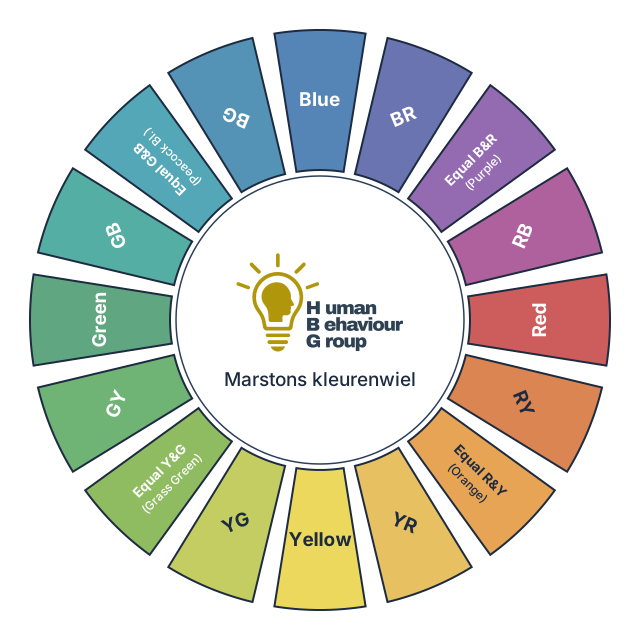
The entire series is represented in circular form, just as the just distinguishable colour sensation series may be represented schematically in circular form, and is frequently termed the " colour circle " or " colour pyramid. " The four primary colours placed at the four corners of the base of the colour pyramid represent turning points in the entire series where a
pagina 172
given type of colour change has reached its maximum. Th^reafter the alteration of hue begins to shift in a new direction.
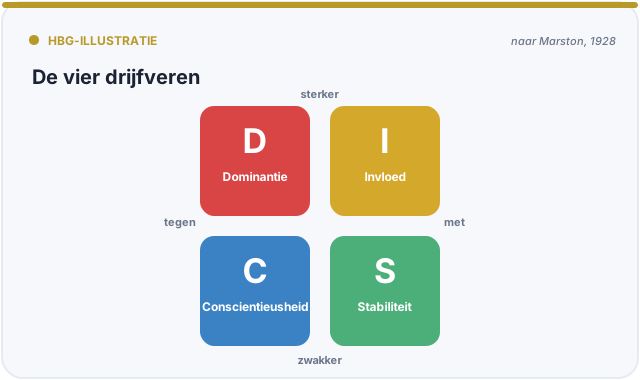
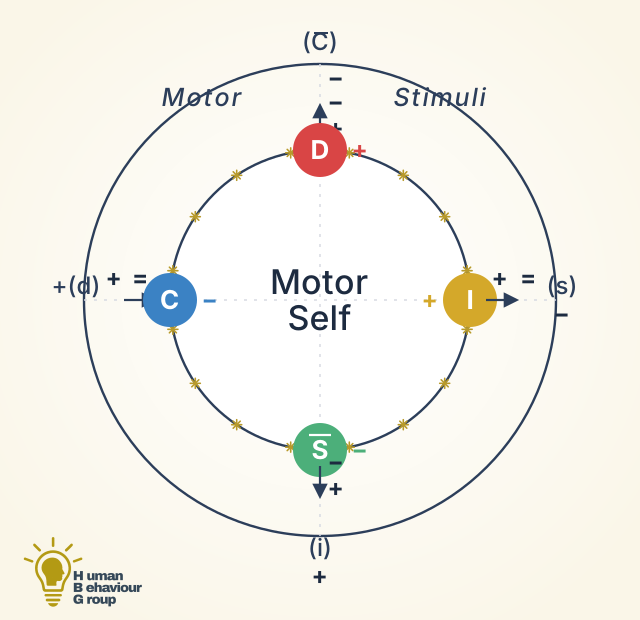
In exactly the same way, the points D, I, S, and C represent nodal points in the integrative emotion series. At each of these points one type of change in one of the two sets of integrative relationships reaches its maximum and begins to change.
Thus, the point D at the top of the diagram represents a maximal value of antagonism between motor stimulus and
1O4
(C)
(Si-
FIGURE 3
" The Emotion Circle and the Colour Circle " l
1 Note : These terms for intermediate colours are from Munsell.
pagina 173
(See A. H. Munsell, A Colour Notation, p. 35).
FIGURE 3. The capital letters D, I, S, C, indicate responses of the motor self. A plus ( -f ) sign near one of these letters, inside the Motor Self, indicates an increase of the Self during response; while a minus ( ) sign indicates a decrease.
Arrows between Motor Self and Motor Stimuli indicate relationship between these two elements during response. Relative length of arrows indicates preponderance of one or other element, (also indicated by plus or minus sign near arrow). Arrows pointing in opposed directions indicate antagonism between Self and Stimulus; arrows pointing in parallel directions indicate alliance.
The small letters (c), (s), (i), (d), indicate the type 01 Stimulus adequate to evoke each response; the Stimulus (c) being in the same relationship to the Self as the Self is to its stimulus at C, etc. A minus ( ) sign near a small letter indicates a decrease of the Stimulus as a
pagina 174
result of the Self's action upon it; while a plus ( -f ) sign^iudicatcs an Increase.
The Colour Circle is placed with the four nodal points or colour, blue, red, yellow, and green, in positions corresponding to the four nodal points 01 emotion, dominance, inducement, submission, and An identity of integrative principles has been suggested by preliminary research in naive associations between primary colours and primary emotions (see Psyche, October, 1927, p. 4).
The points marked " x " on the Motor Self circle suggest just-distinguishable differences of response, in between nodal points D, 1, S, C, comparable to violet, purple, carmine, etc., on the colour circle.
motor self. As we proceed clockwise toward the point I, this antagonism may be thought of as becoming continuously less, until at I an alliance relationship appeals. But at this same point, I, the inferiority of motor stimulus strength and the,, corresponding increase of motor self energy reaches its maximum, and begins to change toward the opposite relationship, which* first appears decisively at S. At this lowest nodal point, S, the alliance relationship between motor stimulus and motor self has reached its maximum, and begins to fall off as we proceed upward toward C, where alliance has disappeared altogether and antagonism relationship has re-
pagina 175
appeared. At the point C, again, the decrease of motor self intensity and response to superior stimulus strength has reached its maximal value, changing again to the opposite relationship by the time our starting point, D, is again reached. Starting at the nodal point, C, which is the point at the extreme left of the diagram, we may summarize the relationships and reactions at the nodal or primary points of the diagram as follows :
Motor stimulus (a^ Antagonistic to motor self.
(b) Superior strength to motor self.
Reaction of motor self (a) Antagonistic to motor stimulus, (b) Decrease of strength.
Motor stimulus (a) Antagonistic to motor self.
(b) Inferior strength to motor self.
.Reaction of motor self (a) Antagonistic to motor stimulus, (b) Increase of strength.
Motor stimulus (a) Allied with motor self.
pagina 176
(b) Interior strength to motor self.
Reaction of motor self (a) Allied with motor stimulus, (b) Increase strength.
Motor stimulus (a) Allied with motor self.
(b) Superior strength to motor self.
Reaction of motor self (a) Allied with motor stimulus, (b) Decrease strength.
We are now prepared to define the term " primary emotion " with complete objectivity. We must first recall that, according to the psychonic theory of consciousness, all relationships between motor stimuli and motor self represented in the diagram above, constitute complex units of motor consciousness, or emotion, at the time they occur in the form of psychonic impulses upon the appropriate motor psychons of the central nervous system. By defining objectively the elements composing these psychonic units of energy, we thereby, ipsc facto, define the physical aspect of the different types of emotional consciousness which we are seeking to discover. With this premise in mind, then, we may suggest the following definitions.
An emotion is a complex unit of motor consciousness, composed
pagina 177
of psychonic impulses representing the motor self, and of psychonic impulses representing a motor stimulus; these two psychonic energies being related to one another,
(1) by alliance or antagonism; and,
(2) by reciprocal superiority and inferiority of strength.
A primary emotion may be designated as an emotion which contains the maximal amount of alliance, antagonism, superiority of strength of the motor self in respect to the motor stimulus, or inferiority of strength of the motor self in respect to the motor stimulus.
Emotions are complex motations, formed by conjunctions of ^various types between the motor self and transient motor
stimuli. It is suggested that the possible types of conjunction constitute a continuous series, wherein each unit represents a quality of emotional consciousness just noticeably different from the emotions most closely resembling it, which lie adjacent to it, on either side, in the total series. At certain nodal points, in this emotion series, there seem to appear definite emotions which represent clear cut types of unit characters of conjunction, between the motor self and the motor stimulus. These nodal emotions are not modified by the admixture of modifying emotional qualities from other adjacent emotions
pagina 178
in the series. There seem to be four such nodal points in the entire emotion circle, and the four emotions occurring at these points may conveniently be termed primary emotions.
The names which I have ventured to select for the four primary emotions in the above integrative analysis were chosen to meet two requirements. First, the commonly understood meaning of the word employed must describe, with as great accuracy and completeness as possible, the objective relationship between motor self and motor stimulus which was to be conceived of as the integrative basis for the primary emotion in question. Secondly, the name chosen for each primary emotion must suggest the experience in question, as it is observed introspectively in everyday life. AfiQther minor consideration which entered into the choice of names for primary emotions was the advantage of new terms not afready weighted with dissimilar affective meaning of literary origin. No matter how clearly one may define in objective terms words such as " fear ", " rage ", etc., the previous connotation which an individual reader may have attached to these words, as a result of life-long learning, will continue reflexly to come to mind each time the term is used.
(I) Compliance is the name suggested for the primary emotion located at " C " in Figure 3. The dictionary definition 1 of the verb " comply " is :
" i. To act in conformity with. 2. To be complacent, courteous."
Both these meanings of compliance (" the act of complying ") seem rather aptly to characterize the integrative relationship indicated at " C " on the diagram. The motor stimulus, which is antagonistic and of greater intensity than the motor
pagina 179
1 Definitions herein quoted are taken from Funk and Wagnalls, Desk Standard Dictionary.
io8 EMOTIONS OF NORMAL PEOPLE
self, evokes a response of diminution of the motor self, designed to readjust the self to the stimulus. The motor stimulus is permitted by this response, to control the organism, in part and for the time being, antagonistically to the motor self. In the course of such a response, the motor self certainly acts " in conformity with " the motor stimulus. In its final adjustment, the self may be said to be " complacent " with respect to control of the organism by its antagonist.
Introspectively, the word " compliance " seems to suggest, to a great majority of the several hundred persons whom I have asked, that the subject is moving himself at the dictates of a superior force.
There is no difficulty arising from the use of this word to designate emotion in literature, since " compliance ", in its literary usage customarily signifies a type of action rather than the emotion accompanying the action.
(II) Dominance is the name suggested for the primary emotion indicated at " D " on the diagram of integrative relationship. " To dominate ", according to the dictionary means :
" i. To exercise control over.
pagina 180
2. To prevail; predominate."
The integrative situation described by dominance (" the act of dominating ") is chiefly characterized by victory of the motor self over an antagonist of inferior intensity. The motor self obviously " prevails." and " predominates " over its phasic antagonist throughout this integrative situation. The motor self " exercises control over " the final common path and hence it " exercises control over " the behaviour of the organism, removing environmental obstacles to the pattern of behaviour dictated by means of its own superior reinforced power. Thus the total objective situation, provided our integrative analysis is correct, is fairly described by the term " dominance ".
Introspectively, dominance suggests to all persons of whom I have inquired, a superiority of self over some sort of antagonist.
The word " dominant " has been used most frequently in literature to describe an " aggressive ", " strong-willed " type of personality or character. This seems rather in accord with the proposed use of the word than otherwise.
(III) Inducement is the name suggested for the primary
emotion indicated at " I " on Figure 3 " To induce ", according to the dictionary is :
" i To influence to act; prevail upon.
pagina 181
2. To lead to."
The integrative situation for which the term " inducement " is proposed consists primarily of a strengthening of the motor self in order more effectively to facilitate the passage of a weaker motor stimulus across the common psychon. The motor self, in such a relationship to its weaker ally, certainly " influences " the motor stimulus by facilitation to " the act " of traversing the final common path. If, as we shall see later, it frequently happens that the motor stimulus* is too weak to win its way alone to efferent discharge, then the motor self truly " leads " its weaker ally across the synapse, " prevailing upon " it, meantime, to facilitate the passage of the stronger motor self impulses.
Introspectively, inducement (" the act of inducing ") indicates to a majority of the subjects asked, a process of persuading someone, in a friendly way, to perform an act suggested by the subject. This meaning, if expressed in bodily behaviour would be very close to the expected behaviour result of the integrative relationship already described. The subjects' emphasis upon the " friendliness " of the persuasion is very significant in making clear the nature of inducement as a primary emotion. The nature of the integrative relationship would necessitate perfect alliance between the interests of inuucer and induced throughout the entire response. The power of inducement in evoking alliance from the induced person lies entirely in the extent to which the inducer is able to serve the other's interest, while initial weakness in the person " induced " is the element which calls forth increase of strength from the inducer.
The word " induce " in literary usage, like the word
pagina 182
" compliance ", has been employed, for the most part, to describe a certain type of behaviour, in which one individual persuades another person to do something which the first individual desires him to do Little use, if any, has been made of the term " inducement " in designating emotional states of consciousness.
(IV) Submission is the name suggested for the primary emotion represented at " S " in Figure 3. The dictionary defines the verb " to submit " as meaning :
no EMOTIONS OF NORMAL PEOPLE
" i. To give up to another.
2. To yield authority or power; to surrender.
3. To be submissive."
Submissive is denned as " docile ", " yielding ", " obedient ", " humble ".
The integrative situation to which the term " submission " is applied consists, in essence, of a decrease in the strength of the motor self to balance a corresponding superiority of strength in the motor stimulus. In assuming this relationship, the motor self might certainly be described as being " humble " and " yielding ". The motor self, in essence, is " giving up to " its stronger ally a portion of itself. After the motor self has completed its response as far as decreasing its own volume goes, it continues, as a weaker ally, to be " docile " and
pagina 183
" obedient " in rendering facilitation to its stronger ally in their common path. This continued rendering of alliance to the motor stimulus might well be described as " yielding " to the authority or power of its stronger ally, while the continuance of a motor self to render such facilitation as weaker ally throughout the persistence of the relationship seems aptly characterized as being " submission ". The bodily behaviour to be expected from this type of integration would be characterized as that of an obedient child toward a loving mother.
Introspective records on the question of what suggestion is conveyed by the word " submit " reveal that the essence of " submission " to nearly all subjects, is voluntary obedience to the commands of the person in authority. With women subjects, the additional meaning of mutual warmth of feeling between the subject and the person submitted to is introspectively present when the submission is thought of as rendered to a loved mother, or to lover of the same or opposite sex. The element of mutual friendliness (represented by alliance in the integrative picture), does not appear in the majority of male reports concerning the introspective suggestion evoked by the word " submission ". This is unfortunate, but I have not been able to find any other word adequately covering the objective description of this emotion which, at the same time, would also include the introspective meaning of mutual warmth of feeling between the person submitting and the person submitted to. The word " submit ", as a name for the primary emotion designated, is intended to convey emphatically this
pagina 184
meaning of pleasantness experienced in the act of " by the person submitting.
Literary use of the word " submission " has followed rather closely the integrative meaning as reported by my subjects. " Submission ", in literary parlance, customarily indicates a passive yielding, one to the other, yet not necessarily with any great amount of pleasantness in the submission exacted. Perhaps, this limitation found in both introspective and literary connotations of the word " submission " indicates that the connection between submitting to a lover and submission to a person of superior power (which is submission closely akin to compliance) is not found properly developed in our present civilization and its literary records.
Outline of Integrative Principles of Primary Emotions and
Concept Psychon :
Psychonic impulse :
pagina 185
Consciousness :
Environmental
stimulus :
Sensation : Motation :
Motor self : Motor stimuli :
Integrative principles of reaction of motor self to motor stimuli :
Primary feelings :
Pleasantness and unpleasantness :
Feelings
Definition
Junctional tissue, at synapses of central nervous system.
pagina 186
Completed excitation of any psychon from emissive pole of one neuron, to receptive polo of next.
Psychonic impulses, or psychonic energy.
Object or force exciting organism's sensory receptors.
Psychonic energy at sensory synapses.
Motor consciousness; affective consciousness; psychonic energy at motor synapses.
Continuous, tonic, motor discharge across motor psychons; psychonic impulses of tonic motor origin.
Phasic motor impulses at motor psychons; psychonic motor impulses of phasic reflex origin.
(1) Exerts antagonistic influence towards antagonistic motor stimulus, and facilitating influence toward allied motor stimulus.
(2) Increases intensity in response to inferior intensity of motor stimulus, and decreases intensity in response to superior motor stimulus intensity.
Simplest recognizable motations; pleasantness and unpleasantness.
pagina 187
Psychonic motor impulses in relationship, respectively, of mutual facilitation or mutual antagonism.
Emotions :
Primary Emotions :
pagina 188
Next simplest motational compounds to primary feelings; composed of :
(1) Psychonic motor impulses of motor self and motor stimulus in relationships of mutual alliance or conflict.
(2) Motor self increasing or decreasing its intensity in response to inferior or superior intensity of motor stimulus. Psychonic impulse combinations of these two relationships found in continuous series.
Nodal points of emotion series, where relationships of alliance, conflict, and increase or decrease of motor self reach maximum, and begin to change toward opposite type of relationship.
Primary emotions are termed : compliance, dominance, inducement, and submission.
(1) Motor stimulus : Antagonistic and superior
intensity to motor self, (initially unpleasant).
(2) Response of motor self : Decrease of in-
pagina 189
tensity, and antagonistic compulsion of motor self (producing indifference and then pleasantness in proportion to volume and inter-facihations of superior motor stimuli yielded to).
(1) Motor stimulus : Antagonistic and inferior
intensity to motor self, (initially unpleasant).
(2) Response of motor self : Increase of intensity, and antagonistic compulsion of motor stimulus, (producing pleasantness in proportion to success, co-existing '*\ith original unpleasantness).
(1) Motor stimulus : Allied aud inferior in-
tensity to motor self, (pleasant).
(2) Response of motor sell : Increase of in-
tensity, and allied compulsion of motor stimulus, (increasingly pleasant).
(1) Motor stimulus : Allied and superior
intensity to motor sell, (pleasant^.
(2) Response of motor self : Decrease of in-
tensity, and allied compulsion of motor self, (increasingly pleasant)
pagina 190